Xbox Technical Specifications
 From Handwiki
 Short description: none
The Xbox technical specifications describe the various components of the Xbox video game console.
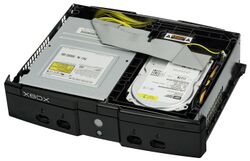
The top of the Xbox, disassembled. It uses a standard DVD-ROM and Hard-disk drive via Parallel ATA.
Central processing unit
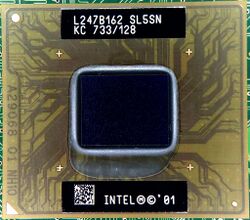
Xbox CPU
- CPU: 32-bit 733 MHz, custom Intel Pentium III Coppermine-based processor in a Micro-PGA2 package (though soldered to the mainboard using BGA). 180 nm process.[1][2][3][4]
- 133 MHz 64-bit GTL+ front-side bus (FSB) to GPU (1.06 GB/s bandwidth)[5]
- 32KB L1 cache. 128 KB on-die L2 cache
- SSE floating point SIMD. Four single-precision floating point numbers per clock cycle.
- MMX integer SIMD
Memory
- Shared graphics memory sub-system
- 64 MB DDR SDRAM at 200 MHz; in dual-channel 128-bit configuration giving 6400 MB/s (6.4 GB/s)[5]
- Maximum of 1.06 GB/s bandwidth accessible by CPU FSB
- Theoretical 5.34 GB/s bandwidth shared by rest of the system
- Supplied by Hynix or Samsung depending on manufacture date and location
- 64 MB DDR SDRAM at 200 MHz; in dual-channel 128-bit configuration giving 6400 MB/s (6.4 GB/s)[5]
Graphics processing unit
.png)
The XGPU
- GPU and system chipset: 233 MHz "NV2A" ASIC. Co-developed by Microsoft and Nvidia and essentially a variant of Geforce 3 chips.
- Floating-point performance: 4.66 GFLOPS[6]
- Geometry engine: 115 million vertices per second, 125 million particles per second (peak)
- 4 pixel pipelines with 2 texture units each
- Peak fillrate:
- Rendering fillrate: 932 megapixels per second (233 MHz × 4 pipelines)
- Texture fillrate: 1,864 megatexels per second (932 MP × 2 texture units)
- Realistic fillrate:
- Rendering fillrate: 250–700 megapixels per second, with Z-buffering, fogging, alpha blending and texture mapping[7]
- Texture fillrate: 500–1400 megatexels per second (250-700 MP × 2 texture units)
- Peak triangle performance: 29,125,000 32-pixel triangles per second, raw or with 2 textures and lighting (32-pixel divided from peak fillrate)
- 485,416 triangles per frame at 60 frames per second
- 970,833 triangles per frame at 30 frames per second
- Realistic triangle performance: 7,812,500–21,875,000 32-pixel triangles per second, with 2 textures, lighting, Z-buffering, fogging and alpha blending (32-pixel divided from realistic fillrate)
- 130,208–364,583 triangles per frame at 60 frames per second
- 260,416–729,166 triangles per frame at 30 frames per second
- 4 textures per pass, texture compression, full scene anti-aliasing (NV Quincunx, supersampling, multisampling)
- Bilinear, trilinear, and anisotropic texture filtering
- Performance lies between a Geforce 3 Series GPU and a Geforce 4 Series GPU. This is due to the added vertex shader present on the ASIC, thus doubling the vertex output compared to Geforce 3 ASICs. Clock speed is the same as the original Geforce 3 series GPU (233MHz) thus slower than Geforce 4 series starting at 250MHz.[8]
Storage
_HDD_(40932184041).jpg)
An original Xbox hard disk drive
- Storage media
- 2×–5× (2.6 MB/s–6.6 MB/s) CAV DVD-ROM
- 8 or 10 GB, 3.5 in, 5,400 RPM hard disk formatted to 8 GB with FATX file system
- Optional 32 MB memory card for saved game file transfer
Audio
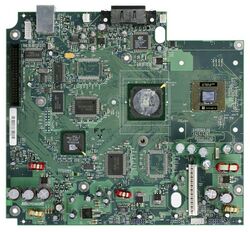
The Xbox motherboard
- Audio processor: NVIDIA "MCPX" (a.k.a. SoundStorm "NVAPU")
- Wolfson Microelectronics XWM9709 AC97 Revision 2.1 Audio Codec
- Integrated Parthus DSP for realtime Dolby Digital encoding
- 64 3D sound channels (up to 256 stereo voices)
- HRTF Sensaura 3D enhancement
- MIDI DLS2 Support
- Monaural, Stereo, Dolby Surround, Dolby Digital Live 5.1, and DTS Surround (DVD movies only) audio output options
Connectivity
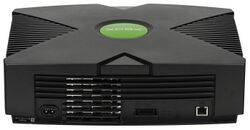
The Xbox has a standard AC in, A/V connector and Ethernet port.
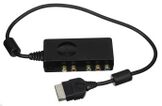

Left: "High Definition AV Pack"; right: HDMI
- Controller ports: 4 proprietary USB 1.1 ports
- A/V outputs: composite video, S-Video, component video, HDMI (via 3rd party), SCART, Digital Optical TOSLINK, and stereo RCA analog audio
- S-Video requires "Advanced AV Pack", component video requires "High Definition AV Pack", TOSLINK requires either of the two
- Resolutions: 480i, 480p, 576i, 576p, 720p, 1080i
- Integrated 10/100BASE-TX wired Ethernet with ICS ICS1893AF Physical Layer Transceiver
- DVD movie playback (add-on required)
Physical specifications
- Weight: 3.86 kg (8.5 lb)
- Dimensions: 320 × 100 × 260 mm (12.5 × 4 × 10.5 in)[9]
See also
- nVIDIA nForce
References
- ↑ "Microsoft announces X-BOX". 2000-04-07. http://xbox.com/intro.htm.
- ↑ "xbox.com || hardware || consoles || xbox video game system". 2001-10-06. http://www.xbox.com/Hardware/consoles/xbox.htm.
- ↑ (in en) XBox Specs - IGN, 2001-10-02, https://www.ign.com/articles/2001/10/02/xbox-specs, retrieved 2020-08-14
- ↑ "CES 2001: Microsoft Unveils the Xbox Console" (in en-US). 2001-01-06. https://www.gamespot.com/articles/ces-2001-microsoft-unveils-the-xbox-console/1100-2671751/.
- ↑ 5.0 5.1 "Hardware Behind the Consoles: Microsoft's Xbox". Anandtech. 2001-11-21. http://www.anandtech.com/show/853/2.
- ↑ https://forum.beyond3d.com/threads/historical-gpu-flops-performance.45255/page-2
- ↑ Graphics Processor Specifications, IGN, 2001
- ↑ "Hardware Behind the Consoles - Part I: Microsoft's Xbox - The X-IGP". Anandtech.com. 2001-11-21. http://www.anandtech.com/show/853/3.
- ↑ Original Xbox Technical Specifications
 |  |
Categories: [Video game hardware]
↧ Download as ZWI file | Last modified: 07/16/2024 06:46:01 | 9 views
☰ Source: https://handwiki.org/wiki/Engineering:Xbox_technical_specifications | License: CC BY-SA 3.0
✘
ZWI is not signed. [what is this?]
ZWI viewer
by the  KSF
KSF
KSF