Estrin (Compound)
 From Handwiki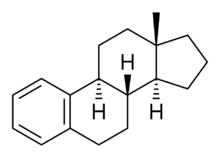
| |
| Names | |
|---|---|
| IUPAC name
Estra-1,3,5(10)-triene
| |
| Systematic IUPAC name
(3aS,3bS,9bS,11aS)-11a-Methyl-2,3,3a,3b,4,5,9b,10,11,11a-decahydro-1H-cyclopenta[a]phenanthrene | |
| Other names
Estratriene
| |
| Identifiers | |
CAS Number
|
|
3D model (JSmol)
|
|
| ChEMBL |
|
| ChemSpider |
|
PubChem CID
|
|
| UNII |
|
InChI
| |
SMILES
| |
| Properties | |
Chemical formula
|
C18H24 |
| Molar mass | 240.39 g/mol |
Except where otherwise noted, data are given for materials in their standard state (at 25 °C [77 °F], 100 kPa). | |
| Infobox references | |

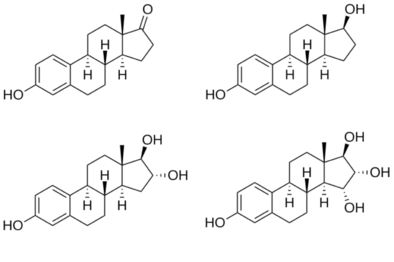
Estrin (American English), or oestrin (British English), also known as estra-1,3,5(10)-triene, is an estrane steroid. It is dehydrogenated estrane with double bonds specifically at the C1, C3, and C5(10) positions. Estrin is a parent structure of the estrogen steroid hormones estradiol, estrone, and estriol, which have also been known as dihydroxyestrin, ketohydroxyestrin, and trihydroxyestrin, respectively.[1][2]
Unlike its estrogen derivatives, estrin itself possesses minimal estrogenic activity, as hydroxyl and/or keto substitutions at the C3 and C17 positions are critical for high binding affinity to the estrogen receptors.[3][4] Estrin has been found to be on the order of 1,000-fold less potent than estradiol in inducing estrogenic responses in vitro.[5][6][3] In addition to estrin, estratrien-17β-ol, which lacks the 3-hydroxyl group of estradiol, and 3-hydroxyestratriene, which lacks the 17β-hydroxyl group of estradiol, both have measurable affinity for the estrogen receptor and are able to activate the receptor and induce progesterone receptor expression.[6][7][3]
The term estrin is also a synonym for estrogen.[8] It was coined by Sir Alan S. Parkes and C. W. Bellerby in 1926 to describe the hormone secreted from the ovaries that induces estrus in animals (i.e., estrogen).[8]
Structures of major endogenous estrogens
 |
See also
- 1-Keto-1,2,3,4-tetrahydrophenanthrene
References
- ↑ Biskind, Morton S. (1935). "Commercial glandular products". Journal of the American Medical Association 105 (9): 667. doi:10.1001/jama.1935.92760350007009a. ISSN 0002-9955.
- ↑ "Estrogenic Hormones: Their Clinical Usage". Cal West Med 49 (5): 362–6. 1938. PMID 18744783.
- ↑ 3.0 3.1 3.2 "The estradiol pharmacophore: ligand structure-estrogen receptor binding affinity relationships and a model for the receptor binding site". Steroids 62 (3): 268–303. 1997. doi:10.1016/s0039-128x(96)00242-5. PMID 9071738.
- ↑ Thomas L. Lemke; David A. Williams (24 January 2012). Foye's Principles of Medicinal Chemistry. Lippincott Williams & Wilkins. pp. 1395–. ISBN 978-1-60913-345-0. https://books.google.com/books?id=Sd6ot9ul-bUC&pg=PA1395.
- ↑ "Regulation of prolactin synthesis in vitro by estrogenic and antiestrogenic derivatives of estradiol and estrone". Endocrinology 124 (4): 1717–26. April 1989. doi:10.1210/endo-124-4-1717. PMID 2924721.
- ↑ 6.0 6.1 Moudgil VK, ed (1987). "Estrogen structure-receptor function relationships". Recent Advances in Steroid Hormone Action. Walter de Gruyter. pp. 443–466.
- ↑ "Ligand-mediated modulation of estrogen receptor conformation by estradiol analogs". Biochemistry 32 (38): 10109–15. September 1993. doi:10.1021/bi00089a029. PMID 8399136.
- ↑ 8.0 8.1 Marc A. Fritz; Leon Speroff (28 March 2012). Clinical Gynecologic Endocrinology and Infertility. Lippincott Williams & Wilkins. pp. 750–. ISBN 978-1-4511-4847-3. https://books.google.com/books?id=KZLubBxJEwEC&pg=PA750.
 |
Categories: [Estranes]
↧ Download as ZWI file | Last modified: 11/06/2025 14:18:25 | 6 views
☰ Source: https://handwiki.org/wiki/Chemistry:Estrin_(compound) | License: CC BY-SA 3.0
 KSF
KSF