309 Fraternitas
 From Handwiki
 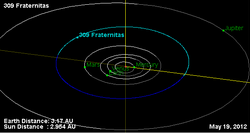 Orbital diagram | |
| Discovery | |
|---|---|
| Discovered by | Johann Palisa |
| Discovery date | 6 April 1891 |
| Designations | |
MPC designation | (309) Fraternitas |
| Pronunciation | /frəˈtɜːrnɪtæs/ |
| Named after | fraternity |
| Minor planet category | Main belt |
| Orbital characteristics[1] | |
| Epoch 31 July 2016 (JD 2457600.5) | |
| Uncertainty parameter 0 | |
| Observation arc | 125.03 yr (45667 d) |
| |{{{apsis}}}|helion}} | 2.97127 astronomical unit|AU (444.496 Gm) |
| |{{{apsis}}}|helion}} | 2.35779 AU (352.720 Gm) |
Semi-major axis | 2.66453 AU (398.608 Gm) |
| Eccentricity | 0.11512 |
| Orbital period | 4.35 yr (1,588.7 d) 4.35 yr (1588.7 d) |
| Mean anomaly | 190.308° |
| Mean motion | 0° 13m 35.785s / day |
| Inclination | 3.71999° |
| Longitude of ascending node | 356.574° |
|{{{apsis}}}|helion}} | 310.477° |
| Physical characteristics | |
| Dimensions | 45.32±3.3 km |
| Rotation period | 22.398 h (0.9333 d) |
| Geometric albedo | 0.0595±0.010 |
| Absolute magnitude (H) | 10.7 |
Fraternitas (minor planet designation: 309 Fraternitas) is a typical Main belt asteroid.[2] It was discovered by Johann Palisa on 6 April 1891 in Vienna. The asteroid name is Latin for 'fraternity'; it was so named in order to commemorate the 25th anniversary of the Maturitätsprüfung Fraternity.[3]
This minor planet is orbiting the Sun at a distance of 2.665 astronomical unit|AU with an orbital eccentricity (ovalness) of 0.115 and a period of 4.35 yr. The orbital plane is inclined at an angle of 3.72° of the ecliptic. Analysis of the asymmetric bimodal light curve of the asteroid from photometric data collected during 2014 provide a rotation period of 22.398±0.001 h with a brightness variation of 0.12±0.01 in magnitude.[4]
References
- ↑ "309 Fraternitas". JPL Small-Body Database. NASA/Jet Propulsion Laboratory. https://ssd.jpl.nasa.gov/sbdb.cgi?sstr=309;cad=1.
- ↑ "Osculating elements from astorb-database for 309 Fraternitas". The Centaur Research Project. http://www.kentauren.info/menu/index1.htm?page=/cgi-bin/astorb2txt.pl?Suchname=Fraternitas.
- ↑ Robinson, L. E. (June 2002), "Photometry of Five Difficult Asteroids: 309 Fraternitas, 366 Vincentina 421 Zahringia, 578 Happelia, 959 Anne", The Minor Planet Bulletin 29: 30–31, Bibcode: 2002MPBu...29...30R.
- ↑ Pilcher, Frederick (January 2015), "Rotation Period Determinations for 275 Sapientia, 309 Fraternitas, and 924 Toni", Bulletin of the Minor Planets Section of the Association of Lunar and Planetary Observers 42 (1): pp. 38–39, Bibcode: 2015MPBu...42...38P.
External links
- 309 Fraternitas at AstDyS-2, Asteroids—Dynamic Site
- Ephemeris · Observation prediction · Orbital info · Proper elements · Observational info
- 309 Fraternitas at the JPL Small-Body Database
- Close approach · Discovery · Ephemeris · Orbit diagram · Orbital elements · Physical parameters
 |  |
Categories: [Background asteroids] [Named minor planets]
↧ Download as ZWI file | Last modified: 12/23/2023 17:24:17 | 2 views
☰ Source: https://handwiki.org/wiki/Astronomy:309_Fraternitas | License: CC BY-SA 3.0
 ZWI signed:
 KSF
KSF