Caladenia Barbarella
 From Handwiki
| Small dragon orchid | |
|---|---|
Conservation status
| |
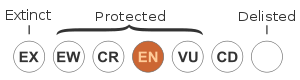 Endangered (EPBC Act) | |
Scientific classification 
| |
| Kingdom: | Plantae |
| Clade: | Tracheophytes |
| Clade: | Angiosperms |
| Clade: | Monocots |
| Order: | Asparagales |
| Family: | Orchidaceae |
| Subfamily: | Orchidoideae |
| Tribe: | Diurideae |
| Genus: | Caladenia |
| Species: | C. barbarella
|
| Binomial name | |
| Caladenia barbarella Hopper & A.P.Br.
| |
Caladenia barbarella, commonly known as the small dragon orchid, is a plant in the orchid family Orchidaceae and is endemic to the south-west of Western Australia. It has a single broad, hairy leaf held close to the ground and a single greenish-yellow and red flower. It is only known from a small area near the Murchison River.
Description
Caladenia barbarella is a terrestrial, perennial, deciduous, herb with an underground tuber and a single ground-hugging, broad, hairy leaf 3–8 cm (1–3 in) long and 3–7 mm (0.1–0.3 in) wide. The single flower is borne on a stem 8–25 cm (3–10 in) tall and is greenish-yellow with red stripes and 2 cm (0.8 in) wide and long. The lateral sepals and petals are short and hang downwards. The labellum is densely hairy and has a large dark red gland at its highest point. It also has many long purple hairs that are thought to attract pollinators. Flowering occurs in late August and September.[1][2][3]
Taxonomy and naming
Caladenia barbarella was first formally described by Stephen Hopper and Andrew Brown in 2001 from a specimen collected in the Cooloomia Nature Reserve near the Murchison river and the description was published in Nuytsia.[4] The specific epithet (barbarella) is a diminutive form of the Latin word barba, hence meaning "a small beard", but also alludes to a comparison of the sexual deception of this orchid to its male insect pollinators, and the French comic-book character Barbarella.[1][5]
Distribution and habitat
Small dragon orchid is known from fourteen populations east and north-east of Kalbarri in the Geraldton Sandplains biogeographic region[6] where it grows under low shrubs in areas that are inundated in winter.[1][2]
Conservation
Caladenia barbarella is classified as "Threatened Flora (Declared Rare Flora — Extant)" by the Western Australian Government Department of Parks and Wildlife[6] and it has also been listed as "Endangered" (EN) under the Australian Government Environment Protection and Biodiversity Conservation Act 1999 (EPBC Act).[3]
References
- ↑ 1.0 1.1 1.2 Brown, Andrew; Dixon, Kingsley; French, Christopher; Brockman, Garry (2013). Field guide to the orchids of Western Australia : the definitive guide to the native orchids of Western Australia. Simon Nevill Publications. p. 140. ISBN 9780980348149.
- ↑ 2.0 2.1 Hoffman, Noel; Brown, Andrew (2011). Orchids of South-West Australia. (3rd ed.). Gooseberry Hill: Noel Hoffman. p. 182. ISBN 9780646562322.
- ↑ 3.0 3.1 "Approved Conservation Advice for Caladenia barbarella (Small Dragon Orchid)". Australian Government Department of the Environment. http://www.environment.gov.au/biodiversity/threatened/species/pubs/68686-conservation-advice.pdf. Retrieved 10 October 2016.
- ↑ "Caladenia barbarella". APNI. https://id.biodiversity.org.au/instance/apni/574317. Retrieved 10 October 2016.
- ↑ Hopper, Stephen D.; Brown, Andrew P. (2001). "Contributions to Western Australian orchidology: 2. New taxa and circumscriptions in Caladenia.". Nuytsia 14 (1/2): 162–166. https://www.biodiversitylibrary.org/item/224538#page/168/mode/1up. Retrieved 1 November 2019.
- ↑ 6.0 6.1 "Caladenia barbarella". FloraBase. Western Australian Government Department of Parks and Wildlife. https://florabase.dpaw.wa.gov.au/browse/profile/19218.
See also Wikidata entry Q9673349.
 |  |
Categories: [Caladenia]
↧ Download as ZWI file | Last modified: 08/30/2022 14:08:11 | 3 views
☰ Source: https://handwiki.org/wiki/Biology:Caladenia_barbarella | License: CC BY-SA 3.0
 ZWI signed:
 KSF
KSF