Sri Lanka Institute Of Information Technology
 From Handwiki
 Coordinates: 6°54′52″N 79°58′20″E / 6.91444°N 79.97222°E
ශ්රී ලංකා තොරතුරු තාක්ෂණ ආයතනය இலங்கை தகவல் தொழில்நுட்ப நிறுவனம் | |
 | |
Other name | SLIIT University |
|---|---|
| Motto | Discover your Future |
| Type | Private |
| Established | 1999 |
| Founder | Kingsley Wickramaratne, Richard Pathirana |
Parent institution | Mahapola Higher Education Scholarship Trust Fund |
Academic affiliations |
|
| Chancellor | Lakshaman L Rathnayake |
| Vice-Chancellor | Lalith Gamage |
Academic staff | 400 |
Administrative staff | 200 |
| Students | 11,300 |
| Undergraduates | 9,000 |
| Postgraduates | 1,500 |
Other students | 800 |
| Location | Malabe (main campus) , colombo (metropolitan campus) Sri Lanka |
| Campus | Urban, 25 acres (10 ha) |
| |u}}rs | |
| Website | sliit |
 | |
The Sri Lanka Institute of Information Technology (Sinhala: ශ්රී ලංකා තොරතුරු තාක්ෂණ ආයතනය; Tamil: இலங்கை தகவல் தொழில்நுட்ப நிறுவனம்) (also known as SLIIT) is a non-profit private university in Sri Lanka specialising in technology and management.[2][3][4][5][6] It has two campuses and four regional centres, the main campus being based in Malabe and a Metropolitan Campus in Colombo. SLIIT is a member of the Association of Commonwealth Universities and International Association of Universities, and has several partnerships with international universities.[7][8]
History
Founding
Lalith Athulathmudali who was then the Minister of Trade and Shipping, originally had the Mahapola Trust Fund acquire 25 acres (10 ha) in Malabe in the 1980s with the expectation of building a Technological University and the headquarters of the Mahapola Trust Fund.[9] Minister of Commerce Kingsley Wickramaratne and Richard Pathirana would eventually use the land for establishing SLIIT.[10]
The Sri Lanka Institute of Information Technology was established in 1999 by incorporation under the Companies Act of 2007 as a nonprofit company by guarantee (registration number GL 24) with the ability to award Bachelor of Science degrees following amendments to the Universities Act the same year, thus gaining recognition from the Minister of Higher Education.[11][12][13] SLIIT was established primarily to educate and train information technology professionals.
Expansions
Initially limited to the fields of information technology and computing, in 2007 SLIIT expanding into new fields of study. These include electronic engineering and business management in collaboration with Sheffield Hallam University.[14] SLIIT also expanded its presence from Colombo and its suburbs to other parts of the country, by establishing centers in Kandy and Matara, making SLIIT accessible in six locations. Presently, SLIIT operates two campuses - the Colombo Metropolitan Campus at Kollupitiya, and the Malabe Campus, with centers in Matara, Kandy, Jaffna, and Kurunegala with an undergraduate student population of over 7,000. A further 1,000 students follow master's degree Programmes, Postgraduate Diploma and other Professional Development Programmes.
In 2011, SLIIT established its faculty of business after it was accredited by the UGC to award Bachelor of Business Administration degrees in Human Capital Management, Accounting and Finance, Marketing Management, Quality management and Management Information Systems.
This was followed in 2012, with the establishment of the Colombo Academy of Hospitality Management (CAHM). The project is a joint venture of SLIIT, Colombo Academy of Hospitality Management (CAHM),[15] and William Angliss Institute of Australia. It has been developed in line with international standards, housing a training kitchen, banqueting facility, training restaurant, model bedrooms, an IT training center, and team rooms for students' practical training to prepare students for the degree of Bachelor of Tourism and Hospitality Management.[16][17]
The faculty of engineering was formed in 2013, with it awarding its own Bachelor of Science in Engineering degrees and master's degrees from partner universities such as Curtin University and Sheffield Hallam University.[4] The SLIIT Computing was established as a privately managed subsidiary of SLIIT in Kollupitiya to further expand undergraduate studies. In 2015, SLIIT established its School of Architecture, offering a three-year degree in architecture. In 2016, introducing 16 new research-based degrees including PhD and MPhil degrees approved by the Ministry of Higher Education, Technology and Innovation of Sri Lanka.[18]
Campuses
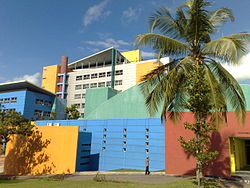
SLIIT has two main campuses in the Western Province- a Metropolitan campus in central Colombo, and a flagship suburban campus at Malabe. The Malabe campus covers an area of about 10 ha (25 acres), making it the larger of the two campuses, and houses the faculties of Computing, Business and Engineering, as well as the main library. Located between Kaduwela and Malabe along the New Kandy Road, it is the only SLIIT campus with sporting facilities. The smaller Metropolitan campus is located within the Bank of Ceylon Merchant Tower at Kollupitiya, hosting mostly postgraduate facilities.
The institute also has regional centers in Kandy, Matara, Jaffna, and Kurunegala.
Governance
The company (Incorporated under Companies Act) is governed by a board of directors headed by a chairman; the current chairman is Professor L. Rathnayake, who succeeded founding chairman Professor Sam Karunaratne.[7] Due to government ownership of the institute, many of the Board's seats are held by government officials on an ex-officio basis.[19]
The Board delegates power over academic and administrative affairs of the institute to the President, who also acts as CEO of the institute. Professor Lalith Gamage is the current President.[20]
Faculties and schools
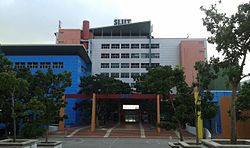
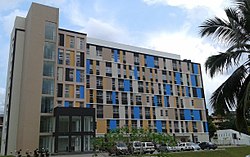
Faculty of Computing
The origins of the Faculty of Computing goes back to the formation of SLIIT in 1999, when it introduced degrees in Information technology.[21]
- Departments
- Information Technology
- Computer Systems and Network Engineering
- Software Engineering
- Information Systems Engineering
- Cyber Security
- Interactive Media
- Data Science
Faculty of Business
The Faculty of Business (Business School), which was formally known as the Faculty of Business was established in 2011, offering BBA degree programs.[22]
- Departments
- Business Management
- Accounting and Finance
- Business Analytics
- Human Capital Management
- Marketing Management
- Quality Management
- Logistics and Supply Chain Management
- Information Management
Faculty of Engineering
Established in 2013, the Faculty of Engineering offers BScs in engineering degree programs.[23]
- Departments
- Civil Engineering
- Electrical & Electronic Engineering
- Mechanical Engineering
- Materials Engineering
Faculty of Humanities and Sciences
The Faculty of Science and Education was established in 2017, with the introduction of a degree programs in Biotechnology, natural sciences, law, education, psychology and nursing.[24]
School of Science
- School of Science - BSc (Hons) Biotechnology - The first degree course in the School of Science is Biotechnology. Established in 2019, by 2021, batches 6 will be in education, enrolling nearly 200 new students annually. It provides the first and only Biotechnology degree course available in Sri Lanka, equipped with state-of-the-art laboratory facilities, including Microbiology, Molecular biology, Tissue Culture, Chemistry. In addition, it maintains close relations with SLINTEC and Peradeniya University.
- School of Education - BEd (Hons) Biological Sciences, BEd (Hons) Physical Sciences, BEd (Hons) English
- School of Law - LLB (Hons) Law [LJMU]
- School of Nursing - Higher Diploma in Nursing, BSc (Hons) Nursing - International [LJMU]
- School of Psychology - Higher Diploma in Psychology, BSc (Hons) Psychology [LJMU]
- English Language Teaching Unit
- Mathematics Unit - BSc (Hons) Financial Mathematics and Applied Statistics [Expected in 2021]
Faculty of Graduate Studies
The Faculty of Graduate Studies is a graduate school that conducts taught and research postgraduate degree programs in the fields of engineering and computing.[18]
Colombo Academy of Hospitality Management
The Colombo Academy of Hospitality Management (CAHM) was started in 2012 as a joint venture with SLIIT and William Angliss Institute of TAFE, offering degrees in tourism and hospitality management.[15]
SLIIT Academy
SLIIT Academy (Private )Limited previously known as SLIIT Computing was established a s a subsidiary of Sri Lanka Institute of Information Technology under the companies act No.17 of 1982 in 2011 and was registered with the Registrar of companies under the No. N (PVS) 29707 on 31 December 2001.[25]
SLIIT Academy (Pvt.) Ltd was established to provide educational opportunities to a wider range of students who wish to progress their higher education with an industrial oriented learning experience. SLIIT Academy offers Foundation Programs & Degrees in IT, Business, Engineering & Health and Life Sciences and Post-Graduate Program in MSc in PM which paves the way for students to keep their knowledge up-to-date in this fast-moving environment. With the growing demands of the workforce, SLIIT ACADEMY has been one of the first to introduce one of a kind Educational opportunity to the Nation of Sri Lanka. A blend of theory and practice gives the edge for those who want to enter the workforce with sound academic background and gives a competitive advantage among the others.[26]
- Foundation Programs
University of Bedfordshire (UOB) Degree Programs
- Foundation Certificate in Information Technology
- Foundation Certificate in Business Management
Curtin University - SLIIT Academy Foundation Certificate programs in
- Information Technology
- Engineering
- Business
- Health & Life Sciences
- Higher Diploma Programs
- Electronic & Electrical Engineering
- Information Technology
- Business Management
- Degree Programs
- Departments
- Computer Science and Software Engineering - UOB
- Computer Networking - UOB
- Electronic & Electrical Engineering - LJM
- Business Administration - UOB
- Human Resources Management - UOB
- Postgraduate Programs
- Project Management – Liverpool John Moores University (LJMU)
School of Architecture
The School of Architecture was established in 2015 offering BSc and MSc degree programs in architecture from the Liverpool John Moores University.[27]
Academics
Affiliations
Partnerships with foreign universities allow students to finish their degree at these universities following an initial study period in Sri Lanka.[28]
| Country | University/Institution | Country | University/Institution |
|---|---|---|---|
.svg.png) Australia Australia
|
Curtin University of Technology[29][30] | .svg.png) Canada Canada
|
Algoma University[31][32] |
| Deakin University[30][33] | Memorial University of Newfoundland[32][34] | ||
| Griffith University[30] |  United Kingdom United Kingdom
|
Aston University[35][36] | |
| La Trobe University[28][30] | Liverpool John Moores University[36][37] | ||
| Macquarie University[30] | University of Nottingham[36] | ||
| Queensland University of Technology[30][38] | University of Hertfordshire[36] | ||
| Royal Melbourne Institute of Technology[30][39] |  United States United States
|
Southeast Missouri State University[40] | |
| Swinburne University[30] | |||
| The University of Adelaide[30] | |||
| University of Newcastle[30][38][41] | |||
| University of South Australia[30] | |||
| University of Tasmania[30][38] | |||
| William Angliss Institute[30] |
Research
SLIIT conducts IT and computer-related research and is a partner of ConceptNursery.com, Sri Lanka's technology incubator. The SLIIT Research Symposium is held annually.[42][43]
Professional courses
SLIIT conducts the Cisco Network Academy courses (CCNA, CCNP and CCSP) under the regional Cisco Network Academy in Sri Lanka. SLIIT is also one of the Microsoft Academies in Sri Lanka offering Certification Courses.[44]
Controversies
Ownership
The Sri Lanka Institute of Information Technology (SLIIT) was established as a government owned but privately managed institute and was built on a property that belonged to the Mahapola Higher Education Scholarship Trust Fund. In 2015 SLIIT Board of Directors had transferred the assets of SLIIT to a company limited by guarantee, which was set up to manage SLIIT. The government auditor department said such a transfer was in contravention of the law and resulted in Mahapola not getting the correct amount of funds from SLIIT. In September 2018, Dr. Rajapakshe submitted a Cabinet paper, attempting to establish SLIIT as a fee-levying institution under the Government, but this has so far been unsuccessful.[45][46][47] In 2021, SLIIT has been asked to appear before the Committee On Public Enterprises (Sri Lanka) for the investigations but SLIIT refused to appear before the Committee citing it was not state-owned and COPE expressed its displeasure.[48][49][50] In 2020, the Sri Lankan parliament appointed a committee to investigate the misuse of public funds by the SLIIT; this committee included 22 members of the Sri Lankan parliament, and its final report was released in April 2021. According to this report, the top management of the SLIIT has taken a series of informal steps to vest state resources in private ownership. Hence, this committee recommends that legal action be taken under the Public Property Act against parties who alienated state ownership and management of the Sri Lanka Institute of Information Technology without proper authority.[51]
Rankings
| Publications | Category | 2013 | 2014 | 2015 | 2016 | 2017 | 2018 | 2020 |
| Lanka Monthly Digest | Higher Education[52] | 1 | - | - | - | - | - | |
| Webometrics Ranking of World Universities | Sri Lankan Universities[53][54] | 11 | 9 | 9 | 14[55] | 14[56] | 12[57] | 12[58] |
| Higher Education Institutes in Sri Lanka[20][59] | - | 1 | 1 | 1[55] | 2[56] | 2[57] | 1[58] |
Sport
The Malabe campus has a range of sporting facilities including cricket, rugby, basketball, netball, volleyball, tennis, table tennis, badminton, chess and carrom. SLIIT sporting teams compete in a range of local and national competitions.[7]
See also
- Information Technology in Sri Lanka
Further reading
- Section 25A of the Universities Act No. 16 of 1978 of Sri Lanka
- 21 November 2012 - Extra Ordinary Gazette 1785/22
References
- ↑ "Other Recognized Degrees". UGC. https://www.ugc.ac.lk/index.php?option=com_content&view=article&id=101&Itemid=37&lang=en.
- ↑ "The Gazette of the Democratic Socialist Republic of Sri Lanka (Extraordinary)". documents.gov.lk. http://www.documents.gov.lk/files/egz/2017/7/2026-35_E.pdf.
- ↑ Universities Act of Sri Lanka
- ↑ 4.0 4.1 "THE UNIVERSITIES ACT, No. 16 OF 1978". The Gazette of the Democratic Socialist Republic of Sri Lanka (1785/22). 21 November 2012. http://documents.gov.lk/Extgzt/2012/PDF/Nov/1785_22/1785_22 (E).pdf. Retrieved 2 June 2015.
- ↑ http://www.documents.gov.lk/files/egz/2015/10/1936-51_E.pdf Template:Bare URL PDF
- ↑ Silva, Anusha. "SLIIT to launch UGC approved Engineering degrees". The Sunday Times. http://www.sundaytimes.lk/130120/education/sliit-to-launch-ugc-approved-engineering-degrees-29075.html.
- ↑ 7.0 7.1 7.2 2014/2015 Student Guide. http://www.sliit.lk/wp-content/uploads/2013/07/StudentGuide2014_2015.pdf. Retrieved 17 September 2014.
- ↑ "Moulding The Future". http://businesstoday.lk/article.php?article=10705.
- ↑ "Mahapola Higher Education Scholarship Trust Fund - 2017". Auditor General's Department. http://www.auditorgeneral.gov.lk/web/images/audit-reports/upload/2017/Funds/3_VIII/Mahapola-Higher-Education-Scholshp-Trt-Fund---E.pdf.
- ↑ Adhikari, Deepthi Pramitha (7 August 2016). "Mahapola & SLIIT". Divaina. http://www.divaina.com/2016/08/07/feature17.html.
- ↑ http://www.documents.gov.lk/files/egz/2016/2/1955-20_E.pdf Template:Bare URL PDF
- ↑ "Alphabetic Search". http://www.drc.gov.lk/App/comreg.nsf/pageS?OpenPage&Start=17500.
- ↑ http://www.documents.gov.lk/files/egz/2012/11/1785-22_E.pdf Template:Bare URL PDF
- ↑ SLIIT offers UK recognised BBA Degrees , ITpro.lk
- ↑ 15.0 15.1 Colombo Academy of Hospitality Management
- ↑ "Globally recognized Hospitality Management degree now offered for the first time in Sri Lanka at SLIIT". http://www.sliit.lk/news/globally-recognised-hospitality-management-degree-now-offered-for-the-first-time-in-sri-lanka-at-sliit/.
- ↑ "History of SLIIT". http://www.sliit.lk/history-sliit/.
- ↑ 18.0 18.1 Indrajeewa, Ajith. "SLIIT as PhD and MPhil Awarding Institute". Observer Education. http://observereducation.lk/2016/11/15/sliit-as-phd-and-mphil-awarding-institute/.
- ↑ "Government Notifications". The Gazette of the Democratic Socialist Republic of Sri Lanka 1933/13: 25A. 21 September 2015. http://www.documents.gov.lk/files/egz/2015/10/1936-51_E.pdf. Retrieved 27 September 2015.
- ↑ 20.0 20.1 "Webometrics ranking of World Universities, picks SLIIT number one". Daily News. 6 April 2015. http://epaper.dailynews.lk/art.asp?id=2015/04/06/pg34_0&pt=p&h=.
- ↑ "Faculty of Computing". https://www.sliit.lk/computing/.
- ↑ "Business School". https://www.sliit.lk/business/.
- ↑ "Faculty of Engineering". https://www.sliit.lk/engineering/.
- ↑ "humanities and sciences". https://www.sliit.lk/humanities-sciences/.
- ↑ "sliit academy". https://www.sliitacademy.lk/about-sliit-academy/.
- ↑ "sliit". https://www.sliit.lk/about/campuses-centers/sliit-academy/e17.html.
- ↑ "School of Architecture". https://www.sliit.lk/architecture/.
- ↑ 28.0 28.1 "La Trobe University, Australia Offers New Programmes For Business As Well As IT/IS Students". Business Today. businesstoday.lk. October 2015. http://www.businesstoday.lk/article.php?article=10374.
- ↑ "Media Releases". Curtin University of Technology. http://announce.curtin.edu.au/release2001/c5901.htm.
- ↑ 30.00 30.01 30.02 30.03 30.04 30.05 30.06 30.07 30.08 30.09 30.10 30.11 30.12 "Australian Universities". Sri Lanka Institute of Information Technology. http://www.sliit.lk/partner_universities/australia-universities/.
- ↑ "SLIIT ties up with Canada's Algoma University". Daily Financial Times. ft.lk. 28 June 2013. http://www.ft.lk/youthcareershigher-education/sliit-ties-up-with-canadas-algoma-university/30-159893.
- ↑ 32.0 32.1 "Canadian Universities". Sri Lanka Institute of Information Technology. http://www.sliit.lk/partner_universities/canada-universities/.
- ↑ "SLIIT strengthens ties with Deakin University". The Sunday Times. sundaytimes.lk. 27 December 2009. http://www.sundaytimes.lk/091227/Education/edu04.html.
- ↑ "SLIIT and Memorial University of Canada sign MoU". The Sunday Times. sundaytimes.lk. 10 February 2013. http://www.sundaytimes.lk/130210/education/sliit-and-memorial-university-of-canada-sign-mou-31878.html.
- ↑ "SLIIT Computing signs MOU with Aston University UK". Daily Financial Times. ft.lk. 23 June 2014. http://www.ft.lk/article/311366/SLIIT-Computing-signs-MOU-with-Aston-University-UK.
- ↑ 36.0 36.1 36.2 36.3 "British Universities". Sri Lanka Institute of Information Technology. http://www.sliit.lk/partner_universities/england-universities/.
- ↑ "SLIIT in partnership with Liverpool John Moores University". Daily News. dailynews.lk. 11 December 2017. http://dailynews.lk/2017/12/11/business/136869/sliit-partnership-liverpool-john-moores-university.
- ↑ 38.0 38.1 38.2 "Transfer options to prestigious foreign universities through SLIIT". Daily Financial Times. ft.lk. 24 October 2013. http://www.ft.lk/article/204758/Transfer-options-to-prestigious-foreign-universities-through-SLIIT.
- ↑ "Sri Lanka Institute of Information Technology, Sri Lanka". rmit.edu.au. https://www.rmit.edu.au/about/our-education/academic-colleges/college-of-business/about/international-engagement/partnerships-and-articulation-agreements/sri-lanka-institute-of-information-technology.
- ↑ "American Universities". Sri Lanka Institute of Information Technology. http://www.sliit.lk/partner_universities/usa-universities/.
- ↑ "Sri Lanka". newcastle.edu.au. 11 June 2014. https://www.newcastle.edu.au/international/uon-in-your-country/university-partners/sri-lanka.
- ↑ SLIIT Research Symposium, SLIIT
- ↑ SLIIT Research Symposium to focus on making Sri Lanka the future hub of knowledge
- ↑ "Keynote Address to the hSenid 10th Anniversary Celebration, 22 March 2007". Embassy of the United States. 22 March 2007. http://colombo.usembassy.gov/22march07.html.
- ↑ http://www.auditorgeneral.gov.lk/web/images/audit-reports/upload/2017/Funds/3_VIII/Mahapola-Higher-Education-Scholshp-Trt-Fund---E.pdf Template:Bare URL PDF
- ↑ "Probe underway to identify SLIIT scam: Directors in trouble". https://srilankamirror.com/news/16533-probe-underway-to-identify-fraudulent-slit-scam-directors-in-trouble.
- ↑ "Assets of Mahapola owned SLIIT worth billions swindled". https://www.newsfirst.lk/2019/05/01/assets-of-mahapola-owned-sliit-worth-billions-swindled/.
- ↑ https://menafn.com/1101422318/Sri-Lanka-COPE-expresses-displeasure-after-SLIIT-rejects-summons
- ↑ "SLIIT WILL BE TAKEN BACK - MINISTER | Daily News". https://www.dailynews.lk/2018/09/01/local/161349/sliit-will-be-taken-back-minister.
- ↑ https://www.newsfirst.lk/2019/04/10/wijeyadasa-rajapakshe-to-make-statement-on-misuse-of-suraksha-and-mahapola-funds-at-pcoi/
- ↑ Second Report of the Committee on Public Enterprises Special Report Presented by the Committee on Public Enterprises on The Sri Lanka Institute of Information Technology (SLIIT) Invested and Established by the Mahapola Higher Education Scholarship Trust Fund (Report). 2021-07-30. https://www.parliament.lk/uploads/comreports/1617702223080560.pdf.
- ↑ "LMD ranks SLIIT No. 1 in Higher Education". Daily News. 12 December 2013.
- ↑ "Sri Lanka". http://www.webometrics.info/en/Asia/Sri Lanka .
- ↑ "2013 July". http://www.lankauniversity-news.com/2013/08/sri-lanka-university-ranking-2013-2014.html.
- ↑ 55.0 55.1 "Sri Lanka Private University Ranking 2016/2017 Official". http://www.lankauniversity-news.com/2016/12/sri-lanka-private-university-ranking.html.
- ↑ 56.0 56.1 "Sri Lanka". Ranking Web of Universities. http://www.webometrics.info/en/Asia/Sri Lanka.
- ↑ 57.0 57.1 "Sri Lanka". Ranking Web of Universities. http://www.webometrics.info/en/Asia/Sri Lanka .
- ↑ 58.0 58.1 "Sri Lanka". webometrics. http://www.webometrics.info/en/Asia/Sri Lanka .
- ↑ "SLIIT ranked SL's highest private educational institution in Webometrics 2015 Rankings". http://www.ft.lk/article/403685/SLIIT-ranked-SL’s-highest-private-educational-institution-in-Webometrics-2015-Rankings.
External links
 |  |
Categories: [Information technology research institutes] [Universities in Sri Lanka]
↧ Download as ZWI file | Last modified: 07/18/2022 11:20:44 | 2 views
☰ Source: https://handwiki.org/wiki/Organization:Sri_Lanka_Institute_of_Information_Technology | License: CC BY-SA 3.0
 ZWI signed:
 KSF
KSF