Tachikawa Ki-54
 From Handwiki
 | Ki-54 | |
|---|---|
| |
| Tachikawa Ki-54 | |
| Role | Twin-engine advanced crew trainer |
| Manufacturer | Tachikawa Aircraft Company Ltd |
| Designer | Shinjiro Shinagawa |
| First flight | Summer 1940 |
| Introduction | 1941 |
| Retired | 1945 (Japan) 1952 (China) |
| Primary user | Imperial Japanese Army Air Force |
| Produced | 1941-1945 |
| Number built | 1,368 |
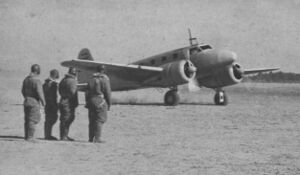
The Tachikawa Ki-54 was a Japanese twin-engine advanced trainer used during World War II. The aircraft was named Hickory by the Allies.
History
The Ki-54 was developed in response to an Imperial Japanese Army requirement for a twin-engine advanced trainer, principally for crew training. The prototype first flew in summer 1940 and, on completing trials, entered production in 1941 as Army Type 1 Advanced Trainer Model A (Ki-54a). The Ki-54a was soon followed by the Ki-54b as Army Type 1 Operations Trainer Model B and Ki-54c as Army Type 1 Transport Model C. The Ki-54b and -c enjoyed successful careers until the end of the war. A few captured aircraft were flown after the war by various users.
Operators
 Japan
Japan
- Imperial Japanese Army Air Force used them for training as per their design.
 Manchukuo
- Manchukuo Air Force Three were provided by Japan as VIP transports.
.svg.png) China-Nanjing
China-Nanjing
- Nanjing air force
 China
China
- Republic of China Air Force Nationalist Chinese (captured).
 China
China
- People's Liberation Army Air Force Communist Chinese (captured): Four captured Ki-54s were used, including in 1951 to train the first class of female pilots in China. They were retired in 1952.[citation needed]
- Template:Country data French Indochina
- Armée de l'Air At least seven Ki-54 were recovered by the French in French Indochina between 1945 and 1947, after the Japanese surrender.
 United Kingdom
- One aircraft operated briefly by No. 273 Squadron RAF during September and October 1945 in French Indochina.[1]
Variants
- Ki-54a - unarmed pilot trainer
- Ki-54b - armed crew trainer
- Ki-54c - eight-passenger light transport, communications aircraft. Civil designation Y-59.
- Ki-54d - maritime reconnaissance/ASW, carried 8x 60-kg (132-lb) depth charges
- Ki-110 - one prototype Ki-54c of all-wood construction, destroyed in US bombing attack
- Ki-111 - projected fuel tanker (none built)
- Ki-114 - projected fuel tanker of all-wood construction (none built)
Surviving aircraft

- A Ki-54 fuselage is in Australia in storage at the Australian War Museum Annex. It was previously part of a playground at the RAAF Fairbairn base kindergarten.[2][3]
- Another Ki-54 fuselage is stored in China at the Chinese Aviation Museum.[4]
- An unrestored Ki-54 is on display at the Misawa Aviation & Science Museum, Japan, it was found at the bottom of Lake Towada in Aomori Prefecture on 13 August 2010. It was recovered on 5 September 2012[5] and has been restored for display.[6]
Specifications (Ki-54c light transport)
Data from The Concise Guide to Axis Aircraft of World War II;[7] Japanese Aircraft of the Pacific War[8]
General characteristics
- Crew: 2
- Capacity: 8
- Length: 11.94 m (39 ft 2 in)
- Wingspan: 17.9 m (58 ft 9 in)
- Height: 3.58 m (11 ft 9 in)
- Wing area: 40 m2 (430 sq ft)
- Empty weight: 2,954 kg (6,512 lb)
- Gross weight: 3,897 kg (8,591 lb)
- Powerplant: 2 × Hitachi Ha13a (Army Type 98 450hp Air Cooled Radial) 9-cylinder air-cooled radial piston engine, 380 kW (510 hp) each for take-off
- 350 kW (470 hp) at 1,700 m (5,600 ft)
- Propellers: 2-bladed metal propeller
Performance
- Maximum speed: 375 km/h (233 mph, 202 kn)
- Cruise speed: 240 km/h (150 mph, 130 kn)
- Range: 960 km (600 mi, 520 nmi)
- Service ceiling: 7,180 m (23,560 ft)
- Wing loading: 97.4 kg/m2 (19.9 lb/sq ft)
- Power/mass: 0.195 kW/kg (0.119 hp/lb)
See also
Aircraft of comparable role, configuration and era
- Airspeed Oxford
- Avro Anson
- Beech Model 18
- Siebel Si 204
Related lists
- List of aircraft of World War II
- List of military aircraft of Japan
References
Notes
- ↑ Thomas, Andy (July 2008). "Vietnam Prelude". FlyPast (Stamford, Lincolnshire, England: Key Publishing) (324): 70–71.
- ↑ "Anyone got pics of the AWM Ki-54?". Warbirdz Aviation Photography. http://www.warbirdz.net/forum/showthread.php?t=363.
- ↑ "Tachikawa Ki-54c 'Hickory' fuselage: 10th Independent Air Brigade, Imperial Japanese Army Air Force". Australian War Memorial. https://www.awm.gov.au/index.php/collection/C966562.
- ↑ "Aircraft database". April 3, 2016. https://www.lph2o.com/aircraft-database?clearfilters=0&clearordering=0&resetfilters=0.
- ↑ "旧陸軍の練習機69年ぶり地上に、青森・十和田湖で引き揚げ" (in ja). September 5, 2012. http://blogs.yahoo.co.jp/onikosato/34388065.html.
- ↑ "旧陸軍練習機、十和田湖で発見…戦時中に墜落" (in ja). August 13, 2010. http://www.yomiuri.co.jp/national/news/20100813-OYT1T00773.htm.
- ↑ Mondey 1996, p. ?.
- ↑ Francillon 1979, p. 256.
Bibliography
- Francillon, René J. (1979). Japanese aircraft of the Pacific War. London: Putnam. ISBN 0-370-30251-6. OCLC 6124909. https://www.worldcat.org/oclc/6124909. (new edition 1987 by Putnam Aeronautical Books, ISBN:0-85177-801-1.)
- Mondey, David (1996). The Concise Guide to Axis Aircraft of World War II. New York: Bounty Books. ISBN 1-85152-966-7.
- Soumille, Jean-Claude (September 1999). "Les avions japonais aux coleurs françaises" (in French). Avions: Toute l'Aéronautique et Son Histoire (78): 6–17. ISSN 1243-8650.
 |  |
Categories: [Low-wing aircraft] [Twin piston-engined tractor aircraft]
↧ Download as ZWI file | Last modified: 05/20/2024 00:28:39 | 3 views
☰ Source: https://handwiki.org/wiki/Engineering:Tachikawa_Ki-54 | License: CC BY-SA 3.0
 KSF
KSF