Long March 4A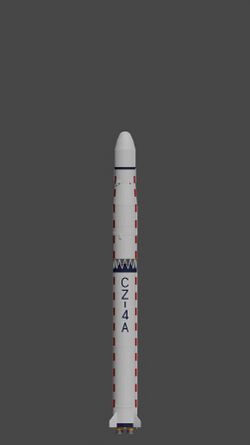 Rendering of Long March 4A |
| Function | Carrier rocket |
|---|
| Manufacturer | CALT |
|---|
| Country of origin | China |
|---|
| Size |
|---|
| Height | 41.9 metres (137 ft)[1] |
|---|
| Diameter | 3.35 metres (11.0 ft)[1] |
|---|
| Mass | 249,000 kilograms (549,000 lb)[1] |
|---|
| Stages | 3 |
|---|
| Capacity
|
|---|
| Payload to LEO | 4,000 kilograms (8,800 lb)[2] |
|---|
| Payload to SSO | 1,500 kilograms (3,300 lb)[2] |
|---|
|
|
|---|
| Associated rockets |
|---|
| Family | Long March |
|---|
| Derivatives | Long March 4B |
|---|
| Launch history |
|---|
| Status | Retired |
|---|
| Launch sites | LA-7, TSLC |
|---|
| Total launches | 2 |
|---|
| Successes | 2 |
|---|
| First flight | 6 September 1988 |
|---|
| Last flight | 3 September 1990 |
|---|
The Long March 4A (Chinese: 长征四号甲火箭), also known as the Changzheng 4A, CZ-4A and LM-4A, sometimes misidentified as the Long March 4 due to the lack of any such designated rocket, was a Chinese orbital carrier rocket. It was launched from Launch Area 7 at the Taiyuan Satellite Launch Center. It was a three-stage rocket, used for two launches in 1988 and 1990. On its maiden flight, on 6 September 1988, it placed the FY-1A weather satellite into orbit. On its second, and final, flight it launched another weather satellite, FY-1B.
A few days after the launch of FY-18, the third-stage of the CZ-4A launch vehicle exploded in the 895 km orbit, creating more than 80 pieces of space debris. This incident led to a redesign of the rocket to include a residual propellant venting system. A venting system was not included in the 4a because of the concern that it would damage the satellite.
It was replaced by a derivative, the Long March 4B, which first flew in 1999. The Long March 4B offers a more powerful third stage, and a larger payload fairing.
List of launches
- Main page: Engineering:List of Long March launches
| Flight No.
|
Date (UTC)
|
Launch site
|
Payload
|
Orbit
|
Result
|
| 1
|
September 6, 1988
20:30
|
LA-7, TSLC
|
Fengyun 1A
|
SSO
|
Success
|
| 2
|
September 3, 1990
00:53
|
LA-7, TSLC
|
Fengyun 1B
|
SSO
|
Success
|
References
- ↑ 1.0 1.1 1.2 Mark Wade. "CZ-4A". Encyclopedia Astronautica. http://www.astronautix.com/lvs/cz4a.htm.
- ↑ 2.0 2.1 Gunter Krebs. "CZ-4 (Chang Zheng-4)". Gunter's Space Page. http://space.skyrocket.de/doc_lau_det/cz-4.htm.
Orbital launch systems |
|---|
- List of orbital launch systems
- Comparison of orbital launch systems
|
| Current |
- Angara
- Antares 230+
- Ariane 5
- Atlas V
- Delta IV Heavy
- Electron
- Epsilon
- Falcon 9 Block 5
- Falcon Heavy
- GSLV
- H-IIA
- H-IIB
- Hyperbola-1
- Jielong 1
- Kuaizhou
- Kaituozhe 2
- Long March
- 2C
- 2D
- 2F
- 3A
- 3B/E
- 3C
- 4B
- 4C
- 5
- 6
- 7
- 11
- Minotaur
- OS-M1
- Pegasus XL
- Proton-M
- PSLV
- Safir
- Shavit
- Simorgh
- Soyuz-2
- 2.1a / STA
- 2.1b / STB
- 2-1v
- Unha
- Vega
- Zenit
- Zhuque-1
|
|---|
| In development |
- Angara 1.2
- Ariane 6
- Bloostar
- Cyclone-4M
- Eris
- Firefly Alpha
- Beta
- H3
- Hyperbola-2
- Irtysh
- Kuaizhou
- LauncherOne
- Long March
- Miura 5
- New Glenn
- New Line 1
- Nuri
- OmegA
- OS-M2
- OS-M4
- Orbex Prime
- SLS
- Soyuz-7
- SSLV
- Starship
- Terran 1
- Vega C
- Vega E
- Vulcan
- Zero
- Zhuque-2
|
|---|
| Retired | |
|---|
| Classes |
- Sounding rocket
- Small-lift launch vehicle
- Medium-lift launch vehicle
- Heavy-lift launch vehicle
- Super heavy-lift launch vehicle
|
|---|
- Symbol † indicates projects terminated before a successful orbital launch
|
Chinese space program |
|---|
- China National Space Administration (CNSA)
|
| Spaceports and landing sites |
- Jiuquan
- Taiyuan
- Wenchang
- Xichang
- Siziwang Banner (landing site)
|
|---|
| Launch vehicles |
- Long March 2
- Long March 3
- Long March 4
- Long March 5
- Long March 6
- Long March 7
- Long March 11
- Kuaizhou
- Kaituozhe
|
|---|
| Exploration programs |
- Shuguang (cancelled)
- Shenzhou (human spaceflight)
- Chang'e (lunar exploration)
- Tiangong (space station)
|
|---|
|
Projects and missions |
|---|
| Science | | Planetary science |
- Chang'e 1 (2007–09)
- Chang'e 2 (2010–present)
- Yinghuo 1† (2011)
- Chang'e 3 (2013–present)
- Chang'e 5-T1 (2014–present)
- Yutu (2013–2016)
- Chang'e 4 (2018-present)
- Yutu-2 (2018-present)
- Chang'e 5 (2020)
- Mars Global Remote Sensing Orbiter and Small Rover (2020)
- ZhengHe (2024)
|
|---|
Astronomy and
cosmology |
- DAMPE (2015–present)
- HXMT (2017–present)
- GECAM (2020)
- SVOM (2021)
- EP (2021)
- ASO-S (2022)
- Xuntian (2022)
- Space Solar Telescope
|
|---|
| Earth observation |
- CSES (2018–present)
- Double Star (2003–07)
- Gaofen (2013–present)
- HY
- TanSat (2016–present)
- Yaogan (2006–present)
- Ziyuan (CBERS) (1999–present)
- SMILE (2023)
|
|---|
|
|---|
| Human spaceflight | | Crewed expeditions |
- List of Chinese astronauts
- Shenzhou 5
- Shenzhou 6
- Shenzhou 7
- Shenzhou 9
- Shenzhou 10
- Shenzhou 11
|
|---|
| Space laboratories and cargos |
- Tiangong 1 (2011–18)
- Tiangong 2 (2016–19)
- Tianzhou 1 (2017)
|
|---|
| Chinese space station |
- Tianhe (2021)
- Wentian (2021)
- Mengtian (2022)
|
|---|
|
|---|
|
| Navigation |
- BeiDou Navigation Satellite System (BDS)
|
|---|
| Telecommunications |
- Tianlian I (2008–present)
- ChinaSat 9 (2009–present)
- Apstar 6C (2018–present)
- Tianlian 2 (2019–present)
|
|---|
Technology
demonstrators |
- FSW Program (1969–2006)
- QUESS (2016–present)
- XPNAV 1 (2016–present)
|
|---|
- Future missions marked in italics, failed missions marked with † sign
|
Long March (rocket family) |
|---|
| Rockets |
- Feng Bao 1
- Long March 1
- Long March 2
- Long March 3
- Long March 4
- Long March 5
- Long March 6
- Long March 7
- Long March 8
- Long March 9
- Long March 11
| |
|---|
| Launch sites |
- Jiuquan
- Taiyuan
- Wenchang
- Xichang
|
|---|
| Manufacturers |
- China Academy of Launch Vehicle Technology
- Shanghai Academy of Spaceflight Technology
|
|---|
| Designers | Wang Xiji |
|---|
- List of Long March launches
|
 | Original source: https://en.wikipedia.org/wiki/Long March 4A. Read more |
 From Handwiki

 KSF
KSF