Decimal
 From Nwe
 | Numeral systems by culture | |
|---|---|
| Hindu-Arabic numerals | |
| Western Arabic Eastern Arabic Khmer |
Indian family Brahmi Thai |
| East Asian numerals | |
| Chinese Counting rods |
Korean Japanese |
| Alphabetic numerals | |
| Abjad Armenian Cyrillic Ge'ez |
Hebrew Ionian/Greek Sanskrit |
| Other systems | |
| Attic Etruscan Urnfield Roman |
Babylonian Egyptian Mayan |
| List of numeral system topics | |
| Positional systems by base | |
| Decimal (10) | |
| 2, 4, 8, 16, 32, 64 | |
| 3, 9, 12, 24, 30, 36, 60, more… | |
A decimal (or denary) system is a numeral system that has the number ten as its base. The term decimal is also used for a number written in this system, or for a fraction expressed using this system.
A number written in decimal notation involves the use of one or more of ten distinct symbols or fundamental units, called digits. The digits are often used with a decimal separator, which indicates the start of a fractional part. The decimal separator may be a dot, a period, or a comma.
The decimal system is the most widely used numeral system. It can be used to represent any number, no matter how large or small. In addition, it greatly simplifies arithmetical operations, a feature that is especially apparent when compared with the system of using Roman numerals. The decimal system forms the basis of the metric system of weights and measures, and it has been tapped to express the currencies of most nations of the world.
Decimal notation
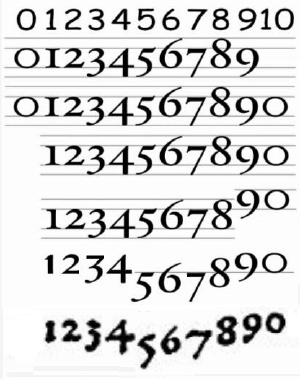
In the decimal system, the ten fundamental units that are currently in widespread use around the globe are: 0, 1, 2, 3, 4, 5, 6, 7, 8, and 9. These ten symbols are called Arabic numerals by Europeans and Indian numerals by Arabs, the two groups' terms referring to the culture from which they learned the system. However, the symbols used in different areas are not identical. For instance, Western Arabic numerals (from which the European numerals are derived) differ from the forms used by other Arab cultures.
The decimal system is a positional numeral system; it has positions for units, tens, hundreds, and so forth. The position of each digit conveys the multiplier (a power of ten) to be used with that digit—each position has a value ten times that of the position to its right. For a mixed number (a number that is the sum of a whole number and a proper fraction), a decimal separator is used to separate the integer part from the fractional part. In English-speaking countries, a dot (·) or period (.) is used as the decimal separator; in many other languages, a comma is used. In addition, each number is preceded by one of the sign symbols, + or −, to indicate positive or negative sign, respectively.
The number ten is the count of the total number of fingers and thumbs on a person's two hands (or toes on two feet). In many languages, the word digit or its translation is also the anatomical term referring to fingers and toes. In English, the term decimal (from Latin decimus) means "tenth," decimate means "reduce by a tenth," and denary (Latin denarius) means "the unit of ten."
There were only two truly positional decimal systems in ancient civilization: the Chinese counting rods system and the Hindu-Arabic numeric system. Both required no more than ten symbols. Other numeric systems required more or fewer symbols.
Decimal fractions
A decimal fraction is a fraction in which the denominator is a power of ten.
Decimal fractions are commonly expressed without a denominator, the decimal separator being inserted into the numerator (with leading zeros added if needed), at the position from the right corresponding to the power of ten of the denominator. For example, 8/10, 83/100, 83/1000, and 8/10000 are expressed as: 0.8, 0.83, 0.083, and 0.0008, respectively.
The integer part (or integral part) of a decimal number is the part to the left of the decimal separator. The part to the right of the decimal separator is the fractional part; if considered as a separate number, a zero is often written in front. If the absolute value of a decimal number is less than one, it is usually expressed with a leading zero.
Trailing zeros after the decimal point are not necessary, but they may be retained in science, engineering, and statistics to indicate a required precision or to show a level of confidence in the accuracy of the number. For example, 0.080 and 0.08 are numerically equal, but in engineering, 0. 080 suggests a measurement with an error of up to 1 part in two thousand (±0.0005), while 0.08 suggests a measurement with an error of up to 1 in two hundred (±0.0005).
Other rational numbers
Any rational number that cannot be expressed as a decimal fraction has a unique infinite decimal expansion ending with recurring decimals.
Ten is the product of the first and third prime numbers (2x5 = 10); it is one greater than the square of the second prime number (3x3 + 1 = 10); and it is one less than the fifth prime number (11 - 1 = 10). This leads to a variety of simple decimal fractions, as follows:
- 1/2 = 0.5
- 1/3 = 0.333333… (with 3 repeating)
- 1/4 = 0.25
- 1/5 = 0.2
- 1/6 = 0.166666… (with 6 repeating)
- 1/8 = 0.125
- 1/9 = 0.111111… (with 1 repeating)
- 1/10 = 0.1
- 1/11 = 0.090909… (with 09 repeating)
- 1/12 = 0.083333… (with 3 repeating)
- 1/81 = 0.012345679012… (with 012345679 repeating)
Other prime factors in the denominator give longer recurring sequences. For instance, see 7 and 13.
That a rational number must have a finite or recurring decimal expansion can be seen as a consequence of the long division algorithm, in that there are only q-1 possible nonzero remainders on division by q, so that the recurring pattern will have a period less than q. For instance to find 3/7 by long division:
      .4 2 8 5 7 1 4 ...
        7 ) 3.0 0 0 0 0 0 0 0
            2 8                         30/7 = 4 r 2
              2 0
              1 4                       20/7 = 2 r 6
                6 0
                5 6                     60/7 = 8 r 4
                  4 0
                  3 5                   40/7 = 5 r 5
                    5 0
                    4 9                 50/7 = 7 r 1
                      1 0
                        7               10/7 = 1 r 3
                        3 0
                        2 8             30/7 = 4 r 2  (again)
                          2 0
                               etc
The converse of this observation is that every recurring decimal represents a rational number p/q. This is a consequence of the fact that the recurring part of a decimal representation is, in fact, an infinite geometric series that will sum to a rational number. For instance,

Real numbers
Every real number has a (possibly infinite) decimal representation. That is, it can be written as

where
- sign() is the sign function,
- ai ∈ { 0,1,…,9 } for all i ∈ Z, are its decimal digits, equal to zero for all i greater than some number (that number being the common logarithm of |x|).
Such a sum converges as i decreases, even if there are infinitely many nonzero ai.
Rational numbers (e.g. p/q) with prime factors in the denominator other than 2 and 5 (when reduced to simplest terms) have a unique recurring decimal representation.
Consider those rational numbers that have only the factors 2 and 5 in the denominator, that is, those that can be written as p/(2a5b). In this case, there is a terminating decimal representation. For instance, 1/1=1, 1/2=0.5, 3/5=0.6, 3/25=0.12, and 1306/1250=1.0448. Such numbers are the only real numbers that do not have a unique decimal representation, as they can also be written as a representation with a recurring 9; for instance, 1=0.99999…, 1/2=0.499999…, and so forth.
This leaves the irrational numbers. They also have unique infinite decimal representation, and can be characterized as the numbers whose decimal representations neither terminate nor recur.
So, in general, the decimal representation is unique if one excludes representations that end in a recurring 9.
The same trichotomy also holds for other base-n positional numeral systems:
- Terminating representation: rational where the denominator divides some nk
- Recurring representation: other rational
- Non-terminating, non-recurring representation: irrational
and a version of this holds for irrational-base numeration systems as well, such as the golden mean base representation.
History
The following is a chronological list of writers and textual materials on decimals.
- c. 3500 - 2500 B.C.E.: Elamites of Iran possibly used early forms of decimal system.[1]
- c. 2900 B.C.E.: Egyptian hieroglyphs show counting in powers of 10 (for exampls, 1 million + 400,000 goats). (See Ifrah, below.)
- c. 2600 B.C.E.: Indus Valley Civilization includes the earliest known physical use of decimal fractions in ancient weight system: 1/20, 1/10, 1/5, 1/2. See Ancient Indus Valley weights and measures
- c. 1400 B.C.E.: Chinese writers show familiarity with the concept of decimals. For example, 547 is written 'Five hundred plus four decades plus seven of days' in some manuscripts.
- c. 1200 B.C.E.: In ancient India, the Vedic text Yajur-Veda states the powers of 10, up to 1055.
- c. 400 B.C.E.: Pingala develops the binary number system for Sanskrit prosody, with a clear mapping to the base-10 decimal system.
- c. 250 B.C.E.: Archimedes writes the Sand Reckoner, which takes decimal calculation up to 1080,000,000,000,000,000.
- c. 100–200 C.E.: The Satkhandagama is written in India—earliest use of decimal logarithms.
- c. 476–550: Aryabhata uses an alphabetic cipher system for numbers that used zero.
- c. 598–670: Brahmagupta explains the Hindu-Arabic numerals (modern number system) which uses decimal integers, negative integers, and zero.
- c. 780–850: Muḥammad ibn Mūsā al-Ḵwārizmī is the first to expound on algorism outside India.
- c. 920–980: Abu'l Hasan Ahmad ibn Ibrahim Al-Uqlidisi provides the earliest known direct mathematical treatment of decimal fractions.
- c. 1300–1500: The Kerala School in South India uses decimal floating point numbers.
- 1548/1549–1620: Simon Stevin, author of De Thiende ('the tenth').
- 1561–1613: Bartholemaeus Pitiscus uses what appears to be decimal point notation.
- 1550–1617: John Napier uses decimal logarithms as a computational tool.
- 1765: Johann Heinrich Lambert discusses (with few proofs) patterns in decimal expansions of rational numbers and notes a connection with Fermat's little theorem in the case of prime denominators.
- 1800: Karl Friedrich Gauss uses number theory to systematically explain patterns in recurring decimal expansions of rational numbers (for example, the relation between period length of the recurring part and the denominator; fractions with the same denominator with recurring decimal parts that are shifts of each other, like 1/7 and 2/7). He also poses questions that remain open to this day.
- 1925: Louis Charles Karpinski publishes The History of Arithmetic.[2]
- 1959: Werner Buchholz writes Fingers or Fists? (The Choice of Decimal or Binary representation).[3]
- 1974: Hermann Schmid publishes Decimal Computation[4]
- 2000: Georges Ifrah's book, The Universal History of Numbers: From Prehistory to the Invention of the Computer, is published in English (translated from the French 1994 publication, Histoire Universelle des Chiffres.[5]
- 2003: Mike Cowlishaw presents Decimal Floating-Point: Algorism for Computers.[6].
Natural languages
A straightforward decimal system, in which 11 is expressed as ten-one and 23 as two-ten-three, is found in Chinese languages except Wu, and in Vietnamese with a few irregularities. Japanese, Korean, and Thai languages have imported the Chinese decimal system. Many other languages with a decimal system have special words for the numbers between 10 and 20, and decades.
Incan languages such as Quechua and Aymara have an almost straightforward decimal system, in which 11 is expressed as ten with one and 23 as two-ten with three.
Some psychologists suggest irregularities of numerals in a language may hinder children's counting ability[7].
Alternative numeral systems
Peoples of various cultures in history have used alternative numeral systems. Pre-Columbian Mesoamerican cultures, such as the Maya, used a vigesimal system (using all twenty fingers and toes); the Babylonians used a sexagesimal (base 60) system; and the Yuki tribe reportedly used an octal (base 8) system. Also, some Nigerians have used several duodecimal (base 12) systems.
Computer hardware and software systems commonly use a binary representation, internally. For external use by computer specialists, this binary representation is sometimes presented in the related octal or hexadecimal systems. For most purposes, however, binary values are converted to the equivalent decimal values for presentation to and manipulation by the public.
Both computer hardware and software also use internal representations that are effectively decimal for storing decimal values and doing arithmetic. Often, this arithmetic is done on data encoded using binary-coded decimal, but other decimal representations are also in use, especially in database implementations. Decimal arithmetic is used in computers so that decimal fractional results can be computed exactly, which is not possible using a binary fractional representation. This is usually important for financial and other calculations.[8]
See also
- Algorithm
- Dewey Decimal System
- Fraction (mathematics)
- Hindu-Arabic numeral system
- Numeral system
- Scientific notation
- Significant figures
- 10 (number)
Notes
- ↑ Robert Englund, 2001, The State of Decipherment of proto-Elamite. Max Planck Institute for the History of Science. Retrieved May 17, 2008.
- ↑ Louis Charles Karpinski, The History of Arithmetic, Rand McNally & Company, 1925.
- ↑ Werner Buchholz, Fingers or Fists? (The Choice of Decimal or Binary representation), Communications of the ACM, Vol. 2 #12, 3–11, ACM Press, December 1959.
- ↑ Hermann Schmid, Decimal Computation, John Wiley & Sons 1974 ISBN 047176180X; reprinted in 1983 by Robert E. Krieger Publishing Company ISBN 0898743184
- ↑ Georges Ifrah, and Robert Laffont, Histoire Universelle des Chiffres, 1994. (The Universal History of Numbers: From prehistory to the invention of the computer, Georges Ifrah, John Wiley and Sons Inc., 2000. Translated from the French by David Bellos, E.F. Harding, Sophie Wood and Ian Monk).
- ↑ Cowlishaw, M. F., Decimal Floating-Point: Algorism for Computers, Proceedings 16th IEEE Symposium on Computer Arithmetic, ISBN 076951894X, 104-111, IEEE Comp. Soc., June 2003
- ↑ Beth Azar, 1999, "English words may hinder math skills development", American Psychology Association Monitor 30(4) . Retrieved May 17, 2008.
- ↑ Decimal Arithmetic FAQ IBM. Retrieved May 17, 2008.
References
ISBN links support NWE through referral fees
- Long, Lynette. Delightful Decimals and Perfect Percents: Games and Activities That Make Math Easy and Fun. New York: J. Wiley, 2003. ISBN 978-0471210580
- Mann, W. Wilberforce. A new system of measures, weights, and money; entitled the Linnbase decimal system; and designed for the adoption of all civilized nations, as the one common system. Ann Arbor, MI: Scholarly Publishing Office, University of Michigan Library, 2005. ISBN 978-1418192112
- Nelson, Marvin N. Metric Handbook for Schools: Learning the Decimal System for Weights & Measures with Experiences and Problems. Minneapolis, MN: Burgess Pub. Co., 1980. ISBN 0808714481
- Rasmussen, Steven, and Spreck Rosekrans. Decimal Concepts. Book 1. Berkeley, CA: Key Curriculum Project, 1985. ISBN 091368421X
- Schmid, Hermann. Decimal Computation. New York: Wiley, 1974. ISBN 047176180X
- Yates, James. Narrative Of The Origin And Formation Of The International Association For Obtaining A Uniform Decimal System Of Measures, Weights And Coins (1856). Whitefish, MT: Kessinger, 2008. ISBN 978-0548866672
External links
All links retrieved July 26, 2022.
- Online Quiz: Decimal Place Value. – kwizNET Learning System.
- Online Quiz: Decimal Sums. – kwizNET Learning System.
- Online Quiz: Decimal to Fraction. – kwizNET Learning System.
- Decimal Worksheets. – Maths Is Fun.
- Convert Decimals to Fractions. – Maths Is Fun.
Credits
New World Encyclopedia writers and editors rewrote and completed the Wikipedia article in accordance with New World Encyclopedia standards. This article abides by terms of the Creative Commons CC-by-sa 3.0 License (CC-by-sa), which may be used and disseminated with proper attribution. Credit is due under the terms of this license that can reference both the New World Encyclopedia contributors and the selfless volunteer contributors of the Wikimedia Foundation. To cite this article click here for a list of acceptable citing formats.The history of earlier contributions by wikipedians is accessible to researchers here:
- Decimal history
The history of this article since it was imported to New World Encyclopedia:
- History of "Decimal"
Note: Some restrictions may apply to use of individual images which are separately licensed.
↧ Download as ZWI file | Last modified: 02/03/2023 20:28:32 | 5 views
☰ Source: https://www.newworldencyclopedia.org/entry/Decimal | License: CC BY-SA 3.0
 ZWI signed:
 KSF
KSF