Jin Chinese
 From Handwiki
 | Jin | |
|---|---|
| 晋语 / 晉語 晋方言 / 晉方言 | |
 Jinyu written in Chinese characters (vertically, traditional Chinese on the left, simplified Chinese on the right) | |
| Native to | China |
| Region | most of Shanxi province; central Inner Mongolia; parts of Hebei, Henan, Shaanxi |
Native speakers | 48 million (2021)e26 |
Language family | Sino-Tibetan
|
| Language codes | |
| ISO 639-3 | cjy |
| Glottolog | jiny1235 |
| Linguasphere | 79-AAA-c |
Jin (simplified Chinese: 晋语; traditional Chinese: 晉語; pinyin: Jìnyǔ; simplified Chinese: 晋方言; traditional Chinese: 晉方言; pinyin: Jìn fāngyán) is a proposed group of varieties of Chinese spoken by roughly 48 million people in northern China ,[1] including most of Shanxi province, much of central Inner Mongolia, and adjoining areas in Hebei, Henan, and Shaanxi provinces. The status of Jin is disputed among linguists; some prefer to include it within Mandarin, but others set it apart as a closely related, but separate sister-group.
Classification
After the concept of Mandarin Chinese was proposed, the Jinnish dialects were universally included within it, mainly because Chinese linguists paid little attention to these dialects at the time. In order to promote Standard Mandarin in the early days of People's Republic of China, linguists started to research various dialects in Shanxi, comparing these dialects with Standard Mandarin for helping the locals to learn it more quickly. During this period, a few linguists discovered some unique features of Jin Chinese that do not exist in other northern Mandarin dialects, planting the seeds for the future independence of Jin Chinese. Finally, in 1985, Li Rong proposed that Jin should be considered a separate top-level dialect group, similar to Yue or Wu. His main criterion was that Jin dialects had preserved the entering tone as a separate category, still marked with a glottal stop as in the Wu dialects, but distinct in this respect from most other Mandarin dialects. Some linguists have adopted this classification. However, others disagree that Jin should be considered a separate dialect group for these reasons:[2][3]
- Use of the entering tone as a diagnostic feature is inconsistent with the way that all other Chinese dialect groups have been delineated based on the reflexes of the Middle Chinese voiced initials.
- Certain other Mandarin dialects also preserve the glottal stop, especially the Jianghuai dialects, and so far, no linguist has claimed that these dialects should also be split from Mandarin.
Dialects
The Language Atlas of China divides Jin into the following eight subgroups:[4]
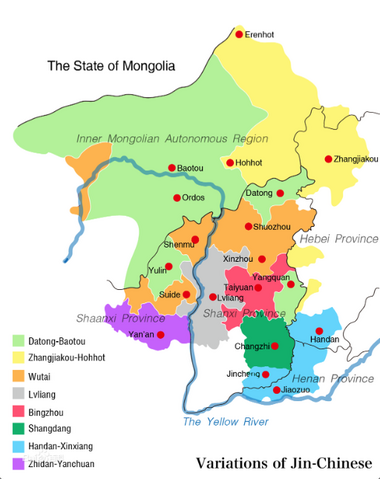
- Bingzhou subgroup (Chinese: 并州片), spoken in central Shanxi (the ancient Bing Province), including Taiyuan. Most dialects under this subgroup can distinguish the light entering tone from the dark one, with only 1 level tone. In many dialects, especially those to the south of Taiyuan, the voiced obstruents from Middle Chinese become tenuis in all 4 tones, namely [b] → [p], [d] → [t] and [g] → [k].
- Lüliang subgroup (Chinese: 呂梁片), spoken in western Shanxi (including Lüliang) and northern Shaanxi. Dialects under this subgroup can differentiate light entering tone from dark entering tone. In most dialects, the voiced obstruents from Middle Chinese become aspirated in both level and entering tones, namely [b] → [pʰ], [d] → [tʰ] and [g] → [kʰ].
- Shangdang subgroup (simplified Chinese: 上党片; traditional Chinese: 上黨片), spoken in the area of Changzhi (ancient Shangdang) in southeastern Shanxi. Dialects under this subgroup can differentiate light entering tone from dark entering tone. The palatalization of velar consonants does not occur in some dialects.
- Wutai subgroup (simplified Chinese: 五台片; traditional Chinese: 五臺片), spoken in parts of northern Shanxi (including Wutai County) and central Inner Mongolia. A few Dialects under this subgroup can differentiate light entering tone from dark entering tone, while the others cannot. The fusion of the level tone and the rising one occurred in some dialects, though some linguists claim every dialect under this subgroup has this feature.[5]
- Da-Bao subgroup (Chinese: 大包片), spoken in parts of northern Shanxi and central Inner Mongolia, including Baotou.
- Zhangjiakou–Hohhot subgroup (simplified Chinese: 张呼片; traditional Chinese: 張呼片), spoken in Zhangjiakou in northwestern Hebei and parts of central Inner Mongolia, including Hohhot.
- Han-Xin subgroup (Chinese: 邯新片), spoken in southeastern Shanxi, southern Hebei (including Handan) and northern Henan (including Xinxiang).
- Zhi-Yan subgroup (Chinese: 志延片), spoken in Zhidan County and Yanchuan County in northern Shaanxi.
The Taiyuan dialect from the Bingzhou subgroup is sometimes taken as a convenient representative of Jin because many studies of this dialect are available, but most linguists agree that the Taiyuan vocabulary is heavily influenced by Mandarin, making it unrepresentative of Jin.[6] The Lüliang subgroup is usually regarded as the "core" of the Jin language group as it preserves most archaic features of Jin. However, there is no consensus as to which dialect among the Lüliang subgroup is the representative dialect.
Phonology
Unlike most varieties of Mandarin, Jin has preserved a final glottal stop, which is the remnant of a final stop consonant (/p/, /t/ or /k/). This is in common with the Early Mandarin of the Yuan dynasty (c. 14th century AD) and with a number of modern southern varieties of Chinese. In Middle Chinese, syllables closed with a stop consonant had no tone. However, Chinese linguists prefer to categorize such syllables as belonging to a separate tone class, traditionally called the "entering tone". Syllables closed with a glottal stop in Jin are still toneless, or alternatively, Jin can be said to still maintain the entering tone. In standard Mandarin Chinese, syllables formerly ending with a glottal stop have been reassigned to one of the other tone classes in a seemingly random fashion.
Initials
| Labial | Alveolar | Alveolo- palatal |
Velar | ||
|---|---|---|---|---|---|
| Stop | voiceless | p | t | k | |
| aspirated | pʰ | tʰ | kʰ | ||
| Affricate | voiceless | ts | tɕ | ||
| aspirated | tsʰ | tɕʰ | |||
| Fricative | voiceless | f | s | ɕ | x |
| voiced | v | z | ɣ | ||
| Nasal | m | n | (ŋ) | ||
| Approximant | l | ||||
- [ŋ] is mainly used in finals.
| Labial | Alveolar | Alveolo- palatal |
Retroflex | Velar | ||
|---|---|---|---|---|---|---|
| Stop | voiceless | p | t | k | ||
| aspirated | pʰ | tʰ | kʰ | |||
| Affricate | voiceless | ts | tɕ | tʂ | ||
| aspirated | tsʰ | tɕʰ | tʂʰ | |||
| Fricative | voiceless | f | s | ɕ | ʂ | x |
| voiced | v | z | ʐ | |||
| prenasal | nᵈz | |||||
| Nasal | m | n | ɲ | ɳ | ŋ | |
| Approximant | l | |||||
- The nasal consonant sounds may vary between nasal sounds [m, n, ɲ, ɳ, ŋ] or prenasalised stop sounds [ᵐb, ⁿd, ᶯɖʐ, ᶮdʲ, ᵑɡ].
- A prenasalised affricated fricative sound /nᵈz/, is also present.
Finals
| Oral | Nasal | Check | ||||||||||||
|---|---|---|---|---|---|---|---|---|---|---|---|---|---|---|
| Medial | ∅ | coda | a | e | i | u | ŋ | æ̃ | ɛ̃ | ∅ | ∅ | ə | a | |
| Nucleus | ∅ | ei | ɒŋ | æ̃ | ɒ̃ | ɐʔ | əʔ | aʔ | ||||||
| Vowel | i | ia | ie | iŋ | iɛ̃ | iɒ̃ | iəʔ | iaʔ | ||||||
| y | ye | yŋ | yɛ̃ | yəʔ | ||||||||||
| a | ai | au | ||||||||||||
| əu | əŋ | |||||||||||||
| oŋ | ||||||||||||||
| ɤ | uɤ | |||||||||||||
| u | ua | uŋ | uæ̃ | uɒ̃ | uəʔ | uaʔ | ||||||||
| Triphthong | iəu | uai | uei | iau | iəŋ | |||||||||
| yəŋ | ||||||||||||||
| uəŋ | ||||||||||||||
| Syllabic | ɹ̩ | əɹ̩ | ||||||||||||
| Oral | Nasal | Check | |||||||||||
|---|---|---|---|---|---|---|---|---|---|---|---|---|---|
| Medial | ∅ | lab. | coda | a | i | u | ŋ | ã | ∅ | ∅ | a | ə | |
| Nucleus | ∅ | ɑu | ã | ə̃ | eʔ | aʔ | əʔ | ||||||
| Vowel | i | iɔ | ia | iu | iã | ĩ | ieʔ | iaʔ | |||||
| y | yɔ | ya | yŋ | yã | yeʔ | yaʔ | |||||||
| ei | eu | eŋ | |||||||||||
| a | ai | ||||||||||||
| iə̃ | |||||||||||||
| ɔ | |||||||||||||
| o | ou | oŋ | |||||||||||
| ɤu | |||||||||||||
| ɯ | iɯ | ||||||||||||
| u | uɔ | ua | ui | uŋ | uã | ueʔ | uaʔ | uəʔ | |||||
| Triphthong | iai | uai | uei | iɑu | |||||||||
| iou | uoŋ | ||||||||||||
| Syllabic | ɹ̩ | ɹ̩ʷ | əɹ̩ | ||||||||||
- The diphthong /ɤu/ may also be realized as a monophthong close central vowel [ʉ].
- Sounds ending in the sequence /-aʔ/ may also be heard as [-ɛʔ], then realized as [ɛʔ, iɛʔ, yɛʔ, uɛʔ].
- /y/ can also be heard as a labio-palatal approximant [ɥ] when preceding initial consonants.
- /i/ when occurring after alveolar sounds /ts, tsʰ, s/ can be heard as an alveolar syllabic [ɹ̩], and is heard as a retroflex syllabic [ɻ̩] when occurring after retroflex consonants /tʂ, tʂʰ, ʂ, ʐ/.
Tones
Jin employs extremely complex tone sandhi, or tone changes that occur when words are put together into phrases. The tone sandhi of Jin is notable in two ways among Chinese varieties:
- Tone sandhi rules depend on the grammatical structure of the words being put together. Hence, an adjective–noun compound may go through different sets of changes compared to a verb–object compound.[11]
- There are Jin varieties in which the "dark level" tone category (yīnpíng 阴平) and "light level" (yángpíng 阳平) tone have merged in isolation but can still be distinguished in tone sandhi contexts. That is, while e.g. Standard Mandarin has a tonal distinction between Tone 1 and Tone 2, corresponding words in Jin Chinese may have the same tone when pronounced separately. However, these words can still be distinguished in connected speech. For example, in Pingyao Jin, dark level tou 偷 'secretly' and ting 听 'to listen' on the one hand, and light level tao 桃 'peach' and hong 红 'red' on the other hand, all have the same rising tone [˩˧] when pronounced in isolation. Yet, when these words are combined into touting 偷听 'eavesdropping' and taohong 桃红 'peach red', the tonal distinction emerges. In touting, tou has a falling tone [˧˩] and ting has a high-rising tone [˧˥], whereas both syllables in taohong still have the same low-rising tone [˩˧] as in isolation.[12]
Grammar
Jin readily employs prefixes such as 圪 /kəʔ/, 黑 /xəʔ/, 忽 /xuəʔ/, and 入(日) /ʐəʔ/, in a variety of derivational constructions. For example:
入鬼 "fool around" < 鬼 "ghost, devil"
In addition, there are a number of words in Jin that evolved, evidently, by splitting a mono-syllabic word into two, adding an 'l' in between (cf. Ubbi Dubbi, but with /l/ instead of /b/). For example:
/pəʔ ləŋ/ < 蹦 /pəŋ/ "hop"
/tʰəʔ luɤ/ < 拖 /tʰuɤ/ "drag"
/kuəʔ la/ < 刮 /kua/ "scrape"
/xəʔ lɒ̃/ < 巷 /xɒ̃/ "street"
A similar process can in fact be found in most Mandarin dialects (e.g. 窟窿 kulong < 孔 kong), but it is especially common in Jin.
This may be a kind of reservation for double-initials in Old Chinese, although this is still controversial. For example, the character 孔 (pronounced /kʰoːŋ/ in Mandarin) which appears more often as 窟窿 /kʰuəʔ luŋ/ in Jin, had the pronunciation like /kʰloːŋ/ in Old Chinese.[citation needed]
Some dialects of Jin make a three-way distinction in demonstratives. (Modern English, for example, has only a two-way distinction between "this" and "that", with "yon" being archaic.)[citation needed]
Vocabulary
Lexical diversity in Jin Chinese is obvious, with some words having a very distinct regionality. Usually, there are more unique words in the core dialects than in the non-core dialects and moreover, some cannot be represented in Chinese characters.
References
Citations
- ↑ Cite error: Invalid
<ref>tag; no text was provided for refs namede26 - ↑ Yan 2006, pp. 60–61, 67–69.
- ↑ Kurpaska 2010, pp. 74–75.
- ↑ Kurpaska 2010, p. 68.
- ↑ Fan, Huiqin 范慧琴 (2015). "Jìn yǔ wǔ tái piàn yīn píng hé shàng shēng de fèn hé jí qí yǎn biàn". 语文研究 (3): 28–32. https://kns.cnki.net/kcms/detail/detail.aspx?DBCode=CJFQ&FileName=YWYJ201503004&DBName=CJFDLAST2015&v=MDAwNDFyQ1VSN2llWnVSc0ZpN25VTHZLUERyU1pMRzRIOVRNckk5RllJUUlCWDFOeWhCbTZrNElUQW1YcmhjeUY=. "文章认为晋语五台片阴平和上声的分合有忻州型和宁武型两个类型,不同类型以及不同方言点的共时差异反映出两个声调的历时演变过程是渐进式的,合流是声调晚期演变的结果,调值相近是合流的直接动因。。".
- ↑ Qiao, Quansheng 乔全生. "Jìn fāngyán yánjiū de lìshǐ, xiànzhuàng yǔ wèilái". pp. 10. https://www1.doshisha.ac.jp/~cjtl210/data1/34_qiaoquansheng.pdf. "太原方言的词汇与其他方言比较,结果认为晋方言的词汇与官话方言非常接近。"
- ↑ 7.0 7.1 Wen, Duanzheng 溫端政; Shen, Ming 沈明 (1999). Hou, Jingyi 侯精一. ed (in zh). Tàiyuánhuà yīndàng. Shanghai: Shanghai jiaoyu chubanshe. pp. 4–12.
- ↑ 8.0 8.1 "[汾阳方言语音教程 第五课 - 汾阳话拼音方案 ([Fenyang Dialect Phonetics Course] Lesson 5 - Fenyang Dialect Pinyin Scheme)"]. 2017. https://mp.weixin.qq.com/s?__biz=MzI4OTQ3MjY0MA==&mid=2247483976&idx=1&sn=dc098cafda048973863c2df2fa6193ba&chksm=ec2feba7db5862b1fbf0bd2876c38f9a2fc4a569fe68f82ddc376d31abc8f0127653a8ae905f#rd.
- ↑ Xia, Liping; Hu, Fang (2016). "Vowels and Diphthongs in the Taiyuan Jin Chinese Dialect". Interspeech 2016. pp. 993–997. doi:10.21437/Interspeech.2016-249. https://www.isca-speech.org/archive/interspeech_2016/xia16b_interspeech.html.
- ↑ Juncheng, Zhao (1989). 汾阳话与普通话简编 [A Compendium of Fenyang and Mandarin]. 山西省汾阳县志办公室 [Shanxi Province Fenyang County Office]. pp. 1–3.
- ↑ Chen, Matthew (2000). Tone Sandhi: Patterns across Chinese Dialects. Cambridge: Cambridge University Press. pp. 93. ISBN 0521033403.
- ↑ Chen, Matthew (2000). Tone Sandhi: Patterns across Chinese Dialects. Cambridge: Cambridge University Press. pp. 51. ISBN 0521033403.
Sources
- (in zh-CN) Zhōngguó Yǔyán Dìtújí (Dì 2 bǎn): Hànyǔ fāngyán juǎn, Beijing: The Commercial Press, 2012.
- Hou 侯, Jingyi 精一; Shen 沈, Ming 明 (2002), Hou, Jingyi, ed. (in zh-CN), Shanghai Education Publishing House, ISBN 7-5320-8084-6
- Kurpaska, Maria (2010), Chinese Language(s): A Look Through the Prism of The Great Dictionary of Modern Chinese Dialects, De Gruyter Mouton, ISBN 978-3-11-021914-2
- Yan, Margaret Mian (2006), Introduction to Chinese Dialectology, LINCOM Europa, ISBN 978-3-89586-629-6.
External links
 |
Jin Chinese test of Wikipedia at Wikimedia Incubator |
- Classification of the Jin Dialects
- Details of the Pingyao Dialect
 |  |
Categories: [Languages of China]
↧ Download as ZWI file | Last modified: 08/20/2024 00:01:26 | 14 views
☰ Source: https://handwiki.org/wiki/Social:Jin_Chinese | License: CC BY-SA 3.0
 KSF
KSF