Carodnia
 From Handwiki
| Carodnia Temporal range: Early Eocene
(Itaboraian-Casamayoran) ~53–48.6 Ma PreЄ
Є
O
S
D
C
P
T
J
K
Pg
N
↓ | |
|---|---|
| |
| Carodnia vieirai | |
Scientific classification 
| |
| Kingdom: | Animalia |
| Phylum: | Chordata |
| Class: | Mammalia |
| Order: | †Xenungulata |
| Family: | †Carodniidae |
| Genus: | †Carodnia Simpson 1935[1] |
| Species | |
| |
| Synonyms | |
|
Ctalecarodnia Simpson 1935 | |
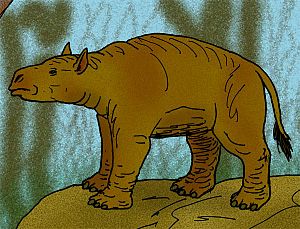
Carodnia is an extinct genus of South American ungulate known from the Early Eocene of Brazil , Argentina , and Peru.[3] Carodnia is placed in the order Xenungulata together with Etayoa and Notoetayoa.[4]
Carodnia is the largest mammal known from the Eocene of South America. It was heavily built and had large canines and cheek teeth with a crested pattern like the uintatheres to which it can be related.[3] In life, it would have been a tapir-sized animal. It bore strong resemblances to dinoceratans, although without tusks or ossicones.
Description
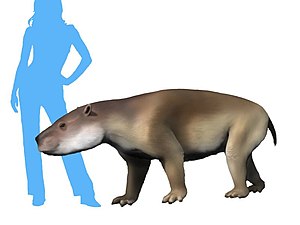
Simpson noted that Carodnia resembles the primitive uintathere Probathyopsis. Although Paula Couto also made the same favorable comparison, he placed Carodnia in the new order Xenungulata. Gingerich 1985 concluded that Probathyopsis shares several dental characteristics with Carodnia, but that in the latter the anterior dentition of is more reduced, the second lower and upper premolars are enlarged and pointed, and that the first and second molars are more lophodont. Gingerich thought the differences could justify a separate family for Carodnia but proposed that it should be included in Probathyopsis,Cifelli 1983 grouped Carodnia with Pyrotheria but later concluded that this was a mistake.[5]
Carodnia is characterized by bilophodont[explain 1] first and second molars and more complex lophate[explain 1] third molars, which suggests possible links to pyrotheres, uintatheres, and even arctocyonids. The bones of the foot are short and robust and the digits terminate in broad, flat, and unfissured hoof-like unguals, unlike any other known meridiungulate.[6]
C. feruglioi and C. cabrerai, from the Riochican in the SALMA classification of Patagonia,[5] are known from only a few dental remains. C. vieirai (from the Itaboraian SALMA of Itaborai)[5] is known from much more complete dental, cranial, and postcranial remains including an almost complete mandible, many vertebrae, and several partial leg bones.[7]
When Simpson 1935 first described Carodnia and Ctalecarodnia, the former was known only from a left lower molar which was lacking in the latter, making a comparison very difficult. Paula Couto 1952, based on considerably more complete remains, concluded that the molars and premolars of both are indistinguishable and therefore reduced Ctalecarodnia to a synonym. Paula Couto also noted that the dentition of C. cabrerai and C. feruglioi are similar except in size, and that C. feruglioi can be a juvenile C. cabrerai, but nevertheless left them as two distinct species.[8]
Distribution
Fossils of Carodnia have been found in:[9]
- Peñas Coloradas Formation, Argentina
- Itaboraí Formation, Brazil
- Mogollón Formation, Peru[2]
Itaboraian correlations
| Basin | Itaboraí | Golfo San Jorge | Salta | Altiplano Basin | Talara & Tumbes |
Altiplano Cundiboyacense |
Cesar-Ranchería | 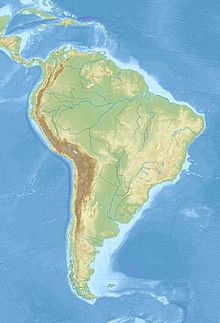     Carodnia (South America) | |
|---|---|---|---|---|---|---|---|---|---|
| Country |  Brazil Brazil |
 Argentina Argentina |
 Peru Peru |
 Colombia Colombia
| |||||
| Carodnia | |
|
|||||||
| Gashternia | 14px | 14px | 14px | ||||||
| Henricosbornia | 14px | 14px | 14px | ||||||
| Victorlemoinea | |
|
|||||||
| Polydolopimorphia | 14px | 14px | 14px | 14px | |||||
| Birds |  |
|
|||||||
| Reptiles | 10px | 10px | 10px | 10px | 10px | ||||
| Fish |  |
| |||||||
| Flora | 10px | 10px | 10px | ||||||
| Environments | Alluvial-lacustrine | Alluvial-fluvial | Fluvio-lacustrine | Lacustrine | Fluvial | Fluvio-deltaic |  Itaboraian volcanoclastics Itaboraian volcanoclastics8px Itaboraian fauna  Itaboraian flora Itaboraian flora | ||
| Volcanic | Yes | ||||||||
Notes
- ↑ 1.0 1.1 A loph is a crest on the crown of a tooth. A bilophodont tooth has two parallel lophs running transversally across the tooth.
References
- ↑ Carodnia in the Paleobiology Database. Retrieved May 2013.
- ↑ 2.0 2.1 Pierre-Olivier Antoine; Guillaume Billet; Rodolfo Salas-Gismondi; Julia Tejada Lara; Patrice Baby; Stéphane Brusset; Nicolas Espurt (2015). "A New Carodnia Simpson, 1935 (Mammalia, Xenungulata) from the Early Eocene of Northwestern Peru and a Phylogeny of Xenungulates at Species Level". Journal of Mammalian Evolution in press (2): 129–140. doi:10.1007/s10914-014-9278-1.
- ↑ 3.0 3.1 "Pantodonts, uintatheres and xenungulates: The first large herbivorous mammals". Paleocene Mammals. August 2005. http://www.paleocene-mammals.de/large_herbivores.htm.
- ↑ "Xenungulata". Palaeocritti. http://www.palaeocritti.com/by-group/eutheria/xenungulata.
- ↑ 5.0 5.1 5.2 Gingerich 1985, pp. 130–1
- ↑ Rose 2006, Xenungulata, p. 238
- ↑ Paula Couto 1952, pp. 371–2
- ↑ Paula Couto 1952, pp. 372–3
- ↑ Carodnia at Fossilworks.org
Bibliography
- Cifelli, Richard (1983). "Eutherian tarsals from the late Paleocene of Brazil". American Museum Novitates (2761). OCLC 10601277.
- Gingerich, Philip D. (1985). "South American Mammals in the Paleocene of North America". in Stehli, Francis G.; Webb, S. David. The Great American Biotic Interchange. Topics in Geobiology. 4. Springer. pp. 123–137. doi:10.1007/978-1-4684-9181-4_5. ISBN 978-1-4684-9183-8. OCLC 716806225. http://www-personal.umich.edu/~gingeric/PDFfiles/PDG168_SAMammPalNA.pdf. Retrieved 5 May 2013.
- Rose, Kenneth David (2006). The beginning of the age of mammals. Baltimore: JHU Press. ISBN 978-0801884726. https://books.google.com/books?id=3bs0D5ix4VAC.
- Paula Couto, Carlos, de (1952). "Fossil mammals from the beginning of the Cenozoic in Brazil. Condylarthra, Litopterna, Xenungulata, and Astrapotheria". Bulletin of the American Museum of Natural History 99: 355–394. OCLC 18189741.
- Simpson, George Gaylord (1935). "Descriptions of the oldest known South American mammals, from the Río Chico Formation". American Museum Novitates. Publications of the Scarritt Expeditions, no. 24 (793). OCLC 44083494.
See also Wikidata entry Q3311285.
 |  |
Categories: [Meridiungulata] [Casamayoran] [Riochican] [Itaboraian]
↧ Download as ZWI file | Last modified: 08/16/2022 12:51:57 | 3 views
☰ Source: https://handwiki.org/wiki/Biology:Carodnia | License: CC BY-SA 3.0
 ZWI signed:
 KSF
KSF