Zingiberaceae
 From Handwiki
| Ginger family Temporal range: Campanian - recent[1]
PreЄ
Є
O
S
D
C
P
T
J
K
Pg
N
| |
|---|---|
| |
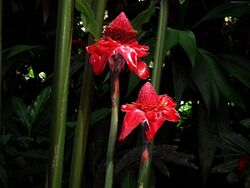
| Red torch ginger (Etlingera elatior) | |
Scientific classification 
| |
| Kingdom: | Plantae |
| Clade: | Tracheophytes |
| Clade: | Angiosperms |
| Clade: | Monocots |
| Clade: | Commelinids |
| Order: | Zingiberales |
| Family: | Zingiberaceae Martinov[2] |
| Type genus | |
| Zingiber Boehm.
| |
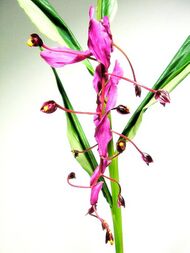
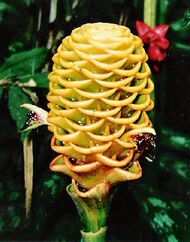
Zingiberaceae (/ˌzɪndʒɪbɪˈreɪsii/) or the ginger family is a family of flowering plants made up of about 50 genera with a total of about 1600 known species[3] of aromatic perennial herbs with creeping horizontal or tuberous rhizomes distributed throughout tropical Africa, Asia, and the Americas. Many of the family's species are important ornamental, spice, or medicinal plants. Ornamental genera include the shell gingers (Alpinia), Siam or summer tulip (Curcuma alismatifolia), Globba, ginger lily (Hedychium), Kaempferia, torch-ginger Etlingera elatior, Renealmia, and ginger (Zingiber). Spices include ginger (Zingiber), galangal or Thai ginger (Alpinia galanga and others), melegueta pepper (Aframomum melegueta), myoga (Zingiber mioga), korarima (Aframomum corrorima), turmeric (Curcuma), and cardamom (Amomum, Elettaria).[4]
Evolution
The earliest known fossils of the family belong to the Campanian age and are from the genera Spirematospermum in Germany ,Tricostatocarpon and Striatornata in Mexico, and Momordiocarpon in India .[5][6] Spirematospermum chandlerae from the Santonian of North Carolina was previously classified in the Zingiberaceae, but more recent studies support it belonging to the Musaceae.[7][1]
Description
Members of the family are small to large herbaceous plants with distichous leaves with basal sheaths that overlap to form a pseudostem. The plants are either self-supporting or epiphytic. Flowers are hermaphroditic, usually strongly zygomorphic, in determinate cymose inflorescences, and subtended by conspicuous, spirally arranged bracts. The perianth is composed of two whorls, a fused tubular calyx, and a tubular corolla with one lobe larger than the other two. Flowers typically have two of their stamenoids (sterile stamens) fused to form a petaloid lip, and have only one fertile stamen. The ovary is inferior and topped by two nectaries, the stigma is funnel-shaped.[citation needed]
Some genera yield essential oils used in the perfume industry (Alpinia, Hedychium).
Taxonomy
| Cladogram: Phylogeny of Zingiberales[8] | |||||||||||||||||||||||||||||||||||||||||||||||||||
|
Phylogenetic tree of the family
Subdivisions
| Zingiberaceae |
| ||||||||||||||||||
_Im_IMG_2441.jpg)

- Subfamily Siphonochiloideae
- Tribe Siphonochileae
- Siphonochilus
- Tribe Siphonochileae
- Subfamily Tamijioideae
- Tribe Tamijieae
- Tamijia
- Tribe Tamijieae
- Subfamily Alpinioideae
- Tribe Alpinieae
- Adelmeria
- Aframomum - grains of paradise
- Alpinia - galangal
- Amomum
- Aulotandra
- Cyphostigma
- Elettaria - cardamom
- Elettariopsis
- Etlingera
- Geocharis
- Geostachys
- Hornstedtia
- Lanxangia
- Leptosolena
- Plagiostachys
- Renealmia
- Siliquamomum
- Vanoverberghia
- ×Alpingera F. Luc-Cayol (Alpinia × Etlingera) - intergeneric hybrid
- Tribe Riedelieae
- Burbidgea
- Pleuranthodium
- Riedelia
- Siamanthus
- Tribe Alpinieae
- Subfamily Zingiberoideae
- Tribe Zingibereae
- Boesenbergia
- Camptandra
- Caulokaempferia
- Cautleya
- Cornukaempferia
- Curcuma - turmeric
- Curcumorpha
- Distichochlamys
- Haniffia
- Haplochorema
- Hedychium
- Hitchenia
- Kaempferia
- Kedhalia
- Laosanthus
- Myxochlamys
- Nanochilus
- Newmania
- Parakaempferia
- Pommereschea
- Pyrgophyllum
- Rhynchanthus
- Roscoea
- Scaphochlamys
- Smithatris
- Stadiochilus
- Stahlianthus
- Zingiber - ginger
- Tribe Globbeae
- Gagnepainia
- Globba
- Hemiorchis
- Tribe Zingibereae
Distribution
The Zingiberaceae have a pantropical distribution in the tropics of Africa, Asia, and the Americas, with their greatest diversity in South Asia.
References
- ↑ 1.0 1.1 "Zingiberales". http://www.mobot.org/mobot/research/apweb/orders/zingiberalesweb.htm.
- ↑ Angiosperm Phylogeny Group (2009). "An update of the Angiosperm Phylogeny Group classification for the orders and families of flowering plants: APG III". Botanical Journal of the Linnean Society 161 (2): 105–121. doi:10.1111/j.1095-8339.2009.00996.x.
- ↑ Christenhusz, Maarten J.M.; Byng, James W. (20 May 2016). "The number of known plants species in the world and its annual increase". Phytotaxa 261 (3): 201. doi:10.11646/phytotaxa.261.3.1.
- ↑ Chattopadhyay, Ishita; Biswas, Kaushik; Bandyopadhyay, Uday; Banerjee, Ranajit K. (2004). "Turmeric and curcumin: Biological actions and medicinal applications". Current Science 87 (1): 44–53.
- ↑ Smith, Selena Y.; Iles, William J. D.; Benedict, John C.; Specht, Chelsea D. (2 August 2018). "Building the monocot tree of death: Progress and challenges emerging from the macrofossil‐rich Zingiberales" (in en). American Journal of Botany 105 (8): 1389–1400. doi:10.1002/ajb2.1123. ISSN 0002-9122. PMID 30071130. https://onlinelibrary.wiley.com/doi/10.1002/ajb2.1123.
- ↑ Smith, Selena Y.; Kapgate, Dashrath K.; Robinson, Shannon; Srivastava, Rashmi; Benedict, John C.; Manchester, Steven R. (2021-02-01). "Fossil Fruits and Seeds of Zingiberales from the Late Cretaceous–Early Cenozoic Deccan Intertrappean Beds of India". International Journal of Plant Sciences 182 (2): 91–108. doi:10.1086/711474. ISSN 1058-5893. http://dx.doi.org/10.1086/711474.
- ↑ Burgos-Hernández, Mireya; Pozo, Carmen; González, Dolores (20 December 2018). "Evolutionary history of Musaceae: ancient distribution and the rise of modern lineages". Botanical Journal of the Linnean Society 189 (1): 23–25. doi:10.1093/botlinnean/boy070. https://academic.oup.com/botlinnean/article-abstract/189/1/23/5254196.
- ↑ Sass et al. 2016.
Bibliography
- Sass, Chodon; Iles, William J.D.; Barrett, Craig F.; Smith, Selena Y.; Specht, Chelsea D. (21 January 2016). "Revisiting the Zingiberales: using multiplexed exon capture to resolve ancient and recent phylogenetic splits in a charismatic plant lineage". PeerJ 4: e1584. doi:10.7717/peerj.1584. PMID 26819846.
External links
- List of Indian medicinal plants from Biodiversity of India
- Abstracts from the Symposia on the Family Zingiberaceae
- A New Classification of the Zingiberaceae from the Third Symposium on Zingiberaceae
- Zomlefer, W.B. Flowering Plant Families. The University of North Carolina Press. 1994.
Wikidata ☰ Q37021 entry
 |  |
Categories: [Zingiberaceae] [Commelinid families] [Cretaceous plants]
↧ Download as ZWI file | Last modified: 06/11/2024 06:42:26 | 2 views
☰ Source: https://handwiki.org/wiki/Biology:Zingiberaceae | License: CC BY-SA 3.0
 KSF
KSF