Perdita (Moon)
 From Handwiki
  | |
| Discovery | |
|---|---|
| Discovered by | Erich Karkoschka / Voyager 2 |
| Discovery date | May 18, 1999 (in images dating back to January 18, 1986) |
| Designations | |
Designation | Uranus XXV |
| Pronunciation | /ˈpɜːrdətə/[1] |
| Adjectives | Perditean /pɜːrdəˈtiːən/[2] |
| Orbital characteristics | |
| Mean orbit radius | 76,417 ± 1 km[3] |
| Eccentricity | 0.0012 ± 0.0005[3] |
| Orbital period | 0.638021 ± 0.000013 d[3] |
| Inclination | 0.0 ± 0.3° (to Uranus' equator)[3] |
| Satellite of | Uranus |
| Physical characteristics | |
| Dimensions | 30 × 30 × 30 km[3] |
| Mean radius | 15 ± 3 km[3] |
| Surface area | ~2,800 km2 [lower-alpha 1] |
| Volume | ~14,000 km3 [lower-alpha 1] |
| Mass | ~0.18×10¹⁷ kg[lower-alpha 1] |
| Mean density | ~1.3 g/cm3 (assumed) |
surface gravity | ~0.0047 m/s2 [lower-alpha 1] |
escape velocity | ~0.011 km/s[lower-alpha 1] |
| Rotation period | synchronous[3] |
| Axial tilt | zero[3] |
| Albedo | 0.08 ± 0.01[4] |
| Physics | ~64 K[lower-alpha 1] |
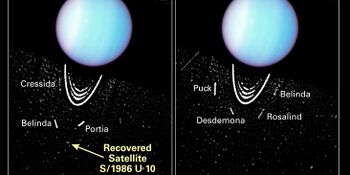
Perdita /ˈpɜːrdətə/ is an inner satellite of Uranus. Perdita's discovery was complicated. The first photographs of Perdita were taken by the Voyager 2 spacecraft in 1986, but it was not recognized from the photographs for more than a decade. In 1999, the moon was noticed by Erich Karkoschka and reported.[3][5] But because no further pictures could be taken to confirm its existence, it was officially demoted in 2001.[6] However, in 2003, pictures taken by the Hubble Space Telescope managed to pick up an object where Perdita was supposed to be, finally confirming its existence.[7][8]
Following its discovery in 1999, it was given the temporary designation of S/1986 U 10.[5] It was named Perdita (Latin for 'lost') after the daughter of Leontes and Hermione in William Shakespeare's play The Winter's Tale. The moon is also designated Uranus XXV.[9]
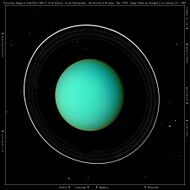
The moon orbits between Belinda and Puck. The above-mentioned Hubble measurements prove that Perdita does not follow a direct Keplerian motion around Uranus. Instead, it is clearly caught in a 43:44 orbital resonance with the nearby moon Belinda. It is also close to an 8:7 resonance with Rosalind.[3][7]
Perdita belongs to the Portia group of satellites, which also includes Bianca, Cressida, Desdemona, Portia, Juliet, Cupid, Rosalind and Belinda.[4] These satellites have similar orbits and photometric properties.[4] Little is known about Perdita apart from its orbit,[3][7] radius of 15 km[3] and geometric albedo of 0.08.[4]
See also
- Moons of Uranus
References
Explanatory notes
- ↑ 1.0 1.1 1.2 1.3 1.4 1.5 Calculated on the basis of other parameters.
Citations
- ↑ Benjamin Smith (1903) The Century Dictionary and Cyclopedia
- ↑ Byrne (2008) Perdita: the literary, theatrical, scandalous life of Mary Robinson
- ↑ 3.00 3.01 3.02 3.03 3.04 3.05 3.06 3.07 3.08 3.09 3.10 3.11 Karkoschka, Voyager 2001.
- ↑ 4.0 4.1 4.2 4.3 Karkoschka, Hubble 2001.
- ↑ 5.0 5.1 IAUC 7171.
- ↑ Foust 2001.
- ↑ 7.0 7.1 7.2 Showalter & Lissauer 2006.
- ↑ IAUC 8194.
- ↑ USGS: Planet and Satellite Names and Discoverers.
Sources
- Karkoschka, Erich (2001). "Voyager's Eleventh Discovery of a Satellite of Uranus and Photometry and the First Size Measurements of Nine Satellites". Icarus 151 (1): 69–77. doi:10.1006/icar.2001.6597. Bibcode: 2001Icar..151...69K.
- Karkoschka, Erich (2001). "Comprehensive Photometry of the Rings and 16 Satellites of Uranus with the Hubble Space Telescope". Icarus 151 (1): 51–68. doi:10.1006/icar.2001.6596. Bibcode: 2001Icar..151...51K.
- Green, Daniel W. E. (May 18, 1999). "S/1986 U 10". IAU Circular 7171: 1. ISSN 0081-0304. Bibcode: 1999IAUC.7171....1K. http://www.cbat.eps.harvard.edu/iauc/07100/07171.html. Retrieved 2012-01-26.
- Foust, Jeff (December 31, 2001). "Moon of Uranus is demoted". Spaceflight Now. http://spaceflightnow.com/news/n0112/31uranusmoon/.
- Showalter, Mark R.; Lissauer, Jack J. (2006-02-17). "The Second Ring-Moon System of Uranus: Discovery and Dynamics". Science 311 (5763): 973–977. doi:10.1126/science.1122882. PMID 16373533. Bibcode: 2006Sci...311..973S.
- Green, Daniel W. E. (September 3, 2003). "Satellites of Uranus". IAU Circular 8194. ISSN 0081-0304. http://www.cbat.eps.harvard.edu/iauc/08100/08194.html. Retrieved 2012-01-26.
- USGS/IAU (July 21, 2006). "Planet and Satellite Names and Discoverers". Gazetteer of Planetary Nomenclature. USGS Astrogeology. http://planetarynames.wr.usgs.gov/Page/Planets#UranianSystem.
External links
- Uranus 'Loses' a Moon: The 'New' Official Moon Count of the Solar System (Archived), Melanie Melton, The Planetary Society, 20 December 2001
Uranus (Outline of Uranus | |||||||
|---|---|---|---|---|---|---|---|
| Geography |
|  | |||||
| Moons |
| ||||||
| Astronomy |
| ||||||
| Exploration |
| ||||||
| Related |
| ||||||
| |||||||
Natural satellites of the Solar System | ||
|---|---|---|
| Planetary satellites |
|  |
| Dwarf-planet satellites |
| |
| Minor-planet moons |
| |
| Ranked by size |
| |
| ||
 |  |
Categories: [Moons of Uranus]
↧ Download as ZWI file | Last modified: 12/20/2023 16:25:48 | 2 views
☰ Source: https://handwiki.org/wiki/Astronomy:Perdita_(moon) | License: CC BY-SA 3.0
 ZWI signed:
 KSF
KSF