Discoverer 16
 From Handwiki
  | |
| Mission type | Optical reconnaissance |
|---|---|
| Operator | United States Air Force /NRO |
| Mission duration | Failed to orbit |
| Spacecraft properties | |
| Spacecraft type | Corona KH-2 |
| Bus | Agena-B |
| Manufacturer | Lockheed |
| Launch mass | 1,091 kilograms (2,405 lb) |
| Start of mission | |
| Launch date | 26 October 1960, 20:26 UTC |
| Rocket | Thor DM-21 Agena-B 253 |
| Launch site | Vandenberg Air Force Base LC-75-3-4 |
| Orbital parameters | |
| Reference system | Geocentric |
| Regime | Low Earth |
| Epoch | Planned |
Discoverer Corona KH-2 | |
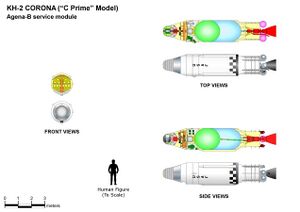
Discoverer 16, also known as Corona 9011, was an American optical reconnaissance satellite which was lost in a launch failure on 26 October 1960. It was the first of ten Corona KH-2 satellites, based on the Agena-B.[1]
The launch of Discoverer 16 occurred at 20:26 UTC on 26 October 1960. A Thor DM-21 Agena-B rocket was used, flying from Launch Complex 75-3-4 at the Vandenberg Air Force Base .[2] The Agena failed to separate from the Thor first stage, and as a result the satellite failed to achieve orbit.[3][4]
Discoverer 16 was intended to have been operated in a low Earth orbit. It had a mass of 1,091 kilograms (2,405 lb),[5] and was equipped with a panoramic camera with a focal length of 61 centimetres (24 in), which had a maximum resolution of 7.6 metres (25 ft).[4] It was to have recorded images onto 70-millimeter (2.8 in) film, which would have been returned in a Satellite Recovery Vehicle. The Satellite Recovery Vehicle aboard Discoverer 16 was SRV-506.[5]
References
- ↑ Krebs, Gunter. "KH-2 Corona". Gunter's Space Page. https://space.skyrocket.de/doc_sdat/kh-2.htm. Retrieved 23 October 2020.
- ↑ McDowell, Jonathan. "Launch Log". Jonathan's Space Page. http://planet4589.org/space/log/launchlog.txt. Retrieved 26 June 2010.
- ↑ Pike, John (9 September 2000). "KH-2 Corona". Federation of American Scientists. http://www.fas.org/spp/military/program/imint/kh-2.htm. Retrieved 26 June 2010.
- ↑ 4.0 4.1 "Corona". Mission and Spacecraft Library. NASA. Archived from the original on 3 October 2007. https://web.archive.org/web/20071003082210/http://msl.jpl.nasa.gov/Programs/corona.html. Retrieved 26 June 2010.
- ↑ 5.0 5.1 Wade, Mark. "KH-2". Encyclopedia Astronautica. Archived from the original on 23 October 2012. https://web.archive.org/web/20121023094149/http://www.astronautix.com/craft/kh2.htm. Retrieved 26 June 2010.
 |  |
Categories: [Satellite launch failures]
↧ Download as ZWI file | Last modified: 03/11/2024 10:28:52 | 4 views
☰ Source: https://handwiki.org/wiki/Engineering:Discoverer_16 | License: CC BY-SA 3.0
 KSF
KSF