Airborne Launch Control System
 From Handwiki
 | Airborne Launch Control System | |
|---|---|
| |
| Role | Survivable LGM-30G ICBM Command & Control |
| Manufacturer | Northrop Grumman |
| Introduction | May 31, 1967 |
| Status | In service |
| Primary user | Air Force Global Strike Command United States Strategic Command 625th Strategic Operations Squadron |
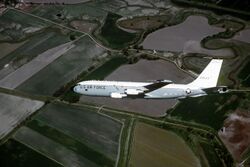
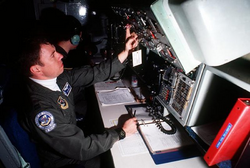
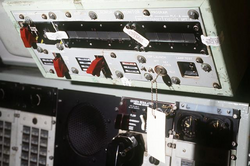
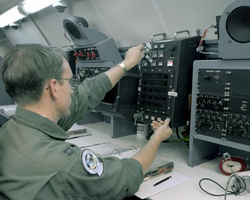
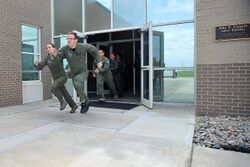
The Airborne Launch Control System (ALCS) provides a survivable launch capability for the United States Air Force's LGM-30G Minuteman III intercontinental ballistic missile (ICBM) force. The ALCS is operated by airborne missileers from Air Force Global Strike Command 's (AFGSC) 625th Strategic Operations Squadron (STOS) and United States Strategic Command (USSTRATCOM). The system is located on board the United States Navy's E-6B Mercury, which serves as USSTRATCOM's "Looking Glass" Airborne Command Post (ABNCP). The ALCS crew is integrated into the ABNCP battle staff and is on alert around the clock.[1]
Overview
In the mid-1960s, United States civilian and military leadership became concerned about the possibility of a decapitating attack from the Soviets, destroying any land-based communication links to the nuclear forces of the Strategic Air Command. One solution to the communication problem was placing radio equipment on board an aircraft, and allow it to fly over the United States and use radio broadcasts to pass along information. This concept would allow communication to missile launch crews to pass along Emergency Action Messages (EAMs), but would not duplicate the missile combat crew's function of actually launching the missiles. The key characteristic added to ALCS (versus other communication methods such as ERCS) was giving the airborne crews the same degree of access to the launch facilities as the underground missile crews.[2]
Minuteman launch facilities contained an ultra high frequency (UHF) receiver that would pick up commands from the ALCS; the destruction of the launch control center or the hardened intersite cable system would not prevent retaliation.[3]
History
ALCS' first generation equipment was declared operational on 31 May 1967.[3]
,_USA_-_Air_Force_AN0823212.jpg)

Operational information
ALCS-configured aircraft
The ALCS mission has been held by multiple aircraft during the last 50 years:
- EC-135 – performed Looking Glass and ALCC mission for the Strategic Air Command (1967–1998)
- EC-135A (ALCC)
- EC-135C (ABNCP and ALCC)
- EC-135G (ALCC and ABNCP)
- EC-135L PACCS Radio Relay
- E-4B Advanced Airborne Command Post – Aircraft tail number 75-0125 performed Looking Glass on a trial basis from 1980 to 1981 to assess possibility of replacing EC-135 fleet. Deemed too expensive and ALCS was subsequently removed from the E-4B.[4]
- E-6B Mercury – performs Looking Glass, ALCC, and TACAMO mission for United States Strategic Command (1998–Present)
- E-6B
ICBMs remotely controlled
- LGM-30A/B Minuteman I (1967–1975)
- LGM-30F Minuteman II (1967–1992)
- LGM-30G Minuteman III (1971–present)
- LGM-118A Peacekeeper (1987–2005)
Units
Units with ALCS crewmembers assigned
- 68th Strategic Missile Squadron (Ellsworth AFB, SD: 1967-1970)[5]
- 91st Strategic Missile Wing (Minot AFB, ND: 1967-1969)[5][6]
- 4th Airborne Command and Control Squadron (Ellsworth AFB, SD: 1970-1992)[7][6]
- 2nd Airborne Command and Control Squadron (Offutt AFB, NE: 1970-1994)[4][8][6]
- 7th Airborne Command and Control Squadron (Offutt AFB, NE: 1994-1998)[6]
- 625th Missile Operations Flight/USSTRATCOM (Offutt AFB, NE: 1998-2007)[9]
- 625th Strategic Operations Squadron/USSTRATCOM (Offutt AFB, NE: 2007–Present)[9]
Units with ALCS-equipped aircraft
- 28th Air Refueling Squadron (Ellsworth AFB, SD: 1967-1970)[6]
- EC-135A, EC-135G
- 906th Air Refueling Squadron (Minot AFB, ND: 1967-1969[6]
- EC-135A, EC-135L
- 38th Strategic Reconnaissance Squadron (Offutt AFB, NE: 1967-1970)
- EC-135C
- 4th Airborne Command and Control Squadron (Ellsworth AFB, SD: 1970-1992)[7][6]
- EC-135A, EC-135C, EC-135G, EC-135L
- 2nd Airborne Command and Control Squadron (Offutt AFB, NE: 1970-1994)[4][8][6]
- EC-135C
- 7th Airborne Command and Control Squadron (Offutt AFB, NE: 1994-1998)[6]
- EC-135C
- STRATCOMWING ONE (Tinker AFB, OK: 1998–Present)
- Fleet Air Reconnaissance Squadron 3 (VQ-3)
- E-6B Mercury
- Fleet Air Reconnaissance Squadron 4 (VQ-4)
- E-6B Mercury
- Fleet Air Reconnaissance Squadron 3 (VQ-3)
ALCS personnel
The Airborne Launch Control System Flight of the 625th Strategic Operations Squadron provides training and crewmembers for two ALCS positions on board the E-6B Mercury.
ALCS-assisted launches
A test of the ALCS, both ground and air components, is called a GIANT BALL.
- This list does not contain any launches after the initial Test and Evaluation phase of the system.
| ALCS-assisted ICBM Launches | |||||
| Date | Designation | System | Location | Note | |
|---|---|---|---|---|---|
| 3 Mar 1967 | BUSY LOBBY | Minuteman | Vandenberg AFB, LF 5 | First ALCS-assisted launch (not in Launch History records) | |
| 17 Apr 1967 | BUSY MISSILE | Minuteman | Vandenberg AFB, LF 08 | ||
| 28 Apr 1967 | BUSY MUMMY | Minuteman | Vandenberg AFB, LF 02 | ||
| 11 May 1967 | BUSY FELLOW | Minuteman | Vandenberg AFB, LF 21 | ||
| 25 Jan 1968 | OLY TRIALS 7 | Minuteman II | Vandenberg AFB, LF 22 | ||
| 12 Mar 1969 | GIANT FIST 3 | Minuteman II | Vandenberg AFB, LF 04 | ||
| 18 Apr 1969 | SST M-3 | Minuteman II | Vandenberg AFB, LF 25 | ||
| 18 Jun 1969 | GLORY TRIP 37B | Minuteman II | Vandenberg AFB, LF 07 | ||
| 23 Jul 1969 | GLORY TRIP 41B | Minuteman II | Vandenberg AFB, LF 07 | ||
| 26 Aug 1969 | GLORY TRIP 15F | Minuteman II | Vandenberg AFB, LF 22 | ||
| 13 Oct 1969 | GLORY TRIP 22F | Minuteman | Vandenberg AFB, LF 24 | ||
| 21 Oct 1969 | GLORY TRIP 45B | Minuteman | Vandenberg AFB, LF 07 | ||
| 5 Dec 1969 | GLORY TRIP 50B | Minuteman | Vandenberg AFB, LF 07 | ||
| 23 Mar 1970 | GLORY TRIP 63B | Minuteman | Vandenberg AFB, LF 07 | ||
| 21 May 1970 | GLORY TRIP 55F | Minuteman | Vandenberg AFB, LF 25 | ||
| 8 Jun 1970 | GLORY TRIP 72B | Minuteman | Vandenberg AFB, LF 07 | ||
| 9 Jul 1970 | GLORY TRIP 66F | Minuteman | Vandenberg AFB, LF 24 | ||
| 3 Aug 1970 | GLORY TRIP 61F | Minuteman | Vandenberg AFB, LF 25 | ||
| 4 Aug 1970 | GLORY TRIP 16L | Minuteman | Vandenberg AFB, LF 05 | ||
| 26 Aug 1970 | GLORY TRIP 43M | Minuteman | Vandenberg AFB, LF 05 | ||
See also
- Post-Attack Command and Control System
- Airborne Launch Control Center
- Operation Looking Glass
- EC-135
- Boeing E-6 Mercury
- Emergency Rocket Communications System
- 625th Strategic Operations Squadron
- TACAMO
References
- ↑ USSTRATCOM ABNCP Fact Sheet
- ↑ George Washington University's "USAF Ballistic Missile Programs 1967-1968", September 1969, pg 17
- ↑ 3.0 3.1 George Washington University: "United States Ballistic Missile Programs: 1964-1966", March 1967, pg 7
- ↑ 4.0 4.1 4.2 "2 ACCS Part 1". http://sac-acca.org/newsletter/flyer0211.pdf.
- ↑ 5.0 5.1 "A History of PACCS, ACCS and ALCS". http://sac-acca.org/newsletter/flyer0496.pdf.
- ↑ 6.0 6.1 6.2 6.3 6.4 6.5 6.6 6.7 6.8 [Hopkins III, Robert S. 1997. Boeing KC-135 Stratotanker: More Than Just a Tanker. Leicester, England: Midland Publishing Limited]
- ↑ 7.0 7.1 "4th ACCS". http://sac-acca.org/newsletter/flyer1100.pdf.
- ↑ 8.0 8.1 "2 ACCS Part 2". http://sac-acca.org/newsletter/flyer0611.pdf.
- ↑ 9.0 9.1 "625th STOS Fact Sheet"
External links
- E-6B ABNCP Factsheet
- LGM-30G Minuteman III Factsheet
 |  |
Categories: [Missile launchers] [Military communications]
↧ Download as ZWI file | Last modified: 03/02/2025 12:20:26 | 4 views
☰ Source: https://handwiki.org/wiki/Social:Airborne_Launch_Control_System | License: CC BY-SA 3.0
 KSF
KSF