Isonoe (Moon)
 From Handwiki
 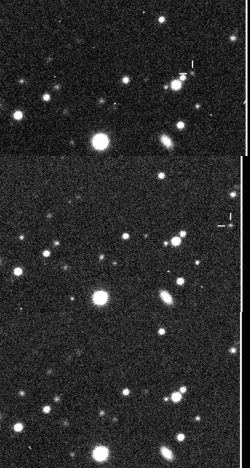 Isonoe imaged by the Canada-France-Hawaii Telescope in December 2001 | |
| Discovery [1] | |
|---|---|
| Discovered by | Scott S. Sheppard David C. Jewitt Yanga R. Fernandez Eugene A. Magnier |
| Discovery site | Mauna Kea Observatory |
| Discovery date | 23 November 2000 |
| Designations | |
Designation | Jupiter XXVI |
| Pronunciation | /aɪˈsɒnoʊ.iː/ |
| Named after | Ισονόη Isonoē |
Alternative names | S/2000 J 6 |
| Adjectives | Isonoean /ˌaɪsənoʊˈiːən/ |
| Orbital characteristics [2] | |
| Epoch 23 March 2018 (JD 2458200.5) | |
| Observation arc | 17.46 yr (6,379 days) |
Semi-major axis | 0.1559024 astronomical unit|AU (23,322,670 km) |
| Eccentricity | 0.2263119 |
| Orbital period | –688.61 d |
| Mean anomaly | 148.53423° |
| Mean motion | 0° 31m 36.216s / day |
| Inclination | 164.45891° (to ecliptic) |
| Longitude of ascending node | 203.99552° |
|{{{apsis}}}|helion}} | 219.75296° |
| Satellite of | Jupiter |
| Group | Carme group |
| Physical characteristics[4] | |
| Mean diameter | 4 km |
| Albedo | 0.04 (assumed) |
| Apparent magnitude | 22.5[3] |
| Absolute magnitude (H) | 16.0[2] |
Isonoe /aɪˈsɒnoʊ.iː/, also known as Jupiter XXVI, is a retrograde irregular satellite of Jupiter. It was discovered by a team of astronomers from the University of Hawaii led by Scott S. Sheppard in 2000, and given the temporary designation S/2000 J 6.[5][1]
Isonoe is about 4 kilometres in diameter, and orbits Jupiter at an average distance of 23,833,000 km in 688.61 days, at an inclination of 166° to the ecliptic (169° to Jupiter's equator), in a retrograde direction and with an eccentricity of 0.166.
It was named in October 2002 after Isonoe, one of the Danaïdes in Greek mythology, and a lover of Zeus (Jupiter).[6]
Isonoe belongs to the Carme group, made up of irregular retrograde moons orbiting Jupiter at a distance ranging between 23 and 24 Gm and at an inclination of about 165°.
References
- ↑ 1.0 1.1 MPEC 2001-A28: S/2000 J 2, S/2000 J 3, S/2000 J 4, S/2000 J 5, S/2000 J 6 2001 January 5 (discovery and ephemeris)
- ↑ 2.0 2.1 "M.P.C. 115890". Minor Planet Circular. Minor Planet Center. 27 August 2019. https://minorplanetcenter.net/iau/ECS/MPCArchive/2019/MPC_20190827.pdf.
- ↑ Sheppard, Scott. "Scott S. Sheppard - Jupiter Moons". Department of Terrestrial Magnetism. Carnegie Institution for Science. https://sites.google.com/carnegiescience.edu/sheppard/moons/jupitermoons.
- ↑ "Planetary Satellite Physical Parameters". Jet Propulsion Laboratory. 19 February 2015. https://ssd.jpl.nasa.gov/?sat_phys_par#jupiter.
- ↑ IAUC 7555: Satellites of Jupiter 2001 January 5 (discovery)
- ↑ IAUC 7998: Satellites of Jupiter 2002 October 22 (naming the moon)
 |  |
Categories: [Moons of Jupiter] [Irregular satellites]
↧ Download as ZWI file | Last modified: 01/22/2024 13:27:17 | 2 views
☰ Source: https://handwiki.org/wiki/Astronomy:Isonoe_(moon) | License: CC BY-SA 3.0
 KSF
KSF