Zizaniopsis Miliacea
 From Handwiki
| Zizaniopsis miliacea | |
|---|---|
| |
Conservation status
| |
 Secure (NatureServe)[1] | |
Scientific classification 
| |
| Kingdom: | Plantae |
| Clade: | Tracheophytes |
| Clade: | Angiosperms |
| Clade: | Monocots |
| Clade: | Commelinids |
| Order: | Poales |
| Family: | Poaceae |
| Genus: | Zizaniopsis |
| Species: | Z. miliacea
|
| Binomial name | |
| Zizaniopsis miliacea (Michx.) Döll & Asch.
| |
| Synonyms[2] | |
|
Zizania miliacea Michx. | |
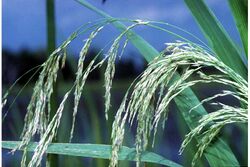
Zizaniopsis miliacea is a species of flowering plant in the grass family, Poaceae.[2] It is known by the common names giant cutgrass, water millet, and southern wildrice. The name giant cutgrass refers to the plant's large, rough-edged leaves, and the name southern wildrice refers to its resemblance to wildrice (Zizania spp.).[3] It is native to the southeastern United States and it can also be found in central Mexico.[4]
This perennial grass grows from rhizomes, producing stems up to 4 meters tall and 3.5 centimeters wide. The stems root at nodes that come in contact with the substrate.[4] It also spreads via functional stolons (decumbent rooting stems) and vegetative buds that erupt from the stems.[3][5] The blue-green leaves are up to a meter long and 3 centimeters wide. The panicles may exceed 80 centimeters long and are usually up to 20 centimeters wide.[4]
This plant grows in aquatic habitat, such as marshes and riverbanks. It is also common in former rice paddies.[3] This grass forms large colonies by spreading via its stolon-like stems and rhizomes.[5] It grows in fresh and brackish water,[4] tolerating some salt in the water. It is sometimes planted for erosion control in wetlands.[6] Large stands of the plant are sometimes considered to be a nuisance, providing "poor wildlife habitat";[7] however, it does provide nesting sites, cover, and food for animals.[8]
References
- ↑ "Zizaniopsis miliacea". NatureServe Explorer (NatureServe): ELEMENT_GLOBAL.2.157142. 2015. https://explorer.natureserve.org/Taxon/ELEMENT_GLOBAL.2.157142/Zizaniopsis_miliacea. Retrieved September 27, 2020.
- ↑ 2.0 2.1 "Zizaniopsis miliacea (Michx.) Döll & Asch.". The Trustees of the Royal Botanic Gardens, Kew. n.d.. https://powo.science.kew.org/taxon/urn:lsid:ipni.org:names:1030293-2.
- ↑ 3.0 3.1 3.2 Fox, A. M. and W. T. Haller. (2000). Production and survivorship of the functional stolons of giant cutgrass, Zizaniopsis miliacea (Poaceae). Am J Bot 87(6) 811-18.
- ↑ 4.0 4.1 4.2 4.3 Zizaniopsis miliacea. Grass Manual Treatment.
- ↑ 5.0 5.1 Holmes, W. C. and D. T. Stalling. (1990). Studies on the reproductive strategy of Zizaniopsis miliacea (Michx.) Doell. & Asch. (Gramineae: Tribe Oryzeae). Castanea 55(2) 113-21.
- ↑ Zizaniopsis miliacea. USDA NRCS Plant Fact Sheet.
- ↑ Birch, J. B. and J. L. Cooley. (1982). Production and standing crop patterns of giant cutgrass (Zizaniopsis miliacea) in a freshwater tidal marsh. Oecologia 52(2) 230-35.
- ↑ Zizaniopsis miliacea. University of Florida, IFAS.
External links
- USDA Plants Profile
- NatureServe
Wikidata ☰ Q8072922 entry
 |  |
Categories: [Oryzoideae]
↧ Download as ZWI file | Last modified: 03/11/2024 11:29:19 | 1 views
☰ Source: https://handwiki.org/wiki/Biology:Zizaniopsis_miliacea | License: CC BY-SA 3.0
 KSF
KSF