Bon (Festival)
 From Handwiki
 | Obon Festival | |
|---|---|
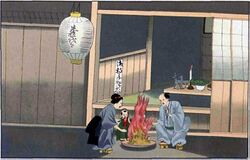 A depiction of Obon in the late Edo period | |
| Also called | Bon |
| Observed by | Japanese people |
| Type | Religious, Cultural |
| Significance | Honors the spirits of one's ancestors |
| Date |
|
| Frequency | Annual |
| Related to |
|
Obon (お盆) or just Bon (盆) is a fusion of the ancient Japanese belief in ancestral spirits and a Japanese Buddhist custom to honor the spirits of one's ancestors. This Buddhist–Confucian custom has evolved into a family reunion holiday during which people return to ancestral family places and visit and clean their ancestors' graves when the spirits of ancestors are supposed to revisit the household altars. It has been celebrated in Japan for more than 500 years and traditionally includes a dance, known as Script error: The function "transl" does not exist..
The festival of Obon lasts for three days; however, its starting date varies within different regions of Japan. When the lunar calendar was changed to the Gregorian calendar at the beginning of the Meiji era, the localities in Japan responded differently, which resulted in three different times of Obon. Script error: The function "transl" does not exist. (Bon in July) is based on the solar calendar and is celebrated around the 15th of July in eastern Japan (Kantō region such as Tokyo, Yokohama and the Tōhoku region), coinciding with Script error: The function "transl" does not exist.. Script error: The function "transl" does not exist. (Bon in August), based on the lunar calendar, is celebrated around the 15th of August and is the most commonly celebrated time. Script error: The function "transl" does not exist. (Old Bon) is celebrated on the 15th day of the seventh month of the lunar calendar, and so differs each year, which appears between August 8 and September 7. Exceptions occurred in 2008 and 2019, when the solar and lunar calendar matched, and so Script error: The function "transl" does not exist. and Script error: The function "transl" does not exist. were celebrated on the same day. Script error: The function "transl" does not exist. is celebrated in areas such as the northern part of the Kantō region, Chūgoku region, Shikoku, and Okinawa Prefecture. These three festival days are not listed as public holidays, but it is customary for people to be given leave.[1]
History of Script error: The function "transl" does not exist.
File:Bon-odori-2014.ogv The Japanese Bon Festival originated from the Ghost Festival of China, which is itself a combination of the Buddhist Script error: The function "transl" does not exist. (Chinese: 盂蘭盆) Festival and the Taoist Script error: The function "transl" does not exist. (中元) Festival.
The Buddhist tradition originates from the story of Maha Maudgalyayana (Mokuren), a disciple of the Buddha, who used his supernatural powers to look upon his deceased mother only to discover she had fallen into the Realm of Hungry Ghosts and was suffering.[2] Greatly disturbed, he went to the Buddha and asked how he could release his mother from this realm. Buddha instructed him to make offerings to the many Buddhist monks who had just completed their summer retreat on the fifteenth day of the seventh month. Mokuren did this and, thus, saw his mother's release. He also began to see the true nature of her past selflessness and the sacrifices she had made for him during her lifetime. The disciple, happy because of his mother's release from suffering and grateful for her many kindnesses, danced with joy. From this dance of joy comes the Script error: The function "transl" does not exist. or "Bon Dance", a time during which ancestors and their sacrifices are remembered and appreciated. See also: Ullambana Sutra.
As Obon occurs in the heat of the summer, participants traditionally wear Script error: The function "transl" does not exist., a kind of light cotton kimono. Many Obon celebrations include a huge carnival with rides, games, and summer festival foods.[3]
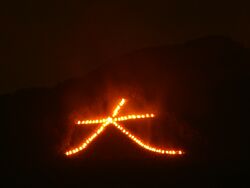
During the festival, families traditionally sent their ancestors' spirits back to their permanent dwelling place under the guidance of fire in a ritual known as Lua error in Module:Lang/utilities at line 268: attempt to call field '_transl' (a nil value)., or, in a larger scale, the Burning of the Character Big in the mountain. Fire also marks the commencement (Script error: The function "transl" does not exist.) as well as the closing of the festival.[4]
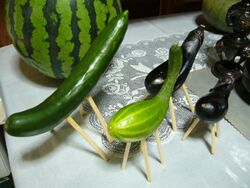
Another significant ritual practiced during the Obon festival in Japan is to craft a cucumber horse and eggplant cow, known as Lua error in Module:Lang/utilities at line 268: attempt to call field '_transl' (a nil value). or Lua error in Module:Lang/utilities at line 268: attempt to call field '_transl' (a nil value).,[5][6] that act as a vessel for the ancestors to come back home and return, respectively.[7]
Etymology
The Japanese word Script error: The function "transl" does not exist. is composed of the honorific prefix Script error: The function "transl" does not exist. and the word Script error: The function "transl" does not exist.. The Script error: The function "transl" does not exist. portion is from the longer Japanese names Urabon (盂蘭盆) or Urabon'e (盂蘭盆会), in turn from the Chinese terms 盂蘭盆 (Script error: The function "transl" does not exist.) or 盂蘭盆會 (Script error: The function "transl" does not exist.).
The Chinese terms are often described as deriving from Sanskrit Script error: The function "transl" does not exist. meaning "hanging upside down", in reference to souls suffering in hell.[8] However, the Sanskrit word was sparsely, if at all, attested;[9] in addition, it would be the present participle of verb Sanskrit Script error: The function "transl" does not exist. ("to hang", intransitive), with no inherent "upside-down" meaning.[10][11]
Moreover, neither the purported meaning of "hanging upside-down" nor the verifiable meaning of "hanging" match the semantics very well, given that the Script error: The function "transl" does not exist. ceremonies are about helping the dead, closer in meaning to the "helping" sense of the Pali verb Script error: The function "transl" does not exist. ("raising, helping"), present participle of Script error: The function "transl" does not exist. ("to raise up, to help").[12] This suggests that explanations of the dead hanging upside-down in hell are more likely to be folk etymologies based on a mistaken connection to the Sanskrit verb, rather than a more direct semantic link to the Pali. Alternatively, Takakusu Junjiro[9] propounded that the origin was in fact Pali Script error: The function "transl" does not exist., a colloquial corruption of the Pali Script error: The function "transl" does not exist. ("raising up; saving; helping"), and that the etymology was mistakenly attributed to Sanskrit.
Script error: The function "transl" does not exist.
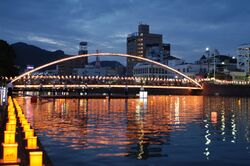
Bon Odori (盆踊り), meaning simply "Bon dance", is a style of dancing performed during Obon. It is a folk entertainment, which has a history of nearly 600 years.[13] Originally a Script error: The function "transl" does not exist. folk dance to welcome the spirits of the dead, the style of celebration varies in many aspects from region to region. Each region has a local dance, as well as different music. The music can be songs specifically pertinent to the spiritual message of Obon, or local Script error: The function "transl" does not exist. folk songs. Consequently, the Bon dance appears different from region to region. Hokkaidō is known for the folk-song Script error: The function "transl" does not exist.. The song Script error: The function "transl" does not exist. takes its namesake from the capital of Japan. Script error: The function "transl" does not exist. in Gujō in Gifu Prefecture is famous for all night dancing. Script error: The function "transl" does not exist. is a folk song from Shiga Prefecture. Residents of the Kansai area will recognize the famous Script error: The function "transl" does not exist.. Tokushima in Shikoku is very famous for its Script error: The function "transl" does not exist., and in the far south, one can hear the Script error: The function "transl" does not exist. of Kagoshima.
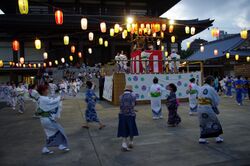
The way in which the dance is performed is also different in each region, though the typical Bon dance involves people lining up in a circle around a high wooden scaffold made especially for the festival called a Script error: The function "transl" does not exist.. The Script error: The function "transl" does not exist. is usually also the bandstand for the musicians and singers of the Obon music. Some dances proceed clockwise, and some dances proceed counter-clockwise around the Script error: The function "transl" does not exist.. Some dances reverse during the dance, though most do not. At times, people face the Script error: The function "transl" does not exist. and move towards and away from it. Still some dances, such as the Kagoshima Script error: The function "transl" does not exist. dance, and the Tokushima Script error: The function "transl" does not exist., simply proceed in a straight line through the streets of the town.
The dance of a region can depict the area's history and specialization. For example, the movements of the dance of the Script error: The function "transl" does not exist. (the "coal mining song") of old Miike Mine in Kyushu show the movements of miners, i.e. digging, cart pushing, lantern hanging, etc.; the above-mentioned Script error: The function "transl" does not exist. mimics the work of fishermen such as hauling in the nets. All dancers perform the same dance sequence in unison.
There are other ways in which a regional Bon dance can vary. Some dances involve the use of different kinds of fans, others involve the use of small towels called Script error: The function "transl" does not exist. which may have colourful designs. Some require the use of small wooden clappers, or Script error: The function "transl" does not exist., during the dance.
The music that is played during the Bon dance is not limited to Obon music and Script error: The function "transl" does not exist.; some modern Script error: The function "transl" does not exist. hits and kids' tunes written to the beat of the Script error: The function "transl" does not exist. are also used to dance to during Obon season.
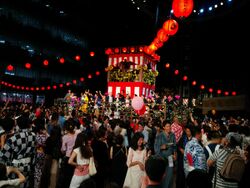
The Bon dance tradition is said to have started in the later years of the Muromachi period as a public entertainment. In the course of time, the original religious meaning has faded, and the dance has become associated with summer.
The Bon dance performed in the Okinawa Islands is known as Script error: The function "transl" does not exist.. Similarly, the Yaeyama Islands have Script error: The function "transl" does not exist..
China
India
Script error: The function "transl" does not exist. (literally "fortnight of the ancestors") is a 16–lunar day period in Hindu calendar when Hindus pay homage to their ancestors (Script error: The function "transl" does not exist.), especially through food offerings. Script error: The function "transl" does not exist. is considered by Hindus to be inauspicious, given the death rite known as Script error: The function "transl" does not exist. or Script error: The function "transl" does not exist. performed during the ceremony.
Korea
The Korean version of the Bon celebration is known as Script error: The function "transl" does not exist.. Participants present offerings at Buddhist shrines and temples, and masked dances are performed. It is as much an agricultural festival as a religious one.[14][15]
Vietnam
Celebrations outside Japan
Philippines
In the Philippines , Filipinos of Japanese descent, with support from the Philippine Nikkei Jin Kai Inc., Philippine Nikkei Jin Kai International School, Mindanao Kokusai Daigaku, and various other Japanese Filipino-based organizations, hold an Obon festival every year along with other Japanese-based Filipino festivals, to celebrate the ancestors of Filipinos of Japanese descent, and to celebrate the friendship between Japan and the Philippines.[16][17]
Argentina
In Argentina, the Bon Festival is celebrated by Japanese communities during the summer of the southern hemisphere. The biggest festival is held in Colonia Urquiza, in La Plata. It takes place on the sports ground of the La Plata Japanese School. The festival also includes Script error: The function "transl" does not exist. shows and typical dances.[18]
Brazil
Bon Festival is celebrated every year in many Japanese communities all over Brazil, as Brazil is home to the largest Japanese population outside Japan. São Paulo is the main city of the Japanese community in Brazil, and also features the major festival in Brazil, with street Script error: The function "transl" does not exist. dancing and Script error: The function "transl" does not exist. dance. It also features Script error: The function "transl" does not exist. and Script error: The function "transl" does not exist. contests. The festival also features a variety of Japanese food and drink, art and dance. Bon is also celebrated in communities of Japanese immigrants and their descendants and friends throughout South America: Bon festivals can be found in the states of Santa Catarina, São Paulo, Goiás, Amazonas, Pará (Tomé-Açu), Mato Grosso, Mato Grosso do Sul, Pernambuco, Bahia, Paraná, Rio Grande do Sul and Brasília.[19]
Malaysia
In Malaysia, Bon Festival is also celebrated every year in Esplanade, Penang, Shah Alam Stadium in Shah Alam, Selangor, and also Universiti Malaysia Sabah at Kota Kinabalu, Sabah. This celebration, which is a major attraction for the state of Selangor, is the brainchild of the Japanese Expatriate & Immigrant's Society in Malaysia. In comparison to the celebrations in Japan, the festival is celebrated on a much smaller scale in Penang, Selangor and Sabah, and is less associated with Buddhism and more with Japanese culture. Held mainly to expose locals to a part of Japanese culture, the festival provides the experience of a variety of Japanese food and drinks, art and dance, with the vast number of Japanese companies in Malaysia taking part to promote their products.
United States and Canada
Bon festivals are also celebrated in North America, particularly by Japanese-Americans or Japanese-Canadians affiliated with Buddhist temples and organizations. Buddhist Churches of America (BCA) temples in the U.S. typically celebrate Bon Festival with both religious Obon observances and traditional Script error: The function "transl" does not exist. dancing around a Script error: The function "transl" does not exist.. Many temples also concurrently hold a cultural and food bazaar providing a variety of cuisine and art, also to display features of Japanese culture and Japanese-American history.[20] Performances of taiko by both amateur and professional groups have recently become a popular feature of Bon Odori festivals.[21][22] Bon festivals are usually scheduled anytime between July and September.
Script error: The function "transl" does not exist. melodies are also similar to those in Japan; for example, the dance Script error: The function "transl" does not exist. from Kyushu is also performed in the U.S. In California, due to the diffusion of Japanese immigration, Script error: The function "transl" does not exist. dances also differ from Northern to Southern California, and some are influenced by American culture, such as "Baseball Script error: The function "transl" does not exist.".
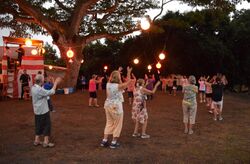
The "Bon season" is an important part of the present-day culture and life of Hawaii. It was brought there by the plantation workers from Japan, and now the Bon dance events are held among the five major islands (Kauai, Oahu, Molokai, Maui and Hawaii) on weekend evenings from June to August. They are held usually at Buddhist missions, but sometimes at Shintoist missions or at shopping centres.[23][24] At some Buddhist missions, the dance is preceded by a simple ritual where the families of the deceased in the past year burn incense for remembrance, but otherwise the event is non-religious. The songs played differ among the regions - one or two hour Bon dance in the Western part of the Big Island (in and around Kailua Kona), for example, typically starts with Script error: The function "transl" does not exist., continues with songs such as Script error: The function "transl" does not exist. (using wooden clappers), Script error: The function "transl" does not exist. (using Script error: The function "transl" does not exist. given at the donation desk), Script error: The function "transl" does not exist. and Script error: The function "transl" does not exist. from Okinawa Prefecture (reflecting the fact that many Okinawan descendants live in Hawaii), Script error: The function "transl" does not exist. for children, zumba songs for the young, Beautiful Sunday, etc., and ends with Script error: The function "transl" does not exist., celebrating abundant harvest.[25] The participants, Japanese descendants and the people of all races, dance in a big circle around the Script error: The function "transl" does not exist., the central tower set up for the dance, from which recorded songs are broadcast and, most of the time, the Script error: The function "transl" does not exist. group accompany the songs playing drums. In larger cities, Bon dance lessons are given by volunteers before the actual events.[26]
Some Japanese museums may also hold Obon festivals, such as the Morikami Museum[27] in Florida.
In St. Louis, Missouri, the Botanical Garden has hosted a Bon festival over Labor Day weekend every year since 1977. Known as the Japanese festival, it is a collaboration with several Japanese-American organizations, and hosts thousands of people over a three-day period. The festival provides authentic Japanese music, art, dance, food, and entertainment including dancing around a Script error: The function "transl" does not exist., sumo wrestling, Script error: The function "transl" does not exist. drums, bonsai demonstrations, music played on traditional instruments, several bazaars, food courts with authentic Japanese foods, tea ceremonies, candlelit lanterns released on the lake in the gardens Japanese garden and much more.[28]
See also
- Script error: The function "transl" does not exist., the concept of offering food to the hungry ghosts in Japanese Buddhism
- Awa Dance Festival
- Ghost Festival, the Chinese counterpart of the Bon Festival.
- Parentalia, a festival in ancient Rome to honor ancestors, including bringing offerings to their on the last day, known as Feralia
- Pitru Paksha, a Hindu festival that bears similarities to the Bon festival
- Day of the Dead, a Mexican festival also revolving around the dead
- Qingming Festival
- Japanese calendar
- Japanese culture
- Veneration of the dead
- Śrāddha, a Hindu culture celebrated for half moon cycle to give the offerings and honor ancestors. Celebrated in all Indian State.
- Takeda Lullaby, a folk lullaby from the Kyoto region in which the Bon Festival is mentioned
References
- ↑ Bon A-B-C, 2002, Bonodori.net, Japan, http://www.bonodori.net/E/sekai/bonabc3.HTML .
- ↑ What is Obon, 1998, Shingon Buddhist International Institute, California, http://www.shingon.org/library/archive/Obon.html.
- ↑ Obon: Japanese festival of the dead, 2000, Asia Society, http://www.asiasource.org/news/at_mp_02.cfm?newsid=27391 .
- ↑ HUR, Nam-Lin (2007). Death and Social Order in Tokugawa Japan: Buddhism, Anti-Christianity, and the Danka System. Harvard University Asia Center, 2007. pp. 192. ISBN 9780674025035.
- ↑ Nihon Kokugo Daijiten, available online via the Kotobank entry for shōryō uma here (in Japanese)
- ↑ Nihon Kokugo Daijiten, available online via the Kotobank entry for ushi uma here (in Japanese)
- ↑ Sato, Ava. "What is Obon? | Guide to Japanese Halloween 2021 - Japan Truly" (in en). https://japantruly.com/what-is-obon/.
- ↑ Chen, K 1968, ‘Filial Piety in Chinese Buddhism’, Harvard Journal of Asiatic Studies, p88.
- ↑ 9.0 9.1 Ashikaga, Ensho (1951). "Notes on Urabon ("Yü Lan P'ên, Ullambana")". Journal of the American Oriental Society 71 (1): 71–75. doi:10.2307/595226.
- ↑ ullamb-related entries at SpokenSanskrit.org website
- ↑ ullamb entry at Sanskrit Dictionary website
- ↑ ulllumpana entry at The Pali Text Society's Pali-English Dictionary website[yes|permanent dead link|dead link}}]
- ↑ Guide, Japan Hoppers Travel. "Bon Odori | Cultural traditions | Japan Travel Guide - Japan Hoppers" (in en). https://www.japanhoppers.com/en/all_about_japan/culture/214/.
- ↑ MobileReference (2007). Encyclopedia of Observances, Holidays and Celebrations from MobileReference. MobileReference. p. 490. ISBN 978-1-60501-177-6. https://books.google.com/books?id=5VhTa1Eiq7oC&pg=PT490. Retrieved 2 April 2013.
- ↑ Dong-Il Cho (2005). Korean Mask Dance. Ewha Womans University Press. p. 49. ISBN 978-89-7300-641-0. https://books.google.com/books?id=dxHQqLz5HBUC&pg=PT49. Retrieved 2 April 2013.
- ↑ Cabiluna, Pearl (August 1, 2016). "Bon Odori Festival 2016 Fever Hits Cebu!". Everything Cebu. https://www.everythingcebu.com/entertainment/bon-odori-festival-2016-fever-hits-cebu/.
- ↑ "Philippine-Japan Festival 2017". SunStar Cebu. October 27, 2017. https://www.sunstar.com.ph/article/401811/Local-News/Philippine-Japan-Festival-2017.
- ↑ "Una tradición que se afirma en la Ciudad", El Día, Sunday, January 9, 2010.
- ↑ "Londrina Matsuri 2019 será no início de setembro" (in pt-BR). https://www.londrinatur.com.br/agenda/londrina-matsuri-2019-setembro/.
- ↑ Nakao, Annie, "Japanese Americans keeping Obon tradition alive", San Francisco Chronicle, Friday, July 8, 2005
- ↑ Schulze, Margaret, "Obon Story: Honoring ancestors, connecting to our community" , in the NikkeiWest newspaper, San Jose, California, Vol. 10, No. 14, July 25th, 2002
- ↑ "Obon Basics" - San Jose Taiko, California
- ↑ "Hawai'i Summer 2016 Bon Dance Schedule". 6 June 2016. http://www.honolulumagazine.com/Honolulu-Magazine/June-2016/Hawaii-Summer-2016-Bon-Dance-Schedule/.
- ↑ "2016 Obon season calendar". 29 May 2016. http://www.staradvertiser.com/features/obon-season/.
- ↑ warubozu047 (23 December 2010). "Fukushima Ondo (福島音頭)". https://www.youtube.com/watch?v=i4BhRpA4584.
- ↑ Bon Dance Overseas --- Hawaii (in ten web pages) (in Japanese)
- ↑ "Lantern Festival: In The Spirit Of Obon – Morikami Museum and Japanese Gardens". http://morikami.org/cultural-programs/lantern-festival/.
- ↑ "Japanese Festival | Labor Day Weekend | Sept. 3–5 | Missouri Botanical Garden". https://events.missouribotanicalgarden.org/japanese_festival.
Bibliography
- Marinus Willem de Visser: Ancient Buddhism in Japan – Sutras and Ceremonies in Use in the 7th and 8th centuries A.D. and their History in Later Times. 2 volumes, Paul Geuthner, Paris 1928–1931; Brill, Leiden 1935, pp 58–115
- Robert J. Smith: Ancestor Worship in Contemporary Japan, Stanford University Press, Stanford, California 1974. ISBN:0-8047-0873-8
- Ensho Ashikaga (1950), The Festival for the Spirits of the Dead in Japan, Western Folklore 9 (3), 217-228 (Subscription content?)
External links
- List All Japanese Obon Festivals & Bon Odori Practices – Schedule
- Bon Dance: Description of various Bon Dance styles and resources. (archived 17 December 2009)
- Obon Festival in Japan
- Photo Gallery of Bon Odori 2007 in Penang, Malaysia
- El Bon Odori de La Plata en Argentina
Culture of Asia | |
|---|---|
| Sovereign states |
|
| States with limited recognition |
|
| Dependencies and other territories |
|
| |
 Book
Book Category
 Asia portal
 |  |
Categories: [Buddhism and death]
↧ Download as ZWI file | Last modified: 09/01/2025 15:08:18 | 2 views
☰ Source: https://handwiki.org/wiki/Philosophy:Bon_(festival) | License: CC BY-SA 3.0
 KSF
KSF