Leipzig University
 From Handwiki
 Universität Leipzig | |
 Seal of Leipzig University | |
| Latin: Universitas Lipsiensis | |
| Motto | Aus Tradition Grenzen überschreiten (German) |
|---|---|
Motto in English | Crossing boundaries out of tradition |
| Type | Public research university |
| Established | 2 December 1409 |
| Budget | € 408.9 million[1] |
| Rector | Eva Inés Obergfell |
Academic staff | 3,234[1] |
Administrative staff | 1,962[1] |
| Students | 29,459[2] |
| Location | Leipzig , Saxony , Germany [ ⚑ ] 51°20′20″N 12°22′43″E / 51.33889°N 12.37861°E |
| Campus | Urban |
| Red Light Blue|u}}rs | Red Light Blue |
| Affiliations | Utrecht Network German U15 |
| Website | www.uni-leipzig.de |
 | |
Leipzig University (German: Universität Leipzig), in Leipzig in Saxony, Germany, is one of the world's oldest universities and the second-oldest university (by consecutive years of existence) in Germany. The university was founded on 2 December 1409 by Frederick I, Elector of Saxony and his brother William II, Margrave of Meissen, and originally comprised the four scholastic faculties. Since its inception, the university has engaged in teaching and research for over 600 years without interruption.
Famous alumni include Angela Merkel, Gottfried Wilhelm von Leibniz, Johann Wolfgang von Goethe, Leopold von Ranke, Friedrich Nietzsche, Robert Schumann, Richard Wagner, Tycho Brahe, Georgius Agricola. The university is associated with ten Nobel laureates, most recently with Svante Pääbo who won the Nobel Prize for Medicine in 2022.
History

Founding and development until 1900
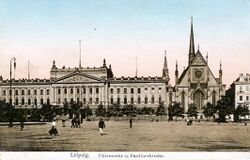
The university was modelled on the University of Prague, from which the German-speaking faculty members withdrew to Leipzig after the Jan Hus crisis and the Decree of Kutná Hora. The Alma mater Lipsiensis opened in 1409, after it had been officially chartered by Pope Alexander V in his Bull of Acknowledgment on (9 September of that year). Its first rector was Johannes Otto von Münsterberg. From its foundation, the Paulinerkirche served as the university church. After the Reformation, the church and the monastery buildings were donated to the university in 1544. In order to secure independent and sustainable funding, the university was endowed with the lordship over nine villages east of Leipzig (university villages). It kept this status for nearly 400 years until land reforms were carried out in the 19th century.
Like many European universities, the University of Leipzig was structured into colleges (collegia) responsible for organising accommodation and collegiate lecturing. Among the colleges of Leipzig were the Small College, the Large College, the Red College (Rotes Kolleg, also known as the New College), the college of our Lady (Frauenkolleg) and the Pauliner-College (Pauliner Kolleg). There were also private residential halls (bursen, see English 'bursaries'). The colleges had jurisdiction over their members. The college structure was abandoned later[timeframe?] and today only the names survive.
During the first centuries, the university grew slowly and was a rather regional institution. This changed, however, during the 19th century when the university became a world-class institution of higher education and research.[citation needed] At the end of the 19th century, important scholars such as Bernhard Windscheid (one of the fathers of the German Civil Code) and Wilhelm Ostwald (viewed as a founder of modern physical chemistry) taught at Leipzig.
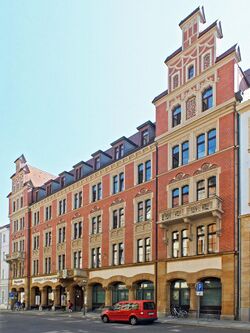
Leipzig University was one of the first German universities to allow women to register as "guest students".[3] At its general assembly in 1873, the Allgemeiner Deutscher Frauenverein (de) thanked the University of Leipzig and Prague for allowing women to attend as guest students. This was the year that the first woman in Germany obtained her JD, Johanna von Evreinov.
During the decline and dissolution of the Ottoman Empire in the 19th and first decade of 20th century together with some other German universities Leipzig University turned into one of the centers of higher education for state administrations and elites of newly independent Balkan states (Romania, Greece, Bulgaria and Serbia) educating over 5,500 students from the region in 1859–1909 period.[4]
Until the beginning of the Second World War, Leipzig University attracted a number of renowned scholars and later Nobel Prize laureates, including Paul Ehrlich, Felix Bloch, Werner Heisenberg and Sin-Itiro Tomonaga. Many of the university's alumni became important scientists.
Nazi period
Under Nazi rule many degrees of Jews were cancelled.[5] Some were later reinstated as Karl-Marx University degrees by the GDR. Noteworthy Nazis, such as Max Clara (chair of anatomy) taught at the university and were appointed to positions with great authority.
The university was kept open throughout World War II, even after the destruction of its buildings. During the war the acting rector, Erich Maschke, described the continuation of the university in a memo on 11 May 1945, announcing the vote for a new rector:
Since 4 December 1943 a fixed determination not to abandon the Leipzig University in the most difficult hour of its more than five-hundred-year history has bonded the professors with each other and with the students. The special task of repairing the damage caused by air attacks has now broadened out to the more general duty to save the continuity of our university and preserve its substance, at the very least its indestructible kernel, through the crisis that has now reached its fullest stage. After the destruction of most of the buildings and the majority of its libraries, this kernel is represented by the professoriate alone. This is what must be preserved as the great repository of value in the university.[6]
By the end of the war 60 per cent of the university's buildings and 70 per cent of its books had been destroyed.
The university under the German Democratic Republic
The university reopened after the war on 5 February 1946, but it was affected by the uniformity imposed on social institutions in the Soviet occupation zone. In 1948 the freely elected student council was disbanded and replaced by Free German Youth members. The chairman of the Student Council, Wolfgang Natonek, and other members were arrested and imprisoned, but the university was also a nucleus of resistance. Thus began the Belter group, with flyers for free elections. The head of the group, Herbert Belter, was executed in 1951 in Moscow. The German Democratic Republic was created in 1949, and in 1953 for Karl Marx Year the university was renamed by its government the Karl Marx University, Leipzig after Karl Marx. In 1968, the partly damaged Augusteum, including Johanneum and Albertinum and the intact Paulinerkirche, were demolished to make way for a redevelopment of the university, carried out between 1973 and 1978. The dominant building of the university was the University Tower (now City-Hochhaus Leipzig), built between 1968 and 1972 in the form of an open book.
After the reunification of Germany
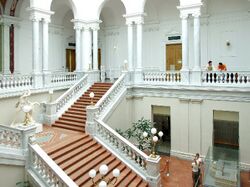
In 1991, following the reunification of Germany, the university's name was restored to the original Leipzig University (Alma mater lipsiensis). The reconstruction of the University Library, which was heavily damaged during the war and in the GDR barely secured, was completed in 2002.
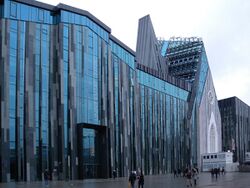
With the delivery of the University Tower to a private user, the university was forced to spread some faculties over several locations in the city. It controversially redesigned its historical centre at the Augustusplatz. In 2002, Behet Bonzio received the second prize in the architectural competition; a first prize was not awarded by the jury. A lobby with partial support of the provincial government called for the rebuilding of St. Paul's Church and Augusteum. This caused the resistance of the university leadership, the majority of the students and population of Leipzig. On 24 March 2004 a jury chose a design by Dutch architect Erick van Egeraat, which was well received by almost all parties. He recalls the outer form of the St. Paul's Church (today called Paulinum) and Augusteum, and abstracted the original building complex. Renovations began in the summer of 2005.
In 2008 the university was able to prevail in the nationwide "Initiative of Excellence" of Germany and it was granted the graduate school "BuildMoNa: Leipzig School of Natural Sciences – Building with Molecules and Nano-objects".[7] In addition, the university was able to receive grants from the Saxon excellence initiative for the "Life" project – a project that tries to explore common diseases more effectively. Also in 2008 the "Bach Archive" was associated with the university. In 2009, the Leipzig University celebrated its 600th anniversary with over 300 scientific and cultural lectures and exhibitions,[8] reflecting the role of the university's research and teaching from its beginning.
Campus
The university's urban campus comprises several locations. All in all, the university is spread across 38 locations in Leipzig. The main buildings in the city center (district Mitte) are still located on the same land plots as the earliest university buildings in 1409. The university's buildings in the center of Leipzig underwent substantial reconstruction from 2005, the new university's main building being drafted by Dutch architect Erick van Egeraat. The estimated total cost for the renovation project is 140 million euros. The new buildings were scheduled to be completed in 2009/2010, in time for the university's 600th anniversary celebrations.
Besides the faculties and other teaching institutions, several other bodies serve the university: the University Library, a university archive and administration, numerous museums (e.g. the Museum for Music Instruments and the Museum of Ancient Egypt) and the university hospital. The university's Leipzig Botanical Garden, the second-oldest botanical garden in Europe. was established in 1542. The university's Musical Instrument Museum includes one of the world's three surviving pianos built by Bartolomeo Cristofori, the piano's inventor. Five other Cristofori instruments are included in the museum's collections.[9]
Key Central institutions[10] of the university are
- Centre for Biotechnology and Biomedicine
- Career Service
- German Institute for Literature
- German Centre for Integrative Biodiversity Research (iDiv) Halle-Jena-Leipzig
- Higher Education Didactics Centre Saxony
- Kustodie (Art Collection)
- Leipzig University Music
- Leipzig Research Centre Global Dynamics
- Research Academy Leipzig
- Language Centre
- Studienkolleg Sachsen (The university's pathway and entrance examination provider)
- Translational Centre for Regenerative Medicine Leipzig
- University Archive
- University Library
- University Computer Centre
- Centre for University Sport
- Centre for Teacher Training and School Research
- Centre for Media and Communikation
Library
The University Library of Leipzig was established in 1543. It is one of the oldest German university libraries and it serves as a source of literature and information for the Leipzig University as well as the general public in the region. Its extensive historical and special collections are nationally and internationally recognized. The library consists of the main building "Bibliotheca Albertina" and forty branches situated near their respective academic institutions. The current stock comprises 5 million volumes and about 7,700 periodicals. Collections range from important medieval and modern manuscripts to incunabula, papyri, autographs, ostraka and coins.
The Apel Codex, a manuscript of 16th century music, is housed in the Leipzig University library,[11] as well as the Papyrus Ebers.
The Leipzig University Library also owns parts of the Codex Sinaiticus, a Bible manuscript from the 4th century, brought from Sinai in 1843 by Constantin von Tischendorf.[12] Papyrus Ebers is the longest and oldest surviving medical manuscript from ancient Egypt, dated to around 1600 BC.[13] The Codex contains large parts of the Old Testament and a complete New Testament in ancient Greek, and is one of the most important known manuscripts of the Greek Old Testament and the New Testament. It is the oldest fully preserved copy of the New Testament.
Some of the University Library locations[14] in Leipzig are:
- Bibliotheca Albertina at Beethovenstraße 6
- Campus Library at Universitätsstr. 3
- Library of Deutsches Literaturinstitut at Wächterstr. 34
- Library of Arts at Dittrichring 18–20
- Library of Musicology at Neumarkt 9–19
- Library of Law at Burgstr. 27
- Library of Medicine at Johannisallee 34
- Library of Medicine at Käthe-Kollwitz-Str. 82
- Library of Veterinary Medicine at the Tierkliniken 5
- Library of Biosciences at Talstr. 35
- Library of Chemistry and Physics at Johannisallee 29
- Library of Earth Sciences at Talstr. 35
- Library of Geography at Johannisallee 19
- Library of Archaeology, Prehistory and Ancient History at Ritterstr. 14
- Library of Oriental Studies at Schillerstr. 6
- Library of Sports Science at Jahnallee 59
In addition to the university library, one of the two centers of the German National Library is based at Leipzig, the collections of which are open to use for academic research.
Faculties
The original four facilities were the Faculty of Arts, Theology, Medicine, and Law. As of November 2021, the university comprises the following 14 faculties with institutes and centers associated with each one.
- Faculty of Chemistry and Mineralogy
- Institute of Analytical Chemistry
- Institute of Bioanalytical Chemistry
- Institute of Chemical Technology
- Institute of Inorganic Chemistry
- Institute of Mineralogy, Crystallography and Materials Science
- Institute of Organic Chemistry
- Wilhelm Ostwald Institut of Physical and Theoretical Chemistry
- Faculty of Economics and Management Science
- Institute of Accounting, Finance and Taxation (IUFB)
- Institute of Building Design and Management (IGB)
- Institute of Business Education and Management Training (IFW)
- Institute of Economic Policy (IWP)
- Institute of Empirical Economic Research (IEW)
- Institute of Information Systems
- Institute of Infrastructure and Resource Management (IIRM)
- Institute of Insurance Science (IVL)
- Institute of Public Finance and Public Management (PFPM)
- Institute of Real Estate Management (IIM)
- Institute of Service and Relationship Management (ISRM)
- Institute of Theoretical Economics (ITVWL)
- Institute of Trade and Banking (IHB)
- Institute of Urban Development and Construction Management (ISB)
- Faculty of Education
- Institute of Educational Sciences
- Institute of Pre-Primary and Primary Education
- Institute of Special and Inclusive Education
- Faculty of History, Arts and Regional Studies
- Department of History
- Institute of African Studies
- Institute of Ancient Near Eastern Studies
- Institute of Anthropology
- Institute of Art Education
- Institute of Art History
- Institute of East Asian Studies
- Institute of Egyptology
- Institute of Musicology
- Institute of Oriental Studies
- Institute of South and Central Asian Studies
- Institute of the Study of Religions
- Institute of Theatre Studies
- Faculty of Law
- Ernst Jaeger Institute of Corporate Restructuring and Insolvency Law
- Institute of Broadcasting Law
- Institute of Energy and Regulatory Law
- Institute of Environmental and Planning Law
- Institute of Foreign and European Private and Procedural Law
- Institute of German and International Law of Banking and Capital Markets
- Institute of International Law
- Institute of Labour and Social Law
- Institute of Law and Politics
- Institute of Public International Law, European Law and Foreign Public Law
- Institute of Tax Law
- Institute of the Foundations of Law
- Institute of the Legal Profession
- Faculty of Life Sciences
- Institute of Biochemistry
- Institute of Biology
- Wilhelm Wundt Institute for Psychology[15]
- Faculty of Mathematics and Computer Science
- Institute of Computer Science
- Institute of Mathematics
- Faculty of Medicine
- Carl Ludwig Institute of Physiology
- Centre for Clinical Trials Leipzig
- Centre for Environmental Medicine and Environmental Epidemiology
- Clinical Pharmacology
- Experimental Centre of the Faculty of Medicine
- General Medicine Unit
- Heart Center Leipzig GmbH
- Innovation Center Computer Assisted Surgery (ICCAS)
- Institute for Medical Physics and Biophysics
- Institute of Anatomy
- Institute of Biochemistry (medicine)
- Institute of Legal Medicine
- Institute of Medical Informatics, Statistics and Epidemiology
- Institute of Social Medicine, Occupational Health and Public Health
- Integrated Research and Treatment Center (IFB) AdiposityDiseases
- Interdisciplinary Centre for Clinical Research
- Karl-Sudhoff-Institute of History of Medicine and Science
- LIFE Forschungszentrum für Zivilisationserkrankungen (LIFE)
- Neurological Rehabilitation Centre
- Paul Flechsig Institute for Brain Research
- Rudolf Boehm Institute of Pharmacology and Toxicology
- Faculty of Philology
- Institute of American Studies
- Institute of Applied Linguistics and Translatology
- Institute of British Studies
- Institute of Classical Studies and Comparative Literature
- Herder-Institute (German as a Foreign Language)
- Institute of German Language and Literature
- Institute of Linguistics
- Institute of Romance Studies
- Institute of Slavonic Studies
- Institute of Sorbian Studies
- Faculty of Physics and Earth Sciences
- Institute of Geography
- Institute of Geophysics and Geology
- Institute of Meteorology
- Peter Debye Institute of Soft Matter Physics
- Felix Bloch Institute of Solid State Physics
- Institute of Theoretical Physics
- Faculty of Social Sciences and Philosophy
- Institute of Communication and Media Studies[16]
- Institute of Global and European Studies
- Institute of Philosophy
- Institute of Political Science
- Institute of Sociology
- Institute of the Study of Culture
- Faculty of Sport Science
- Institute of Sport Medicine and Prevention
- Institute of General Kinesiology and Athletics Training
- Institute of Movement and Training Science in Sports I
- Institute of Movement and Training Science in Sports II
- Institute of Exercise and Public Health
- Institute of Sport Psychology and Physical Education
- Faculty of Theology
- Institute of Church History
- Institute of New Testament Science
- Institute of Old Testament Studies
- Institute of Practical Theology
- Institute of Religious Education
- Institute of Systematic Theology
- Faculty of Veterinary Medicine
- Department for birds and reptiles
- Department for horses
- Department for ruminants and swine
- Department for small animal
- Institute of Anatomy, Histology and Embryology
- Institute of Animal Hygiene and Veterinary Public Health
- Institute of Animal Nutrition, Nutrition Diseases and Dietetics
- Institute of Bacteriology and Mycology
- Institute of Food Hygiene
- Institute of Immunology
- Institute of Parasitology
- Institute of Pathology
- Institute of Pharmacology, Pharmacy and Toxicology
- Institute of Physiological Chemistry
- Institute of Physiology
- Institute of Virology
- Oberholz Farm for Teaching and Research
Institutes affiliated with the university
- International Max Planck Research School- Mathematics in the Sciences (IMPRS MiS), in association with Max Planck Institute for Mathematics in the Sciences[17]
- International Max Planck Research School on Neuroscience of Communication: Function, Structure, and Plasticity, in association with Max Planck Institute for Human Cognitive and Brain Sciences[18]
- International Max Planck Research School "The Leipzig School of Human Origins", in association with Max Planck Institute for Evolutionary Anthropology[19]
- Institute of Non-Classical Chemistry e.V[20]
- Institute for Applied Informatics[21]
- Simon Dubnow Institute for Jewish History and Culture at Leipzig University
- Leipzig Centre for the History and Culture of East Central Europe
- Translational Centre for Regenerative Medicine
- German Centre for Integrative Biodiversity Research (iDiv)
- Institute of East Asian Studies of the Leipzig University
- Institute of Classical Archaeology of the Leipzig University
- Institute for International Law, European Law and Foreign Public Law (InVEA) of the Leipzig University
Academics
Today, the university has 14 faculties. With over 29,000 students, it is Saxony's second-largest university. There are now more than 150 institutes and the university offers 190 study programs leading to Bachelor's degrees, Master's degrees, Staatsexamen, Diplom (equivalent to master's degree)[22] and Ph.D.s.
The university offers a number of courses in English and other foreign languages, and there are several programs which have been specially designed for foreign students. Exchange partner universities include the universities of Arizona, Oklahoma, Houston, Alberta, Ohio, and Edinburgh. Traditionally contacts to universities in Eastern Europe and the Far East are strong as well, e.g. there are cooperations with leading institutions such as Moscow's Lomonosov University and Renmin University in Beijing.
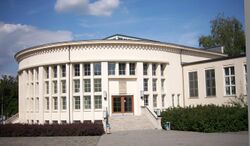
There are several International Master's programs: American Studies, Global Studies, Sustainable Development Studies, SEPT[23] (MBA in SME Promotion)[24] and one Bachelor/Master's/Ph.D. program (International Physics Studies Program[25]) taught in English. American Studies Leipzig was awarded three international professorships: The Fulbright-Leipzig Chair for American Studies, the DAAD Professorship for American and International Studies, and the Picador Guest Professorship for Literature.[26] It is also the home of Aspeers – Emerging voices in American Studies, a graduate-level peer-reviewed scholarly journal for American studies. Erasmus Mundus Global Studies is an interdisciplinary, research-based Master offered by a consortium of five European universities: Leipzig University, the London School of Economics, University of Vienna, University of Wroclaw and Roskilde University. In the field of anthropology, the university is cooperating with the Leipzig Max Planck Institute for Evolutionary Anthropology. In 1995, the Leibniz-Institute for Jewish History and Culture named after Simon Dubnow was formed as a research institution related to the university. Since 2008 the university is also home to one of Germany's few Confucius Institutes. The institute is based on an agreement of June 2006 between the university administration and representatives of the Chinese Embassy to establish a Confucius Institute in cooperation with the Renmin University and the "National Office for Teaching Chinese as a Foreign Language". Leipzig University has been the home of the first German chair for Chinese and East Asian Languages in the 19th century, which later became the Institute of East Asian Studies, which still exists today (see Georg von der Gabelentz).
Rankings
Template:Infobox Germany university rankings Leipzig University is recognized in several university ranking systems. In the 2024 QS World University Rankings, the university was ranked 479th globally, placing it within the top 30 (29th) nationally.[27] The Academic Ranking of World Universities (ARWU), for 2023, positioned the university in the range of 201–300 on the global scale and somewhere between 10th and 19th within the country.[28]
The university is ranked 18th in Germany, 98th in Europe, and 264th in the world by the web-based Webometrics Ranking of World Universities, a ranking evaluating universities' scientific online publications.[29][30]
International students
Leipzig university has a large body of international students. In winter term 2017, out of its 28,797 students about 11% (3,174) were foreign students.[31]
Student life
Leipzig has a thriving student life with a large number of student run bars, sports clubs and recreational facilities for students. The student body in Leipzig is diverse, not only due to the broad spectrum of subjects at the university but also because of the other higher education institutions in the city. The Moritzbastei is the largest student club in Germany, it is part of the historic city fortifications of Leipzig and is famous for its atmosphere and large number of cultural events.
The university is home to the Leipzig Academic Orchestra and the University Choir of Leipzig. There are numerous courses offered in performing arts every semester and a dance festival is organised by students once a year. In the field of sports, the university offers training opportunities and courses in almost all disciplines. During the annual Leipzig book fair, the university library and other university institutions organise public events for authors.
Notable people
File:Porträtt av Tycho Brahe - Skoklosters slott - 90153.tifthumb|150px|Johann Wolfgang von Goethe
.jpg)
Leipzig University has produced many notable individuals and noble laureates. Some famous people affiliated with Leipzig include:
Music
- Johann Christoph Altnickol, German composer, son-in-law to Johann Sebastian Bach
- Johann Friedrich Agricola, German composer, pupil of Johann Sebastian Bach
- Carl Philipp Emanuel Bach, German composer, second famous son of Johann Sebastian Bach
- Johann Christoph Friedrich Bach, German composer, 3rd famous son of Johann Sebastian Bach
- Wilhelm Friedemann Bach, German composer, first famous son of Johann Sebastian Bach
- Lorenz Christoph Mizler, German composer and music theorist, pupil of Johann Sebastian Bach
- Friedrich Blume, German music theorist
- Robert Schumann, German music composer
- Christoph Graupner, German composer
- Johann Kuhnau, German composer, Thomaskantor
- Johann David Heinichen, German composer and music theorist, Royal Polish and Electoral Saxon Kapellmeister
- Richard Wagner, German composer
- Georg Philipp Telemann, German composer
Humanities
- Theodor Mommsen, German historian, Nobel Prize in Literature
- Franz Delitzsch, German Theologian and Hebrew Scholar
- Michael Ranft, German historian and theologian.
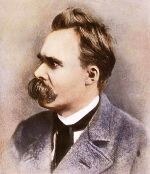
- Friedrich Nietzsche, German philosopher
- Adolf von Harnack, German theologian
- Johann Wolfgang von Goethe, German poet and polymath
- Max Muller, philologist and Orientalist who wrote authoritative works on Indology.
- Leonard Bloomfield, American linguist who led the development of structural linguistics in the United States during the 1930s and the 1940s. He is considered to be the father of American Distributionalism.
- Hans-Georg Gadamer, German philosopher and rector of the university
- Johann Christoph Gottsched, German poet, author, and critic
- Christian Friedrich Henrici, German poet, Saxon Actuary, Postal clerk, Postal Commissioner, and Wine inspector
- Gotthold Ephraim Lessing, German philosopher and writer
- Lin Yutang, Chinese author and linguist
- Nathan Söderblom, Swedish clergyman, Nobel Peace Prize
- C. F. W. Walther, first President of the Lutheran Church–Missouri Synod and its most influential theologian.
- Ferdinand de Saussure, linguist, founder of structuralism
- Gert Jäger, Otto Kade and Albrecht Neubert, translation scholars and founders of the Leipzig School
Sciences
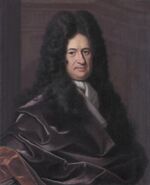
- Gottfried Wilhelm von Leibniz, German philosopher, polymath, and mathematician who developed calculus,
- Felix Klein, German mathematician, known for his work in group theory, complex analysis and non-Euclidean geometry
- Sophus Lie, Norwegian mathematician who developed Lie algebra
- August Ferdinand Möbius, German mathematician and theoretical astronomer, known for the Möbius strip.
- Karl Mollweide, German mathematician and astronomer, known for the Mollweide projection
- Hermann Hankel, German mathematician, known for the Hankel transform
- Felix Hausdorff, German mathematician, one of the founders of modern topology, known for the Hausdorff space
- Bartel Leendert van der Waerden, Dutch mathematician
- Johann Samuel Traugott Gehler German mathematician, physicist and lawyer, author of 'Physikalisches Wörterbuch'
- Edgar Odell Lovett, American mathematician
- Eberhard Zeidler, German mathematician and first managing director of Max Planck institute of mathematics in the sciences
- Wei-Liang Chow, Chinese mathematician and stamp collector born in Shanghai, known for his work in algebraic geometry.
- Johann Heinrich Winckler, German physicist
- Werner Heisenberg, German physicist, Nobel Prize in Physics
- Felix Bloch, Swiss physicist, Nobel Prize in Physics
- Klaus Fuchs, German theoretical physicist and atomic spy
- Friedrich Hund, German physicist, discovered quantum tunnelling and is known for Hund's rules
- Julius Edgar Lilienfeld, Austro-Hungarian physicist
- Ludwig Boltzmann, Austrian physicist
- Tycho Brahe,[32] Danish astronomer
- Gustav Hertz, German physicist, Nobel Prize in Physics
- Sin-Itiro Tomonaga, Japanese physicist, Nobel Prize in Physics
- William Vermillion Houston, American physicist
- Edward Teller, Hungaro-American nuclear scientist, member of the Manhattan Project
- Peter Debye, Dutch-American physicist and chemist, Nobel Prize in Chemistry
- Wilhelm Ostwald, German chemist, Nobel Prize in Chemistry
- Emil Kraepelin, German Psychiatrist
- Paul Ehrlich, German doctor, Nobel Prize in Medicine
- Svante Pääbo, Nobel Prize in Medicine, currently teaches molecular evolutionary biology at the university
- Felix Otto, German mathematician, currently teaches mathematical physics at the university
- Gustav Theodor Fechner, German psychologist, founder of Psychophysics
- Maximilian von Frey, physiologist, inventor of the esthesiometer
- Ernst Heinrich Weber, German physician and professor whose studies paved the way for the founding of Psychology
- Katja Werthmann, German ethnologist, regional focus West Africa, full professor at Leipzig University
- Wilhelm Wundt, German psychologist, founded the first formal laboratory for psychological research
- Friedrich Trendelenburg, German surgeon, described surgical removal of pulmonary emboli[33]
- Dorothy Anna Hahn, American organic chemist, lifelong educator in organic chemistry at Mount Holyoke College
Politics
- Luo Gan, Chinese Politician, Member of the Politburo Standing Committee
- Johann Major, German Lutheran theologian, a principal author of the so-called Leipzig Interim, and author of the Majoristic Controversy
- Angela Merkel, first female German Chancellor
- Hans-Dietrich Genscher, German politician, Foreign Minister and Vice Chancellor
- Rudolph Sohm, lawyer and Church historian
- Cai Yuanpei, president of Peking University and leading thinker in the early Chinese communist movement
- Michelle Bachelet, first female President of Chile between 2006 and 2010
- Selig Brodetsky, Israeli President of the Hebrew University of Jerusalem
- Raila Amolo Odinga, Kenyan politician
Sports
- Luz Long, German Olympic long-jumper, noted for his sportsmanship
See also
- Handelshochschule Leipzig (HHL)
- Leipzig school (sociology)
- List of medieval universities
- List of universities in Germany
Notes
References
- ↑ 1.0 1.1 1.2 "Jahresbericht 2015" (in de). pp. 53–59. https://www.uni-leipzig.de/fileadmin/ul/Dokumente/2015_Jahresbericht.pdf.
- ↑ "Zahlen und Fakten" (in de). https://www.uni-leipzig.de/universitaet/profil/leitbild-profil-geschichte/zahlen-und-fakten.html.
- ↑ "Louise Otto Peters. Das erste Vierteljahrhundert. Marburger Abhandlungen zur Politischen Wissenschaft" (in de). Die deutsche Frauenbewegung 1843–1889 (1 ed.). Berlin: Hain. 1972. p. 112. ""Auf der Generalversammlung des Allgemeinen deutschen Frauenvereins 1873 dankt eine Referentin den Universitäten in Leipzig und Prag für die Zulassung der Frauen als Gasthörerinnen."
- ↑ Pippidi, Adrei (2010). "The Development of an Administrative Class in South-East Europe". in Mungiu-Pippidi, Alina; Meurs, Wim Van. Ottomans Into Europeans: State and Institution-building in South Eastern Europe. New York City & Chichester: Columbia University Press. pp. 111–134. ISBN 978-0-231-70168-6.
- ↑ "A Jewish Palestinian's quest to receive his degree, from Nazi Germany". wn.com. http://article.wn.com/view/2012/04/18/A_Jewish_Palestinians_quest_to_receive_his_degree_from_Nazi_/.
- ↑ Universitätsarchiv Leipzig, Rectorate 50. Quoted in Grondin, Jean (2003). Hans-Georg Gadamer: A Biography. New Haven: Yale University Press. p. 234. ISBN 0-300-09841-3.
- ↑ Dr. Alexander Weber (17 May 2013). "Graduate School BuildMoNa". Buildmona.de. http://www.buildmona.de.
- ↑ "Universität Leipzig 600th Anniversary". http://www.sechshundert.de/index1_e.php?JavaScript=On.
- ↑ "Museum of Musical Instruments". http://mfm.uni-leipzig.de/_eng/dasmuseum/europ_Musical_Instruments.php?navid=16.
- ↑ Leipzig, Universität. "Universität Leipzig: Central Institutions". https://www.uni-leipzig.de/en/university/faculties-and-central-institutions/institutions.html.
- ↑ Sadie, Stanley; Latham, Alison (1994). "The Grove Concise Dictionary of Music". The Grove Concise Dictionary of Music.
- ↑ Aland, Kurt; Aland, Barbara (1995). The Text of the New Testament: An Introduction to the Critical Editions and to the Theory and Practice of Modern Textual Criticism. Erroll F. Rhodes (trans.). Grand Rapids, Michigan: William B. Eerdmans Publishing Company. pp. 107–108. ISBN 978-0-8028-4098-1. https://archive.org/details/textnewtestament00kurt.
- ↑ "In Pursuit Of Knowledge - An Exhibition of Leipzig University Library -". http://www.inpursuitofknowledge.org/.
- ↑ "Universitätsbibliothek Leipzig: Locations". https://www.ub.uni-leipzig.de/locations/?L=1.
- ↑ Huster, S. (2021, 26 November). Senat stimmt Umbenennung zu Institut für Psychologie trägt offiziell den Namen Wilhelm Wundt [Senate approves renaming the Institute of Psychology after Wilhelm Wundt]. Das Leipziger Universitätsmagazin. https://magazin.uni-leipzig.de/das-leipziger-universitaetsmagazin/artikel/institut-fuer-psychologie-traegt-offiziell-den-namen-wilhelm-wundt-2021-11-26/
- ↑ Tillack-Graf, Anne-Kathleen: Institute of Communication and Media Studies (University of Leipzig). The SAGE International Encyclopedia of Mass Media and Society. SAGE Publications, 2019.
- ↑ "Graduate School". https://www.imprs-mis.mpg.de/index.html.
- ↑ "About Us". http://imprs-neurocom.mpg.de/167966/about-us.
- ↑ Leipzig, International Max Planck Research School: The Leipzig School of Human Origins. "IMPRS "The Leipzig School of Human Origins" – Home". http://www.leipzig-school.eva.mpg.de/index.html.
- ↑ "Pursuing a Doctorate in Leipzig" (in en,de). uni-leipzig.de. Leipzig: Universität Leipzig. 2016. https://www.uni-leipzig.de/fileadmin/ul/Dokumente/Promotionsleitfaden_2016.pdf.
- ↑ "InfAI | Institut für Angewandte Informatik". https://infai.org/.
- ↑ Since the adoption of the Bachelor's degree and Master's degree only three study programs leading to Diplom have remained: Maths, Mathematical economics and Protestant Christian Theology.
- ↑ SEPT, the international Program of the University of Leipzig for Small and Medium-Sized Enterprise promotion and training http://www.sept.uni-leipzig.de/
- ↑ "SEPT – MBA program at glance". Sept.uni-leipzig.de. http://www.sept.uni-leipzig.de/MBA-Program.10.0.html.
- ↑ "Homepage of the International Physics Studies Program at Leipzig". Uni-leipzig.de. http://www.uni-leipzig.de/~intphys/.
- ↑ "The Picador Guest Professorship for Literature | American Studies Leipzig". Americanstudies.uni-leipzig.de. http://americanstudies.uni-leipzig.de/picador.
- ↑ Cite error: Invalid
<ref>tag; no text was provided for refs namedQS - ↑ Cite error: Invalid
<ref>tag; no text was provided for refs namedARWU - ↑ "Germany | Ranking Web of Universities: More than 28000 institutions ranked". https://www.webometrics.info/en/Europe/Germany.
- ↑ "Europe | Ranking Web of Universities: More than 28000 institutions ranked". https://www.webometrics.info/en/Europe.
- ↑ "Statistical Office of Saxony, Statistical data of June 2018 for academic winter term 2017". https://www.statistik.sachsen.de/download/030_SB-Bildung/StudentenanHochschulen.pdf.
- ↑ John Louis Emil Dreyer, Tycho Brahe: a Picture of Scientific Life and Work in the Sixteenth Century, Cambridge UP (2014 [1890]), p. 16.
- ↑ Arch Klin Chir 86:686, 2908, 1908
Literature
- Merskin, Debra L. (2020). The Sage international encyclopedia of mass media and society. Thousand Oaks, California. ISBN 978-1-4833-7551-9. OCLC 1130315057.
- Scholars and Literati at the University of Leipzig (1409–1800), in Repertorium Eruditorum Totius Europae/RETE.
External links
- Official website of Leipzig University
- History of the Leipzig University
 Herbermann, Charles, ed (1913). "University of Leipzig". Catholic Encyclopedia. New York: Robert Appleton Company.
 |  |
Categories: [Educational institutions established in the 15th century]
↧ Download as ZWI file | Last modified: 07/17/2024 17:10:37 | 2 views
☰ Source: https://handwiki.org/wiki/Organization:Leipzig_University | License: CC BY-SA 3.0
 KSF
KSF