July 18, 2023
Topic: Daily Brew
 From Ballotpedia - Reading time: 18 min

Welcome to the Tuesday, July 18, Brew.
By: Samuel Wonacott
In yesterday’s edition, an editing mistake led us to incorrectly write that the following state legislators switched parties in 2023 from Republican to Democrat: Francis Thompson (LA House), Tricia, Cotham (N.C. House), Jeremy LaCombe (LA House), David Pritt (W.Va. House), and Mesha Mainor (GA House). Those lawmakers actually switched from the Democratic Party to the Republican Party. We regret the error.
Here’s what’s in store for you as you start your day:
- 19.3% of all state legislator censures have occurred in 2023
- 43 state legislative special elections have been scheduled this year
- Mississippi State Senate sees lowest number of incumbent retirements since 2011
19.3% of all state legislator censures have occurred in 2023
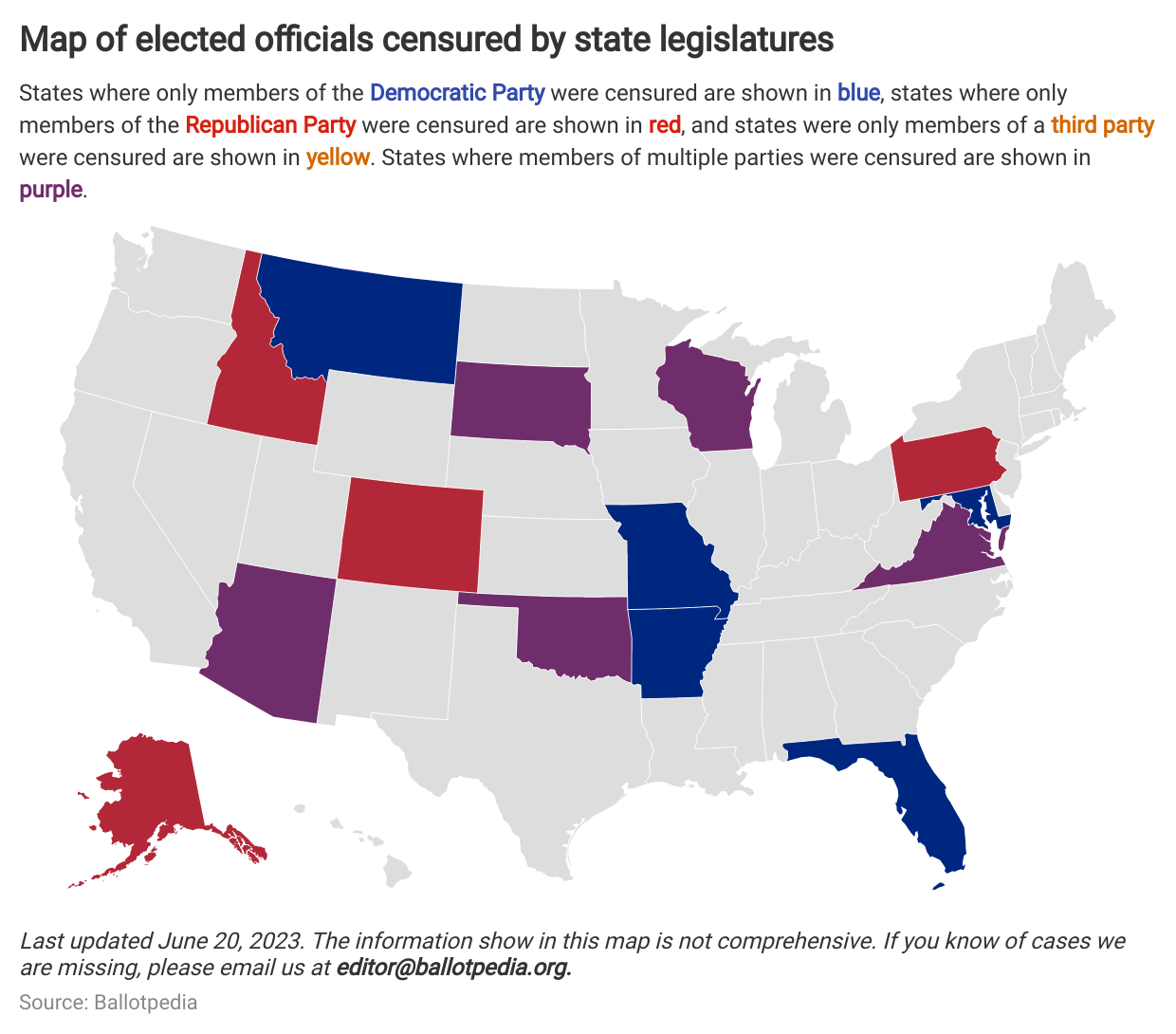
Six state legislators have been censured this year—the second-highest number of state lawmakers censured in one year since the first case in 1838. Overall, lawmakers censured this year account for 19.3% of the 31 cases we’ve tracked.
A censure is the formal way in which a lawmaker's colleagues can express disapproval of a legislator’s words or actions. In addition to censure, some lawmakers may be removed from committee assignments.
In 2023, there have been three Democrats and three Republicans censured across five states:
- Alaska state Rep. David Eastman (R-27)
- Arizona state Rep. Stephanie Stahl Hamilton (D-21)
- Montana state Rep. Zooey Zephyr (D-100)
- Oklahoma state Rep. Mauree Turner (D-88)
- Oklahoma state Rep. Dean Davis (R-98)
- South Dakota state Sen. Julie Frye-Mueller (R-30)
In total, since 1838, censured state legislators include 12 Democrats, 11 Republicans (one of whom was censured twice), and seven members of other parties. Eight of the 14 states where censures have occurred have had two or more legislators censured.

The highest number of censures for one year occurred in 1941 when seven Wisconsin senators were all censured at once for their refusal to vote on a bill.
We also track state legislators who’ve been expelled from their chambers. A lawmaker can be expelled through a vote or automatically, depending on state law, as a result of a conviction. We’ve tracked 79 cases in which elected officials were expelled from state legislatures between 1813 and 2023—including three this year.
Click below to read more about censured state lawmakers.
43 state legislative special elections have been scheduled this year
Today, voters in Wisconsin State Assembly District 24 will go to the polls to vote in a special election to replace Daniel Knodl (R), who won a special election to the Wisconsin Senate in April. District 24 includes parts of several counties north of Milwaukee.
Let’s take a look at who is running in the election and what’s at stake, and then catch up on state legislative special elections this year more generally.
Bob Tatterson (D) and Paul Melotik (R) are on the ballot. Both advanced from their respective primaries automatically because they were the only candidates to file.
Tatterson is the founder and president of an investment firm, and a former chemical engineer, volunteer firefighter, and chief technology officer. Tatterson said his top issue is public safety. His campaign website lists reproductive rights, gun safety, and open government as some of his other priorities. Tatterson completed Ballotpedia’s Candidate Connection survey when he ran in the 2022 general election for District 24 against Knodl. Click here to read his responses.
Melotik is a business owner and current Ozaukee County Board Supervisor. Melotik said his priorities are education and conservation. On his campaign website, Melotik says: “Smaller government, less regulation, and a robust private sector are what will position the state for future success.”
The winner of the election will serve out the remainder of Knodl’s term, which ends in 2024.
This special election is one of 43 that have been scheduled this year. Since 2011, there have been an average of 85 state legislative special elections during odd-numbered years.
The reasons for this year's special elections:
- 9 due to appointment, election, or the seeking of election to another position
- 23 due to resignation
- 9 due to the death of the incumbent
- 2 due to removal from office
Between 2010 and 2022, 112 state legislative seats have switched partisan control in special elections. Two seats have switched partisan control in 2023:
- On June 13, Abden Simmons (R) defeated Wendy Pieh (D) for Maine House of Representatives District 45 to replace Clinton Collamore, Sr. (D).
- On Jan. 10, Aaron Rouse (D) defeated Kevin Adams (R) in the special election for Virginia Senate District 7, replacing Jennifer Kiggans (R).

Click here to learn more about the special election for Wisconsin Assembly District 24. Click below to learn more about this year’s state legislative special elections.
Mississippi Senate has lowest number of incumbent retirements since 2011
Only four states are holding legislative elections this year, and that includes Mississippi. The Magnolia State’s state House and Senate primaries are coming up on Aug. 8 (with runoffs scheduled for Aug. 29 if necessary). Today, we’re going to look at the Senate, where all 52 seats are up for election. Republicans currently have a 36-15 majority (with one independent) in the chamber.
Here’s what you need to know.
- This year, three incumbent senators did not run for re-election, the lowest number of retirements since 2011. That’s a 66% decrease from the average of 8.7 retirements per cycle between 2011 and 2019.
- Sixteen incumbents in the 52-member Senate face primary challengers (that’s compared to 32 in the 122-member House).
We’ve identified eight battleground primaries in the Senate based on media coverage and endorsements. Of the eight primaries, six are Republican and two are Democratic. Six of these primaries have incumbents, while two are in open districts.
Democratic battlegrounds:
- Mississippi Senate District 27: Incumbent Hillman Frazier and Marvin Hightower are running in the primary. Frazier and Hightower ran against each other for the same district in 2019. Frazier defeated Hightower 65% to 38%. The Mississippi Association of Educators endorsed Frazier.
- Mississippi State Senate District 29: Incumbent David Blount and Dwayne Pickett are running. The Mississippi Association of Educators endorsed Blount.
For Democrats, campaign priorities and messages include: civil rights, economic development, public safety, education, police reform, healthcare, and infrastructure.
Republican battlegrounds:
- Mississippi State Senate District 6: Incumbent Chad McMahan and Lauren Smith are running in the primary for Senate District 6. The Mississippi Association of Educators endorsed McMahan, while the Mississippi Freedom Caucus endorsed Smith.
- Mississippi State Senate District 9: Incumbent Nicole Boyd and Ricky Caldwell are running in the primary for Senate District 9. The Mississippi Association of Educators endorsed Boyd, while the Mississippi Freedom Caucus endorsed Caldwell.
- Mississippi State Senate District 15: Incumbent Bart Williams and Alan Sibley are running in the primary for Senate District 15. The Mississippi Association of Educators endorsed Williams, while the Mississippi Freedom Caucus endorsed Sibley.
- Mississippi State Senate District 19: Incumbent Kevin Blackwell and Walter Hopper are running in the primary for Senate District 19. The Mississippi Freedom Caucus endorsed Hopper.
- Mississippi State Senate District 36: Jared Morrison and Brian Rhodes are running in the primary for Senate District 36. This district is open, meaning no incumbents are running.
- Mississippi State Senate District 42: Don Hartness and Robin Robinson are running in the primary for Senate District 42. Robinson has served in the Mississippi House since 2020. This district is open, meaning no incumbents are running. The Mississippi Freedom Caucus endorsed Hartness.
For Republicans, campaign priorities and messages include: education, constitutional rights, cutting taxes, conservative values, public safety, Second Amendment rights, and election integrity.
CNalysis rates each election based on the likelihood of a Democratic or Republican victory. Currently, the outlet rates 11 elections as Uncontested Democratic and four as Solid Democratic. It rates 26 elections as Uncontested Republican, 10 as Solid Republican, and one as Very Likely Republican.
Learn more about the Mississippi Senate elections and the battleground elections Ballotpedia identified using the link below.
Keep reading
 EncycloReader
is supported by the
EncycloReader
is supported by the  KSF
KSF