Howard Berman
 From Ballotpedia - Reading time: 10 min
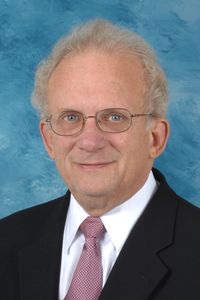
Howard Berman (b. April 15, 1941) was a Democratic member of the U.S. House representing California's 28th Congressional District from 1983 to 2013. He lost his re-election bid in 2012 for the U.S. House, representing California's 30th District.[1] He was displaced from the 28th District by redistricting.[2]
The primary battle between Berman and Brad Sherman made Politico's list of the five ugliest member vs. member battles.[3]
Based on an analysis of bill sponsorship by GovTrack, Berman was a "moderate Democratic leader."[4]
Biography[edit]
Berman was born in Los Angeles, California. He earned his B.A. and his LL.B. from the University of California, Los Angeles in 1962 and 1965 respectively.
Career[edit]
Below is an abbreviated outline of Berman's academic, professional, and political career:[5]
- 2003-2013: U.S. House of Representatives, California's 28th Congressional District
- 1983-2003: U.S. House of Representatives, California's 26th Congressional District
- 1973-1982: California State Assembly
- 1968, 1976, 1984: Delegate, Democratic National Convention
- 1966-1967: VISTA volunteer
Committee assignments[edit]
U.S. House[edit]
2011-2012[edit]
Berman served on the following committees:[6]
- Foreign Affairs Committee, Ranking Member
- Judiciary Committee
- Subcommittee on Intellectual Property, Competition, and the Internet
Issues[edit]
House Judiciary Committee[edit]
Congressman Berman was first appointed to the House Judiciary Committee shortly after he was sworn into office in January of 1983.[7] Berman served on the House Judiciary Subcommittee on Immigration, Citizenship, Refugees, Border Security, and International Law.[8]
The Congressman participated in the impeachment proceedings of President Bill Clinton in 1998.[9]
Lobbying position after leaving office[edit]
Berman was listed in March 2013 by USA Today as one of 16 former lawmakers who had taken on a lobbying related position after leaving office since January 2011. Former lawmakers may take positions with either lobbying firms or trade associations. Former U.S. House members are barred from lobbying their former colleagues for one year, and former U.S. Senate members are barred for two years. There are no restrictions, however, on providing advice to those who seek to shape federal legislation. Former legislators can also immediately lobby the executive branch and officials in state and local governments.[10]
Specific votes[edit]
Fiscal Cliff[edit]
 Berman voted for the fiscal cliff compromise bill, which made permanent most of the Bush tax cuts originally passed in 2001 and 2003 while also raising tax rates on the highest income levels. He was one of 172 Democrats who voted in favor of the bill. The bill was passed in the House by a 257 - 167 vote on January 1, 2013.[11]
Elections[edit]
2012[edit]
Berman ran for re-election in the 2012 election for the U.S. House, representing California's 30th District as a Democrat. He was displaced from the 28th District by redistricting.[2] He and district 28 incumbent Brad Sherman (D) advanced past the blanket primary on June 5, 2012, defeating Vince Gilmore (D), Mark Reed (R), Susan Shelley (R), Navraj Singh (R), and Michael Powelson (G). They faced off in the November 6, 2012, general election and Sherman won.[1][12][13] Berman and Sherman were both considered vulnerable incumbents in the election.[14]
The race between Berman and Brad Sherman heated up further in a debate on October 11 when the two candidates nearly had a physical altercation. Berman moved over to Sherman's side of the stage and put a finger in his face. Sherman responded by putting his arm around Berman and asking "Do you want to get into this." A sheriff's deputy soon walked between the men, calming them down.[15]
| Party | Candidate | Vote % | Votes | |
|---|---|---|---|---|
| Democratic |  Brad Sherman Incumbent Brad Sherman Incumbent |
60.3% | 149,456 | |
| Democratic | Howard Berman Incumbent | 39.7% | 98,395 | |
| Total Votes | 247,851 | |||
| Source: California Secretary of State "Official Election Results, 2012 General Election" | ||||
| Candidate | Vote % | Votes |
|---|---|---|
|
Brad Sherman (D) Incumbent |
42.4% | 40,589 |
| Howard Berman (D) Incumbent |
32.4% | 31,086 |
| Mark Reed (R) | 12.5% | 11,991 |
| Navraj Singh (R) | 5.8% | 5,521 |
| Susan Shelley (R) | 4% | 3,878 |
| Michael Powelson (G) | 2.1% | 1,976 |
| Vince Gilmore (D) | 0.8% | 792 |
| Total Votes | 95,833 | |
Endorsements[edit]
Berman was endorsed by Senator Barbara Boxer over his primary opponent and fellow incumbent Brad Sherman. She stated, "Because of Brad’s campaign mailing, which outrageously tries to connect you to the San Bruno tragedy, I will no longer stay neutral in this race." This is referring to a 2010 explosion in San Bruno, which resulted in eight deaths, caused by PG&E's failure to maintain their gas line.[16]
Berman was also endorsed by Republican Senators John McCain and Lindsey Graham as well as Independent Joe Lieberman.[17]
2010[edit]
On November 2, 2010, Berman won re-election to the United States House. He advanced past the blanket primary on June 5, 2012, defeating Merlin Froyd (R) and Carlos A. Rodriguez (Libertarian) in the general election.[18]
| U.S. House, California District 28 General Election, 2010 | ||||
|---|---|---|---|---|
| Party | Candidate | Vote % | Votes | |
| Democratic | Howard Berman Incumbent |
69.5% | 88,385 | |
| Republican | Merlin Froyd | 22.4% | 28,493 | |
| Libertarian | Carlos A. Rodriguez | 8% | 10,229 | |
| Total Votes | 127,107 | |||
Campaign themes[edit]
2012[edit]
Berman's campaign website listed the following issues:[19]
- Jobs and the Economy
- Excerpt: "Getting our economy moving again has been one of Howard’s top priorities in Congress. He knows that job growth is largest in new companies, and that the biggest problem faced by today’s small businesses is fewer customers with less money to spend."
- Veterans
- Excerpt: "He has made it a priority to help veterans facing hard times get back on their feet. He’s pushed for funding of programs to help treat homeless veterans with substance abuse and other mental health issues. He’s sought funds to improve the VA’s Supportive Housing program, and coordinated and co-hosted a veterans home buyers workshop."
- Intellectual Property Rights
- Excerpt: "Howard believes that robust protection of intellectual property and prevention of copyright theft protects local investments and creates jobs. The Chamber of Commerce has noted that America’s IP-intensive industries employ more than 19 million workers–at all educational and skill levels. From 2000 to 2007, the annual salary of all workers in IP-intensive industries averaged about 60% more than for similar workers in non-IP-intensive industries."
- Middle East
- Excerpt: "Howard has been one of the boldest and most effective Congressional voices in support of close US-Israeli relations since his first days in office. As Chairman of the House Foreign Affairs Committee from 2008-2010, and now as its top Democrat, he’s been the recognized leader of annual efforts to whip Members of the House to support full funding for aid to Israel."
- Foreign Policy and National Security
- Excerpt: "In addition to his indispensable work on Israel, Iran and the Middle East, Howard has been a major force on a wide range of other foreign policy and national security issues."
- Education
- Excerpt: "As a graduate of Los Angeles’ public schools, including Hamilton High School and UCLA, Howard knows firsthand that a strong public school system is key to our nation’s global competitiveness and our children’s futures."
- The Environment
- Excerpt: "The Santa Monica Mountains Conservancy Act was enacted in 1979 by Assembly Bill 1312, authored by Assemblyman Howard Berman. Since it became law, it has provided the means to preserve over 60,000 acres of parkland in both wilderness and urban settings, and improve more than 114 public recreational facilities in the Santa Monica Mountains."
Polls[edit]
2012[edit]
| Brad Sherman vs. Howard Berman | |||||||||||||||||||
|---|---|---|---|---|---|---|---|---|---|---|---|---|---|---|---|---|---|---|---|
| Poll | Brad Sherman | Howard Berman | Undecided | Margin of error | Sample size | ||||||||||||||
| SurveyUSA (September 20, 2012) | 45% | 32% | 23% | +/-4 | 628 | ||||||||||||||
| Note: The polls above may not reflect all polls that have been conducted in this race. Those displayed are a random sampling chosen by Ballotpedia staff. If you would like to nominate another poll for inclusion in the table, send an email to editor@ballotpedia.org. | |||||||||||||||||||
Campaign finance summary[edit]
Ballotpedia currently provides campaign finance data for all federal- and state-level candidates from 2020 and later. We are continuously working to expand our data to include prior elections. That information will be published here as we acquire it. If you would like to help us provide this data, please consider donating to Ballotpedia.
Personal Gain Index[edit]

- See also: Personal Gain Index (U.S. Congress)
- See also: Personal Gain Index (U.S. Congress)
The Personal Gain Index (U.S. Congress) is a two-part measurement that illustrates the extent to which members of the U.S. Congress have prospered during their tenure as public servants.
It consists of two different metrics:
PGI: Change in net worth[edit]

Between 2004 and 2012, Berman's calculated net worth[20] increased by 411 percent. Between 2004 and 2012, the average annual percentage increase for a member of Congress was 15.4 percent.[21]
| Howard Berman Yearly Net Worth | |
|---|---|
| Year | Average Net Worth |
| 2004 | $605,311 |
| 2012 | $2,544,978 |
| Growth from 2004 to 2012: | 320% |
| Average annual growth: | 40%[22] |
| Comparatively, the American citizen experienced a median yearly decline in net worth of -0.94%.[23] | |
The data used to calculate changes in net worth may include changes resulting from assets gained through marriage, inheritance, changes in family estates and/or trusts, changes in family business ownership, and many other variables unrelated to a member's behavior in Congress.
Analysis[edit]
Congressional staff salaries[edit]
The website Legistorm compiles staff salary information for members of Congress. Berman paid his congressional staff a total of $1,048,441 in 2011. He ranked 104th on the list of the lowest paid Democratic representative staff salaries and ranked 115th overall of the lowest paid representative staff salaries in 2011. Overall, California ranked 5th in average salary for representative staff. The average U.S. House of Representatives congressional staff was paid $954,912.20 in fiscal year 2011.[24]
Staff bonuses[edit]
According to an analysis by CNN, Berman was one of nearly 25 percent of House members who gave their staff bonuses in 2012. Berman's staff was given an apparent $6,648.00 in bonus money.[25]
Net worth[edit]
Based on congressional financial disclosure forms and calculations made available by OpenSecrets.org, Berman's net worth as of 2010 was estimated between $1,139,171 and $1,224,169. That averages to $1,181,670, which is lower than the average net worth of Democratic representatives in 2010 of $4,465,875.[26]
National Journal vote ratings[edit]
- See also: National Journal vote ratings
2012[edit]
Each year National Journal publishes an analysis of how liberally or conservatively each member of Congress voted in the previous year. Berman ranked 122nd in the liberal rankings in 2012.[27]
2011[edit]
Each year National Journal publishes an analysis of how liberally or conservatively each member of Congress voted in the previous year. Berman ranked 69th in the liberal rankings in 2011.[28]
Voting with party[edit]
November 2011[edit]
Howard Berman voted with the Democratic Party 94.2 percent of the time, which ranked 34 among the 192 House Democratic members as of 2011.[29]
Personal[edit]
Note: Please contact us if the personal information below requires an update.
Berman and his wife, Janis, have two children.
Recent news[edit]
This section links to a Google news search for the term Howard + Berman + California + House
See also[edit]
- California's 30th Congressional District
- California's 30th Congressional District elections, 2012
- United States House of Representatives
External links[edit]
- Social media:
- Biographies:
- Political profiles:
- Financial (federal level):
- Interest group ratings:
- Issue positions:
- Public statements:
- Voting record:
- Media appearances:
- Media coverage:
Footnotes[edit]
- ↑ 1.0 1.1 CNN, "California Districts Race - 2012 Election Center," accessed December 1, 2012
- ↑ 2.0 2.1 "California incumbents seek new districts to call home," washingtonpost.com, August 11, 2011
- ↑ Politico, "Congress 2012: The 5 ugliest member vs. member battles" accessed April 18, 2012
- ↑ GovTrack, "Berman" accessed May 17, 2012
- ↑ Biographical Directory of the United States Congress, "Howard Lawrence Berman," accessed November 6, 2011
- ↑ Congressman Howard L. Berman, Representing the 28th District of California, "Biography"
- ↑ Cite error: Invalid
<ref>tag; no text was provided for refs namedbio - ↑ Congressman Howard Berman, "Committee Assignments"
- ↑ Government Printing Office, "Impeachment Inquiry: President William Jefferson Clinton," November 19, 1998(See Page II)
- ↑ USA Today, "Ex-lawmakers go to lobbying-related jobs," March 26, 2013
- ↑ U.S. House, "Roll Call Vote on the Fiscal Cliff," accessed January 4, 2013
- ↑ California Secretary of State, "Official primary candidate list," accessed March 13, 2014
- ↑ California Secretary of State, "Unofficial election results," November 6, 2012 (dead link)
- ↑ New York Times"house Race Ratings" accessed October 3
- ↑ The Washington Post, "Berman-Sherman debate turns nasty, in a House race that is already heated," October 12, 2012
- ↑ TheHill.com, "Sen. Boxer picks Berman over Sherman," February 21, 2012
- ↑ Politico, "GOP senators to endorse Democrat Howard Berman," September 10, 2012
- ↑ U.S. Congress House Clerk, "Statistics of the Congressional Election of November 2, 2010," accessed March 28, 2013
- ↑ Campaign website, Issues
- ↑ This figure represents the total percentage growth from either 2004 (if the member entered office in 2004 or earlier) or the member's first year in office (as noted in the chart below).
- ↑ This number was found by dividing each member's total net worth growth percentage by the number of years included in the calculation.
- ↑ This figure represents the total percentage growth divided by the number of years for which there are net worth figures for each member.
- ↑ This figure was calculated using median asset data from the Census Bureau. Please see the Congressional Net Worth data for Ballotpedia spreadsheet for more information on this calculation.
- ↑ LegiStorm, "Howard Berman"
- ↑ CNN Politics, "Congressional bonuses in a time of cuts," accessed March 8, 2013
- ↑ OpenSecrets, "Berman, (D-Cali), 2010"
- ↑ National Journal, "2012 Congressional Vote Ratings," February 21, 2013
- ↑ National Journal, "Searchable Vote Ratings Tables: House," accessed February 23, 2012
- ↑ OpenCongress, "Voting With Party," accessed July 2014
| Political offices | ||
|---|---|---|
| Preceded by David Dreier |
U.S. House of Representatives - California, District 28 2003-2013 |
Succeeded by Adam Schiff |
| Preceded by ' |
U.S. House of Representatives - California, District 26 1983-2003 |
Succeeded by ' |
| Preceded by ' |
California State Assembly 1973-1982 |
Succeeded by ' |

 EncycloReader
is supported by the
EncycloReader
is supported by the  KSF
KSF