REINS Act
 From Ballotpedia - Reading time: 28 min
| What is the REINS Act? The Regulations from the Executive in Need of Scrutiny Act (REINS Act) is a legislative proposal aimed at increasing legislative oversight of administrative agency rulemaking by requiring legislative approval of agency regulations with certain financial or economic impacts before the regulations take effect. Click here to learn about the federal-level REINS Act. Click here to learn about REINS-style laws at the state level. |
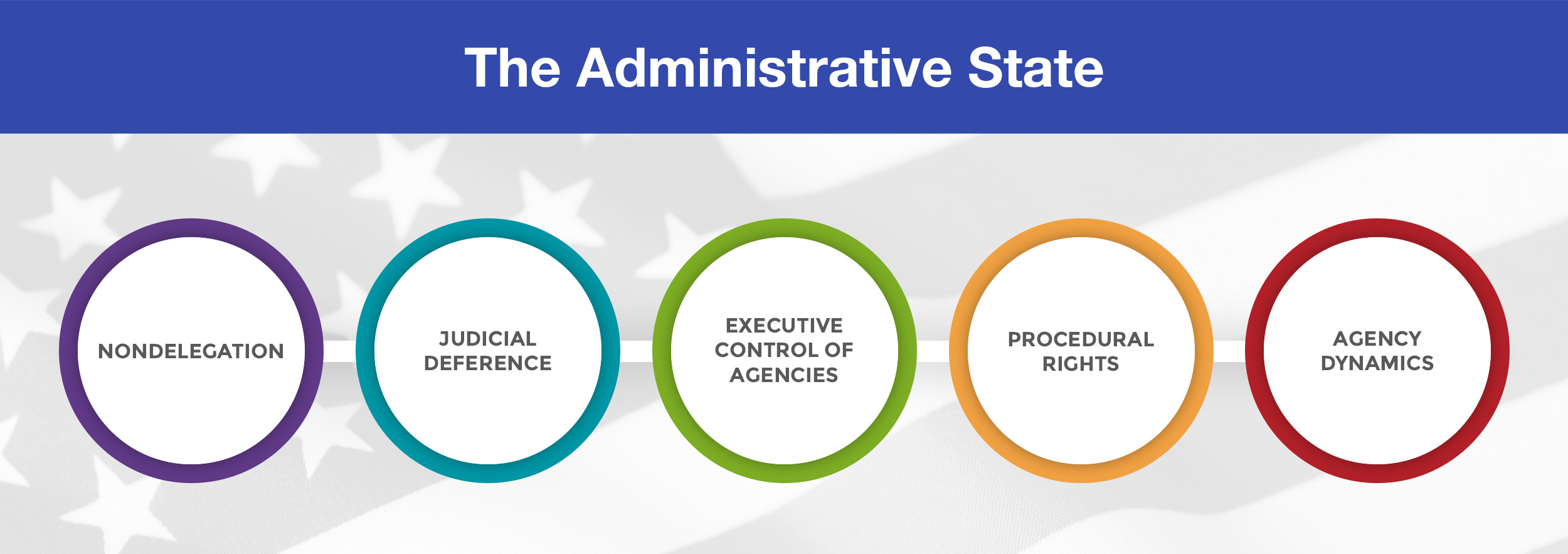
| Five Pillars of the Administrative State |
|---|

|
| Nondelegation |
| •Nondelegation doctrine • Timeline • Court cases • Arguments for and against • Reform proposals • Scholarly work |
| More pillars |
| • Judicial deference • Executive control of agencies • Procedural rights • Agency dynamics |
| Click here for more coverage of the administrative state on Ballotpedia.
|
| Click here to access Ballotpedia's administrative state legislation tracker. |
The Regulations from the Executive in Need of Scrutiny Act, also known as the REINS Act, is a legislative proposal put forth at both the federal and state levels designed to increase legislative oversight of administrative agency rulemaking by requiring legislative approval of agency regulations with certain financial or economic impacts before the regulations become effective. This page focuses on the federal REINS Act, which would apply to major agency rules—defined by the Congressional Review Act (CRA) as agency rules that have financial implications on the U.S. economy of $100 million or more, increase consumer prices, or have significant harmful effects on the economy.[1][2]
REINS-style state laws, which take similar approaches to legislative oversight of agency rulemaking, were effective in four states as of May 2024. These laws were enacted in Florida (2010), Wisconsin (2017), Indiana (2024), and Kansas (2024). To track the progress of other proposed REINS-style state laws, view Ballotpedia's Administrative State Legislation Tracker.
This article contains the following sections:
- Background and history of the REINS Act in Congress
- Timeline of key events in the REINS Act's legislative history
- Provisions of the REINS Act
- Sponsors of the REINS Act
- Arguments about the REINS Act
- Attempts to achieve goals of the REINS Act in other legislation
Background[edit]
- See also: Congressional Review Act
The REINS Act is designed to amend the Congressional Review Act (CRA) of 1996. Under the CRA, Congress has the authority to issue resolutions of disapproval to nullify certain agency regulations that it considers to be harmful. The REINS Act aims to expand the CRA to require congressional approval of certain major agency regulations before those regulations are implemented. Rather than issuing resolutions of disapproval after a rule takes effect, the REINS Act seeks to give Congress the preemptive authority to halt the initial enactment of certain regulations.[2]
The REINS Act defines major agency regulations as those that have financial impacts on the U.S. economy of $100 million or more, increase consumer prices, or have significant harmful effects on the economy.[2]
In addition, the REINS Act would require Congress to examine all existing regulations that have financial impacts on the U.S. economy of $100 million or more.
History of the REINS Act in Congress[edit]
The REINS Act was initially designed by Tea Party activist Lloyd Rogers in 2009. Rogers contacted former U.S. Representative Geoff Davis (R-Ky.) to propose legislation requiring that "all rules, regulations, or mandates that require citizens, state or local government financial expenditures must first be approved by the U.S. Congress before they can become effective."[3] The proposal was incorporated into the Republican Party's Pledge to America legislative agenda leading up to the 2010 election cycle, and the legislation was first introduced on October 8, 2009, by Davis in the 111th Congress (2009-2010).[4]
The REINS Act was later introduced as legislation in the 112th Congress (2011-2013), the 113th Congress (2013-2015), the 114th Congress (2015-2017) and the 115th Congress (2017-2019). The U.S. House of Representatives passed every version of the legislation between the 112th and 115th Congresses. The U.S. Senate, however, had not taken action on the legislation until the U.S. Senate Homeland Security and Governmental Affairs Committee passed a version of the bill out of committee during the 115th Congress.[3][5][6][7][8]
The legislation was reintroduced during the 116th Congress (2019-2021) and the 117th Congress (2021-2022) but did not pass.[9] In July 2020, the U.S. Senate Homeland Security and Governmental Affairs Committee passed the REINS Act with a party-line vote of 8-5.[10]
Congresswoman Kat Cammack (R-Fla.), joined by more than 170 Republican cosponsors, introduced the REINS Act as H.R. 277 in the 118th Congress (2023-2025) on January 11, 2023. The U.S. House of Representatives voted 221-210 on June 14, 2023, to pass the act.[11]
Timeline[edit]
This is a timeline of events about the federal REINS Act and the enactment of REINS-style state laws:
- June 12, 2024: The Arizona State Legislature put a ballot measure on the Nov. 5 ballot that would amend state law similarly to the REINS-style acts that were vetoed on May 19, 2023 and April 16, 2024 by Governor Katie Hobbs (D).
- April 29, 2024: The Kansas House of Representatives voted to override the governor's veto with a vote of 87-38 and the Kansas State Senate voted to override the governor's veto with a vote of 27-12.
- April 25, 2024: The Kansas REINS-style act vetoed by Governor Laura Kelly (D).
- April 16, 2024: The Arizona REINS-style act (2024) vetoed by Governor Katie Hobbs (D).
- March 13, 2024: The Indiana REINS-style act was signed into law by Governor Eric Holcomb (R).
- June 14, 2023: The REINS Act passed the House in the 118th United States Congress with a vote of 221-210.[11]
- May 19, 2023: The Arizona REINS-style act (2023) vetoed by Governor Katie Hobbs (D).
- January 31, 2023: Sen. Rand Paul (R) introduced the REINS Act in the U.S. Senate in the 118th United States Congress.[12]
- January 11, 2023: Rep. Kat Cammack (R) introduced the REINS Act in the U.S. House of Representatives in the 118th United States Congress.[11]
- March 10, 2021: Rep. Kat Cammack (R) introduced the REINS Act in the U.S. House of Representatives in the 117th United States Congress.[13]
- January 27, 2021: Sen. Rand Paul (R) introduced the REINS Act in the U.S. Senate in the 117th United States Congress.[14]
- July 25, 2019: Rep. F. James Sensenbrenner (R) introduced the REINS Act in the U.S. House of Representatives in the 116th United States Congress.[15]
- January 10, 2019: Sen. Rand Paul (R) introduced the REINS Act in the U.S. Senate in the 116th United States Congress.[16]
- August 9, 2017: The Wisconsin REINS-style Act was signed by Governor Scott Walker.
- January 5, 2017: The REINS Act passed the House in the 115th United States Congress with a vote of 237-187.[17]
- January 4, 2017: Sen. Rand Paul (R) introduced the REINS Act in the U.S. Senate in the 115th United States Congress.[8]
- January 3, 2017: Rep. Doug Collins (R) introduced the REINS Act in the U.S. House of Representatives in the 115th United States Congress.[17]
- July 28, 2015: The REINS Act passed the House in the 114th United States Congress with a vote of 243-165.[18]
- January 21, 2015: Sen. Rand Paul (R) introduced the REINS Act in the U.S. Senate and Rep. Todd Young (R) introduced the REINS Act in the U.S. House of Representatives in the 114th United States Congress.[19][18]
- August 2, 2013: The REINS Act passed the House in the 113th United States Congress with a vote of 232-183.[20]
- February 26, 2013: Sen. Rand Paul (R) introduced the REINS Act in the U.S. Senate in the 113th United States Congress.[21]
- January 23, 2013: Rep. Todd Young (R) introduced the REINS Act in the U.S. House of Representatives in the 113th United States Congress.[20]
- December 7, 2011: The REINS Act passed the House in the 112th United States Congress with a vote of 241-184.[22]
- February 7, 2011: Sen. Rand Paul (R) introduced the REINS Act in the U.S. Senate in the 112th United States Congress.[23]
- January 20, 2011: Rep. Geoff Davis (R) introduced the REINS Act in the U.S. House of Representatives in the 112th United States Congress.[22]
- November 16, 2010: The Florida House of Representatives voted to override the governor's veto with a vote of 99-21 and the Florida State Senate voted to override the governor's veto with a vote of 32-7.
- September 22, 2010: Sen. Jim DeMint (R) introduced the REINS Act in the U.S. Senate in the 111th United States Congress.[24]
- May 28, 2010: The Florida REINS-style Act was vetoed by Governor Charlie Crist (R).
- October 8, 2009: Rep. Geoff Davis (R) first introduced the REINS Act in the U.S. House of Representatives in the 111th United States Congress.[4]
Provisions[edit]
The REINS Act proposes the following procedures, according to an analysis by the Congressional Research Service:
|
The REINS Act proposes the following changes to provisions regarding congressional review of agency rulemaking:
|
The REINS Act defines the following regulations as major rules:
|
Text of the bill[edit]
The full text of the REINS Act, introduced by U.S. Representative Kat Cammack (R-Fla.) during the 118th Congress, is provided below:[27]
Sponsors of the REINS Act[edit]
118th Congress (2023-2025)[edit]
In the U.S. House of Representatives[edit]
Congresswoman Kat Cammack (R-Fla.) introduced the REINS Act as H.R. 277 in the 118th Congress (2023-2025) on January 11, 2023. "The REINS Act is a core part of House Republicans' mission to reintroduce government accountability and to restore Congress' role to check the regulatory actions of federal agencies. I'm grateful to the overwhelming support of my colleagues on this bill and look forward to seeing it pass the House this Congress," said Cammack in a press release about the bill.[28]
The bill had 182 Republican cosponsors as of May 2023.[11]
In the U.S. Senate[edit]
The REINS Act of 2023 was sponsored by U.S. Senator Rand Paul (R-Ky.) in the U.S. Senate on January 31, 2023.[12]
The bill had 28 cosponsors as of June 2023:[12]
117th Congress (2021-2023)[edit]
In the U.S. Senate[edit]
The REINS Act of 2021 was sponsored by U.S. Senator Rand Paul (R-Ky.) in the U.S. Senate on January 27, 2021. "By making Congress more accountable for the most costly and intrusive federal rules, the REINS Act would give Kentuckians and citizens throughout the country a greater voice in determining whether these major rules are in America’s best interests," said Sen. Paul in a statement about the 2021 version of the bill.[29]
The bill had 30 cosponsors as of March 2022:[14]
In the U.S. House of Representatives[edit]
The REINS Act of 2021 was sponsored by Representative Kat Cammack (R-Fla.) in the U.S. House of Representatives on March 10, 2021.[13]
The bill had 126 cosponsors as of November 2022:[13]
116th Congress (2019-2021)[edit]
In the U.S. Senate[edit]
The REINS Act of 2019 was sponsored by U.S. Senator Rand Paul (R-Ky.) in the U.S. Senate. "Last Congress, we made tremendous progress on relieving the burdens placed on the American people by unelected bureaucrats, but much more remains to be done," said Senator Paul in a statement about the 2019 version of the bill. "Passing the REINS Act would reassert Congress’ legislative authority and help us further reduce unnecessary, overreaching government interference in Americans’ everyday lives."[30]
The bill had 42 cosponsors as of July 2020:[16]
In the U.S. House of Representatives[edit]
The REINS Act of 2019 was sponsored by U.S. Representative F. James Sensenbrenner (R-Wis.) in the U.S. House of Representatives. In a statement released the day he sponsored the bill, Sensenbrenner said, "It is time for Congress to reclaim its Article I authority by restoring the constitutional balance of power. The American people deserve a more direct say in regulations that could impact their everyday lives. The REINS Act would place a desperately needed check on unelected bureaucrats, saving taxpayers money."[31]
The bill had 16 cosponsors as of September 2020:[15]
Arguments about the REINS Act[edit]
The following sections provide a selection of policy arguments about the REINS Act.
Arguments in support of the REINS Act[edit]
Joseph Postell, a visiting fellow for The Heritage Foundation, argued in a 2023 article that the REINS Act is necessary to address concerns with the administrative state:[32]
|
A 2016 report from the Competitive Enterprise Institute (CEI) argued that the REINS Act would improve relations between Congress and the administrative state by helping to restore the separation of powers by making members more accountable for regulatory decisions:[33]
|
The CEI report also contended that the REINS Act would increase transparency in the rulemaking process because agencies would know that Congress had the final say before a new regulation could take effect:[33]
|
Law professor Jonathan H. Adler wrote in a 2011 opinion piece in The Regulatory Review that the REINS Act would create accountability in the regulatory process:[34]
|
Arguments in opposition to the REINS Act[edit]
The Office of Management and Budget argued in a 2023 statement that the REINS Act undermines the regulatory process. The statement argued against passing the act, according to Government Executive:[35]
|
Opponents of the REINS Act have argued that the proposal would make it harder for agencies to protect the public and follow the law, according to a 2017 report from the Institute for Policy Integrity at the New York University (NYU) School of Law. The report claimed that Congress cannot make the highly technical decisions necessary for good regulation:[36]
|
The report also argued that the REINS Act raises constitutional concerns because delayed regulations could face court challenges that resemble INS v. Chadha (1984). In Chadha, the U.S. Supreme Court held that one-house legislative vetoes are unconstitutional because they violate the separation of powers outlined in the U.S. Constitution:[36]
|
The Public Citizen, a nonprofit advocacy organization, argued in a 2017 article against the REINS Act, stating that it threatens the separation of powers and politicizes the regulatory process:[37]
|
Attempts to achieve goals of the REINS Act in other legislation[edit]
The following sections provide information on legislation that attempted to achieve goals similar to the REINS Act.
Limit, Save, Grow Act (2023)[edit]
The U.S. House of Representatives on April 26, 2023, voted 219-210 to pass H.R. 2811, the Limit, Save, Grow Act of 2023, which aimed to raise the federal government’s debt ceiling and included provisions related to the REINS Act. President Joe Biden (D) had stated that he would veto the Limit, Save, Grow Act if it reached his desk.[38]
The Limit, Save, Grow Act did not become law. Congress raised the debt ceiling by passing the Fiscal Responsibility Act of 2023, which was signed into law on June 3, 2023. The Fiscal Responsibility Act did not include the REINS provisions.[39]
Foreign Investment Risk Review Modernization Act (2018)[edit]
The Foreign Investment Risk Review Modernization Act of 2018 (FIRRMA) would have granted the Committee on Foreign Investment in the United States (CFIUS), a panel housed within the Treasury Department, increased authority to review transactions related to direct foreign investments for potential security hazards. The legislation was amended in May 2018 with the support of U.S. Senator Pat Toomey (R-Pa.) to mirror elements of the REINS Act. Toomey’s amendment would have required a simple majority for congressional approval for CFIUS’ major regulations—those with an annual economic impact upwards of $100 million.[40][41]
The Trump administration opposed FIRRMA on the grounds that the legislation “could potentially result in CFIUS being unable to establish regulations, thereby undermining national security,” according to The Washington Post. FIRRMA did not come to a vote during the 115th United States Congress.[42]
See also[edit]
External links[edit]
Footnotes[edit]
- ↑ Congressional Research Service, "Disapproval of Regulations by Congress:Procedure Under the Congressional Review Act," October 10, 2001
- ↑ 2.0 2.1 2.2 GovTrack, "H.R. 26: Regulations from the Executive in Need of Scrutiny Act of 2017—Overview," accessed July 14, 2017
- ↑ 3.0 3.1 The Jackson Sun, "We were never closer to seeing REINS Act become law," January 4, 2017
- ↑ 4.0 4.1 Congress.gov, "H.R. 3765 - Regulations From the Executive in Need of Scrutiny Act of 2009," accessed June 7, 2023
- ↑ Boston Herald, "Smith: Congress can regain power with REINS," January 6, 2017
- ↑ The Heritage Foundation’, “Taking the REINS on Regulation,” October 12, 2011
- ↑ The Heritage Foundation, “'REINS Act of 2013': Promoting Jobs, Growth, and Competitiveness,” March 6, 2013
- ↑ 8.0 8.1 Congress.gov, "S.21 - Regulations from the Executive in Need of Scrutiny Act of 2017," accessed June 7, 2023
- ↑ Reuters, "Republicans act to curb U.S. regulation; Democrats poised for fight," January 5, 2017
- ↑ Bloomberg Law, "Senate Panel Moves Regulatory Bills to Aid Economic Recovery (1)," July 22, 2020
- ↑ 11.0 11.1 11.2 11.3 Congress.gov, "H.R.277 - REINS Act of 2023," accessed June 7, 2023
- ↑ 12.0 12.1 12.2 Congress.gov, "S.184 - Regulations from the Executive in Need of Scrutiny Act of 2023
- ↑ 13.0 13.1 13.2 Congress.gov, "H.R.1776 - Regulations from the Executive in Need of Scrutiny Act of 2021," accessed June 7, 2023
- ↑ 14.0 14.1 Congress.gov, "S.68 - Regulations from the Executive in Need of Scrutiny Act of 2021," accessed June 7, 2023
- ↑ 15.0 15.1 Congress.gov, "H.R.3972 - Regulations from the Executive in Need of Scrutiny Act of 2019," accessed June 7, 2023
- ↑ 16.0 16.1 Congress.gov, "S.92 - Regulations from the Executive in Need of Scrutiny Act of 2019," accessed June 7, 2023
- ↑ 17.0 17.1 Congress.gov, "H.R.26 - Regulations from the Executive in Need of Scrutiny Act of 2017," accessed June 7, 2023
- ↑ 18.0 18.1 Congress.gov, "H.R.427 - Regulations from the Executive in Need of Scrutiny Act of 2015," accessed June 7, 2023
- ↑ Congress.gov, "S.266 - Regulations From the Executive in Need of Scrutiny Act of 2015," accessed June 7, 2023
- ↑ 20.0 20.1 Congress.gov, "H.R. 367 - Regulations From the Executive in Need of Scrutiny Act of 2013," accessed June 7, 2023
- ↑ Congress.gov, "S.15 - Regulations From the Executive in Need of Scrutiny Act of 2013," accessed June 7, 2023
- ↑ 22.0 22.1 Congress.gov, "H.R.10 - Regulations From the Executive in Need of Scrutiny Act of 2011," accessed June 7, 2023
- ↑ Congress.gov, "S.299 - REINS Act," accessed June 7, 2023
- ↑ Congress.gov, "S.3826 - Regulations From the Executive in Need of Scrutiny Act of 2010," accessed June 7, 2023
- ↑ 25.0 25.1 25.2 GovTrack, "H.R. 26: Regulations from the Executive in Need of Scrutiny Act of 2017—Library of Congress Summary," accessed July 14, 2017
- ↑ 26.00 26.01 26.02 26.03 26.04 26.05 26.06 26.07 26.08 26.09 26.10 Note: This text is quoted verbatim from the original source. Any inconsistencies are attributable to the original source.
- ↑ Kat Cammack, "H.R.277 - Regulations from the Executive in Need of Scrutiny Act of 2023," accessed January 31, 2023
- ↑ Congresswoman Kat Cammack, "Congresswoman Cammack Introduces REINS Act To Limit Executive Overreach," January 11, 2023
- ↑ Rand Paul, "Dr. Rand Paul Reintroduces the REINS Act for 2021," January 28, 2021
- ↑ Official Website, U.S. Senator Rand Paul, "Senators Reintroduce REINS Act," accessed February 8, 2019
- ↑ Jim Sensenbrenner, "Sensenbrenner Leads Effort to Rein in Unelected Bureaucrats," July 25, 2019
- ↑ The Heritage Foundation, "House to Vote to Reduce Power of Bureaucracy With REINS Act," June 7, 2023
- ↑ 33.0 33.1 Competitive Enterprise Institute, "REINing In Regulatory Overreach," November 15, 2016
- ↑ The Regulatory Review, "The REINS Act: A Constitutional Means to Control Delegation," July 25, 2011
- ↑ Government Executive, "The White House Threatens Vetoes Over Regulation Bills," June 6, 2023
- ↑ 36.0 36.1 Institute for Policy Integrity, "The REINS Act Is Burdensome, Irrational, and Legally Questionable," June 2017
- ↑ The Public Citizen, "What is the REINS Act and why do we oppose it?" January 3, 2017
- ↑ Congress.gov, "H.R.2811 - Limit, Save, Grow Act of 2023," accessed June 12, 2023
- ↑ Congress.gov, "H.R.3746 - Fiscal Responsibility Act of 2023," accessed June 12, 2023
- ↑ The Weekly Standard, "Senate to Vote on Measure Giving Congress a Say in Foreign Investment Review Process," June 14, 2018
- ↑ Congress.gov, "S.2098 - Foreign Investment Risk Review Modernization Act of 2018," accessed June 14, 2018
- ↑ The Washington Post, "Senate sides with Trump, votes down GOP plan to expand Congress’s national security oversight," June 14, 2018

| |||||||||||
 EncycloReader
is supported by the
EncycloReader
is supported by the  KSF
KSF