National University of Singapore
 From Citizendium - Reading time: 27 min



| National University of Singapore 新加坡国立大学 Universiti Nasional Singapura சிங்கப்பூர் தேசிய பல்கலைக்கழகம் | |
|---|---|
 | |
| Address | |
| Information | |
| Type | Public research university |
| Established | 1905; (as King Edward VII College of Medicine) 8 August 1980; (as National University of Singapore) |
| Principal | Tan Eng Chye |
| Mascot | LiNUS |
| Color(s) | NUS Orange, NUS Blue[1] |
| Website | www.nus.edu.sg |
The National University of Singapore (NUS) is a national public research university in Singapore. Founded in 1905 as the Straits Settlements and Federated Malay States Government Medical School, NUS is the oldest autonomous university in the country.[2] It offers degree programs in a wide range of disciplines at both the undergraduate and postgraduate levels, including in the sciences, medicine and dentistry, design and environment, law, arts and social sciences, engineering, business, computing, and music.[3]
NUS is one of the most highly-ranked academic institutions in the world.[4][5] It has consistently featured in the top 30 of the QS World University Rankings and the Times Higher Education World University Rankings, and in the top 100 of the Academic Ranking of World Universities[6]. As of 2022–2023, NUS is 11th worldwide according to QS [7] and 19th worldwide according to THE.[8]
NUS's main campus is located in the southwestern part of Singapore, adjacent to the Kent Ridge subzone of Queenstown, accommodating an area of 170 ha (420 acres).[9] The Duke–NUS Medical School, a postgraduate medical school jointly established with Duke University, is located at the Outram campus;[10] and its Bukit Timah campus houses the Faculty of Law and Lee Kuan Yew School of Public Policy. The Yale-NUS College, a joint liberal arts college between NUS and Yale University, is located next to the NUS University Town on the main campus.[11]
NUS's affiliated faculty members and researchers include one Nobel Prize laureate, one Tang Prize laureate, and one Vautrin Lud laureate.
History[edit]

In September 1904, Tan Jiak Kim led a group of representatives of the Chinese and other non-European communities to petition the Governor of the Straits Settlements, Sir John Anderson, to establish a medical school in Singapore.[12] It was noted by Anderson that there were other petitions prior which were not successful due to concerns over having a sufficient number of students and support from the local community.[13] Tan, who was the first president of the Straits Chinese British Association, managed to raise 87,077 Straits dollars from the community, including a personal donation of $12,000.[13][14][15] On 3 July 1905, the medical school was founded and was known as the Straits Settlements and Federated Malay States Government Medical School. At Anderson's directions, the school was hosted temporarily at a recently emptied block at a Government-run asylum in Pasir Panjang while providing the staff required to run the school.[13]
In 1912, the medical school received an endowment of $120,000 from King Edward VII Memorial Fund, started by physician Lim Boon Keng. Subsequently, on 18 November 1913, the name of the school was changed to King Edward VII Medical School. In 1921, it was again changed to King Edward VII College of Medicine to reflect its academic status.[16][17]
In 1928,[18] Raffles College, a separate institution from the medical school, was established to promote education in arts and social sciences.[19]
University of Malaya (1949–1962)[edit]
On 8 October 1949, Raffles College was merged with King Edward VII College of Medicine to form the University of Malaya. The two institutions were merged to provide for the higher education needs of the Federation of Malaya.[20]
The growth of University of Malaya was very rapid during the first decade of its establishment and resulted in the setting up of two autonomous divisions in 1959, one located in Singapore and the other in Kuala Lumpur.[20]
Nanyang University (1955–1980)[edit]
In 1955, Nanyang University (abbreviated Nan-tah, 南大) was established on the backdrop of the Chinese community in Singapore.[9]
University of Singapore (1962–1980)[edit]
In 1960, the governments of then Federation of Malaya and Singapore indicated their desire to change the status of the divisions into that of a national university.[12] Legislation was passed in 1961, establishing the former Kuala Lumpur division as the University of Malaya, while the Singapore division was renamed the University of Singapore on 1 January 1962.
Present form[edit]
The National University of Singapore (NUS) was formed with the merger of the University of Singapore and Nanyang University on 6 August 1980.[21] This was done in part due to the government's desire to pool the two institutions' resources into a single, stronger entity and promote English as Singapore's main language of education. The original crest of Nanyang University with three intertwined rings was incorporated into the new coat-of-arms of NUS.[22]
NUS began its entrepreneurial education endeavours in the 1980s, with the setting up of the Centre for Management of Innovation and Technopreneurship in 1988. In 2001, this was renamed the NUS Entrepreneurship Centre (NEC), and became a division of NUS Enterprise. NEC is currently headed by Wong Poh Kam[23] and its activities are organised into four areas, including a business incubator, experiential education, entrepreneurship development and entrepreneurship research.
NUS has 17 faculties and schools across three campus locations in Singapore – Kent Ridge, Bukit Timah and Outram.
Incident[edit]
PRC scholar calling Singaporeans "dogs"[edit]
On 18 February 2012, NUS scholar from People's Republic of China Sun Xu (孙旭), wrote on his microblog calling Singaporeans "dogs".[24] He was sentenced to $3000 Singapore Dollar fine and required to perform three months of community service by the National University of Singapore. His scholarship benefits for his final semester was also revoked by NUS. Sun also issued a public apology on his Facebook page.[25][26]
Other issue[edit]
A number of China's netizens reportedly expressed their support over Sun's comment against Singaporean, while Hong Kong's netizens expressed their support for Singaporean.[27]
Sexualised orientation camp games 2016[edit]
The orientation camp games in NUS were reportedly sexualised as revealed by participant. Issues reported including:
- The girl had to lie on the floor, then the boy pretended to kick open a door and say, 'Kor kor (big brother) coming.' The girl had to respond, 'Mei mei (little sister) don't want.' The boy then kicked open her legs and did push-ups while lying on top of her.
- Getting participants to answer inappropriate questions including: which man's bodily fluid participant would want to drink, who among them is the sluttiest, and who would never get married and die alone.
- Sexualised camp's cheering and chanting.
- Orientation group leader reportedly stopped some girls from leaving and told them to finish playing the game.
It was reported that there have been complaints regarding the camp's sexualisation issue over the past decade, and still happening by 2016 despite the complaints.
Singapore news media The New Paper (TNP) asked NUS why it had been unable to tackle the problem of inappropriate activities during such camps despite numerous complaints over the past decade. An NUS spokesman did not address the question, but instead said that it is currently looking into the issue.[28]
Chen Chun Hua academic fraud[edit]
Chen Chun Hua, a visiting professors of NUS was reportedly investigated by NUS Business School after she was accused of academic fraud in 2022. Upon then, the university removed her profile on it's official website. Chen, who is reportedly from Peking University, allegedly has a degree from a fake university in Europe and pretended to be a “military adviser” for Huawei. Her education qualification begin to gain attention after Huawei issued a public statement refuting her ties to the firm and its founder Ren Zhengfei. Chen's professional biography on Newhuadu Business School’s website listed her qualified with doctorate of business administration from the "European University of Ireland" in 2001. Singapore news media, TODAY, reported that it couldn't find the official website of "European University of Ireland". The British magazine, Times Higher Education, reported that the education ministry in Ireland had previously investigated the “European University of Ireland”.[29][30][31]
NUS undergraduate molest woman[edit]
Terence Siow Kai Yuan, a student in NUS, molested a woman at Serangoon MRT station in September 2018, by touching her twice on her thigh and once at her private parts.
Controversially, District Judge Jasvender Kaur, rejected calls from the prosecution for Siow to be handed a jail term, and described Siow's three instances of touching his victim as "minor intrusions". The judge agreed with Siow's lawyer that Siow wants to reform and said: "I think there can be no doubt that there is extremely strong propensity for reform." The judge reportedly cited Siow's academic results and the probation report's recommendation for probation, and said: "He was 22 years old when he committed the offences... and the nature of the acts (is) relatively minor".
Siow was sentenced to 21 months of supervised probation on 25 September 2019. He have to perform 150 hours of community service. His parent reportedly put up a SGD $5000 bond to ensure his good behaviour. The NUS spokesperson told the news media that Siow had faced disciplinary sanctions at a Board of Discipline hearing in October 2018.[32]
Student strangle ex-girlfriend[edit]
On 9 May 2019, a NUS dentistry student, Yin Zi Qin, climbed together with his victim into her bedroom via a window from an adjacent showroom unit. After entering the room, Yin gave the victim roses, begged for her forgiveness, and pleaded with her not to end the relationship. When the victim declined his request, Yin banged his head against the wall and remained silent for a while.
As they resumed talking, Yin began strangling the woman’s neck. She screamed and struggled, causing Yin to release her but press his thumb against her left eye. Her eye bled from the incident. The victim blacked out and fainted. When she regained consciousness shortly after, she found herself lying face down on the floor. Yin apologised to her and the victim told him to leave. Yin then climbed out of her bedroom into the showroom unit. Meanwhile, the victim’s mother heard the commotion and approached the victim to ask who had hit her. Hearing the exchange, Yin returned to the bedroom to seek the forgiveness from the victim’s parents. Yin encountered the victim’s stepfather, who pinned him to the ground. Yin asked him to call for an ambulance as the victim was injured, while the mother called the police.
The victim went to the hospital and was given three weeks of medical leave and diagnosed with abrasions over her neck and an abnormally swollen eye with bloody tears. She also suffered a conjunctival infection to her eye for five months. Apart from physical injuries, the victim has insomnia and suffers from nightmares of Yin breaking into her house.
On 17 July 2020, Yin was sentenced to a short detention order of 12 days.[33][34] According to NUS, Yin was suspended and barred from entering the university campus, while the school conducts its disciplinary proceedings.[35]
Two petitions began circulating online after Yin was sentenced, with one calling for a harsher sentence for the student, and another calling for NUS to expel the student.[36][37]
Tembusu College lecturer molest women[edit]
In October 2020, a lecturer and fellow of Tembusu College, Dr Jeremy Fernando, was expelled by NUS following an internal investigation after it received two complaints alleging that he had “behaved inappropriately as a teaching staff”.[38] A police report about Fernando's behaviour was made by NUS.[39]
Fernando was handed a molestation charge in March 2023 was granted a discharge amounting to an acquittal by the court on 29 January 2024, this comes after his charge was compounded upon reaching an agreement with the alleged victim to compensate her.[40]
Professor sexually harassing student in 2020[edit]
On 1 December 2020, Professor Theodore G. Hopf from the Department of Political Science in the Faculty of Arts and Social Sciences (FASS), was expelled for sexually harassing a student.
According to NUS, it received an anonymous complaint in August 2020, alleging that Hopf had sexually harassed a student. The case was investigated and a Committee of Inquiry (COI) was appointed on 7 October 2020. According to the report submitted to NUS by COI on 18 November 2020:
- Hopf admitted that, during a meeting between the student and him on campus in August, he offered and drank alcohol with the student, and also made an offensive remark about certain parts of the student’s anatomy.
- At the same meeting, Hopf pulled the student forcefully towards him twice, during which the student resisted, moved back and told him to stop. Hopf admitted to placing his hands on the shoulders of the student while facing the student, but denied pulling the student towards him. The COI found the student’s account to be credible.
- In October 2018, Hopf had sent a sex text message to the student. While Hopf admitted to sending the sex-text message to the student, he explained to the COI that the sex-text message was meant for someone else. The COI found that as Hopf did not clearly inform the student that the message was meant for someone else, and did not apologise for sending the message by mistake, it was a serious professional misconduct.[41]
Zheng Yongnian sexual harassment[edit]
A NUS East Asian Institute (EAI) director, Zheng Yongnian, was allegedly involved in sexual harassment on other NUS staff member. He was alleged hugging a female staff without her consent on 30 May 2018, patting the staff's buttock, and held onto the staff's back when taking group photo in October 2018. The female staff reported the incident to the police in May 2019, and she also stated that she had suffered “bullying and retaliations” from the EAI and NUS management for accusing Zheng of sexual harassment.
Zheng was suspended from his duties on 20 May 2019, and was also issued a “no-contact order”, which prevented him from contacting the staff member who filed the complaint as well as other employees, students, suppliers or customers of NUS without the university's consent.
In April 2020, the police, in consultation with the Attorney-General’s Chambers, issued a stern warning to Prof Zheng over the incident. Three months later, in July, NUS appointed a committee of inquiry to look into the complaint.
According to NUS official statement, Zheng had admitted hugging the staff member in his room after the meeting, but denied patting or touching her buttocks. According to NUS claim, NUS couldn't establish the veracity of claims of Zheng had patting the staff's buttock, and held onto the staff's back when taking group photo in October 2018, due to absence of evidence.[42]
Zheng resigned from the university in September 2020. Zheng claimed that his resignation had nothing to do with the sexual harassment allegations and complaints.[43]
PRC Student illegally flying drone[edit]
A NUS student from People's Republic of China, Xu Zi Zhou, flew his DJI Mavic Air 2 drone at Yunnan Garden in Nanyang Technological University (NTU) to take photographs and videos of his girlfriend and her friend On 1 June 2021. At about 4.30pm that day, the Civil Aviation Authority of Singapore (CAAS) detected the drone flying at a maximum altitude of 518.37 feet (158m) above mean sea level and within 5km of Tengah aerodrome. Xu was found to have no valid permit for operating an unmanned aircraft within 5km of Tengah aerodrome, he was fined SGD $5000 by court on 10 October 2022.[44]
Associate Professor sexual misconduct in 2022[edit]
In April 2022, Associate Professor Ethan Putterman from NUS' political science department was expelled. NUS did not provide details about his alleged misconduct. [45]
Putterman told the news media that he admitted his mistake last month and offered to resign. He also said that: "This said, NUS chose to fire me regardless and go public with it despite my almost 21 years of service to the university."
According to the victim, she made a complaint of sexual misconduct on 3 March 2022, alleging that the act happened on campus earlier that month. She also made a police report on her own accord.[46]
Filming sexual act without consent[edit]
On 10 February 2021, a male student was expelled from NUS for filming himself engaging in sexual acts with two female students separately without their consent.[47]
Cryptocurrency mining in dormitory[edit]
In April 2022, a student was investigated by NUS after cryptocurrency mining rigs were found in an apartment in NUS UTown Residence (university dormitory). The UTown Residence has ordered for the equipment to be removed for the safety of residents, due to fire hazard and risk of power outages.[48]
Another student told the news media that he removed his mining equipment after he learnt about this incident on 11 April 2022. The student also told the media that the university did not specifically prohibit mining.[49]
Research fellow cheating university[edit]
Thomas Teh Kok Hiong was a research fellow at NUS' Department of Biomedical Engineering. He purchase items for his car, for himself and his family, and then forge documents to make claims up to 16 times higher to NUS. He submitted 22 claims to NUS to fraudulently receive some SGD $39,500 between 2010 and 2018. Teh had altered receipts and invoices, and forged document to make claim. He lied that he was buying items for projects in university when they were for his personal use or fictitious in nature. On 14 July 2022, Teh pleaded guilty to a slew of cheating and forgery offences. He reportedly has made full restitution to NUS.[50]
Teh was sentenced to 20 weeks of imprisonment on 25 July 2022.[51]
Professor submitted false expense claims[edit]
Tan Kok Kiong was an Associate Professor at the Department of Electrical and Computer Engineering at the material time, and was later promoted to Professor on 1 Jan 2018. Between November 2012 and April 2019, Tan submitted 37 false expense reports, deceiving NUS into reimbursing him SGD $88,399.40. He altered invoices by making handwritten changes or used software such as Microsoft Word and Adobe Acrobat. He also used false documents to support his expense claims. Tan submitted fictitious invoices and also altered real invoices to reflect higher prices or different descriptions to support expense reports.
Tan pleaded guilty to 11 charges of forgery and 1 charge of cheating, he was sentenced to 24 weeks of imprisonment on 22 April 2024. He reportedly has made full restitution to NUS.[52]
Education[edit]
NUS has a semester-based modular system for conducting undergraduate courses. It adopts features of the British system, such as small group teaching (tutorials) on top of regular two-hour lectures, and the American system (course credits). NUS has 17 faculties and schools across three campuses, including a music conservatory.[53]
Reputation and rankings[edit]
Overall rankings[edit]
NUS was ranked 11th worldwide (1st in Asia) in the Quacquarelli Symonds (QS) World University Rankings 2022,[7] 19th worldwide in the Times Higher Education (THE) World University Rankings 2023,[8] 26th worldwide in the U.S. News & World Report (USNWR) 2022-2023 Best Global Universities Rankings,[54] and 71st worldwide in the Academic Ranking of World Universities (ARWU) 2022.
The Aggregate Ranking of Top Universities (ARTU), which sorts universities based on their aggregate performance across THE, QS, and ARWU, ranked NUS 28th worldwide in 2022.[55]
In 2020, NUS is ranked 29th in the world by SCImago Institutions Rankings.[56]
NUS placed 26th globally in the Informatics Institute/METU's University Ranking by Academic Performance (URAP) 2022–2023.[57]
In the jointly published THE–QS World University Rankings from 2004 to 2009 (before THE and QS started publishing separate rankings in 2010), NUS was ranked globally 18th (2004), 22nd (2005), 19th (2006), 33rd (2007), 30th (2008 and 2009).
NUS was ranked 19th worldwide in the THE World Reputation Rankings 2022.[58]
NUS was named the world's 10th most international university by THE in 2023.[59]
Rankings by subjects / areas[edit]
QS Subject Ranking[edit]
According to the QS World University Rankings by Subject 2022,[60][61] NUS has been placed in the global top 10 in 16 subjects, among which petroleum engineering (1st), civil engineering (3rd), and chemical engineering (3rd) are the highest ranked. In total, 37 NUS programmes were ranked among world's top 50, making NUS the joint top university in Asia alongside The University of Tokyo. In 2022, Singapore had 23 programmes (16 from NUS and 7 from NTU) in the global top 10, the fourth highest number worldwide and the highest among Asia-Pacific economies.[62][63]
| Subject (only subjects ranked within world's top 10 are listed) | NUS's world rank [60] |
|---|---|
| Engineering - Petroleum | 1 |
| Engineering - Civil & Structural | 3 |
| Engineering - Chemical | 3 |
| Social Policy & Administration | 4 |
| Geography | 5 |
| Computer Science & Information Systems | 6 |
| Architecture / Built Environment | 6 |
| Materials Science | 7 |
| Engineering - Electrical & Electronic | 8 |
| Chemistry | 8 |
| Engineering - Mechanical, Aeronautical & Manufacturing | 9 |
| Politics & International Studies | 9 |
| Sociology | 10 |
| Linguistics | 10 |
| Law | 10 |
| Environmental Sciences | 10 |
According to the QS World University Rankings by Subject (broad subject areas) 2022,[60] NUS was ranked:
| Broad Subject Area | NUS's world rank |
|---|---|
| Engineering & Technology | 7 |
| Social Sciences & Management | 7 |
| Arts and Humanities | 12 |
| Natural Sciences | 15 |
| Life Sciences & Medicine | 21 |
Times Higher Education Subject Ranking[edit]
According to the Times Higher Education World University Rankings by Subjects (2023) [64] which ranked universities in 11 different subjects, NUS was among the world's top 10 in three subjects (computer science, law, and engineering) and top 20 in four subjects (business and economics, physical sciences, clinical & health, and social sciences):
| Subject | NUS's world rank |
|---|---|
| Computer Science | 7 |
| Engineering | 8 |
| Law | 9 |
| Business and Economics | 11 |
| Physical Sciences | 14 |
| Clinical & Health | 14 |
| Social Sciences | 17 |
| Life Sciences | 23 |
| Arts & Humanities | 27 |
| Psychology | 48 |
Financial Times' s Business School Rankings[edit]
NUS's performance in the Business School Rankings by Financial Times:[65]
| FT Subject | Year | NUS's world rank | Ranked Entity |
|---|---|---|---|
| EMBA | 2022 | 11 | UCLA: Anderson/National University of Singapore |
| EMBA | 2022 | 24 | National University of Singapore Business School |
| MBA | 2022 | 21 | National University of Singapore Business School |
Graduate employability rankings[edit]
NUS graduates ranked 8th worldwide in the Times Higher Education's Global University Employability Ranking 2022,[66] and 17th worldwide in the QS Graduate Employability Rankings 2022.[67]
Organisation[edit]
Business[edit]

The NUS Business School was founded as the Department of Business Administration in 1965.[68] The NUS Business School ranks 6th in the Forbes "The Best International MBAs: Two-Year Programs" and 21st in the Financial Times Global MBA Rankings 2022. NUS also offers MBA double degrees in collaboration with overseas universities such as Peking University, HEC Paris, and Yale University.[69]
Computing[edit]

The School of Computing established in 1998, has two departments: Computer Science; and Information Systems and Analytics.[70][71]
Dentistry[edit]

The Faculty of Dentistry traces its origins in 1929 as a Department of Dentistry within the King Edward VII College of Medicine.[72] The faculty conducts a four-year dental course leading to a Bachelor of Dental Surgery degree.
Design and Engineering[edit]
The interdisciplinary College of Design and Engineering (CDE)[73] was established in 2021, bringing together two pre-existing faculties, the School of Design and Environment (SDE) and the Faculty of Engineering (FoE).
Design and Environment[edit]
The School of Design and Environment has three departments: Department of Architecture; Department of the Built Environment; and the Division of Industrial Design.[74]
Engineering[edit]
The Faculty of Engineering was established in 1968. It is the largest faculty in the university, and consists of several departments spanning diverse engineering fields.
The NUS Faculty of Engineering was ranked sixth in the world by the Academic Ranking of World Universities for Engineering/Technology and Computer Sciences.[75] It has also been ranked seventh in the world in the subject category of Engineering and Technology by the 2017 QS World University Subject Rankings[76] and 2016-2017 Times Higher Education World University Subject Rankings.[77]
Humanities and Sciences[edit]
The interdisciplinary College of Humanities and Sciences (CHS)[78] was established in 2020, merging the two largest faculties, the Faculty of Arts and Social Sciences, and the Faculty of Science.[79]
Arts and Social Sciences[edit]
The Faculty of Arts and Social Sciences has roots in Raffles College. Initially offering just four subjects: English, History, Geography and Economics, the Faculty now offers majors, minors and special programmes across 16 Departments.[80] This includes the Centre for Language Studies, which teaches 12 different languages, and the Office of Programmes, which houses four multidisciplinary fields and five minor programmes.[81] The South Asian Studies Programme is not officially classified as a department, but as a departmental entity.[82]
Science[edit]
The Faculty of Science comprises multiple departments, spanning across natural and applied sciences. The first female Dean of the Faculty of Science was Gloria Lim, who was appointed in 1973. She served a four-year term and was reappointed in 1979, but resigned after one year to allow Koh Lip Lin to continue his post. In 1980, University of Singapore merged with Nanyang University to form NUS, resulting in overlapping posts.[83]
Integrative Sciences and Engineering[edit]
The NUS Graduate School for Integrative Sciences and Engineering (NGS) was established in 2003. The principal purpose of NGS is "to promote integrative PhD research encompassing both laboratory work and coursework programmes which not only transcend traditional subject boundaries but also provides students with a depth of experience about science and the way it is carried out."[84]
Law[edit]
The NUS Faculty of Law was first established as a Department of Law in the University of Malaya in 1956. The first law students were admitted to the Bukit Timah campus of the university the following year. In 1980, the faculty shifted to the Kent Ridge campus, but in 2006 it relocated back to the Bukit Timah site.[85]
The faculty offers LLB, LLM, JD, and PhD programmes, alongside continuing education and graduate certificate programmes.
Medicine[edit]
The Yong Loo Lin School of Medicine at NUS was first established as the Straits Settlements and Federated Malay States Government Medical School in 1905. The School uses the British undergraduate medical system, offering a full-time undergraduate programme leading to a Bachelor of Medicine and Bachelor of Surgery (MBBS). For Nursing, the Bachelor of Science (Nursing) conducted by the Alice Lee Centre for Nursing Studies is offered. The department also offers postgraduate programmes in nursing, medicine, and medical science.[86]
Duke–NUS Medical School[edit]
The Duke–NUS Medical School (Duke–NUS) is a graduate medical school in Singapore. The school was set up in April 2005 as the Duke–NUS Graduate Medical School, Singapore's second medical school, after the Yong Loo Lin School of Medicine, and before the Lee Kong Chian School of Medicine. The Duke–NUS Medical School is a collaboration between Duke University in North Carolina, United States and the National University of Singapore.[87]
Music[edit]

The Yong Siew Toh Conservatory of Music (YSTCM) is a collaboration between NUS and the Peabody Institute of Johns Hopkins University. Singapore's first conservatory of music, YSTCM was founded as the Singapore Conservatory of Music in 2001. The School was renamed Yong Siew Toh Conservatory of Music after a gift was made by the family of the late Dr Yong Loo Lin in memory of his daughter.[17]
Public Health[edit]
The Saw Swee Hock School of Public Health is Singapore's first and only tertiary education institution for public health.[88] The school traces its origins to the University of Malaya's Department of Social Medicine and Public Health, formed in 1948.[89]
Public Policy[edit]
The Lee Kuan Yew School of Public Policy was established in 2004 as an autonomous graduate school of NUS. Although the School was formally launched in 2004, it inherited NUS's Public Policy Programme, which was established in 1992 in partnership with Harvard University's Kennedy School of Government.[90]
University Scholars Programme[edit]
The University Scholars Programme (USP) was an undergraduate academic programme established in 2001 in NUS, which comprised a compulsory general education programme. USP admitted 240 undergraduates annually.[91][92] USP students resided in Cinnamon College at the NUS University Town.[91]
Yale-NUS College[edit]
The Yale-NUS College is a liberal arts college in Singapore established in August 2013 as a joint project of Yale University and the National University of Singapore. It is an autonomous college within NUS, allowing it greater freedom to develop its own policies while tapping on the existing facilities and resources of the main university.[93] Students who graduate receive a degree awarded by NUS.[93] Pericles Lewis, a former professor at Yale, was appointed as the founding president in 2012.[94][95][96][97]
In August 2021, NUS announced that it was going to merge Yale-NUS College with the University Scholars Programme to form a new honours college, NUS College, by 2025[98][99] The merger marks the dissolution of NUS's partnership with Yale University. The last class of Yale-NUS College students were those admitted in 2021, following which Yale-NUS would operate for several years until all of its students have graduated.[100]
Teaching centres[edit]
NUS has a variety of teaching centres including:
- Centre for Development of Teaching and Learning (CDTL)[101]
- Centre for Instructional Technology (CIT)[102][103]
- Centre for English Language Communication (CELC)[104]
- Institute of Systems Science (ISS),[105] which offers professional IT continuing education
- Centre for Teaching and Learning CTL at Yale-NUS College[106]
NUS High School of Mathematics and Science[edit]
NUS High School of Mathematics and Science is a school specialising in mathematics and science, and provides secondary and pre-tertiary education to students with inclinations to these fields.[107][108]
Research[edit]
The major research focuses at NUS are biomedical science, physical science, engineering, nanoscience, material science, information technology, humanities, social sciences, and defence.[109][110][111]
One of several niche research areas of strategic importance to Singapore being undertaken at NUS is bioengineering. Initiatives in this area include bioimaging, tissue engineering and tissue modulation.[112]
The university has received a number of grants from the Bill & Melinda Gates Foundation for research into areas including vaccine development,[113] water treatment,[114][115] mobile devices in healthcare,[116] iris recognition,[117] synthetic antibodies,[118] tuberculosis,[119] and government response to the COVID-19 pandemic in Asia.[120]
Research institutes and centres[edit]
Currently, NUS hosts 21 university-level research institutes and centres (RICs) in various fields. Four of these RICs have been designated Research Centres of Excellence by the Singapore government — the Cancer Science Institute of Singapore, Centre for Quantum Technologies, Mechanobiology Institute, and Institute for Functional Intelligent Materials.[121]
Besides university-level RICs, NUS also affiliates with other universities to establish research centres and institutes.[122] The Logistics Institute – Asia Pacific is a collaborative effort between NUS and the Georgia Institute of Technology for research and education in logistics.[123] The Next Age Institute, a partnership with Washington University in St. Louis, is the most recent cross-university centre involving NUS, established in February 2015.[124]
Entrepreneurship[edit]
NUS began its entrepreneurial education endeavours in the 1980s, establishing the Centre for Management of Innovation and Technopreneurship in 1988. In 2001, this was renamed the NUS Entrepreneurship Centre (NEC), and became a division of NUS Enterprise, the entrepreneurial arm of NUS. Its activities include entrepreneurial education and outreach, technology commercialisation, and a business incubator.[125][126]
The NUS Overseas Colleges (NOC) programme was started in 2001, giving students the opportunity to experience, live, work and study in an entrepreneurial hub. Participants of the programme either spend 6 months or a year overseas, taking courses at partner universities and working in start-ups.[127]
The NUS Industry Liaison Office (ILO) is another department that is involved in the creation of deep tech start-ups. It manages the university's technology transfer and promotes research collaborations with industry and partners. ILO manages NUS intellectual property, commercialises its intellectual assets and facilitates the spinning off of technologies into start-up companies.[128]
Campus facilities and resources[edit]
IT and computing services[edit]
NUS hosts NUSNET, an intranet, which is used in research, teaching, learning and administration. In 2004, a campus-wide grid computing network was deployed, connecting at least 1,000 computers. At the time, it was one of the largest of such virtual supercomputing facilities in the region.[129]
Library services[edit]
The NUS Libraries comprises eight libraries: the Central Library, Chinese Library, CJ Koh Law Library, Hon Sui Sen Memorial Library, the Medical Library, Music Library, Science Library and East Asian Institute Library. As of June 2017, there are 2,354,741 unique titles, and 26,074 microform resources[130] in the collection.[131]
NUS University Town[edit]
The NUS University Town (UTown) opened in August 2011. Located at the Kent Ridge campus, it was built on the site of a former golf course.[132] UTown hosts the four residential colleges of NUS and also contains a graduate residence.[133]
Transportation[edit]
The university has a free Internal Shuttle Bus system that operates across the Bukit Timah and Kent Ridge campuses.[134] In late 2022, the university started to deploy electric bus in partnership with CDG.[135]
Student accommodation[edit]
NUS has three types of student accommodation: halls of residence, student residences, and residential colleges. There are about 6,000 residential places distributed between halls of residence and student residences on campus, in addition to around 4,100 students who live in the residential colleges and graduate residences.[136]
Halls of residence[edit]
NUS has 7 Halls of Residence with about 3,000 residential places. A points system, based on co-currciular activities and leadership roles, is used to allocate residential places to students. Halls have their own interest groups and student productions in addition to university-wide student co-curricular activities. Halls compete with each other in the Inter-Hall Games.[137]
The Halls of Residence are:[138]
- Eusoff Hall
- Kent Ridge Hall
- King Edward VII Hall
- Raffles Hall
- Sheares Hall
- Temasek Hall
Student residences[edit]
NUS has two student residences — Prince George's Park Residences and UTown Residences — for undergraduate and graduate students.[139] The residences are arranged in clusters of 11 to 15 single rooms, with shared kitchen and bathroom facilities. The UTown Residences also has apartments for students.[140]
Residential colleges[edit]
NUS also houses residential colleges, which are modeled after the college systems of universities. Like halls, residential colleges have unique co-curricular activities. Residential colleges also have their own academic programmes, with general education requirements differing from each other and the rest of the university. The academic programmes in residential colleges take place in seminars.[141]
Cinnamon College/West Wing[edit]
Cinnamon College housed the University Scholars Programme (USP) until the 2021 intake. Together with the current Yale-NUS College Campus (which has been renamed the "West Wing"), the college will house the NUS College from the 2022 intake onwards. USP students and faculty are accommodated in 600 rooms.[142]
Tembusu College[edit]
Tembusu College was the second residential colleges in NUS University Town. Tembusu houses mainly first and second-year undergraduates, in addition to resident faculty, visiting scholars and graduate fellows.[143] The former founding Rector of Tembusu College is Singapore's Ambassador-at-Large and former United Nations Ambassador Tommy Koh, who is also the former Dean of the NUS Faculty of Law.[144]
College of Alice & Peter Tan[edit]
The College of Alice & Peter Tan (CAPT) is a Residential College for all NUS undergraduates which emphasizes active citizenship and community engagement. It provides a two-year academic programme.[145]
Residential College 4[edit]
Residential College 4 (RC4) is another Residential College in NUS.[146]
Ridge View Residential College[edit]
Ridge View Residential College (RVRC) was formally established in April 2014, housed in the former Ridge View Residences. It is the only residential college that is situated outside University Town. The site was the former location for Kent Ridge Hall until November 2002. In November 2015, an annex building to RVRC was constructed. It was completed in February 2017.[147]
List of principal officers[edit]
The following table is a list of the principal officers of the National University of Singapore's predecessors. Note that the office of the President of Raffles College was renamed Principal of Raffles College from 1938.[148]
| Principals (King Edward VII Medical College) |
Presidents and Principals (Raffles College) | ||
|---|---|---|---|
| 1905–1909 | Gerald Dudley Freer | 1928–1931 | Richard Olaf Winstedt |
| 1909–1918 | R. D. Keith | 1932–1934 | James Watson |
| 1918–1929 | G. H. MacAlister | 1935–1937 | Frederick Joseph Morten |
| 1929–1947 | George V. Allen | 1937–1938 | Alexander Keir |
| 1947–1949 | D. W. G. Faris | 1938–1941 | George McOwan |
| 1949–present | Bill Patiten | 1946–1948 | W. E. Dyer |
| 1948–1949 | George V. Allen | ||
Notable alumni[edit]
Since its inception in 1905, NUS has had many distinguished alumni from Singapore and Malaysia, including two Singapore Prime Ministers and four Singapore Presidents, two Malaysian Prime Ministers, and many politicians, judiciaries, business executives, educators and local celebrities. It counts among its graduates, heads of state/government Abdul Razak Hussein, Benjamin Sheares, Goh Chok Tong, Mahathir Mohamad and S. R. Nathan. The first prime minister of Singapore, Lee Kuan Yew, attended Raffles College briefly prior to World War II.
A number of its graduates are also notable politicians such as Rais Yatim,[149] Malaysia's former Minister of Information, Communications and Culture, Ng Eng Hen, Singapore's Minister for Defence,[150] Vivian Balakrishnan, Singapore's Minister for Foreign Affairs, and S. Jayakumar, Singapore's former Deputy Prime Minister.[151]
Many of Singapore's business leaders come from NUS, including as former Chairman of the Singapore Exchange, and Singapore Tourism Board Chew Choon Seng,[152] CEO of the Hyflux Group Olivia Lum,[153] former CEO of the Temasek Holdings Ho Ching,[154] Chairman of SPRING Singapore Philip Yeo[155] and CEO of Razer Inc Min-Liang Tan.[156]
In international politics, NUS counts among its graduates former Director-General of the World Health Organization Margaret Chan,[157] former President of the United Nations Security Council Kishore Mahbubani,[158] and vice-president of the International Olympic Committee Ng Ser Miang.[159]
NUS had served as Singapore's only law school for half a century, until the SMU School of Law was set up in 2007. Many of Singapore's judges and lawyers come from the school. This includes Singapore's Minister for Law, and Home Affairs K. Shanmugam,[160] the fourth Chief Justice of Singapore Sundaresh Menon[161] and the third Chief Justice of Singapore Chan Sek Keong.[162]
In academia, NUS faculty include former vice-president of Finance for the University of Virginia, and Cornell University Yoke San Reynolds,[163] and former Vice-Chancellor of the University of Hong Kong Wang Gungwu.[164]
-
 Lee Kuan Yew, 1st Prime Minister of Singapore
 -
 Goh Chok Tong, 2nd Prime Minister of Singapore
 -
 Tony Tan, 7th President of Singapore
 -
 S. R. Nathan, 6th President of Singapore
 -
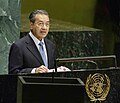 Mahathir Mohamad, 4th and 7th Prime Minister of Malaysia
 -
 Margaret Chan, 7th Director-General of the World Health Organization
 -
 Kishore Mahbubani, President of the United Nations Security Council (2001–2002)
 -
 Halimah Yacob, 8th President of Singapore
 -
 Ng Eng Hen, Singapore Minister for Defence
 -
 Sha'ari Tadin, Member of Parliament and founder of Singapore Central Council (Majlis Pusat Singapura)


.jpg)


Attribution[edit]
- Some content on this page may previously have appeared on Wikipedia.
Footnotes[edit]
- ↑ Corporate Colours – website NUS
- ↑ (2007) "Towards an "entrepreneurial university" model to support knowledge-based economic development: the case of the National University of Singapore, Poh-Kam Wong, Yuen-Ping Ho, Annette Singh". World Development 35 (6): 941–958. DOI:10.1016/j.worlddev.2006.05.007. Research Blogging.
- ↑ National University of Singapore (NUS) (en). QS Top Universities.
- ↑ QS World University Rankings 2021 (en) (28 May 2020).
- ↑ QS University Rankings: Asia 2021 (en) (19 November 2020).
- ↑ Wikipedia has an article about Academic Ranking of World Universities
- ↑ 7.0 7.1 QS World University Rankings 2023.
- ↑ 8.0 8.1 Times Higher Education World University Rankings 2023. Times Higher Education.
- ↑ 9.0 9.1 History. National University of Singapore.
- ↑ About Duke-NUS Medical School.
- ↑ University Town, NUS · 2 College Ave West, Stephen Riady Centre, Singapore 138607 (en).
- ↑ 12.0 12.1 Loo Lay Yen. National University of Singapore: A Brief Chronological History. Lib.nus.edu.sg.
- ↑ 13.0 13.1 13.2 GOVERNMENT MEDICAL SCHOOL FOR MALAYA.. The Singapore Free Press and Mercantile Advertiser (Weekly) (5 October 1905).
- ↑ Zaccheus, Melody (10 February 2019). Shedding light on life and legacy of Peranakan pioneer Tan Kim Seng (en).
- ↑ A Legacy of Giving.
- ↑ King Edward VII College of Medicine | Infopedia. eresources.nlb.gov.sg.
- ↑ 17.0 17.1 Our History - NUS Yong Loo Lin School of Medicine. NUS Yong Loo Lin School of Medicine.
- ↑ National University of Singapore website – Milestones. Nus.edu.sg.
- ↑ Raffles College | Infopedia. eresources.nlb.gov.sg.
- ↑ 20.0 20.1 corporate@um.edu.my. Our History. um.edu.my.
- ↑ History. National University of Singapore.
- ↑ Milestones. National University of Singapore.
- ↑ Chng, Grace (20 May 2012). Start-up godfather. The Straits Times.
- ↑ https://sg.news.yahoo.com/blogs/singaporescene/poreans-outraged-over-prc-scholar-dog-072146916.html
- ↑ https://sg.news.yahoo.com/chinese-scholar-sun-xu-s-scholarship-terminated.html
- ↑ https://newsinfo.inquirer.net/167653/chinese-student-punished-for-calling-singaporeans-dogs
- ↑ https://temasektimes.wordpress.com/2012/03/01/chinas-netizens-rally-behind-sun-xu-and-agree-with-him-that-singaporeans-are-dogs/
- ↑ https://www.straitstimes.com/singapore/students-say-nus-orientation-camp-games-increasingly-sexualised-some-told-to-re-enact-rape
- ↑ NUS Business School reviewing visiting professor’s credentials after accusations of academic fraud (en).
- ↑ NUS Visiting Professor Embroiled In Fake Degree Scandal, Profile Removed From University's Website (en-GB) (2022-07-24).
- ↑ Visiting professor at NUS Business School called out in China as fraud with fake credentials (en).
- ↑ https://mothership.sg/2019/09/singapore-crime-nus-molest-good-grades/
- ↑ https://sg.news.yahoo.com/nus-dental-student-who-strangled-exgirlfriend-given-12-days-detention-no-criminal-record-100531057.html
- ↑ https://www.channelnewsasia.com/singapore/nus-student-admits-climbing-ex-girlfriends-home-strangling-her-779261
- ↑ https://www.todayonline.com/singapore/nus-dentistry-student-who-choked-ex-girlfriend-suspended-and-barred-campus-pending-disciplinary
- ↑ https://www.straitstimes.com/singapore/nus-dentistry-student-who-tried-to-strangle-ex-girlfriend-suspended-by-nus-facing-ongoing
- ↑ https://www.change.org/p/national-university-of-singapore-expulsion-from-nus-for-yin-zi-qin
- ↑ https://www.channelnewsasia.com/singapore/jeremy-fernando-nus-tembusu-safe-nus-692781
- ↑ https://www.channelnewsasia.com/singapore/former-nus-lecturer-jeremy-fernando-acquitted-molestation-4082106
- ↑ https://mothership.sg/2024/01/jeremy-fernando-molestation-charge-compounded/
- ↑ https://sg.news.yahoo.com/nus-sacks-professor-sexually-harassing-student-highprofile-dismissal-045220885.html
- ↑ https://www.todayonline.com/singapore/former-director-east-asian-institute-hugged-colleague-without-consent-acted
- ↑ https://www.straitstimes.com/singapore/former-director-of-nus-east-asian-institute-had-behaved-inappropriately-with-subordinate
- ↑ https://www.channelnewsasia.com/singapore/student-fined-s5000-fly-drone-ntu-campus-yunnan-garden-take-photos-girlfriend-xu-zi-zhou-2999016
- ↑ https://www.channelnewsasia.com/singapore/nus-ethan-putterman-fass-pol-science-professor-inappropriate-behaviour-2653521
- ↑ https://www.todayonline.com/singapore/sacked-nus-prof-admits-mistake-behaving-inappropriately-towards-student-claims-everything-was-consensual-1886521
- ↑ https://www.todayonline.com/singapore/nus-student-expelled-after-filming-sex-acts-2-women-without-their-consent
- ↑ https://www.todayonline.com/singapore/nus-investigating-after-crypto-mining-rigs-found-utown-residence-1871591
- ↑ https://www.todayonline.com/singapore/nus-student-packs-crypto-mining-rigs-dorm-1872426
- ↑ https://www.straitstimes.com/singapore/courts-crime/former-research-fellow-convicted-of-forging-expense-claims-and-cheating-nus-of-39500
- ↑ https://www.todayonline.com/singapore/ex-research-fellow-jailed-20-weeks-cheating-nus-s39000-submitting-fake-expense-claims-1952346
- ↑ https://www.channelnewsasia.com/singapore/ex-nus-prof-jailed-fake-invoices-dupe-84000-television-vacuum-4283366
- ↑ National University of Singapore (NUS). Ministry of Education, Singapore.
- ↑ 2022-2023 Best Global Universities Rankings.
- ↑ Full Rankings | Rankings.
- ↑ SCImago Institutions Rankings - Higher Education - All Regions and Countries - 2020 - Overall Rank.
- ↑ Middle East Technical University, Graduate School of Informatics.
- ↑ World Reputation Rankings 2022. Times Higher Education.
- ↑ Most international universities in the world 2018: top 200. Times Higher Education.
- ↑ 60.0 60.1 60.2 QS World University Rankings by Subject 2022 (en).
- ↑ Sixteen NUS programmes in global top 10 (en-sg).
- ↑ Auto, Hermes (2022-04-06). NUS and NTU are top universities in Asia in QS world university rankings | The Straits Times (en).
- ↑ Symonds, QS Quacquarelli. QS World University Rankings by Subject 2022 (en).
- ↑ World University Rankings by subject (en).
- ↑ Business school rankings from the Financial Times - FT.com.
- ↑ Best universities for graduate jobs: Global University Employability Ranking 2022 (en) (2022-11-23).
- ↑ QS Graduate Employability Rankings 2018.
- ↑ Faculty & Departments. Bschool.nus.edu (31 July 2010).
- ↑ Double Degree – NUS MBA. mba.nus.edu.sg.
- ↑ NUS – School of Computing. Comp.nus.edu.sg.
- ↑ NUS Computing - Master's in Computer Science. comp.nus.edu.sg.
- ↑ NUS - Faculty of Dentistry.
- ↑ College of Design and Engineering.
- ↑ NUS School of Design and Environment.
- ↑ Academic Ranking of World Universities in Engineering/Technology and Computer Sciences - 2016 - 2016 Top 100 Universities in Natural Sciences and Mathematics - ARWU-FIELD 2016.
- ↑ Engineering and Technology (3 March 2017).
- ↑ World University Rankings 2016-2017 by subject: engineering and technology (20 September 2016).
- ↑ Home Page – NUS College of Humanities and Sciences.
- ↑ Teng, Amelia (8 December 2020). NUS launches new interdisciplinary College of Humanities and Sciences (en).
- ↑ Role, Mission & Heritage - NUS Faculty of Arts and Social Sciences.
- ↑ Departments - NUS Faculty of Arts and Social Sciences.
- ↑ About the South Asian Studies Programme.
- ↑ (2015) Singapore's Scientific Pioneers. Singapore: Asian Scientist Publishing Pte Ltd. ISBN 978-981-09-5893-0.
- ↑ NGS – NUS Graduate School for Integrative Sciences and Engineering. Nus.edu.sg (3 August 2015).
- ↑ History & Milestones - NUS Law. NUS Law.
- ↑ Alice Lee Centre for Nursing Studies-Yong Loo Lin School Of Medicine.
- ↑ (2012) "21st Century Learning in Medicine: Traditional Teaching versus Team-Based Teaching". Medical Science Educator 22 (2): 57–64. DOI:10.1007/BF03341758. Research Blogging.
- ↑ The School.
- ↑ Milestone.
- ↑ NUS LKYSPP (2015). Lee Kuan Yew School of Public Policy.
- ↑ 91.0 91.1 Overview – University Scholars Programme. usp.nus.edu.sg.
- ↑ Residential Colleges.
- ↑ 93.0 93.1 FAQs – Yale-NUS College.
- ↑ Fischer, Karin (30 May 2012). Yale Scholar Will Be First President of New Institution in Singapore.
- ↑ Davie, Sandra (30 May 2012). Prof Pericles Lewis named president of Yale-NUS liberal arts college.
- ↑ 'Not the job' of Yale-NUS College to tell students what to think (30 May 2012).
- ↑ Yale's Pericles Lewis to be inaugural Yale-NUS president, Yale News, 30 May 2012.
- ↑ Yale-NUS to be merged into a new college in 2025 as NUS seeks interdisciplinary education at scale.
- ↑ NUS College.
- ↑ Davie, Sandra. What's behind the decision to close Yale-NUS College?, The Straits Times, 5 September 2021.
- ↑ History, Vision & Mission, Strategies. nus.edu.sg.
- ↑ CIT - About. cit.nus.edu.sg.
- ↑ CIT – Quality. Cit.nus.edu.sg (16 January 2003).
- ↑ About Us. nus.edu.sg.
- ↑ About Us. iss.nus.edu.sg.
- ↑ Yale-NUS College. teaching.yale-nus.edu.sg.
- ↑ NUS High School celebrates 10 years of math and science education.
- ↑ NUS High School of Mathematics and Science.
- ↑ key areas. nus.edu.sg.
- ↑ Research Areas & Facilities. Materials Science and Engineering.
- ↑ Home - Temasek Defence Systems Institute. Temasek Defence Systems Institute.
- ↑ Research Areas. Biomedical Engineering.
- ↑ National University of Singapore (en) (November 2021).
- ↑ National University of Singapore (en) (June 2011).
- ↑ National University of Singapore (en) (March 2013).
- ↑ National University of Singapore (en) (September 2021).
- ↑ National University of Singapore (en) (October 2011).
- ↑ National University of Singapore (en) (October 2008).
- ↑ National University of Singapore (en) (March 2017).
- ↑ National University of Singapore (en) (June 2020).
- ↑ Shafeeq, Syarafana. New NUS research centre to study functional intelligent materials with uses such as in artificial organs, 7 October 2021.
- ↑ Research Institutes.
- ↑ Logistics Education at NUS. Edumaritime.com.
- ↑ Home.
- ↑ S'pore start-up incubator sets up US hub.
- ↑ Our Purpose - NUS Enterprise. NUS Enterprise.
- ↑ Tan, Eng Chye. Which university? Which course of study?, 25 April 2016.
- ↑ NUS researchers turn waste paper into oil absorbent.
- ↑ NUS And SCS Unveil Biggest Supercomputing Grid in the Region. NCS (16 November 2004).
- ↑ Library Statistics 2016/2017. Libportal.nus.edu.sg.
- ↑ Library Statistics 2016/2017. ocr (19 January 2018).
- ↑ Leow, Si Wan (1 April 2010). August 2011 start for UTown at NUS.
- ↑ About UTown.
- ↑ Getting around NUS.
- ↑ Transforming campus mobility through electrification (en-sg).
- ↑ Graduates.
- ↑ Home | IHG 18/19. IHG 18/19.
- ↑ NUS Halls of Residence. National University of Singapore.
- ↑ Student Residences. National University of Singapore.
- ↑ UTown Residence " University Town. Utown.nus.edu.sg.
- ↑ Your residential options @NUS.
- ↑ Cinnamon College (USP) – University Scholars Programme. usp.nus.edu.sg.
- ↑ About - Tembusu College. tembusu.nus.edu.sg.
- ↑ Professor Tommy Koh - People - Tembusu College. tembusu.nus.edu.sg.
- ↑ About Us | The College of Alice & Peter Tan. The College of Alice & Peter Tan.
- ↑ RC4 Experience – NUS Residential College 4. rc4.nus.edu.sg. “,”
- ↑ Ridge View Annex (RVA) – NUS Office of Estate Development (OED). uci.nus.edu.sg.
- ↑ Loo Lay Yen. Our Chancellors and Vice-Chancellors : a biographical sketch : Roll of Honour. Lib.nus.edu.sg.
- ↑ NUS: Faculty of Law - Alumni. law1.nus.edu.sg.
- ↑ NUS alumni to comprise almost half of 14th Singapore Parliament (28 July 2020).
- ↑ Professor S Jayakumar appointed as NUS Pro-Chancellor (18 June 2020).
- ↑ Chew Choon Seng | GIC Board of Directors. GIC.
- ↑ Olivia Lum, Hyflux Ltd: Profile and Biography. Bloomberg.com.
- ↑ Ho Ching. Forbes.
- ↑ Philip L. Yeo, MBA 1976 - Alumni - Harvard Business School. alumni.hbs.edu (January 2006). “University of Singapore”
- ↑ Min-Liang Tan, Razer Inc: Profile and Biography. Bloomberg.com.
- ↑ Congratulations to Dr Margaret Chan, one of CNN's 19 Most Important Women in the History of Science - Saw Swee Hock School of Public Health. Saw Swee Hock School of Public Health.
- ↑ About Kishore Mahbubani - Kishore Mahbubani. Kishore Mahbubani.
- ↑ NG SER MIANG | Thomson Medical. Thomson Medical.
- ↑ LawLink (2008).
- ↑ 60 years of legal education (24 October 2017).
- ↑ CHAN Sek Keong - NUS Law. NUS Law.
- ↑ Yoke San Reynolds, U-Va.'s retiring vice president, saved the university nearly $1 billion.
- ↑ Kumari, Sheena. Wang Gungwu | Infopedia. eresources.nlb.gov.sg.
 EncycloReader
is supported by the
EncycloReader
is supported by the  KSF
KSF