Virtual community
 From EduTechWiki - Reading time: 4 min
Definition[edit | edit source]
- A virtual community, also called online community is a group of people that interact through computer-mediated communication, mostly a website or portal that provides various channels for social networking.
- PC Magazine (20:17, 26 June 2006 (MEST)) defines virtual community as “a group of individuals who share a common interest via e-mail, blogs, instant messages, chat rooms or newsgroups. Members of a virtual community are self-subscribing. Contrast with virtual workgroup”
- “A virtual community is defined herein as an aggregation of individuals or business partners who interact around a shared interest, where the interaction is at least partially supported and/or mediated by technology and guided by some protocols or norms. This definition embraces key components of definitions put forth in existing literature by including elements such as interacting groups of people, shared interest and technology mediation.” (C.E. Porter retrieved 20:17, 26 June 2006 (MEST))
- “A virtual community is a group of people communicating or interacting with each other by means of information technologies, typically the Internet, rather than in person. Virtual communities are also known as online communities or computer-mediated communities (CMC) [...] Today, virtual community or online community can be used loosely for a variety of social groups interacting via the Internet. It does not necessarily mean that there is a strong bond among the members although Rheingold mentions in that virtual communities form "when people carry on public discussions long enough, with sufficient human feeling, to form webs of personal relationships" [1]. An email distribution list may have hundreds of members and the communication which takes place may be merely informational (questions and answers are posted), but members may remain relative strangers and the membership turnover rate could be high. This is in line with the liberal use of the term community.” (Wikipedia retrieved 20:17, 26 June 2006 (MEST)).
DSchneider agrees with this Wikipedia definition and suggests reading the community of practice article that deals with more Rheingold-like considerations.
Typologies[edit | edit source]
Typically, in educational technology one often makes the distinction between a the (virtual) community of interest and the (virtual) community of practice. A community of learning or a knowledge-building community are somewhat in between...
Virtual habitats and MMORPG are other forms of virtual environments more common in the world of gaming and social role playing, but they also constitute a kind of virtual community even if sometimes avatars don't have real world identity.
Constance E. Porter defines five Ps of virtual communities and that would allow to categorize virtual communities:
- Purpose (Content of Interaction) -- This attribute describes the specific focus of discourse, or focal content of communication, among community members.
- Place (Extent of Technology Mediation of Interaction) -- This attribute defines the location of interaction, where interaction occurs either completely virtually or only partially virtually.
- Platform (Design of Interaction) -- This attribute refers to the technical design of interaction in the virtual community, where designs enable synchronous communication, asynchronous communication or both.
- Population (Pattern of Interaction) -- This attribute refers to the pattern of interaction among community members as described by group structure (e.g. small group or network) and type of social ties (e.g. strong, weak, stressful).
- Profit Model (Return on Interaction) -- This attribute refers to whether a community creates tangible economic value where value is defined as revenue-generation.
In a nice drawing made in 2007, Randall Munroe, distinguished between practicals vs. intellectuals and focus on real life vs. focus on web. This map also shows estimated size of membership. It comes as not such a big surprise that "my" spaces were very big.

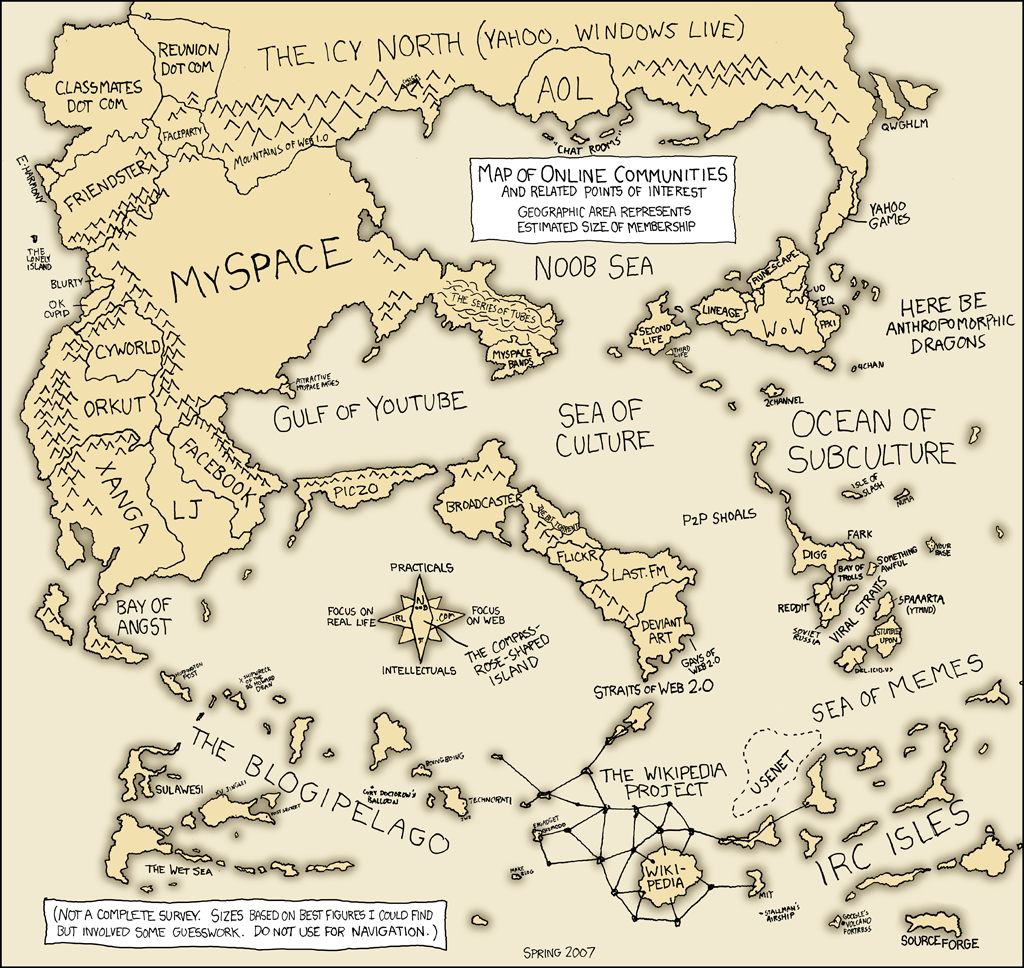
This map looks very different in the 2010 update. A full view is available here.

An other update was made by Ethan Block, also in 2010.
Technology[edit | edit source]
In principle, any Internet technology that enables computer-mediated communication can support virtual communities.
Over the years different networking technologies emerged and most of it still exists.
- 1980's
- UseNet the first decentralized forum system helped to shape within computer science population what today can be called the "Internet culture"
- Bulletin Board Systems were the equivalent in the PC world
- Early forms of virtual habitats like text-based virtual reality or 2D interactive environments.
- Early 1990's
- Mailing lists and Forums evolve
- Mailing lists are being managed through various kinds of List servers
- Web-based forums appear.
- User programmable text-based virtual reality (e.g. MOOs
- Late 1990's and early 2000's
- Portals, web-based groupware, learning management systems include to various degrees support for on-line communities. Mostly, support is weak, since typical management (in particular universities) are not interested in fostering virtual communities.
- Networked many user computer games such as MMORPGs
- Multi-user 3D interactive environments
- Mid 2000
- Social software in various forms
- Some renewal of 3D worlds (e.g. Second Life).
- learning management systems include more collaborative features like wikis (but the principle that a class should be isolated and its space killed after the term still very much dominates.
- Personal learning environment in the sense that they can (like blogs) be tied together by some of its components that can be shared.
Links[edit | edit source]
- Wikipedia - Virtual community
- The WELL Community and the some, since 1985. “The WELL is a cherished and acclaimed destination for conversation and discussion. For twenty years it has captivated intelligent, creative people. It is widely known as the primordial ooze where the online community movement was born — where Howard Rheingold first coined the term "virtual community.” ([1], retrieved 16:21, 8 April 2007 (MEST))
- Wiki:Virtual Community/Social Media Stanford 2012 Course Wiki, Course page. Instructor: Howard Rheingold. This page includes summaries and links to readings and videos.
References[edit | edit source]
- Porter, Constance Elise, A Typology of Virtual Communities: A Multi-Disciplinary Foundation for Future Research, JCMC 10 (1), Article 3, November 2004 (HTML)
- Rheingold, H. (2000). The Virtual Community: Homesteading on the Electronic Frontier. London: MIT Press. (ISBN 0262681218) - HTML free online.
 EncycloReader
is supported by the
EncycloReader
is supported by the  KSF
KSF