Table of Contents Categories
AU Microscopii
Topic: Astronomy
 From HandWiki - Reading time: 14 min
250px AU Microscopii, J band image, 2MASS. | |
| Observation data Equinox J2000.0]] (ICRS) | |
|---|---|
| Constellation | Microscopium |
| Right ascension | 20h 45m 09.53250s[1] |
| Declination | –31° 20′ 27.2379″[1] |
| Apparent magnitude (V) | 8.73[2] |
| Characteristics | |
| Spectral type | M1Ve[2] |
| Apparent magnitude (V) | 8.627±0.052[3] |
| Apparent magnitude (J) | 5.436±0.017[3] |
| U−B color index | 1.01 |
| B−V color index | 1.45 |
| Variable type | Flare star |
| Astrometry | |
| Radial velocity (Rv) | −6.90±0.37[1] km/s |
| Proper motion (μ) | RA: +281.319[1] mas/yr Dec.: -360.148[1] mas/yr |
| Parallax (π) | 102.9432 ± 0.0231[1] mas |
| Distance | 31.683 ± 0.007 ly (9.714 ± 0.002 pc) |
| Absolute magnitude (MV) | 8.61 |
| Details | |
| Mass | 0.60±0.04[3] M☉ |
| Radius | 0.82±0.02[3] R☉ |
| Luminosity | 0.102±0.002[3] L☉ |
| Surface gravity (log g) | 4.52±0.05[3] cgs |
| Temperature | 3665±31[3] K |
| Rotation | 4.8367±0.0006 d[4] |
| Rotational velocity (v sin i) | 8.5±0.2[3] km/s |
| Age | 23±3, 18.5±2.4[3] Myr |
| Other designations | |
| Database references | |
| SIMBAD | data |
| Exoplanet Archive | data |
| ARICNS | data |
AU Microscopii (AU Mic) is a young red dwarf star located 31.7 light-years (9.7 parsecs) away – about 8 times as far as the closest star after the Sun.[5] The apparent visual magnitude of AU Microscopii is 8.73,[2] which is too dim to be seen with the naked eye. It was given this designation because it is in the southern constellation Microscopium and is a variable star. Like β Pictoris, AU Microscopii has a circumstellar disk of dust known as a debris disk and at least three exoplanets, with the presence of an additional planet being likely.[6][3]
Stellar properties
AU Mic is a young star at only 22 million years old; less than 1% of the age of the Sun.[7] With a stellar classification of M1 Ve,[2] it is a red dwarf star[8] with a physical radius of 75% that of the Sun. Despite being half the Sun's mass,[9][10] it is radiating only 9%[11] as much luminosity as the Sun. This energy is being emitted from the star's outer atmosphere at an effective temperature of 3,700 K, giving it the cool orange-red hued glow of an M-type star.[12] AU Microscopii is a member of the β Pictoris moving group.[13][14] AU Microscopii may be gravitationally bound to the binary star system AT Microscopii.[15]

AU Microscopii has been observed in every part of the electromagnetic spectrum from radio to X-ray and is known to undergo flaring activity at all these wavelengths.[17][18][19][20] Its flaring behaviour was first identified in 1973.[21][22] Underlying these random outbreaks is a nearly sinusoidal variation in its brightness with a period of 4.865 days. The amplitude of this variation changes slowly with time. The V band brightness variation was approximately 0.3 magnitudes in 1971; by 1980 it was merely 0.1 magnitudes.[23]
Planetary system
AU Microscopii's debris disk has an asymmetric structure and an inner gap or hole cleared of debris, which has led a number of astronomers to search for planets orbiting AU Microscopii. By 2007, no searches had led to any detections of planets.[24][25] However, in 2020 the discovery of a Neptune-sized planet was announced based on transit observations by TESS.[7] Its rotation axis is well aligned with the rotation axis of the parent star, with the misalignment being equal to 5+16−15°.[26]
Since 2018, a second planet, AU Microscopii c, was suspected to exist. It was confirmed in December 2020, after additional transit events were documented by the TESS observatory.[27] A 2024 study which performed measurements of Rossiter–McLaughlin effect for the planet c revealed that the planet is possibly misaligned with the star's rotation axis, returning a poorly constrained value of projected obliquity λc = 67.8°+31.7°
−49.0°.[28]
A third planet in the system was suspected since 2022 based on transit-timing variations,[29] and "validated" in 2023, although several possible orbital periods of planet d cannot be ruled out yet. This planet has a mass comparable to that of Earth.[6] Radial velocity observations have also found evidence for a fourth, outer planet as of 2023.[3] Observations of the AU Microscopii system with the James Webb Space Telescope were unable to confirm the presence of previously unknown companions.[30] Observations with CHEOPS also detected strong TTVs of AU Mic c, which can be explained with planet d on a 12.6 day orbit. The mass of planet d is found to be only about 20% of the mass of earth (or two Mars masses) according to this study.[31]
| Companion (in order from star) |
Mass | Semimajor axis (AU) |
Orbital period (days) |
Eccentricity | Inclination | Radius |
|---|---|---|---|---|---|---|
| b | 6.3+2.5 −1.8 M⊕ |
0.0645±0.0013 | 8.4630351±0.0000003 | 0.00021±0.00006 | 89.9904+0.0036 −0.0019° |
4.07±0.17 R⊕ |
| d (unconfirmed) | <4.9 M⊕ | — | 12.73812±0.00128 | 0.00097±0.00042 | 88.10±0.43° | — |
| c | 11.6+3.3 −2.7 M⊕ |
0.1101±0.0020 | 18.85901±0.00009 | 0.01056±0.00089 | 89.589+0.058 −0.068° |
3.24±0.16 R⊕ |
| e (unconfirmed) | 35.2+6.7 −5.4 M⊕ |
0.17 | 33.11±0.06 | — | — | — |
| Debris disk | <50–>150 AU | — | — | |||
Debris disk

File:Mysterious ripples moving through the disc of AU Microscopii.webm
.jpeg)
All-sky observations with the Infrared Astronomy Satellite revealed faint infrared emission from AU Microscopii.[35][36] This emission is due to a circumstellar disk of dust which first resolved at optical wavelengths in 2003 by Paul Kalas and collaborators using the University of Hawaii 2.2-m telescope on Mauna Kea, Hawaii.[5] This large debris disk faces the earth edge-on at nearly 90 degrees,[37] and measures at least 200 AU in radius. At these large distances from the star, the lifetime of dust in the disk exceeds the age of AU Microscopii.[5] The disk has a gas to dust mass ratio of no more than 6:1, much lower than the usually assumed primordial value of 100:1.[38] The debris disk is therefore referred to as "gas-poor", as the primordial gas within the circumstellar system has been mostly depleted.[39] The total amount of dust visible in the disk is estimated to be at least a lunar mass, while the larger planetesimals from which the dust is produced are inferred to have at least six lunar masses.[40]
The spectral energy distribution of AU Microscopii's debris disk at submillimetre wavelengths indicate the presence of an inner hole in the disk extending to 17 AU,[41] while scattered light images estimate the inner hole to be 12 AU in radius.[42] Combining the spectral energy distribution with the surface brightness profile yields a smaller estimate of the radius of the inner hole, 1 - 10 AU.[24] The inner part of the disk is asymmetric and shows structure in the inner 40 AU.[43] The inner structure has been compared with that expected to be seen if the disk is influenced by larger bodies or has undergone recent planet formation.[43] The surface brightness (brightness per area) of the disk in the near infrared as a function of projected distance from the star follows a characteristic shape. The inner of the disk appear approximately constant in density and the brightness is unchanging, more-or-less flat.[42] Around the density and surface brightness begins to decrease: first it decreases slowly in proportion to distance as ; then outside , the density and brightness drops much more steeply, as .[42] This "broken power-law" shape is similar to the shape of the profile of β Pic's disk.
In October 2015 it was reported that astronomers using the Very Large Telescope (VLT) had detected very unusual outward-moving features in the disk. By comparing the VLT images with those taken by the Hubble Space Telescope in 2010 and 2011 it was found that the wave-like structures are moving away from the star at speeds of up to 10 kilometers per second (22,000 miles per hour). The waves farther away from the star seem to be moving faster than those close to it, and at least three of the features are moving fast enough to escape the gravitational pull of the star.[44] Follow-up observations with the SPHERE instrument on the Very Large Telescope were able to confirm the presence of the fast-moving features,[45] and James Webb Space Telescope observations found similar features within the disk in two NIRCam filters;[30] however, these features have not been detected in the radio with Atacama Large Millimeter Array observations.[46][47] These fast-moving features have been described as "dust avalanches", where dust particles catastrophically collide into planetesimals within the disk.[48][47]
Methods of observation
File:Hubble captures blobs of material sweeping through stellar disc AU Microscopii.tif AU Mic's disk has been observed at a variety of different wavelengths, giving humans different types of information about the system. The light from the disk observed at optical wavelengths is stellar light that has reflected (scattered) off dust particles into Earth's line of sight. Observations at these wavelengths utilize a coronagraphic spot to block the bright light coming directly from the star. Such observations provide high-resolution images of the disk. Because light having a wavelength longer than the size of a dust grain is scattered only poorly, comparing images at different wavelengths (visible and near-infrared, for example) gives humans information about the sizes of the dust grains in the disk.[50]
![millimeter observation of the disk from the REASONS survey[51]](https://handwiki.org/wiki/File:The_74_exocomet_belts_imaged_by_ALMA%E2%80%99s_REASONS_survey,_showing_belts_of_all_shapes,_sizes_and_ages_(REASONS_comboplot_full_nonames).jpg)
Optical observations have been made with the Hubble Space Telescope and Keck Telescopes. The system has also been observed at infrared and sub-millimeter wavelengths with the James Clerk Maxwell Telescope, Spitzer Space Telescope, and the James Webb Space Telescope. This light is emitted directly by dust grains as a result of their internal heat (modified blackbody radiation). The disk cannot be resolved at these wavelengths, so such observations are measurements of the amount of light coming from the entire system. Observations at increasingly longer wavelengths give information about dust particles of larger sizes and at larger distances from the star.
Gallery
-
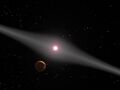 Artist's impression of AU Microscopii Credit: NASA/ESA/G. Bacon (STScI)
 -
 Artist's impression of AU Microscopii and planet AU Mic b, which is losing mass.
 -
 Artist's interpretation of AU Microscopii b, with the star in the back. Via Blufound

.jpg)

See also
- List of exoplanets discovered in 2020 - AU Microscopii b and c
- List of exoplanets discovered in 2023 - AU Microscopii d
References
- ↑ 1.0 1.1 1.2 1.3 1.4 Vallenari, A. et al. (2022). "Gaia Data Release 3. Summary of the content and survey properties". Astronomy & Astrophysics. doi:10.1051/0004-6361/202243940 Gaia DR3 record for this source at VizieR.
- ↑ 2.0 2.1 2.2 2.3 Torres, C. A. O. et al. (December 2006), "Search for associations containing young stars (SACY). I. Sample and searching method", Astronomy and Astrophysics 460 (3): 695–708, doi:10.1051/0004-6361:20065602, Bibcode: 2006A&A...460..695T
- ↑ 3.00 3.01 3.02 3.03 3.04 3.05 3.06 3.07 3.08 3.09 3.10 3.11 Donati, J-F; Cristofari, P I; Finociety, B et al. (24 April 2023). "The magnetic field and multiple planets of the young dwarf AU Mic". Monthly Notices of the Royal Astronomical Society 525: 455–475. doi:10.1093/mnras/stad1193. ISSN 0035-8711.
- ↑ Szabó, Gy. M. et al. (October 2021). "The changing face of AU Mic b: stellar spots, spin-orbit commensurability, and transit timing variations as seen by CHEOPS and TESS". Astronomy & Astrophysics 654: A159. doi:10.1051/0004-6361/202140345. Bibcode: 2021A&A...654A.159S.
- ↑ 5.0 5.1 5.2 Kalas, Paul; Liu, Michael C.; Matthews, Brenda C. (26 March 2004). "Discovery of a Large Dust Disk Around the Nearby Star AU Microscopii". Science 303 (5666): 1990–1992. doi:10.1126/science.1093420. PMID 14988511. Bibcode: 2004Sci...303.1990K.
- ↑ 6.0 6.1 6.2 Wittrock, Justin M. et al. (2023), "Validating AU Microscopii d with Transit Timing Variations", The Astronomical Journal 166 (6): 232, doi:10.3847/1538-3881/acfda8, Bibcode: 2023AJ....166..232W
- ↑ 7.0 7.1 Plavchan, Peter et al. (2020). "A planet within the debris disk around the pre-main-sequence star AU Microscopii". Nature 582 (7813): 497–500. doi:10.1038/s41586-020-2400-z. PMID 32581383. Bibcode: 2020Natur.582..497P.
- ↑ Maran, S. P. et al. (September 1991). "An Investigation of the Flare Star AU Mic with the Goddard High Resolution Spectrograph on the Hubble Space Telescope". Bulletin of the American Astronomical Society 23: 1382. Bibcode: 1991BAAS...23.1382M.
- ↑ Del Zanna, G.; Landini, M.; Mason, H. E. (April 2002). "Spectroscopic diagnostics of stellar transition regions and coronae in the XUV: AU Mic in quiescence". Astronomy and Astrophysics 385 (3): 968–985. doi:10.1051/0004-6361:20020164. Bibcode: 2002A&A...385..968D. http://discovery.ucl.ac.uk/9518/1/9518.pdf.
- ↑ Mouillet, David (26 March 2004). "Nearby Planetary Disks". Science 303 (5666): 1982–1983. doi:10.1126/science.1095851. PMID 15044792.
- ↑ Plavchan, Peter et al. (June 2009), "New Debris Disks Around Young, Low-Mass Stars Discovered with the Spitzer Space Telescope", The Astrophysical Journal 698 (2): 1068–1094, doi:10.1088/0004-637X/698/2/1068, Bibcode: 2009ApJ...698.1068P
- ↑ "The Colour of Stars", Australia Telescope, Outreach and Education (Commonwealth Scientific and Industrial Research Organisation), December 21, 2004, http://outreach.atnf.csiro.au/education/senior/astrophysics/photometry_colour.html, retrieved 2012-01-16
- ↑ Zuckerman, B.; Song, Inseok (September 2004). "Young Stars Near the Sun". Annual Review of Astronomy & Astrophysics 42 (1): 685–721. doi:10.1146/annurev.astro.42.053102.134111. Bibcode: 2004ARA&A..42..685Z.
- ↑ Barrado y Navascués, David et al. (August 1, 1999). "The age of beta Pictoris". The Astrophysical Journal 520 (2): L123–L126. doi:10.1086/312162. Bibcode: 1999ApJ...520L.123B.
- ↑ Monsignori Fossi, B. C. et al. (October 1995). "The EUV spectrum of AT Microscopii". Astronomy & Astrophysics 302: 193. Bibcode: 1995A&A...302..193M.
- ↑ "MAST: Barbara A. Mikulski Archive for Space Telescopes". Space Telescope Science Institute. https://mast.stsci.edu/portal/Mashup/Clients/Mast/Portal.html.
- ↑ Maran, S. P. et al. (1 February 1994). "Observing stellar coronae with the Goddard High Resolution Spectrograph. 1: The dMe star AU microscopoii". The Astrophysical Journal 421 (2): 800–808. doi:10.1086/173692. Bibcode: 1994ApJ...421..800M.
- ↑ Cully, Scott L. et al. (September 10, 1993). "Extreme Ultraviolet Explorer deep survey observations of a large flare on AU Microscopii". The Astrophysical Journal 414 (2): L49–L52. doi:10.1086/186993. Bibcode: 1993ApJ...414L..49C.
- ↑ Kundu, M. R. et al. (15 January 1987). "Microwave observations of the flare stars UV Ceti, AT Microscopii, and AU Microscopii". The Astrophysical Journal 312: 822–829. doi:10.1086/164928. Bibcode: 1987ApJ...312..822K.
- ↑ Tsikoudi, V.; Kellett, B. J. (December 2000). "ROSAT All-Sky Survey X-ray and EUV observations of YY Gem and AU Mic". Monthly Notices of the Royal Astronomical Society 319 (4): 1147–1153. doi:10.1046/j.1365-8711.2000.03905.x. Bibcode: 2000MNRAS.319.1147T.
- ↑ Kunkel, W. E. (1973). "Activity in Flare Stars in the Solar Neighborhood". The Astrophysical Journal Supplement 25: 1. doi:10.1086/190263. Bibcode: 1973ApJS...25....1K.
- ↑ Butler, C. J. et al. (December 1981). "Ultraviolet spectra of dwarf solar neighbourhood stars. I". Monthly Notices of the Royal Astronomical Society 197 (3): 815–827. doi:10.1093/mnras/197.3.815. Bibcode: 1981MNRAS.197..815B.
- ↑ Butler, C. J. et al. (March 1987). "Rotational modulation and flares on RS CVn and BY DRA systems. II - IUE observations of BY Draconis and AU Microscopii". Astronomy and Astrophysics 174 (1–2): 139–157. Bibcode: 1987A&A...174..139B.
- ↑ 24.0 24.1 Stanimir A. Metchev; Joshua A. Eisner; Lynne A. Hillenbrand (March 20, 2005). "Adaptive Optics Imaging of the AU Microscopii Circumstellar Disk: Evidence for Dynamical Evolution". The Astrophysical Journal 622 (1): 451–462. doi:10.1086/427869. Bibcode: 2005ApJ...622..451M.
- ↑ E. Masciadri; R. Mundt; Th. Henning; C. Alvarez (1 June 2005). "A Search for Hot Massive Extrasolar Planets around Nearby Young Stars with the Adaptive Optics System NACO". The Astrophysical Journal 625 (2): 1004–1018. doi:10.1086/429687. Bibcode: 2005ApJ...625.1004M.
- ↑ Addison, Brett C.; Horner, Jonathan; Wittenmyer, Robert A.; Plavchan, Peter; Wright, Duncan J.; Nicholson, Belinda A.; Marshall, Jonathan P.; Clark, Jake T. et al. (2021), "The Youngest Planet to Have a Spin-Orbit Alignment Measurement AU Mic B", The Astronomical Journal 162 (4): 137, doi:10.3847/1538-3881/ac1685, Bibcode: 2021AJ....162..137A
- ↑ 27.0 27.1 Martioli, E.; Hébrard, G.; Correia, A. C. M.; Laskar, J.; Lecavelier Des Etangs, A. (2021), "New constraints on the planetary system around the young active star AU Mic", Astronomy & Astrophysics 649: A177, doi:10.1051/0004-6361/202040235
- ↑ Yu, H. et al. (27 November 2024). "A possible misaligned orbit for the young planet AU Mic c". Monthly Notices of the Royal Astronomical Society 536 (3): 2046–2063. doi:10.1093/mnras/stae2655. Bibcode: 2025MNRAS.536.2046Y.
- ↑ Wittrock, Justin M. et al. (2022), "Transit Timing Variations for AU Microscopii b and C", The Astronomical Journal 164 (1): 27, doi:10.3847/1538-3881/ac68e5, Bibcode: 2022AJ....164...27W
- ↑ 30.0 30.1 Lawson, Kellen; Schlieder, Joshua E.; Leisenring, Jarron M.; Bogat, Ell; Beichman, Charles A.; Bryden, Geoffrey; Gáspár, András; Groff, Tyler D. et al. (2023-10-01). "JWST/NIRCam Coronagraphy of the Young Planet-hosting Debris Disk AU Microscopii". The Astronomical Journal 166 (4): 150. doi:10.3847/1538-3881/aced08. ISSN 0004-6256. Bibcode: 2023AJ....166..150L.
- ↑ 31.0 31.1 Matrà, L.; Marino, S.; Wilner, D. J.; Kennedy, G. M.; Booth, M.; Krivov, A. V.; Williams, J. P.; Hughes, A. M. et al. (2025-01-15). "REsolved ALMA and SMA Observations of Nearby Stars (REASONS): A population of 74 resolved planetesimal belts at millimetre wavelengths". Astronomy and Astrophysics 693. doi:10.1051/0004-6361/202451397. Bibcode: 2025A&A...693A.151M.
- ↑ Cale, Bryson L. et al. (1 December 2021). "Diving Beneath the Sea of Stellar Activity: Chromatic Radial Velocities of the Young AU Mic Planetary System". The Astronomical Journal 162 (6): 295. doi:10.3847/1538-3881/ac2c80. Bibcode: 2021AJ....162..295C.
- ↑ Donati, J. -F.; Cristofari, P. I.; Moutou, C.; L'Heureux, A.; Cook, N. J.; Artigau, E.; Alencar, S. H. P.; Gaidos, E.; Vidotto, A.; Petit, P.; Carmona, A.; Ray, T.; the SPIRou science team (2025). "Six-yr SPIRou monitoring of the young planet-host dwarf AU Mic". arXiv:2507.01746 [astro-ph.SR].
- ↑ "Dusty Debris Disk Around AU Mic6". October 18, 2023. https://esawebb.org/images/au-mic1/.
- ↑ "IRASFSC - IRAS Faint Source Catalog, Version 2.0". https://heasarc.gsfc.nasa.gov/W3Browse/all/irasfsc.html.
- ↑ Moshir, M. (1990-01-01). "IRAS Faint Source Catalogue, version 2.0.". IRAS Faint Source Catalogue: 0. Bibcode: 1990IRASF.C......0M. https://ui.adsabs.harvard.edu/abs/1990IRASF.C......0M.
- ↑ Paul Kalas, James R. Graham and Mark Clampin (23 June 2005). "A planetary system as the origin of structure in Fomalhaut's dust belt". Nature 435 (7045): 1067–1070. doi:10.1038/nature03601. PMID 15973402. Bibcode: 2005Natur.435.1067K.
- ↑ Aki Roberge; Alycia J. Weinberger; Seth Redfield; Paul D. Feldman (20 June 2005). "Rapid Dissipation of Primordial Gas from the AU Microscopii Debris Disk". The Astrophysical Journal 626 (2): L105–L108. doi:10.1086/431899. Bibcode: 2005ApJ...626L.105R.
- ↑ Roberge, Aki; Weinberger, Alycia J.; Redfield, Seth; Feldman, Paul D. (2005-06-01). "Rapid Dissipation of Primordial Gas from the AU Microscopii Debris Disk". The Astrophysical Journal 626 (2): L105–L108. doi:10.1086/431899. ISSN 0004-637X. Bibcode: 2005ApJ...626L.105R. https://ui.adsabs.harvard.edu/abs/2005ApJ...626L.105R.
- ↑ C. H. Chen; B. M. Patten; M. W. Werner; C. D. Dowell; K. R. Stapelfeldt; I. Song; J. R. Stauffer; M. Blaylock et al. (December 1, 2005). "A Spitzer Study of Dusty Disks around Nearby, Young Stars". The Astrophysical Journal 634 (2): 1372–1384. doi:10.1086/497124. Bibcode: 2005ApJ...634.1372C.
- ↑ Michael C. Liu; Brenda C. Matthews; Jonathan P. Williams; Paul G. Kalas (June 10, 2004). "A Submillimeter Search of Nearby Young Stars for Cold Dust: Discovery of Debris Disks around Two Low-Mass Stars". The Astrophysical Journal 608 (1): 526–532. doi:10.1086/392531. Bibcode: 2004ApJ...608..526L.
- ↑ 42.0 42.1 42.2 John E. Kirst; D. R. Ardila; D. A. Golimowski; M. Clampin; H. C. Ford; G. D. Illingworth; G. F. Hartig; F. Bartko et al. (February 2005). "Hubble Space Telescope Advanced Camera for Surveys Coronagraphic Imaging of the AU Microscopii Debris Disk". The Astronomical Journal 129 (2): 1008–1017. doi:10.1086/426755. Bibcode: 2005AJ....129.1008K.
- ↑ 43.0 43.1 Michael C. Liu (3 September 2004). "Substructure in the Circumstellar Disk Around the Young Star AU Microscopii". Science 305 (5689): 1442–1444. doi:10.1126/science.1102929. PMID 15308766. Bibcode: 2004Sci...305.1442L.
- ↑ "Mysterious Ripples Found Racing Through Planet-Forming Disk". http://hubblesite.org/newscenter/archive/releases/2015/36/.
- ↑ Boccaletti, A.; Sezestre, E.; Lagrange, A.-M.; Thébault, P.; Gratton, R.; Langlois, M.; Thalmann, C.; Janson, M. et al. (2018-06-01). "Observations of fast-moving features in the debris disk of AU Mic on a three-year timescale: Confirmation and new discoveries" (in en). Astronomy & Astrophysics 614: A52. doi:10.1051/0004-6361/201732462. ISSN 0004-6361. Bibcode: 2018A&A...614A..52B. https://www.aanda.org/articles/aa/abs/2018/06/aa32462-17/aa32462-17.html.
- ↑ Daley, Cail; Hughes, A. Meredith; Carter, Evan S.; Flaherty, Kevin; Lambros, Zachary; Pan, Margaret; Schlichting, Hilke; Chiang, Eugene et al. (2019-04-01). "The Mass of Stirring Bodies in the AU Mic Debris Disk Inferred from Resolved Vertical Structure". The Astrophysical Journal 875 (2): 87. doi:10.3847/1538-4357/ab1074. ISSN 0004-637X. Bibcode: 2019ApJ...875...87D.
- ↑ 47.0 47.1 Vizgan, David; Meredith Hughes, A.; Carter, Evan S.; Flaherty, Kevin M.; Pan, Margaret; Chiang, Eugene; Schlichting, Hilke; Wilner, David J. et al. (2022-08-01). "Multiwavelength Vertical Structure in the AU Mic Debris Disk: Characterizing the Collisional Cascade". The Astrophysical Journal 935 (2): 131. doi:10.3847/1538-4357/ac80b8. ISSN 0004-637X. Bibcode: 2022ApJ...935..131V.
- ↑ Chiang, Eugene; Fung, Jeffrey (2017-10-05). "Stellar Winds and Dust Avalanches in the AU Mic Debris Disk". The Astrophysical Journal 848 (1): 4. doi:10.3847/1538-4357/aa89e6. ISSN 0004-637X. Bibcode: 2017ApJ...848....4C.
- ↑ "Hubble captures blobs of material sweeping through stellar disc" (in en). https://www.spacetelescope.org/images/opo1902a/.
- ↑ Sanders, Robert (2007-01-08). "Dust around nearby star like powder snow". UC Berkeley News. http://www.berkeley.edu/news/media/releases/2007/01/08_dust.shtml.
- ↑ Matrà, L.; Marino, S.; Wilner, D. J.; Kennedy, G. M.; Booth, M.; Krivov, A. V.; Williams, J. P.; Hughes, A. M. et al. (2025-01-15). "REsolved ALMA and SMA Observations of Nearby Stars (REASONS): A population of 74 resolved planetesimal belts at millimetre wavelengths". Astronomy and Astrophysics 693. doi:10.1051/0004-6361/202451397. Bibcode: 2025A&A...693A.151M.
External links
- "AU and AT Microscopii AB". SolStation. 2004. http://www.solstation.com/stars/au-mic3.htm.

 |  |
 EncycloReader
is supported by the
EncycloReader
is supported by the  KSF
KSF