Dufay (crater)
Topic: Astronomy
 From HandWiki - Reading time: 5 min
 LRO image | |
| Diameter | 39 km |
|---|---|
| Depth | Unknown |
| Colongitude | 191° at sunrise |
Dufay is a lunar impact crater that is located on the far side of the Moon. It lies about one crater diameter to the east of the large walled plain Mandel'shtam. To the northwest is the crater Papaleksi and to the east is Valier.
The rim of this crater is heavily worn by impacts, and several small craterlets lie along the southern edge. The inner wall is somewhat wider on the western side when compared to the east and southeast. The interior floor is relatively level and featureless.
Albedo Anomaly
To the northeast of Dufay is a bright albedo anomaly that does not correlate with any topographic features. The lunar surface at the anomaly is not atypical under low sun angles.[1] The albedo anomaly is associated with an enhancement in Thorium.[2]
-
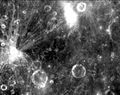 Dufay is at center, and the elongate white patch above right of center is the anomaly. The bright feature to the left is Mandel'shtam F crater and its ray system.
 -
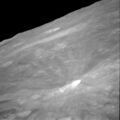 The albedo anomaly is visible above center in this view from Apollo 11


Satellite craters

By convention these features are identified on lunar maps by placing the letter on the side of the crater midpoint that is closest to Dufay.
| Dufay | Latitude | Longitude | Diameter |
|---|---|---|---|
| A | 9.5° N | 170.5° E | 15 km |
| B | 8.5° N | 171.0° E | 20 km |
| D | 6.3° N | 170.5° E | 32 km |
| X | 7.2° N | 168.5° E | 42 km |
| Y | 8.3° N | 168.4° E | 16 km |
-
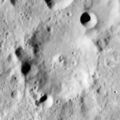 Dufay X crater

References
- ↑ Dufay Albedo Anomaly low-Sun controlled NAC mosaic, Lunar Reconnaissance Orbiter Camera
- ↑ N. E. Petro. Association Between Small Thorium Enhancements, Silicic Volcanism, and Enhanced OH/H2O as Measured by the Moon Mineralogy Mapper. Annual Meeting of the Lunar Exploration Analysis Group, 2014. [1]
- Andersson, L. E.; Whitaker, E. A. (1982). NASA Catalogue of Lunar Nomenclature. NASA RP-1097.
- Blue, Jennifer (July 25, 2007). "Gazetteer of Planetary Nomenclature". USGS. http://planetarynames.wr.usgs.gov/.
- Bussey, B.; Spudis, P. (2004). The Clementine Atlas of the Moon. New York: Cambridge University Press. ISBN 978-0-521-81528-4.
- Cocks, Elijah E.; Cocks, Josiah C. (1995). Who's Who on the Moon: A Biographical Dictionary of Lunar Nomenclature. Tudor Publishers. ISBN 978-0-936389-27-1. https://archive.org/details/isbn_9780936389271.
- McDowell, Jonathan (July 15, 2007). "Lunar Nomenclature". Jonathan's Space Report. http://host.planet4589.org/astro/lunar/.
- Menzel, D. H.; Minnaert, M.; Levin, B.; Dollfus, A.; Bell, B. (1971). "Report on Lunar Nomenclature by the Working Group of Commission 17 of the IAU". Space Science Reviews 12 (2): 136–186. doi:10.1007/BF00171763. Bibcode: 1971SSRv...12..136M.
- Moore, Patrick (2001). On the Moon. Sterling Publishing Co.. ISBN 978-0-304-35469-6. https://archive.org/details/patrickmooreonmo00patr.
- Price, Fred W. (1988). The Moon Observer's Handbook. Cambridge University Press. ISBN 978-0-521-33500-3.
- Rükl, Antonín (1990). Atlas of the Moon. Kalmbach Books. ISBN 978-0-913135-17-4.
- Webb, Rev. T. W. (1962). Celestial Objects for Common Telescopes (6th revised ed.). Dover. ISBN 978-0-486-20917-3. https://archive.org/details/celestialobjects00webb.
- Whitaker, Ewen A. (1999). Mapping and Naming the Moon. Cambridge University Press. ISBN 978-0-521-62248-6.
- Wlasuk, Peter T. (2000). Observing the Moon. Springer. ISBN 978-1-85233-193-1.
 |  |
 EncycloReader
is supported by the
EncycloReader
is supported by the  KSF
KSF