Table of Contents Categories
Lagoon Nebula
Topic: Astronomy
 From HandWiki - Reading time: 7 min
| Emission nebula | |
|---|---|
| H II region | |
 M8, the Lagoon Nebula | |
| Observation data: J2000 epoch | |
| Right ascension | 18h 03m 37s[1] |
| Declination | −24° 23′ 12″[1] |
| Distance | 4,100[2] ly (1,250 pc) |
| Apparent magnitude (V) | 4.6[3] |
| Apparent dimensions (V) | 90 × 40 arcmins[3] |
| Constellation | Sagittarius |
| Physical characteristics | |
| Radius | 55 × 20 ly |
| Designations | Sharpless 25, RCW 146, Gum 72 M8 contains: NGC 6523, NGC 6530,[1] Hourglass nebula[4] |
The Lagoon Nebula (catalogued as Messier 8 or M8, NGC 6523, Sharpless 25, RCW 146, and Gum 72) is a giant emission nebula with an H II region located in the constellation Sagittarius. Discovered by Giovanni Hodierna in 1654, it is one of only two star-forming nebulae faintly visible to the naked eye from mid-northern latitudes[5][6] (the other being the Orion Nebula).
Characteristics
Located approximately 4,000–6,000 light-years from Earth, the nebula spans 110 by 50 light-years (appearing as 90' by 40' in Earth's sky). While appearing pink in long-exposure photographs, it typically appears gray when viewed through binoculars or telescopes due to the human eye's limited color sensitivity in low-light conditions. The nebula contains the young open cluster NGC 6530 within its structure.[7]
The Lagoon Nebula features several distinctive structures, including:
- Multiple Bok globules cataloged by E. E. Barnard (B88, B89, and B296)
- A funnel-shaped structure formed by ultraviolet radiation from a hot O-type star
- The centrally-located Hourglass Nebula (named by John Herschel), distinct from the Engraved Hourglass Nebula in Musca
Observations in 2006 revealed four Herbig–Haro objects within the Hourglass structure, providing direct evidence of ongoing star formation through accretion processes.[2]
Gallery
-
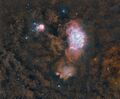 Lagoon Nebula in HaRGB
 -
 Lagoon Nebula in SHO by amateur astronomer Buzz Jumaah from Auckland, New Zealand
 -
 False color (SHO without green reduction) close up from Madison, Wisconsin, USA
 -
![The Lagoon Nebula as imaged by the Vera C. Rubin Observatory in very high-resolution, taken on May 28, 2025[8][lower-alpha 1]](https://handwiki.org/wiki/images/thumb/5/57/Trifid_Vera_Rubins.png/120px-Trifid_Vera_Rubins.png%3Futm_source%3Dcommons.wikimedia.org%26utm_campaign%3Dimageinfo%26utm_content%3Dthumbnail) The Lagoon Nebula as imaged by the Vera C. Rubin Observatory in very high-resolution, taken on May 28, 2025[8][lower-alpha 1]
The Lagoon Nebula as imaged by the Vera C. Rubin Observatory in very high-resolution, taken on May 28, 2025[8][lower-alpha 1]


.jpg)
![The Lagoon Nebula as imaged by the Vera C. Rubin Observatory in very high-resolution, taken on May 28, 2025[8][lower-alpha 1]](https://handwiki.org/wiki/File:Trifid_Vera_Rubins.png)
See also
Notes
- ↑ The bluish-pink nebula on the upper right is the Trifid Nebula.
References
- ↑ 1.0 1.1 1.2 "M 8". SIMBAD. Centre de données astronomiques de Strasbourg. http://simbad.u-strasbg.fr/simbad/sim-basic?Ident=M+8.
- ↑ 2.0 2.1 Arias, J. I.; Barbá, R. H.; Maíz Apellániz, J. (2006). "The infrared Hourglass cluster in M8". Monthly Notices of the Royal Astronomical Society 366 (3): 739–757. doi:10.1111/j.1365-2966.2005.09829.x. Bibcode: 2006MNRAS.366..739A.
- ↑ 3.0 3.1 Stoyan, Ronald (2008). Atlas of the Messier Objects: Highlights of the Deep Sky. Cambridge University Press. p. 88. ISBN 978-0-521-89554-5.
- ↑ "SIMBAD Astronomical Database". Results for Hourglass Nebula. http://simbad.u-strasbg.fr/Simbad.
- ↑ Vowler, Faith; Bolles, Dana (12 September 2024). "Messier 8" (in en). https://science.nasa.gov/mission/hubble/science/explore-the-night-sky/hubble-messier-catalog/messier-8/. "M8 was discovered in 1654"
- ↑ Kronberg, Guy McArthur, Hartmut Frommert, Christine. "Messier Object 8". http://www.messier.seds.org/m/m008.html.
- ↑ N. F. H. Tothill; Marc Gagné; B. Stecklum; M. A. Kenworthy (2008). "The Lagoon Nebula and its Vicinity". in Bo Reipurth. Handbook of Star-Forming Regions: Volume 2 The Southern Sky. Astronomical Society of the Pacific. p. 53. ISBN 978-1-58381-671-4.
- ↑ "Trifid and Lagoon (Image)". NSF–DOE Vera C. Rubin Observatory. 2025. https://rubinobservatory.org/gallery/collections/first-look-gallery/n4kvj0cemd5pbdqgtjdgp2jg2t.
External links
- Breaking Waves in the Stellar Lagoon — ESA/Hubble Photo Release
- Messier 8, SEDS Messier pages
- NightSkyInfo.com – M8, the Lagoon Nebula
- Messier 8, Pete's Astrophotography Gallery
- Messier 8, Lagoon Nebula, Map
- Astronomy Picture of the Day (APOD): Lagoon Nebula
- APOD: 2005 August 3 - The Busy Center of the Lagoon Nebula
- The Scale of the Universe (Astronomy Picture of the Day 2012 March 12)
- The Lagoon Nebula on WikiSky: DSS2, SDSS, GALEX, IRAS, Hydrogen α, X-Ray, Astrophoto, Sky Map, Articles and images
- 7/30/2015 Photo release Hubble Space Telescope
- Lagoon Nebula on Instagram
| List |
|  |
|---|---|---|
| See also | ||


Coordinates:  18h 03m 37s, −24° 23′ 12″
 |  |
 EncycloReader
is supported by the
EncycloReader
is supported by the  KSF
KSF