Lipik (crater)
Topic: Astronomy
 From HandWiki - Reading time: 6 min
 Lipik Crater Channels, as seen by THEMIS. | |
| Planet | Mars |
|---|---|
| Coordinates | Coordinates: 38°25′S 248°26′W / 38.42°S 248.43°W |
| Diameter | 56 km |
Lipik Crater is a crater in the Hellas quadrangle of Mars, located at 38.42° S and 248.43° W. It is 56 km in diameter and was named after Lipik, a town in Croatia.[1] Close-up pictures of the crater show glacial features. The crater is not very deep, so much ice and dust may have accumulated over the years. If one measures the diameter of a crater, the original depth can be estimated with various ratios. Because of this relationship, researchers have found that many Martian craters contain a great deal of material; much of it is believed to be ice deposited when the climate was different.[2]
Glacier flows are visible in some of the pictures below from Lipik Crater.
Glaciers, loosely defined as patches of currently or recently flowing ice, are thought to be present across large but restricted areas of the modern Martian surface, and are inferred to have been more widely distributed at times in the past.[3][4] Lobate convex features on the surface known as viscous flow features and lobate debris aprons, which show the characteristics of non-Newtonian flow, are now almost unanimously regarded as true glaciers.[3][5][6][7][8][9][10][11][12]
A climate model, reported in the journal Science in 2006, found that large amounts of ice should accumulate in the Hellas region, in the same places like Lipik Crater where glaciers are observed. Water is transported from the south polar area to northern Hellas and falls as precipitation.[13]

Western side of Lipik Crater, as seen by CTX camera (on Mars Reconnaissance Orbiter). Arrow points to a tongue-shaped glacier that is enlarged in next image.

Tongue-shaped glacier in Lipik Crater, as seen by CTX camera (on Mars Reconnaissance Orbiter). Note: this is an enlargement of previous image.

Lipik Crater, as seen by CTX camera (on Mars Reconnaissance Orbiter).
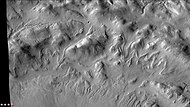
Enlargement of northern wall of Lipik, as seen by CTX camera (on Mars Reconnaissance Orbiter). Many tongue-shaped glaciers are visible. Note: this is an enlargement of the previous image.


References
- ↑ Lipik, planetarynames.wr.usgs.gov
- ↑ Garvin, J., et al. 2002. Global geometric properties of martian impact craters. Lunar Planet Sci. 33. Abstract @1255.
- ↑ 3.0 3.1 "The Surface of Mars" Series: Cambridge Planetary Science (No. 6) ISBN:978-0-511-26688-1 Michael H. Carr, United States Geological Survey, Menlo Park
- ↑ Hugh H. Kieffer (1992). Mars. University of Arizona Press. ISBN 978-0-8165-1257-7. https://books.google.com/books?id=NoDvAAAAMAAJ. Retrieved March 7, 2011.
- ↑ Milliken, R. E.; Mustard, J. F.; Goldsby, D. L. (2003). "Viscous flow features on the surface of Mars: Observations from high-resolution Mars Orbiter Camera (MOC) images". Journal of Geophysical Research 108 (E6): 5057. doi:10.1029/2002je002005. Bibcode: 2003JGRE..108.5057M.
- ↑ Squyres, S.W.; Carr, M.H. (1986). "Geomorphic evidence for the distribution of ground ice on Mars". Science 213 (4735): 249–253. doi:10.1126/science.231.4735.249. PMID 17769645. Bibcode: 1986Sci...231..249S. https://zenodo.org/record/1230966.
- ↑ Head, J.W.; Marchant, D.R.; Dickson, J.L.; Kress, A.M. (2010). "Criteria for the recognition of debris-covered glacier and valley glacier landsystem deposits". Earth Planet. Sci. Lett. 294: 306–320. doi:10.1016/j.epsl.2009.06.041. Bibcode: 2010E&PSL.294..306H.
- ↑ Holt, J.W. (2008). "Radar sounding evidence for buried glaciers in the southern mid-latitudes of Mars". Science 322 (5905): 1235–1238. doi:10.1126/science.1164246. PMID 19023078. Bibcode: 2008Sci...322.1235H.
- ↑ Morgan, G.A.; Head, J.W.; Marchant, D.R. (2009). "Lineated valley fill (LVF) and lobate debris aprons (LDA) in the Deuteronilus Mensae northern dichotomy boundary region, Mars: Constraints on the extent, age and episodicity of Amazonian glacial events". Icarus 202 (1): 22–38. doi:10.1016/j.icarus.2009.02.017. Bibcode: 2009Icar..202...22M.
- ↑ Plaut, J.J.; Safaeinili, A.; Holt, J.W.; Phillips, R.J.; Head, J.W.; Sue, R.; Putzig, A. (2009). "Frigeri Radar evidence for ice in lobate debris aprons in the mid-northern latitudes of Mars". Geophys. Res. Lett. 36 (2): L02203. doi:10.1029/2008gl036379. Bibcode: 2009GeoRL..36.2203P.
- ↑ Baker, D.M.H.; Head, J.W.; Marchant, D.R. (2010). "Flow patterns of lobate debris aprons and lineated valley fill north of Ismeniae Fossae, Mars: Evidence for extensive mid-latitude glaciation in the Late Amazonian". Icarus 207 (1): 186–209. doi:10.1016/j.icarus.2009.11.017. Bibcode: 2010Icar..207..186B.
- ↑ Arfstrom, J. (2005). "Terrestrial analogs and interrelationships". Icarus 174 (2): 321–335. doi:10.1016/j.icarus.2004.05.026. Bibcode: 2005Icar..174..321A.
- ↑ Forget, F., et al. 2006. Formation of Glaciers on Mars by Atmospheric Precipitation at High Obliquity. Science: 311, 368-371.
See also
- Climate of Mars
- Glacier
- Glaciers on Mars
- Impact crater
- Impact event
- List of craters on Mars
- Ore resources on Mars
- Planetary nomenclature
- Water on Mars
 |  |
 EncycloReader
is supported by the
EncycloReader
is supported by the  KSF
KSF