-
 NGC 654 - by Kanwar Singh
 -
 Map showing location of NGC 654
NGC 654
Topic: Astronomy
 From HandWiki - Reading time: 6 min
| NGC 654 | |
|---|---|
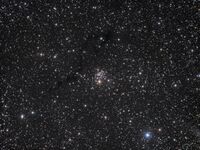
.jpg) NGC 654 in Cassiopeia Credit: Antonio F. Sánchez | |
| Observation data (J2000 epoch) | |
| Constellation | Cassiopeia |
| Right ascension | 01h 44m 00s[1] |
| Declination | +61° 53′ 06″[1] |
| Distance | 7,830 ly (2,400 pc) |
| Apparent magnitude (V) | 6.5 [1] |
| Apparent dimensions (V) | 5' |
| Physical characteristics | |
| Estimated age | 14 million years[2] |
| Other designations | Fuzzy Butterfly Cluster[3],Cr 18 |
NGC 654 is an open cluster in the constellation Cassiopeia. It was discovered by William Herschel in 1787. With apparent magnitude 6.5, it can be observed by binoculars.[4] It is located 2,5° northeast of the star Delta Cassiopeiae. In the same low power field can also be seen the open clusters NGC 663 and NGC 659. It surrounds a 7th magnitude yellowish star, an F5Ia supergiant, which is a possible member of the group.[5]
It is 2,400 parsec away. It is a very young cluster, aged approximately 15 million years, but it could be as old as 40 million years, with a time spread of star formation of at least ~20 Myr. The central region of the cluster shows less reddening than the rest of the cluster.[6] One explanation is that between the Solar System and the cluster lie two dust layers, one at 200pc and one more at 1Kpc.[7] Behind the cluster is one more dust layer. The cluster has approx. 80 members, including three Be stars and a few luminous stars like HD 10494 and F5Ia. The earliest spectral type is around B0.[8]
NGC 654 is assumed to form part of the stellar association Cassiopeia OB8, that is located in the Perseus Arm of the Milky Way, along with the open clusters M103, NGC 663, NGC 659, and some supergiant stars scattered between them, all of them having similar ages and distances.[9][10]
Gallery


References
- ↑ 1.0 1.1 1.2 "NGC 654". SIMBAD. Centre de données astronomiques de Strasbourg. http://simbad.u-strasbg.fr/simbad/sim-basic?Ident=NGC+654.
- ↑ WEBDA: NGC 654
- ↑ "Cassiopeia Constellation: Stars, Myth, Facts, Location – Constellation Guide". https://www.constellation-guide.com/constellation-list/cassiopeia-constellation/.
- ↑ Stephen James O'Meara (2011). Deep-Sky Companions: The Secret Deep vol. 4. Cambridge University Press. pp. 31–33. ISBN 978-1-139-50007-4. https://books.google.com/books?id=v859bKO0A4gC&pg=PA31.
- ↑ Huestamendia, G.; del Rio, G.; Mermilliod, J.-C. (July 1993). "UBV photometry of open clusters in the Cassiopeia region. II - Photoelectric observations of NGC 654". Astronomy and Astrophysics Supplement Series 100 (1): 25–32. Bibcode: 1993A&AS..100...25H. http://cdsads.u-strasbg.fr/abs/1993A%26AS..100...25H. Retrieved 29 December 2015.
- ↑ A. K. Pandey; K. Upadhyay; K. Ogura; Ram Sagar; V. Mohan; H. Mito; H. C. Bhatt; B. C. Bhatt (April 2005). "Stellar contents of two young open clusters: NGC 663 and 654". MNRAS 358 (4): 1290–1308. doi:10.1111/j.1365-2966.2005.08784.x. Bibcode: 2005MNRAS.358.1290P.
- ↑ Biman J. Medhi; Maheswar G.; J. C. Pandey; T. S. Kumar; Ram Sagar (2008). "Optical polarimetric study of open clusters: distribution of interstellar matter towards NGC 654". MNRAS 388 (1): 105–116. doi:10.1111/j.1365-2966.2008.13405.x. Bibcode: 2008MNRAS.388..105M.
- ↑ H.M. Shi - J.Y. Hu (April 1999). "Spectroscopic observations of young open clusters: IC 1805, NGC 654 and NGC 6823". Astron. Astrophys. Suppl. Ser. 136 (2): 313–331. doi:10.1051/aas:1999217. Bibcode: 1999A&AS..136..313S. http://aas.aanda.org/articles/aas/pdf/1999/08/ds8200.pdf. Retrieved 29 December 2015.
- ↑ Negueruela, I.; González-Fernández, C.; Marco, A.; Clark, J. S. (2011). "A massive association around the obscured open cluster RSGC3". Astronomy & Astrophysics 528: A59. doi:10.1051/0004-6361/201016102. Bibcode: 2011A&A...528A..59N.
- ↑ Humphreys, R. M. (1978). "Studies of luminous stars in nearby galaxies. I. Supergiants and O stars in the Milky Way.". Astrophysical Journal Supplement Series 38: 309–350. doi:10.1086/190559. Bibcode: 1978ApJS...38..309H.
External links
- NGC 654 on WikiSky: DSS2, SDSS, GALEX, IRAS, Hydrogen α, X-Ray, Astrophoto, Sky Map, Articles and images
Coordinates:  01h 44m 00s, +61° 53′ 6″
 |  |
Licensed under CC BY-SA 3.0 | Source: https://handwiki.org/wiki/Astronomy:NGC_6548 views | Status: cached on April 22 2026 12:08:15↧ Download this article as ZWI file
 EncycloReader
is supported by the
EncycloReader
is supported by the  KSF
KSF