Pandora (moon)
Topic: Astronomy
 From HandWiki - Reading time: 6 min
 View of Pandora's western hemisphere.[lower-alpha 1] | |
| Discovery | |
|---|---|
| Discovered by | Stewart A. Collins D. Carlson Voyager 1 |
| Discovery date | October, 1980 |
| Designations | |
Designation | Saturn XVII |
| Pronunciation | /pænˈdɔːrə/ |
| Named after | Πανδώρα Pandōra |
| Adjectives | Pandoran[1] |
| Orbital characteristics [2] | |
| Epoch December 31, 2003 (JD 2453005.5) | |
| 141720±10 km | |
| Eccentricity | 0.0042 |
| Orbital period | 0.628504213 d |
| Inclination | 0.050°±0.004° to Saturn's equator |
| Satellite of | Saturn |
| Group | Possible outer shepherd moon of the F Ring |
| Physical characteristics | |
| Dimensions | 103.0 × 79.0 × 63.0 km (± 0.6 × 0.6 × 0.4 km)[3]: 2 |
| Mean diameter | 80.0±0.6 km[3]: 2 |
| Volume | 268990±860 km3[4]: 4 |
| Mass | (1.357±0.002)×1017 kg[lower-alpha 2] |
| Mean density | 0.5045±0.0017 g/cm3[4]: 4 |
| 0.0022–0.0061 m/s2[3]: 3 | |
| 0.019 km/s at longest axis to 0.024 km/s at poles | |
| Rotation period | synchronous |
| Axial tilt | zero |
| Albedo | 0.6 |
| Physics | ≈ 78 K |
Pandora is an inner satellite of Saturn. It was discovered in 1980 from photos taken by the Voyager 1 probe, and was provisionally designated S/1980 S 26.[5] In late 1985 it was officially named after Pandora from Greek mythology.[6] It is also designated Saturn XVII.[7]
Pandora was thought to be an outer shepherd satellite of the F Ring. However, recent studies indicate that it does not play such a role, and that only Prometheus, the inner shepherd, contributes to the confinement of the narrow ring.[8][9] It is more heavily cratered than nearby Prometheus, and has at least two large craters 30 kilometres (19 mi) in diameter. The majority of craters on Pandora are shallow as a result of being filled with debris. Ridges and grooves are also present on moon's surface.[10]
The orbit of Pandora appears to be chaotic, as a consequence of a series of four 118:121 mean-motion resonances with Prometheus.[11] The most appreciable changes in their orbits occur approximately every 6.2 years,[2] when the periapsis of Pandora lines up with the apoapsis of Prometheus and the moons approach to within about 1,400 kilometres (870 mi). Pandora also has a 3:2 mean-motion resonance with Mimas.[2]
From its very low density and relatively high albedo, it seems likely that Pandora is a very porous icy body. There is much uncertainty in these values, however, so this remains to be confirmed.
Gallery
-
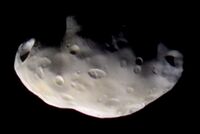 View of the moon, taken during Cassini's September 2005 flyby.
 -
 Pandora as seen from the Cassini probe in 2005; the rings of Saturn are in the background.
 -
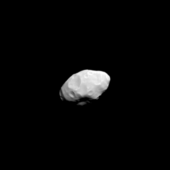 Cassini captured this close view of Saturn's moon Pandora during the spacecraft's flyby on June 3, 2010.
 -
 Voyager 2 image of Pandora (August 1981).


_PIA_12690.png)

References
Notes
- ↑ This view was taken by Cassini, during the spacecraft's close flyby on December 18, 2016. The image was taken from a distance of 40,500 kilometres (25,200 miles); the closest approach by the spacecraft during its 14-year tenure in the Saturn system.
- ↑ Calculated from the standard gravitational parameter GM = (9.058±0.011)×10−3 km3·s–2 given by Lainey et al. (2023), divided by the gravitational constant G = 6.6743×10⁻² km3·kg–1·s–2.[4]
Citations
- ↑ Robert Kolvoord (1990) Saturn's F ring: imaging and simulation, p. 104
- ↑ 2.0 2.1 2.2 Spitale Jacobson et al. 2006.
- ↑ 3.0 3.1 3.2 Thomas & Helfenstein 2020.
- ↑ 4.0 4.1 4.2 Lainey et al. 2023.
- ↑ IAUC 3532.
- ↑ IAUC 4157.
- ↑ USGS: Planet and Satellite Names and Discoverers.
- ↑ "On the masses and motions of mini-moons: Pandora's not a "shepherd," but Prometheus still is". Planetary Society. 2014-07-05. http://www.planetary.org/blogs/emily-lakdawalla/2014/07010001-ringmoons-shepherds.html.
- ↑ Cuzzi, J. N.; Whizin, A. D.; Hogan, R. C.; Dobrovolskis, A. R.; Dones, L.; Showalter, M. R.; Colwell, J. E.; Scargle, J. D. (April 2014). "Saturn's F Ring core: Calm in the midst of chaos". Icarus 232: 157–175. doi:10.1016/j.icarus.2013.12.027. ISSN 0019-1035. Bibcode: 2014Icar..232..157C.
- ↑ Solar System, NASA: Pandora.
- ↑ Renner et al. 2005.
Sources
- Marsden, Brian G. (October 31, 1980). "Satellites of Saturn" (discovery). IAU Circular 3532. http://www.cbat.eps.harvard.edu/iauc/03500/03532.html. Retrieved 2011-12-29.
- Marsden, Brian G. (January 3, 1986). "Satellites of Saturn and Pluto" (naming the moon). IAU Circular 4157. http://www.cbat.eps.harvard.edu/iauc/04100/04157.html. Retrieved 2011-12-29.
- Renner, Stéfan F.; Sicardy, Bruno; French, Richard G. (March 2005). "Prometheus and Pandora: Masses and orbital positions during the Cassini tour". Icarus 174 (1): 230–240. doi:10.1016/j.icarus.2004.09.005. Bibcode: 2005Icar..174..230R.
- "Saturn: Moons: Pandora". Solar System Exploration: Planets. NASA. 4 Apr 2011. http://solarsystem.nasa.gov/planets/profile.cfm?Object=Sat_Pandora.
- Spitale, J. N.; Jacobson, R. A.; Porco, C. C.; Owen, W. M. Jr. (2006). "The orbits of Saturn's small satellites derived from combined historic and Cassini imaging observations". The Astronomical Journal 132 (2): 692–710. doi:10.1086/505206. Bibcode: 2006AJ....132..692S.
- Thomas, P. C. (July 2010). "Sizes, shapes, and derived properties of the saturnian satellites after the Cassini nominal mission". Icarus 208 (1): 395–401. doi:10.1016/j.icarus.2010.01.025. Bibcode: 2010Icar..208..395T. http://www.ciclops.org/media/sp/2011/6794_16344_0.pdf.
- USGS/IAU (July 21, 2006). "Planet and Satellite Names and Discoverers". Gazetteer of Planetary Nomenclature. USGS Astrogeology. http://planetarynames.wr.usgs.gov/Page/Planets#SaturnianSystem.
- Thomas, P. C.; Helfenstein, P. (July 2020). "The small inner satellites of Saturn: Shapes, structures and some implications". Icarus 344: 20. doi:10.1016/j.icarus.2019.06.016. 113355. Bibcode: 2020Icar..34413355T.
- Lainey, V.; Rambaux, N.; Cooper, N.; Dahoumane, R.; Zhang, Q. (February 2023). "Characterising the interior of five inner Saturnian moons using Cassini ISS data". Astronomy & Astrophysics 670: 6. doi:10.1051/0004-6361/202244757. L25. Bibcode: 2023A&A...670L..25L.
External links
.jpg)
 |  |
 EncycloReader
is supported by the
EncycloReader
is supported by the  KSF
KSF