Caragana arborescens
Topic: Biology
 From HandWiki - Reading time: 3 min
| Caragana arborescens | |
|---|---|

| |
| Shelter break of Caragana arborescens | |
Scientific classification 
| |
| Kingdom: | Plantae |
| Clade: | Tracheophytes |
| Clade: | Angiosperms |
| Clade: | Eudicots |
| Clade: | Rosids |
| Order: | Fabales |
| Family: | Fabaceae |
| Subfamily: | Faboideae |
| Genus: | Caragana |
| Species: | C. arborescens
|
| Binomial name | |
| Caragana arborescens Lam.
| |
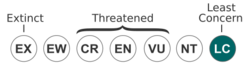
Caragana arborescens, the Siberian peashrub,[2] Siberian pea-tree,[3] or caragana, is a species of legume native to Siberia and parts of China (Heilongjiang, Xinjiang) and neighboring Mongolia and Kazakhstan.[4] It was taken to the United States by Eurasian immigrants, who used it as a food source while travelling west. In some areas of the United States it is considered an invasive species. Introduced on the Canadian prairies in the 1880s, the hardy caragana provided shelter-belts, wildlife habitat, nitrogen fixation, and windbreaks to prevent soil erosion and snow drifting.
Description
It is a perennial shrub or small tree growing 2–6 m (6 ft 7 in–19 ft 8 in) tall.[4] Typically, it has a moderate to fast growth rate, being able to grow one to three feet during the first year after trimming.[original research?]
The leaves vary from light green to dark green, and are alternate and compound with many small leaflets. Fragrant yellow flowers bloom in May or June. The fruits are legumes which contain many seeds, and ripen in July. As the seed pods dry they have a tendency to twist and pop open, releasing the seeds.[5]
The plant tolerates a wide range of climatic environments in the United States such as Alaska, California, and New Mexico.[1] It can live up to 140 years.[2]
Uses
Caragana arborescens can be grown as an ornamental plant and has been extensively used in windbreaks.[6] It has an extensive root system, and can be used in erosion control.[7]
The production of seeds is very large, but they are small in size and bland in flavor.[8][9] The seeds are edible by humans and chickens, but should be cooked before being consumed by people.[10]{{failed verification|date=December 2024} It can be used to neutralize soil to prepare for further planting and as a legume, C. arborescens fixes nitrogen. It is suitable for planting in single-row field windbreaks where a dense, short barrier is desired;[original research?] and it is recommended for planting in the outer rows of multi-row plantings.[original research?]
C. arborescens is used for nesting by several songbirds but its seeds are rarely eaten by them. The plant is not a preferred food for browsing animals, but its fragrant flowers attract many pollen-consuming animals.{{citation needed|date=November 2024}
References
- ↑ Han, B.; Botanic Gardens Conservation International (BGCI); IUCN SSC Global Tree Specialist Group (2019). "Caragana arborescens". IUCN Red List of Threatened Species 2019. doi:10.2305/IUCN.UK.2019-2.RLTS.T147642122A147642124.en. https://www.iucnredlist.org/species/147642122/147642124. Retrieved 6 October 2023.
- ↑ "Caragana arborescens". Natural Resources Conservation Service PLANTS Database. USDA. https://plants.usda.gov/core/profile?symbol=CAAR18.
- ↑ (xls) BSBI List 2007, Botanical Society of Britain and Ireland, https://bsbi.org/download/3542/, retrieved 2014-10-17
- ↑ 4.0 4.1 Yingxin Liu, Chang Zhaoyang & Gennady P. Yakovlev. "Caragana arborescens". Flora of China. Missouri Botanical Garden, St. Louis, MO & Harvard University Herbaria, Cambridge, MA. http://www.efloras.org/florataxon.aspx?flora_id=2&taxon_id=200011995.
- ↑ Kansas Forest Service: Caragana arborescens
- ↑ Skinner, Hugh; Williams, Sara (2004). Best Trees and Shrubs for the Prairies. Calgary, Canada: Fifth House. pp. 74–75. ISBN 978-1-894004-95-4. https://archive.org/details/besttreesshrubsf0000skin/page/74.
- ↑ "Siberian peashrub | Minnesota Department of Agriculture" (in en). https://www.mda.state.mn.us/siberian-peashrub.
- ↑ "Caragana arborescens Siberian Pea Tree, Siberian peashrub" (in en). https://pfaf.org/user/plant.aspx?latinname=Caragana+arborescens.
- ↑ Facciola, Stephen (1990). Cornucopia: A Source Book of Edible Plants. Vista, California: Kampong Publications. p. 89. ISBN 978-0-9628087-0-8. https://archive.org/details/cornucopiasource0000facc/page/89. Retrieved 2 May 2024.
- ↑ Jacke, Dave; Toensmeier, Eric (2005) (in en). Edible Forest Gardens. White River Junction, Vermont: Chelsea Green Publishing. p. 5. ISBN 978-1-890132-60-6. https://archive.org/details/edibleforestgard0000jack/page/5. Retrieved 2 May 2024.
External links
- Properties and characteristics of Caragana arborescens
- Germplasm Resources Information Network: Caragana arborescens Lam.
- Jepson Manual Treatment
- Purdue New Crops Profile
- Siberian pea-tree
- Caragana arborescens Siberian Pea Tree Bonsai Guide
Wikidata ☰ Q162124 entry
 |  |
 EncycloReader
is supported by the
EncycloReader
is supported by the  KSF
KSF