Cuscuta pentagona
Topic: Biology
 From HandWiki - Reading time: 2 min
Short description: Species of flowering plant
| Cuscuta pentagona | |
|---|---|

| |
| Cuscuta pentagona flowers | |
Scientific classification 
| |
| Script error: No such module "Taxobox ranks".: | Plantae |
| Script error: No such module "Taxobox ranks".: | Tracheophytes |
| Script error: No such module "Taxobox ranks".: | Angiosperms |
| Script error: No such module "Taxobox ranks".: | Eudicots |
| Script error: No such module "Taxobox ranks".: | Asterids |
| Script error: No such module "Taxobox ranks".: | Solanales |
| Script error: No such module "Taxobox ranks".: | Convolvulaceae |
| Script error: No such module "Taxobox ranks".: | Cuscuta |
| Script error: No such module "Taxobox ranks".: | <div style="display:inline" class="script error: no such module "taxobox ranks".">C. pentagona |
| Binomial name | |
| Cuscuta pentagona Engelm.
| |
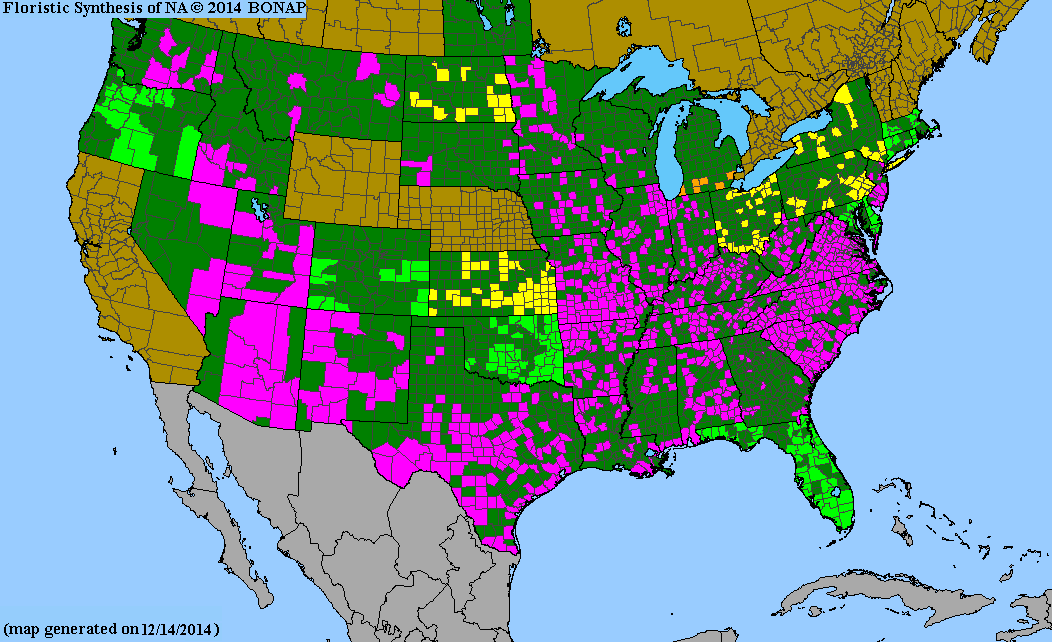
Cuscuta pentagona, the fiveangled dodder, is a parasitic plant in the morning glory family Convolvulaceae. It is native to North America, where it is widespread in the United States and Canada.[1] Unlike the closely related C. campestris, it has not become established on other continents.[2]
Cuscuta pentagona is a slender annual vine. It is parasitic on a wide range of herbaceous plants, but with particular emphasis on members of the aster family (Asteraceae).[3]
Its typical natural habitat is in moist, open areas such as riverbanks, wet prairies, and pond edges.[3] It is tolerant of disturbance, as can be found as a weed in fields and along roadsides.[3][4]
References
 |
Wikimedia Commons has media related to Cuscuta pentagona. |
- ↑ "Cuscuta pentagona", County-level distribution map from the North American Plant Atlas (NAPA) (Biota of North America Program (BONAP)), 2014, http://bonap.net/MapGallery/County/Cuscuta%20pentagona.png, retrieved 30 May 2019
- ↑ Costea, M.; Nesom, G.L.; Stefanović, S. (2006). "Taxonomy of the Cuscuta pentagona complex (Convolvulaceae) in North America". SIDA, Contributions to Botany 22 (1): 151–175.
- ↑ 3.0 3.1 3.2 Yatskievych, George (2006). Flora of Missouri, Volume 2. Missouri Botanical Garden Press. pp. 942.
- ↑ Weakley, Alan (2015). "Flora of the Southern and Mid-Atlantic States". http://www.herbarium.unc.edu/flora.htm.
Wikidata ☰ Q4116685 entry
 |  |
Licensed under CC BY-SA 3.0 | Source: https://handwiki.org/wiki/Biology:Cuscuta_pentagona1 views | ↧ Download this article as ZWI file
 EncycloReader
is supported by the
EncycloReader
is supported by the  KSF
KSF