Table of Contents Categories
Monk parakeet
Topic: Biology
 From HandWiki - Reading time: 17 min
| Monk parakeet | |
|---|---|
_Santiago.jpg)
| |
| in Chile | |
Scientific classification 
| |
| Kingdom: | Animalia |
| Phylum: | Chordata |
| Class: | Aves |
| Order: | Psittaciformes |
| Family: | Psittacidae |
| Genus: | Myiopsitta |
| Species: | M. monachus
|
| Binomial name | |
| Myiopsitta monachus (Boddaert, 1783)
| |
| Subspecies | |
|
2–4, see text | |

| |
| Synonyms | |
|
Psittacus monachus (Boddaert, 1783) | |

The monk parakeet (Myiopsitta monachus), also known as the monk parrot or Quaker parrot, is a species of true parrot in the family Psittacidae. It is a small to medium, bright-green parrot with a greyish breast and greenish-yellow abdomen. Its average lifespan is approximately 15 years. It originates from the temperate to subtropical areas of South America. Self-sustaining feral populations occur in many places, mainly in areas of similar climate in North America and Europe.
Taxonomy
The monk parakeet was described by French polymath Georges-Louis Leclerc, Comte de Buffon, in 1780 in his Histoire Naturelle des Oiseaux.[2] The bird was also illustrated in a hand-coloured plate engraved by François-Nicolas Martinet in the Planches Enluminées D'Histoire Naturelle, which was produced under the supervision of Edme-Louis Daubenton to accompany Buffon's text.[3] Neither the plate caption nor Buffon's description included a scientific name, but in 1783, Dutch naturalist Pieter Boddaert coined the binomial name Psittacus monachus in his catalogue of the Planches Enluminées.[4] As Buffon did not specify the origin of his specimen, in 1937 the American ornithologist James Peters assigned the type location as Montevideo, Uruguay.[5] The monk parakeet is now placed in the genus Myiopsitta that was introduced by French naturalist Charles Lucien Bonaparte in 1854.[6][7] The genus name combines the Ancient Greek mus, muos meaning "mouse" and the Neo-Latin psitta meaning "parrot", alluding to the mouse-grey face and underparts. The specific epithet monachus is Late Latin for "monk".[8]
The monk parakeet is one of two species in the genus Myiopsitta, the other being the cliff parakeet (Myiopsitta luchsi). The latter was previously treated as a subspecies of the Monk Parakeet. Due to morphological and behavioural differences, and geographical dissimilarities, the International Ornithological Committee elevated the cliff parakeet to species status in 2015.[9] BirdLife International's Handbook of the Birds of the World followed suit in 2020 and the South American Classification Committee of the American Ornithological Society in late 2024.[10][11] As of late 2024 the Clements taxonomy retains the cliff parakeet as a subspecies of the monk parakeet.[12] The monk and cliff parakeets' elevational ranges apparently do not overlap, so they are thus entirely, but just barely, allopatric.[13]
Three subspecies are recognized:[14][13]
- M. m. monachus (Boddaert, 1783) is found in Argentina from southeastern Santiago del Estero Province throughout the Río Salado and lower Paraná basins to Buenos Aires Province and Uruguay; it is the largest subspecies.
- M. m. calita (Boddaert, 1783) is found in the Andean foothills up to 1,000 m above mean sea level, from southeastern Bolivia (Santa Cruz and Tarija departments) to Paraguay and northwestern Argentina, then west of the range of monachus, extending into the lowlands again in Río Negro and possibly Chubut provinces. Smaller than monachus, wings more prominently blue, grey of head darker.
- M. m. cotorra (Finsch, 1868) is found in southwestern Brazil (Mato Grosso, Mato Grosso do Sul, possibly Rio Grande do Sul)[15] throughout the Río Paraguay and middle Paraná basins, as well as the Gran Chaco. It is essentially identical to M. m. calita, but reported as less yellow below and brighter overall.
The subspecies' ranges meet in the general area of Paraguay, and there they are insufficiently delimited. The distinctness and delimitation of M. m. calita and M. m. cotorra especially require further study.
Description

 Monk Parakeet bird call may be heard here, from xeno-canto.org, retrieved 1.08.2018 Monk Parakeet bird call may be heard here, from xeno-canto.org, retrieved 1.08.2018 |
The nominate subspecies of this parrot is 29 cm (11 in) long on average, with a 48-centimetre (19 in) wingspan, and weighs 100 g (3.5 oz). Females tend to be 10–20% smaller, but can only be reliably sexed by DNA or feather testing. Monk parakeets display very subtle sexual dimorphism in the colouration of their crown and wing coverts, but this is not noticeable to the human eye.[16] It has bright-green upperparts. The forehead and breast are pale grey with darker scalloping and the rest of the underparts are very light-green to yellow. The remiges are dark blue, and the tail is long and tapering. The bill is orange. The call is a loud and throaty chape(-yee) or quak quaki quak-wi quarr, and screeches skveet</ref>[13]
Domestic breeds in colours other than the natural plumage have been produced. These include birds with white, blue, and yellow in place of green. As such colouration provides less camouflage, feral birds are usually of wild-type colouration.{{Citation needed|date=October 2024}
Behaviour and ecology

The monk parakeet and the cliff parakeet are the only two parrot species outside some members of the African lovebirds (Agapornis sp.)[17] that build nests. Monk and cliff parakeets are unique among even nesting parrots for their construction of large, external nests in trees or manmade structures instead of using tree cavities.[18]
-
Couple in flight in Mato Grosso, Brazil
-
 flock in Uruguay
 -
 with nesting material
 -
 nest in Santiago
 -
 Nests in Zaragoza
_flock_in_flight_Colonia.jpg)
_in_flight_with_nesting_material_Colonia.jpg)


The monk parakeet is a gregarious species which often breeds colonially, building a single large nest with separate entrances for each pair.[18][19] It is not uncommon, however, for pairs or individuals to nest outside of colonies, especially during the breeding season.[19] In the wild, the colonies can become quite large, with pairs occupying separate "apartments" in composite nests that can reach the size of a small automobile. These nests can attract many other tenants, including some which cohabit with the monk parakeets.[20] These tenants include many other birds, such as pigeons, sparrows, American kestrels, and yellow-billed teal, but mammals like red squirrels may also occupy a nest.[18][20][21] Monk parakeets also sometimes breed in groups, with a Barcelona-based study finding that about 20% of monk parakeet breeding units are composed of three to five birds. These breeding groups can be made of both related and unrelated birds, and sometimes involve multiple females laying their eggs in one nest.[22]
Their 1–11 white eggs are incubated continuously by the female, during which time the male will provide her with food.[18][23] Unusually for a parrot, monk parakeet pairs occasionally have helper individuals, often grown offspring, which assist with feeding the young (see kin selection). Monk parakeets have an average lifespan in their natural environment of 6 years.[24] However, birds in captivity can reach 10 – 20 years.[25][26]
Monk parakeets probably have individual voice prints that allow them to recognize each other, independently from the used call type.[27]
In both their native South America, as well as areas where they have been introduced, monk parakeets are among the most destructive birds for crops.[28][29][30] Several countries have implemented measures to control the spread of feral populations; nest removal is a common practice in the United States,[31] and the United Kingdom's Department for the Environment, Food and Rural Affairs is planning to remove monk parakeet colonies, citing threats to infrastructure and potential crop damage.[32]
Feral populations are often descended from very small founder populations. Being as social and intelligent as they are, monk parakeets develop some cultural traditions, namely vocal dialects that differ between groups.{{Citation needed|date=November 2024} e number of birds, a range of "dialects" exists. If the founder population is small, however, a process similar to genetic drift may occur if prominent founders vocalize in an unusual "dialect", with this particular way of vocalizing becoming established in the resulting feral colony. For example, no fewer than three different "dialects" occur among the feral monk parrots of the Milford, Connecticut, metropolitan area.[33]
Native distribution
In its native range, the monk parakeet is very common.[1] In Argentina, Brazil, and Uruguay, monk parakeets are regarded as major agricultural pests (as noted by Charles Darwin, among others).[34] Their population explosion in South American rural areas seems to be associated with the expansion of eucalyptus forestry for paper pulp production, which offers the bird the opportunity to build protected nests in artificial forests where ecological competition from other species is limited.[14][34]
Invasive species


Feral populations have been recorded in Europe, the Americas, North Africa, the Middle East,[35] and East and Southeast Asia.[1][36]
As one of the few temperate-zone parrots, the monk parakeet is able to survive cold climates. This is partly attributed to their habit of building nests on warm electrical equipment, which also can create serious fire risk.[37]
Europe

It is estimated that monk parakeets in Spain account for more than 80% of Europe's feral population.[38] As an invasive species, it harms local fauna such as pigeons and sparrows, as well as crops. Spain has outlawed the possession and trafficking of monk parakeets since 2013.[39] Madrid had the greatest population of monk parakeets in Europe, with 10,800 as of June 2015,[40] and the population in Barcelona was estimated at 5,000 in the same year.[41] Between 2013 and 2021, the monk parakeet population in Seville increased from 1,200 to 6,300 individuals.[42]
Other locations with documented populations include:
- Canary Islands[38]
- Portugal[43][38]
- Balearic Islands[43][38]
- France[43]
- Sardinia[38]
- Italy[43]
- Greece[38]
- Great Britain[43]
- Belgium[43][38]
- Netherlands[38]
In Greece, monk parakeets have established breeding colonies in the National Garden, Athens.[44]
In the United Kingdom, the Department for the Environment, Food and Rural Affairs announced plans in 2011 to control them, countering the threat to infrastructure, crops, and native British wildlife by trapping and rehoming, removing nests, and shooting when necessary.[45]
Groups of monk parakeets can be found in the Belgian capital city Brussels and its surrounding areas. They have been living in the wild at least since the 1970s.[46]
Monk parakeet populations have previously been reported in Denmark,[43] Germany,[43][47] Austria, and Czechia,[43] but have not survived; the relatively colder weather in these countries likely contributes to these failed invasions.[38] Other populations in the UK, France, and the Netherlands have also similarly declined into extirpation.[46]
Middle East
Populations have been documented in:
The Americas
Populations have been documented in:
- Canada[50]
- Mexico[35]
- Brazil[35]
- Chile[35]
- Bahamas[51]
- United States[31]
- Cayman Islands[35]
- Puerto Rico[52]
Brazil
The species has in recent years expanded its range in Brazil, where a self-sustaining population occurs in the downtown area of Rio de Janeiro. Since this population occurs far from the bird's original range in Brazil – it was only found in the far south and southwest – it is most probably a consequence of escapees from the pet trade.
Bahamas
A breeding population on the island of Eleuthera was present from 1985 to the mid 1990s, but had disappeared by 1996, possibly due to the impact of hurricanes.[50]
Canada
In 1984, six monk parakeets were released from a pet store in Dollard-des-Ormeaux, a suburb of Montreal, Quebec. In May 1987, monk parakeets were recorded breeding in Canada for the first time in the Montreal suburb of Laval; this constitutes the northernmost continental breeding record for the species.[50]
Mexico
The monk parakeet was first recorded in Mexico City between 1994–1995.[53] As of 2015, monk parakeets have been reported in 97 Mexican cities, and in all regions of the country.[53][54]

Following a 2008 ban on the capture and sale of native parrot species, the legal pet market pivoted to the sale of monk parakeets, which likely increased the number of escapees and subsequent feral populations.[53][54] Sometimes, the head and breast feathers of monk parakeets are dyed yellow to deceive uninformed buyers, mimicking the endangered yellow-headed amazon.
United States
Thousands of monk parakeets were imported to the United States between the 1960s and the 1980s as pets.[55] Many escaped or were intentionally released, and populations were allowed to proliferate. By the early 1970s, M. monachus was established in seven states, and by 1995, it had spread to eight more. In Florida alone, estimates range from 150,000 to 500,000.[56] Austin, Dallas, and Houston, Texas, also have thriving monk parakeet populations.[57][58][59]
New York State
.jpg)
In 2012, a pair of monk parakeets attempted nesting in Watervliet, New York, about 240 km (150 mi) north of New York City, near Albany, New York.[60]
They have also found a home in Brooklyn, and Queens, New York, notably in Green-Wood Cemetery, with some speculating they were accidentally released at John F. Kennedy Airport in the 1960s.[61] They thrive in Brooklyn, Queens, and western Long Island due to their preference for nesting in utility poles; populations have not expanded to Manhattan because of the borough's underground wiring.[62]
Chicago
The population in Chicago is estimated to be at 1,000 birds, with healthy colonies located in several of the city's parks.[63] According to University of Chicago ornithologist Dr. Stephen Pruett-Jones, the population originated in the pet trade.[64] The first documented parrot nest in Chicago dates to 1973.[64] The species thrives despite harsh winters; attempts to remove them have been resisted by Hyde Park residents, including Mayor Harold Washington.[65] The birds are generally welcomed in the city, especially by bird watchers, and were the subject of a 2012 ornithological study.[63]
-
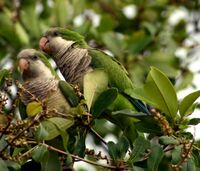 Two Monk parakeets in a tree – Florida
 -
 Monk parakeet nest in League City
 -
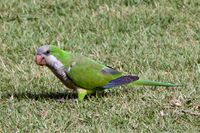 Monk parakeet in San Juan
 -
 Pair of monk parakeets in Green-Wood Cemetery, Brooklyn, NY
 -
 The large nest in the Green-Wood Cemetery gate


.jpg)
New Zealand
Auckland has banned the sale, breeding, and distribution of monk parakeets since September 1, 2022.[66] However, pre-existing monk parakeets can be kept.[66] Monk parakeets, among some other parrots, have been cited to be pests that compete with native birds and damage native trees.[67]
As pets
Monk parakeets are highly intelligent, social birds. Those kept as pets routinely develop vocabularies of scores of words and phrases.[68] Due to this early speaking ability, it is overtaking the cockatiel as the favourite bird to teach to talk. Another contributing factor to growing popularity is that this bird has a shorter lifespan and lower price{{citation needed|date=June 2023} Because of monk parakeets' listing as an agricultural pest and invasive species, the U.S. states of California,[69] Colorado,[70] Georgia,[71] Hawaii,[72] Idaho,[73] Kansas,[74] Kentucky,[75] Maine,[76] New Jersey,[77] Pennsylvania,[78] Tennessee,[79] Wisconsin,[80] and Wyoming,[81] as well as Western Australia[82] outlaw their sale and ownership. In Connecticut, ownership is permitted, but sale and breeding are prohibited. In New York and Virginia, one can own monk parakeets with banding and registration. In Rhode Island, an exotic animal possession permit is required for ownership.[83] In Ohio, owning one is legal if the bird's flight feathers are clipped or it is incapable of free flight.[84]
-
 Pet with blue mutation
 -
 Pets with yellow mutation


References
- ↑ 1.0 1.1 1.2 BirdLife International (2018). "Myiopsitta monachus". IUCN Red List of Threatened Species 2018. doi:10.2305/IUCN.UK.2018-2.RLTS.T45427277A132189848.en. https://www.iucnredlist.org/species/45427277/132189848. Retrieved 19 November 2021.
- ↑ Buffon, Georges-Louis Leclerc de (1780). "La perruche souris" (in fr). Histoire Naturelle des Oiseaux. 11. Paris: De L'Imprimerie Royale. pp. 206–207. https://biodiversitylibrary.org/page/42410131.
- ↑ Buffon, Georges-Louis Leclerc de; Martinet, François-Nicolas; Daubenton, Edme-Louis; Daubenton, Louis-Jean-Marie (1765–1783). "Perruche à poitrine grise". Planches Enluminées D'Histoire Naturelle. 8. Paris: De L'Imprimerie Royale. Plate 768. https://biodiversitylibrary.org/page/35218431.
- ↑ Boddaert, Pieter (1783) (in fr). Table des planches enluminéez d'histoire naturelle de M. D'Aubenton: avec les denominations de M.M. de Buffon, Brisson, Edwards, Linnaeus et Latham, precedé d'une notice des principaux ouvrages zoologiques enluminés. Utrecht. p. 48, Number 768. https://biodiversitylibrary.org/page/27822668.
- ↑ Peters, James Lee, ed (1937). Check-list of Birds of the World. 3. Cambridge, Massachusetts: Harvard University Press. p. 200. https://biodiversitylibrary.org/page/14477915.
- ↑ Bonaparte, Charles Lucien (1854). "Tableau des perroquets". Revue et Magasin de Zoologie Pure et Appliquée. 2nd 6: 145–158 [150]. https://biodiversitylibrary.org/page/13681221.
- ↑ Gill, Frank; Donsker, David, eds (2019). "Parrots, cockatoos". World Bird List Version 9.2. International Ornithologists' Union. https://www.worldbirdnames.org/bow/parrots/.
- ↑ Jobling, James A. (2010). The Helm Dictionary of Scientific Bird Names. London: Christopher Helm. pp. 259, 263. ISBN 978-1-4081-2501-4. https://archive.org/details/Helm_Dictionary_of_Scientific_Bird_Names_by_James_A._Jobling.
- ↑ "IOC Version 5.1 (Jan 15, 2015)". 15 January 2015. https://www.worldbirdnames.org/new/updates/species-updates/.
- ↑ HBW and BirdLife International (2020) Handbook of the Birds of the World and BirdLife International digital checklist of the birds of the world. Version 5. Available at: http://datazone.birdlife.org/userfiles/file/Species/Taxonomy/HBW-BirdLife_Checklist_v5_Dec20.zip [.xls zipped 1 MB].
- ↑ Remsen, J. V., Jr., J. I. Areta, E. Bonaccorso, S. Claramunt, G. Del-Rio, A. Jaramillo, D. F. Lane, M. B. Robbins, F. G. Stiles, and K. J. Zimmer. Version 18 November 2024. A classification of the bird species of South America. American Ornithological Society. https://www.museum.lsu.edu/~Remsen/SACCBaseline.htm retrieved 26 November 2024
- ↑ Clements, J. F., P.C. Rasmussen, T. S. Schulenberg, M. J. Iliff, T. A. Fredericks, J. A. Gerbracht, D. Lepage, A. Spencer, S. M. Billerman, B. L. Sullivan, M. Smith, and C. L. Wood. 2024. The eBird/Clements checklist of birds of the world: v2024. Downloaded from https://www.birds.cornell.edu/clementschecklist/download/ retrieved October 23, 2024
- ↑ 13.0 13.1 13.2 Juniper, Tony; Parr, Mike (1998). Parrots: A Guide to Parrots of the World. Helm Identification Guides. London: Christopher Helm. pp. 475–476, plate 62. ISBN 1-873403-40-2.
- ↑ 14.0 14.1 Cite error: Invalid
<ref>tag; no text was provided for refs namedhbw - ↑ Amorim, James Faraco; Piacentini, Vítor de Queiroz (2006). "Novos registros de aves raras em Santa Catarina, Sul do Brasil, incluindo os primeiros registros documentados de algumas espécies para o Estado" (in pt, en). Revista Brasileira de Ornitologia 14 (2): 145–149. http://www.ararajuba.org.br/sbo/ararajuba/artigos/Volume142/ara142not1.pdf. (electronic supplement , PDF)
- ↑ Morales, Macarena; Gigena, Deysi J.; Benitez-Vieyra, Santiago M.; Valdez, Diego J. (2020). "Subtle sexual plumage colour dimorphism and size dimorphism in a South American colonial breeder, the Monk Parakeet (Myiopsitta monachus)". Avian Research 11 (18). doi:10.1186/s40657-020-00204-x.
- ↑ Eberhard, Jessica R. (1998). "Evolution of nest-building behavior in Agapornis parrots". The Auk 115 (2): 455–464. doi:10.2307/4089204.
- ↑ 18.0 18.1 18.2 18.3 Eberhard, Jessica R. (1998). "Breeding biology of the monk parakeet". Wilson Bulletin 110 (4): 463–473.
- ↑ 19.0 19.1 Butcher, E.H.; Martin, L.F.; Martella, M.B.; Navarro, J.L. (1990). "Social behaviour and population dynamics of the monk parakeet". Proceedings of the 20th International Ornithological Conference: 681–689. https://www.researchgate.net/publication/284944251.
- ↑ 20.0 20.1 Hernandez-Brito, Dailos; Carrete, Marina; Blanco, Guillermo; Romero-Vidal, Pedro; Senar, Juan Carlos; Mori, Emiliano; White, Jr., Thomas H.; Luna, Alvaro et al. (2021). "The role of monk parakeets as nest-site facilitators in their native and invaded areas". Biology 10 (7): 683. doi:10.3390/biology10070683. PMID 34356538.
- ↑ Port, Jeffrey L.; Brewer, Glenda L. (2004). "Use of monk parakeet (Myiopsitta monachus) nests by speckled teal (Anas flavirostris) in eastern Argentina". Ornithologica Neotropical 15: 209–218. https://sora.unm.edu/sites/default/files/journals/on/v015n02/p0209-p0218.pdf.
- ↑ Dawson Pell, Francesca S. E.; Senar, Juan Carlos; Ortega‐Segalerva, Alba; Burke, Terry; Hatchwell, Ben J. (April 2026). "Variable social organization and breeding system of a social parrot revealed by genetic analysis" (in en). Ibis 168 (2): 451–464. doi:10.1111/ibi.13457. ISSN 0019-1019. https://onlinelibrary.wiley.com/doi/10.1111/ibi.13457.
- ↑ Navarro, Joaquin L.; Martella, Monica B.; Butcher, Enrique H. (1992). "Breeding season and productivity of monk parakeets in Cordoba, Argentina". The Wilson Bulletin 104 (3): 413–424.
- ↑ "Monk Parakeet Overview, All About Birds, Cornell Lab of Ornithology" (in en). https://www.allaboutbirds.org/guide/Monk_Parakeet/overview.
- ↑ "Monk Parrots". The Texas State University System. https://tsusinvasives.org/home/database/myiopsitta-monachus.
- ↑ Thompson, Eric (2024). "A Year as a Monk Parakeet". Ph.D. Thesis - Theses and Dissertations, City University of New York.. https://academicworks.cuny.edu/cgi/viewcontent.cgi?article=2214&context=hc_sas_etds.
- ↑ Smeele, Simeon Q.; Senar, Juan Carlos; Aplin, Lucy M.; McElreath, Mary Brooke (2023-10-04). "Evidence for vocal signatures and voice-prints in a wild parrot" (in en). Royal Society Open Science 10 (10). doi:10.1098/rsos.230835. ISSN 2054-5703. PMID 37800160. Bibcode: 2023RSOS...1030835S.
- ↑ Mott, Donald F. (1973). "Monk parakeet damage to crops in Uruguay and its control". Bird Control Seminars Proceedings 102: 79–81. https://digitalcommons.unl.edu/icwdmbirdcontrol/102.
- ↑ Castro, Jorge; Saez, Carmen; Molina-Morales, Mercedes (2022). "The monk parakeet (Myiopsitta monachus) as a potential pest for agriculture in the Mediterranean basin". Biological Invasions 24 (4): 895–903. doi:10.1007/s10530-021-02702-5. Bibcode: 2022BiInv..24..895C.
- ↑ Senar, J.C.; Domenech, J.; Arroyo, L.; Torre, I.; Gordo, O. (2016). "An evaluation of monk parakeet damage to crops in the metropolitan area of Barcelona". Animal Biodiversity and Conservation 39 (1): 141–145. doi:10.32800/abc.2016.39.0141.
- ↑ 31.0 31.1 Avery, Michael L.; Lindsay, James R. (November 2016). "Monk Parakeets". https://www.aphis.usda.gov/sites/default/files/Monk-Parakeet.pdf.
- ↑ "Defra to remove problem monk parakeets from wild". 24 April 2011. https://www.bbc.co.uk/news/uk-13181503.
- ↑ Buhrmann-Deever, Susannah C.; Rappaport, Amy R.; Bradbury, Jack W. (2007). "Geographic variation in contact calls of feral North American populations of the monk parakeet". The Condor 109 (2): 389–398. doi:10.1650/0010-5422(2007)109[389:GVICCO2.0.CO;2].
- ↑ 34.0 34.1 Russello, Michael A.; Avery, Michael L.; Wright, Timothy F. (2008). "Genetic evidence links invasive monk parakeet populations in the United States to the international pet trade". BMC Evolutionary Biology 8 (1): 217. doi:10.1186/1471-2148-8-217. PMID 18652686. Bibcode: 2008BMCEE...8..217R.
- ↑ 35.0 35.1 35.2 35.3 35.4 Calzada Preston, Carlos E.; Pruett-Jones, Stephen; Eberhard, Jessica (2021). "Chapter 11: Monk parakeets as a globally naturalized species". Naturalized Parrots of the World. Princeton University Press. pp. 173–192. ISBN 978-0-691-20441-3.
- ↑ "Monk Parakeets in Singapore" (in en-GB). Bird Ecology Study Group. 22 February 2013. https://besgroup.org/2013/02/22/monk-parakeets-in-singapore/.
- ↑ Burgio, Kevin R.; Rubega, Margaret A.; Sustaita, Diego (2014-09-30). "Nest-building behavior of Monk Parakeets and insights into potential mechanisms for reducing damage to utility poles". PeerJ 2. doi:10.7717/peerj.601. ISSN 2167-8359. PMID 25289186.
- ↑ 38.0 38.1 38.2 38.3 38.4 38.5 38.6 38.7 38.8 Postigo, Jose-Luis; Strubbe, Diederik; Mori, Emiliano; Ancillotto, Leonardo; Carneiro, Ines; Latsoudis, Panagiotis; Menchetti, Mattia; Parau, Liviu G. et al. (2019). "Mediterranean versus Atlantic monk parakeets Myiopsitta monachus: towards differentiated management at the European scale". Pest Management Science 75 (4): 915–922. doi:10.1002/ps.5320. PMID 30620129. Bibcode: 2019PMSci..75..915P.
- ↑ Planelles, Manuel (12 November 2015). "Monk parakeets now seen as a plague in major Spanish cities" (in en). https://english.elpais.com/elpais/2015/11/11/inenglish/1447256002_327689.html.
- ↑ Ansede, Manuel (5 June 2018). "Así se llenó España de cotorras" (in es). Diario El País. https://elpais.com/elpais/2018/06/03/ciencia/1528060036_486087.html?rel=mas.
- ↑ Senar, Conroy & Montalvo (2021). In: S. Pruett-Jones (ed). Naturalized Parrots of the World: Distribution, Ecology, and Impacts of the World's Most Colorful Colonizers. Princeton: Princeton University Press
- ↑ Hernandez-Brito, Dailos; Carrete, Martina; Tella, Jose L. (2022). "Annual Censuses and Citizen Science Data Show Rapid Population Increases and Range Expansion of Invasive Rose-Ringed and Monk Parakeets in Seville, Spain". Animals 12 (6): 677. doi:10.3390/ani12060677. PMID 35327075.
- ↑ 43.0 43.1 43.2 43.3 43.4 43.5 43.6 43.7 43.8 Strubbe, Diederik; Matthysen, Erik (2009). "Establishment success of invasive ring-necked and monk parakeets in Europe". Journal of Biogeography 36 (12): 2264–2278. doi:10.1111/j.1365-2699.2009.02177.x. Bibcode: 2009JBiog..36.2264S.
- ↑ "A real urban "jungle"". January 2013. http://greekbirding.blogspot.co.il/2013/01/a-real-urban-jungle.html.
- ↑ Gray, Louise (25 April 2011). "Wild parakeets living in Britain to be shot before they become a nuisance". The Daily Telegraph. https://www.telegraph.co.uk/earth/earthnews/8471075/Wild-parakeets-living-in-Britain-to-be-shot-before-they-become-a-nuisance.html.
- ↑ 46.0 46.1
- Borowski, Zbigniew; Zub, Karol; Jacob, Jens (2019-03-08). "Applied research for optimized vertebrate management: 11thEuropean Vertebrate Pest Management Conference". Pest Management Science (John Wiley & Sons, Inc.) 75 (4): 885–886. doi:10.1002/ps.5302. ISSN 1526-498X. PMID 30848566. Bibcode: 2019PMSci..75..885B.
- This review cites this research.
- Postigo, Jose-Luis; Strubbe, Diederik; Mori, Emiliano; Ancillotto, Leonardo; Carneiro, Inês; Latsoudis, Panagiotis; Menchetti, Mattia; Pârâu, Liviu G et al. (April 2019). "Mediterranean versus Atlantic monk parakeets Myiopsitta monachus: towards differentiated management at the European scale". Pest Management Science 75 (4): 915–922. doi:10.1002/ps.5320. PMID 30620129. Bibcode: 2019PMSci..75..915P. https://www.researchgate.net/publication/330250031. Retrieved 10 April 2023.
- ↑ "The Mysterious Story of the Green Parrots in Düsseldorf | Life in Düsseldorf". 20 December 2018. https://www.lifeinduesseldorf.com/duesseldorf-green-parrots/.
- ↑ "Non-native parrots causing substantial damage in Israel" (in en). 2019-07-31. https://www.jpost.com/health-science/non-native-parrots-cause-substantial-damage-in-israel-less-so-in-europe-597277.
- ↑ Postigo, Jose-Luis; Shwartz, Assaf; Strubbe, Diederik; Muñoz, Antonio-Román (Feb 2017). "Unrelenting spread of the alien monk parakeet Myiopsitta monachus in Israel. Is it time to sound the alarm?". Pest Management Science 73 (2): 349–353. doi:10.1002/ps.4349. ISSN 1526-4998. PMID 27368082. Bibcode: 2017PMSci..73..349P.
- ↑ 50.0 50.1 50.2 Burgio, Kevin R.; van Rees, Charles B.; Block, Kali E.; Pyle, Peter; Patten, Michael A.; Spreyer, Mark F.; Bucher, Enrique H. (2020). "Monk Parakeet (Myiopsitta monachus)" (in en). Birds of the World. Cornell Lab of Ornithology. doi:10.2173/bow.monpar.01. https://birdsoftheworld.org/bow/species/monpar/1.0/distribution. Retrieved 16 February 2025.
- ↑ Avery, Michael L. and Shiels, Aaron B., "Monk and Rose-Ringed Parakeets" (2018). USDA National Wildlife Research Center - Staff Publications. 2037. https://digitalcommons.unl.edu/icwdm_usdanwrc/2037
- ↑ Falcon, Wilfredo; Tremblay, Raymond L. (2018). "From the cage to the wild: introductions of Psittaciformes to Puerto Rico". PeerJ 6. doi:10.7717/peerj.5669. PMID 30397538.
- ↑ 53.0 53.1 53.2 Hobson, Elizabeth A.; Smith-Vidaurre, Grace; Salinas-Melgoza, Alejandro (2017). "History of nonnative Monk Parakeets in Mexico". PLOS ONE 12 (9): e0184771. doi:10.5281/zenodo.832314. PMID 28926594.
- ↑ 54.0 54.1 "Pretty, but dangerous! Records of non-native monk parakeets (Myiopsitta monachus) in Mexico". Revista Mexicana de Biodiversidad 82: 1053–1056. 2011. http://www.ibiologia.unam.mx/barra/publicaciones/revista%2082_3/34-739.pdf.
- ↑ Lund, Nicholas (26 June 2015). "The monk parakeet: A jailbird who made good". Audubon Society. http://www.audubon.org/news/the-monk-parakeet-jailbird-who-made-good.
- ↑ Gorman, James (8 September 2004). "Birds do it, bees do it ...". San Diego Union Tribune. New York Times News Service. http://legacy.sandiegouniontribune.com/uniontrib/20040908/news_1c8parakeet.html.
- ↑ "Austin's wild monk parakeets search for new home". 26 February 2016. http://austinot.com/monk-parakeets-austin.
- ↑ Clark, By Gary (11 December 2015). "Monk parakeets are a fun, outdoor surprise" (in en-US). Houston Chronicle. https://www.houstonchronicle.com/news/article/Monk-parakeets-are-a-fun-outdoor-surprise-6691473.php.
- ↑ "Parakeets: The enduring mystery at Dallas' White Rock Lake". 13 September 2018. https://www.wfaa.com/article/news/parakeets-the-enduring-mystery-at-dallas-white-rock-lake/287-594040700.
- ↑ "Watervliet aflutter over pair of exotic birds". Albany Times Union. http://www.timesunion.com/local/article/Watervliet-aflutter-over-pair-of-exotic-birds-3638372.php.
- ↑ Powell, Michael (28 December 2006). "Parrots have colonized the wilds of Brooklyn". The Washington Post. https://www.washingtonpost.com/wp-dyn/content/article/2006/12/27/AR2006122701474.html.
- ↑ Giunta, Joe (20 June 2017). "Birds of Brooklyn: Monk Parakeet". https://www.bbg.org/article/birds_of_brooklyn_monk_parakeet.
- ↑ 63.0 63.1 Kuykendall, Mark (2014). "Chicago's subtropical parrots thrive in Chiberia". Medill Reports (Chicago, IL: Northwestern University). http://news.medill.northwestern.edu/chicago/news.aspx?id=226621.
- ↑ 64.0 64.1 Bobeda, Tricia (29 August 2013). "Chicago: A home fit for wild parrots". https://www.wbez.org/shows/curious-city/chicago-a-home-fit-for-wild-parrots/830ed536-2772-470d-b95f-2134c6b29a09.
- ↑ Brotman, Barbara (19 April 1988). "Parrot troopers defend their feathered friends". The Chicago Tribune. https://www.chicagotribune.com/news/ct-xpm-1988-04-19-8803100092-story.html.
- ↑ 66.0 66.1 "Monk parakeet". https://www.tiakitamakimakaurau.nz/protect-and-restore-our-environment/pests-in-auckland/pest-search/myimon/.
- ↑ "The big bird ban". https://www.nzgeo.com/stories/the-big-bird-ban/.
- ↑ "The Vocabulary of a Quaker Parrot". http://www.butnowyouknow.com/oatmeal.html.
- ↑ Restricted Species Laws and Regulations. State of California - Department of Fish and Wildlife. 8 April 2021. https://nrm.dfg.ca.gov/FileHandler.ashx?DocumentID=28427&inline.
- ↑ Colorado Administrative Code, 2 CCR 406-0-008 - POSSESSION OF TERRESTRIAL WILDLIFE. https://www.law.cornell.edu/regulations/colorado/2-CCR-406-0-008
- ↑ "Guide to Legal Pets". https://gadnrle.org/legal-pets#:~:text=Note%3A%20The%20Georgia%20Department%20of,the%20agriculture%20industry%20of%20this.
- ↑ "Animal Guidelines" (in en). https://hdoa.hawaii.gov/pi/pq/import-program/animal-guidelines/.
- ↑ "IDAPA 02 – IDAHO DEPARTMENT OF AGRICULTURE Plants Division 02.06.09 – Rules Governing Invasive Species and Noxious Weeds" (in en). https://proddfmmainsa.blob.core.windows.net/dfm-admin-website/rules/current/02/020609.pdf.
- ↑ Kansas Administrative Regulations, Agency 115, Article 18, Line 10. https://sos.ks.gov/publications/pubs_kar_Regs.aspx?KAR=115-18-10&Srch=Y
- ↑ "Transportation and Holding of Live Exotic Wildlife - Kentucky Department of Fish & Wildlife". https://fw.ky.gov/Wildlife/Pages/Transportation-and-Holding-of-Live-Exotic-Wildlife.aspx.
- ↑ "Fish and Wildlife in Captivity". https://www.maine.gov/ifw/fish-wildlife/captivity/index.html#:~:text=The%20Prohibited%20Species%20List%20is,placed%20in%20Category%201%20when:.
- ↑ Sobko, Katie (2017). "A spring ritual: Monk parakeet nests are removed". https://www.northjersey.com/story/news/2017/03/29/monk-parakeet-nest-removal-under-way-bergen-county/99493892/.
- ↑ 58 Pa. Code § 137.1
- ↑ "1660-01-18". Rules of the Tennessee Wildlife Resources Agency. pp. 03, 4b. https://publications.tnsosfiles.com/rules/1660/1660-01/1660-01-18.20220130.pdf.
- ↑ Wisconsin Administrative Code, Section NR 40 - Invasive Species Identification, Classification, and Control. https://docs.legis.wisconsin.gov/code/admin_code/nr/001/40
- ↑ "Wildlife Possession and Importation Reference Table". https://wgfd.wyo.gov/licenses-applications/permits/possessing-wildlife/possessing-wildlife-brochure.
- ↑ "Parrot intercept a reminder to check import rules". Western Australia Department of Agriculture and Food. 8 October 2010. http://archive.agric.wa.gov.au/PC_94269.html. "[...] a monk parakeet, a prohibited species which is not permitted to be imported into or kept in WA."
- ↑ "Title 250, Chapter 40, Subchapter 05". Rhode Island Code of Regulations. p. 3.17 E. 2f. https://dem.ri.gov/sites/g/files/xkgbur861/files/pubs/regs/regs/agric/wildanml16.pdf.
- ↑ "Are Quakers Legal in My State?". Quaker Information Center. 31 December 2004. http://quakerville.net/qic/statelaw.asp.
Further reading
- Bolognini, Marco (2021). Quaker Parrots: Caring - Breeding - Selection - Mutations. Italy. ISBN 979-8-7121-9944-0. https://www.amazon.com/Quaker-Parrots-Breeding-Selection-Mutations/dp/B08WZFPR6T/ref=tmm_pap_swatch_0?_encoding=UTF8&qid=&sr=#detailBullets_feature_div.
- Athan, Mattie Sue; Davey, JoAnn; Davey, Jon-Mark (2004). Parrots in the City: One Bird's Struggle for a Place on the Planet. Framingham, Massachusetts: Quaker Parakeet Society. ISBN 1-59113-563-X. http://parrotsinthecity.com/.
- Johnson, Steve A.; Logue, Sam (2009). "Monk Parakeet (Myiopsitta monachus)". Florida's Introduced Birds. University of Florida/IFAS. http://edis.ifas.ufl.edu/uw302.
- Field Guide to the Birds of North America. Washington, D.C.: National Geographic Society. 2002. ISBN 0-7922-6877-6.
- Sibley, David Allen (2000). The Sibley Guide to Birds. New York: Alfred A. Knopf. ISBN 0-679-45122-6.
- "Monk Parakeet". Cornell University. https://www.allaboutbirds.org/guide/Monk_Parakeet/overview.
External links
 |
Wikispecies has information related to Monk parakeets |
- Monk parakeet entry in the World Parrot Trust's Parrot Encyclopedia
- Guide to ageing and sexing (PDF) by Javier Blasco-Zumeta and Gerd-Michael Heinze
- Time lapse photography showing a pet monk parakeet constructing a nest on YouTube
Information on monk parakeets as introduced species
- Monk parakeet news from around the world
- Naturalized Parrots in the U.S.
- Monk parakeet factsheet from the University of Florida/IFAS
- BrooklynParrots.com, a website about monk parakeets in Brooklyn
- The Parakeet of City Streets, an article on introduced monk parakeets on 10000birds.com
Information on monk parakeets as pets
- QuakerVille, a forum for monk parakeet owners
Wikidata ☰ Q724987 entry
 |  |
 EncycloReader
is supported by the
EncycloReader
is supported by the  KSF
KSF