Table of Contents Categories
Naticidae
Topic: Biology
 From HandWiki - Reading time: 8 min
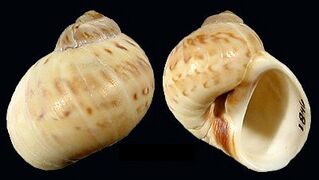
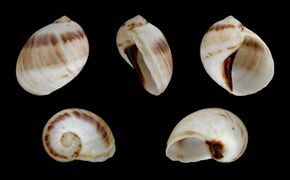
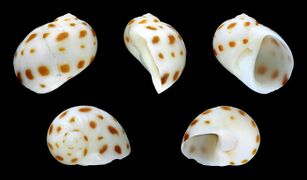
Naticidae, common name moon snails or necklace shells, is a family of medium to large-sized predatory sea snails, marine gastropod molluscs in the clade Littorinimorpha. The shells of the species in this family are mostly globular in shape.
Naticidae is the only family in the superfamily Naticoidea.
It has been estimated that worldwide there are about 260–270 recent species of naticid snails.[1] This group is assumed to have originated in the late Triassic or in the early Jurassic.[1] Members of this family can be recognized by the shape of their shells, distinct appearance, or by their predatory behaviour.[1]
Distribution
Naticids are widely distributed and occur worldwide and are considered to be a delicate part of the web of nature amongst many others. The greatest diversity of both species and genera is found in tropical regions. Even so, naticid snails are also plentiful in temperate, Arctic and Antarctic waters.[1]
Habitat
Moon snails live on sandy substrates, at a great variety of depths depending on the species (from the intertidal zone to thousands of meters in depth).[1] They are often seen ploughing along in the sand, searching for bivalves and other prey, resulting in countersunk bore-holes.
Life habits

Naticids are predatory, feeding mostly on bivalves. They will also attack almost any other shelled mollusk they encounter in the sand, such as scaphopods and other gastropods, including other moon snails.[1] Additionally, Conuber sordidum was shown to prey on the soldier crab Mictyris longicarpus (Crustacea) by drilling predation.[2][3] To catch soldier crabs, C. sordidum uses the same behaviour as when hunting shelled molluscan prey.[3]
The moon snail envelops the prey and then bores a hole through the shell using its radula and an acid secretion. Once the shell is bored open, the proboscis is used to consume the flesh of the prey. The hole in the shell, which has a "countersunk" appearance with chamfered edges, and which varies in size according to the species, is a characteristic sign of moon snail predation.
Sand collars
.jpg)
In the breeding season, the female moon snail lays a rather stiff egg mass which includes sand and mucus. These objects wash up on sandy beaches fairly often, and are known by the common name "sand collars" because of their resemblance to an old-fashioned removable shirt collar or false-collar, especially when intact. These egg masses are characteristic of the moon snails, being unique to this family.[4] The sand collar consists of sand grains cemented together by a gelatinous matrix, with the embedded eggs contained within the matrix. The collar is laid by the female moon snail, and the size of the sand collar gives an indication of the size of the adult female moon snail that laid it; larger species of moon snail lay larger sand collars.
Human interactions
In Korean cuisine, moon snails are called golbaengi (골뱅이) and eaten as golbaengi-muchim (moon snail salad).[5]
Moon snail shells are attractive and relatively large, and often popular in jewellery and ornamentation.
Taxonomy
Traditional classification
Some authors have suggested a distinct separation of the Naticidae into four subfamilies: Ampullospirinae, Naticinae, Polinicinae and Sininae.[6] This arrangement is mainly based on morphological data, such as details of the operculum including the material (calcareous in the Naticinae, corneous in the Polinicinae and Sininae) and size, and also the morphology of the shell.[7][8][9]
2005 taxonomy
The following four subfamilies were recognized in the taxonomy of Bouchet & Rocroi (2005):[10]
- Naticinae Guilding, 1834 - synonyms: Neveritinae Gray, 1857; Choristidae Verrill, 1882; Euspiridae Cossmann, 1907; Mammillinae Iredale & McMichael, 1962; Eunaticinini Oyama, 1469
- Sininae Woodring, 1928 - synonyms: Sigaretidae Gary, 1827; Cryptostomidae Gray, 1827
- Globisininae Powell, 1933
- Polinicinae Gray, 1847
Genera
Genera in the family Naticidae include:
- Unassigned to a subfamily
- † Amauropsina Chelot, 1885
- † Amauropsona H. J. Finlay & Marwick, 1937
- † Austrocochlis H. J. Finlay & Marwick, 1937
- Benthobulbus J. H. McLean, 1995
- † Carinacca Marwick, 1924
- † Cepatia J. E. Gray, 1842
- † Darwinices Griffin & Pastorino, 2013
- Laguncula W. H. Benson, 1842
- † Magnatica Marwick, 1924
- † Maxwellinatica Beu & B. A. Marshall, 2011
- † Nanggulania K. Martin, 1914
- † Pliconacca K. Martin, 1914
- † Polinella Marwick, 1931
- Subfamily Naticidae incertae sedis (temporary name)
- Haliotinella Souverbie, 1875
- Microlinices Simone, 2014
- subfamily Naticinae
- Cochlis Röding, 1798
- Cryptonatica Dall, 1892
- Glyphepithema Rehder, 1943
- Lunaia Berry, 1964: synonym of Natica Scopoli, 1777
- Natica Scopoli, 1777
- Naticarius Duméril, 1806[11]
- Notocochlis Powell, 1933
- Paratectonatica Azuma, 1961
- Proxiuber Powell, 1933
- Stigmaulax Mörch, 1852
- Tanea Marwick, 1931
- † Taniella Finlay & Marwick, 1937
- Tasmatica Finlay & Marwick, 1937
- Tectonatica Sacco, 1890
- subfamily Globisininae
- Falsilunatia Powell, 1951
- Globisinum Marwick, 1924
- subfamily Polinicinae Gray, 1847
- Amauropsis Mörch, 1857
- Bulbus Brown, 1839
- Conuber Finlay & Marwick, 1937
- Euspira Agassiz in Sowerby, 1838
- Friginatica Hedley, 1916
- Glossaulax Pilsbry, 1929
- Hypterita Woodring, 1957
- Kerguelenatica Powell, 1951
- Mammilla Schumacher, 1817
- Neverita Risso, 1826: its subgenus or synonym includes Glossaulax Pilsbry, 1929[8][12][13]
- Polinices Montfort, 1810[14]
- Pseudopolinices Golikov & Sirenko, 1983
- Sinuber Powell, 1951
- † Tahunacca P. A. Maxwell, 1992
- Uberella Finlay, 1928
- Subfamily Sininae Woodring, 1928
- Calinaticina J. Q. Burch & Campbell, 1963
- Eunaticina Fischer, 1885
- Gennaeosinum Iredale, 1929
- Payraudeautia Bucquoy, Dautzenberg & Dollfus, 1883: (uncertain > taxon inquirendum, treated by some as synonym of Euspira)
- † Sigaretotrema Sacco, 1890
- Sigatica O. Meyer & Aldrich, 1886
- Sinum Röding, 1798
subfamily ?
- † Gyrodes Conrad, 1860: belongs to the family †Gyrodidae Conrad, 1860
- Spironema Meek, 1864[15] - notin WoRMS.
Synonyms
 | It has been suggested that this section be merged with Polinices, Sinum and Natica . (Discuss) Proposed since August 2025. |
- Acrybia Adams, 1853: synonym of Bulbus T. Brown, 1839
- Albula Röding, 1798: synonym of Polinices Montfort, 1810 (Invalid: junior homonym of Albula Osbeck, 1762 [Pisces])
- Aloconatica Shikama, 1971: synonym of Stigmaulax Mörch, 1852
- Boreonatica A. N. Golikov & Kussakin, 1974: synonym of Cryptonatica Dall, 1892 (junior objective synonym of Cryptonatica)
- Catinus Oken, 1835: synonym of Sinum Röding, 1798
- Cryptostoma: synonym of Cryptostomus Blainville, 1818: synonym of Sinum Röding, 1798 (incorrect subsequent spelling of Cryptostomus)* Choristes P. P. Carpenter, 1872: synonym of Amauropsis Mörch, 1857
- Cryptostomus Blainville, 1818: synonym of Sinum Röding, 1798
- Ectosinum Iredale, 1931: synonym of Sinum Röding, 1798
- Eucaryum Ehrenberg, 1831: synonym of Polinices Montfort, 1810
- Eunatica Melvill, 1899: synonym of Natica (Eunatica) Melvill, 1899: synonym of Natica Scopoli, 1777 (unaccepted rank)
- † Labellinacca Cossmann, 1919: synonym of Euspira Agassiz, 1837
- Lunaia S. S. Berry, 1964: synonym of Natica Scopoli, 1777
- Lunatia Gray, 1847: synonym of Euspira Agassiz, 1837 (junior subjective synonym)
- Heliconatica Dall, 1924: synonym of Eunaticina P. Fischer, 1885
- Mamilla: synonym of Mammilla Schumacher, 1817 (incorrect spelling of generic name)
- Mamillaria Swainson, 1840: synonym of Polinices Montfort, 1810
- Mamma H. Adams & A. Adams, 1853: synonym of Polinices Montfort, 1810 (junior synonym)
- Mammillaria Herrmannsen, 1847: synonym of Mamillaria Swainson, 1840: synonym of Polinices Montfort, 1810 (Unjustified emendation)
- Nacca Risso, 1826: synonym of Natica Scopoli, 1777
- Naticarinus [sic]: synonym of Naticarius Duméril, 1805 (misspelling - incorrect subsequent spelling)
- Naticella Swainson, 1840: synonym of Polinices Montfort, 1810
- Naticina Guilding, 1834: synonym of Polinices Montfort, 1810 (junior subjective synonym)
- Naticina J. E. Gray, 1847: synonym of Eunaticina P. Fischer, 1885 (junior homonym, Invalid: junior homonym of Naticina Guilding, 1834; Eunaticina P. Fischer, 1885 is a replacement name)
- Naticus Montfort, 1810: synonym of Naticarius Duméril, 1805
- Pervisinum Iredale, 1931: synonym of Eunaticina P. Fischer, 1885
- Polynices Herrmannsen, 1847: synonym of Polinices Montfort, 1810 (Invalid: unjustified emendation of Polinices)
- Pristinacca H. J. Finlay & Marwick, 1937: synonym of † Taniella H. J. Finlay & Marwick, 1937 (junior subjective synonym)
- Propesinum Iredale, 1924: synonym of Eunaticina P. Fischer, 1885
- Quantonatica Iredale, 1936: synonym of Naticarius Duméril, 1805
- Ruma Gray, 1847: synonym of Mammilla Schumacher, 1817
- Sigaretus Lamarck, 1799: synonym of Sinum Röding, 1798 (unaccepted > junior subjective synonym)
- † Sulconacca Marwick, 1924: synonym of Friginatica Hedley, 1916 (junior subjective synonym)
- Uber R. A. Philippi, 1853: synonym of Polinices Montfort, 1810
Gallery
-
-
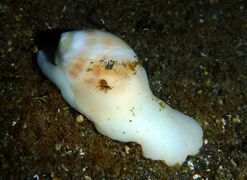
 Naticarius orientalis; north coast of East Timor
 -

-
-
-
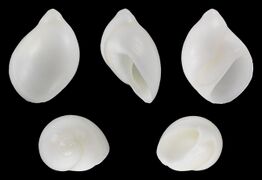
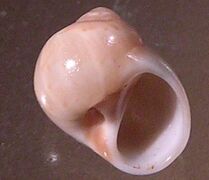 Eunaticina nitida
 -
-
-
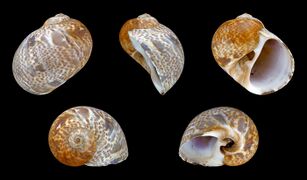 Natica hebraea
 -
-

-

-

-
-
-
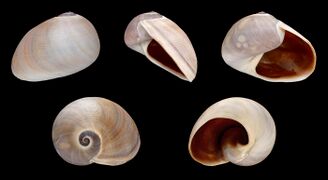
 Tasmatica schoutanica
 -
 50-second video of snails (most likely Natica chemnitzi and Cerithium muscarum) feeding on the sea floor in the Gulf of California, Puerto Peñasco, Mexico.
 -
 Naticid boring in Stewartia from the Calvert Formation, Zone 10, Calvert Co., MD (Miocene).
 -
 Fossil Naticarius millepunctatus; Nicosia Formation, Pliocene, Cyprus
.JPG)


.jpg)


References
- ↑ 1.0 1.1 1.2 1.3 1.4 1.5 Huelsken, T.; Marek, C; Schreiber, S; Schmidt, I; Hollmann, M. (2008). "The Naticidae (Mollusca: Gastropoda) of Giglio Island (Tuscany, Italy): Shell characters, live animals, and a molecular analysis of egg masses". Zootaxa (Magnolia Press) 1770: 1–40. doi:10.11646/zootaxa.1770.1.1. ISSN 1175-5334. http://www.mapress.com/zootaxa/2008/f/zt01770p040.pdf. Retrieved 7 June 2010.
- ↑ Ann M. Cameron (1966). "Some aspects of the behaviour of the soldier crab, Mictyris longicarpus". Pacific Science 20 (2): 224–234.
- ↑ 3.0 3.1 Huelsken, T. (2011) First evidence of drilling predation by Conuber sordidus (Swainson, 1821) (Gastropoda: Naticidae) on soldier crabs (Crustacea: Mictyridae). Molluscan Research, 31(2), 125-131. [1]
- ↑ Bandel, K. (1999) On the origin of the carnivorous gastropod group Naticoidea (Mollusca) in the Cretaceous with description of some convergent but unrelated groups. Greifswalder Geowissenschaftliche Beiträge, 6, 134-175
- ↑ National Institute of Korean Language (30 July 2014). "주요 한식명(200개) 로마자 표기 및 번역(영, 중, 일) 표준안" (in ko). http://www.korean.go.kr/common/download.do?file_path=notice&c_file_name=140730_%ED%95%9C%EC%8B%9D%EB%AA%85_%EB%A1%9C%EB%A7%88%EC%9E%90_%ED%91%9C%EA%B8%B0_%EB%B0%8F_%ED%91%9C%EC%A4%80_%EB%B2%88%EC%97%AD_%ED%99%95%EC%A0%95%EC%95%88_.pdf&o_file_name=140730_%ED%95%9C%EC%8B%9D%EB%AA%85_%EB%A1%9C%EB%A7%88%EC%9E%90_%ED%91%9C%EA%B8%B0_%EB%B0%8F_%ED%91%9C%EC%A4%80_%EB%B2%88%EC%97%AD_%ED%99%95%EC%A0%95%EC%95%88_.pdf.
- 주요 한식명 로마자 표기 및 표준 번역 확정안 공지. National Institute of Korean Language (Press release) (in 한국어). 2014-05-02.
- ↑ Kabat A.R. 1991. The classification of the Naticidae (Mollusca: Gastropoda): Review and analysis of the supraspecific taxa. Bull. Mus. Comp. Zool., 152, 417-449.
- ↑ Cernohorsky W.O. 1971. The family Naticidae (Mollusca: Gastropoda) in the Fiji Islands. Auckland Inst. Mus., 8, 169-208.
- ↑ 8.0 8.1 Marincovich L.N. 1977. Cenozoic Naticidae (Mollusca: Gastropoda) of the Northeastern Pacific. Bulletins of American Paleontology, 70, 169-212.
- ↑ Bandel K. 1999. On the origin of the carnivorous gastropod group Naticoidea (Mollusca) in the Cretaceous with description of some convergent but unrelated groups. Greifswalder Geowissenschaftliche Beiträge, 6, 134-175.
- ↑ Bouchet, Philippe; Rocroi, Jean-Pierre; Frýda, Jiri; Hausdorf, Bernard; Ponder, Winston; Valdés, Ángel; Warén, Anders (2005). "Classification and nomenclator of gastropod families". Malacologia (Hackenheim, Germany: ConchBooks) 47 (1-2): 1–397. ISBN 3-925919-72-4. ISSN 0076-2997.
- ↑ Huelsken, T., Wägele, H., Peters, B., Mather, A., Hollmann, M. (2011) Molecular analysis of adults and egg masses reveals two independent lineages within the infaunal gastropod Naticarius onca (Röding, 1798) (Caenogastropoda: Naticidae). Molluscan Research, 31(3), 141-151. PDF
- ↑ Majima, R. 1989. Cenozoic fossil Naticidae (Mollusca: Gastropoda) in Japan. Bulletins of American Paleontology, 96 (331), 1-159.
- ↑ Huelsken T. et al. 2006. Neverita delessertiana (Recluz in Chenu, 1843): a naticid species (Gastropoda: Caenogastropoda) distinct from Neverita duplicata (Say, 1822) based on molecular data, morphological characters, and geographical distribution. Zootaxa, 1257:1-25.
- ↑ Huelsken, T., Tapken, D., Dahlmann, T., Wägele, H., Riginos, C., Hollmann, M. (2012). Systematics and phylogenetic species delimitation within Polinices s.l. (Caenogastropoda: Naticidae) based on molecular data and shell morphology. Organisms Diversity & Evolution. doi:10.1007/s13127-012-0111-5.
- ↑ Siemers C. T. & King N. R. (1974). "Macroinvertebrate paleoecology of a transgressive marine sandstone, Cliff House Sandstone (Upper Cretaceous), Chaco Canyon, northwestern New Mexico" PDF.
Further reading
- Powell A. W. B. 1979. New Zealand Mollusca, William Collins Publishers Ltd, Auckland, New Zealand ISBN 0-00-216906-1
- Ponder W. & Lindberg D. 1997. Towards a phylogeny of gastropod molluscs; an analysis using morphological characters. Zoological Journal of the Linnean Society, 119: 83-265, London, ISSN 0024-4082.
- Aronowsky A. (2003). "Mystery of naticid predation history solved: Evidence from a "living fossil" species: COMMENT". pp E34. Geological Society of America- online. http://www.gsajournals.org/perlserv/?request=get-static&name=i0091-7613-31-6-e34&ct=1.
- Colgan D.J. et al. 2007. Molecular phylogenetics of Caenogastropoda (Gastropoda: Mollusca). Molecular Phylogenetics and Evolution, 42, 717-37.
- Torigoe K. & Inaba A. (2011) Revision on the classification of Recent Naticidae. Bulletin of the Nishinomiya Shell Museum 7: 133 + 15 pp., 4 pls.
External links
- CLEMAM - Taxonomic Database on European Marine Mollusca of the Muséum National d'Histoire Naturelle and the Department of Systematics & Evolution, Paris.
- The Naticidae of Giglio Island at Morphobank - Homology of phenotypes over the web
- Malacolog 4.1.0 - A Database of Western Atlantic Marine Mollusca
- "Naticidae". Integrated Taxonomic Information System. https://www.itis.gov/servlet/SingleRpt/SingleRpt?search_topic=TSN&search_value=72878.
- Naturamediterraneo - Mediterranean fauna and flora
- Publications and sequences of the Naticidae submitted to the NCBI
- Miocene Gastropods and Biostratigraphy of the Kern River Area, California; United States Geological Survey Professional Paper 642
 This article incorporates text from this source, which is in the public domain.
Wikidata ☰ Q1563463 entry
 |  |
 EncycloReader
is supported by the
EncycloReader
is supported by the  KSF
KSF