Sheep moth
Topic: Biology
 From HandWiki - Reading time: 2 min
| Sheep moth | |
|---|---|

| |
Scientific classification 
| |
| Kingdom: | Animalia |
| Phylum: | Arthropoda |
| Class: | Insecta |
| Order: | Lepidoptera |
| Family: | Saturniidae |
| Genus: | Hemileuca |
| Species: | H. eglanterina
|
| Binomial name | |
| Hemileuca eglanterina Boisduval, 1852
| |
The sheep moth, or common sheep moth (Hemileuca eglanterina), is a member of the family Saturniidae of silk moths and is native to western North America. In California, its range is west of the Sierran crest[1] and the mountains of Southern California, ranging near to the coast.[2] The moth is dayflying and appears in summer.[1] It feeds on plants of three genera: Ceanothus, Rhamnus (including coffeeberry), and Rosa.[1][2] Nuttall's sheep moth and one other species are similar, occurring in sagebrush areas east of the Sierra Nevada.[1] The species was first described by Jean Baptiste Boisduval in 1852.[3]
The sheep moth has a 5.5-8.5 centimeter wingspan and a relatively slender body. Its forewings are pink with a yellow streak in the middle and the hindwings are yellowish with variable black markings. There is an all-black form near Mount Shasta.[1] The larvae are black with branched yellowish spines that become orange in later development and an orange-brown head.[1]
Gallery
-
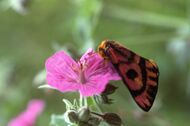 Adult on flower
 -
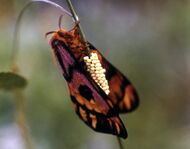 Adult laying eggs
 -
 Caterpillar larva on bitterbrush.


.jpg)
References
- ↑ 1.0 1.1 1.2 1.3 1.4 1.5 Jerry A. Powell, Charles L. Hogue (1981). California Insects. University of California Press. pp. 230. ISBN 9780520037823. https://books.google.com/books?id=vE-u08itGrAC&pg=PA230&dq=sheep+moth.
- ↑ 2.0 2.1 Michael L. Charters (May 18, 2009). "Common sheep moth". Butterflies and Moths of Southern California. Sierra Madre, California. http://www.calflora.net/butterflies/commonsheepmoth.html. Retrieved February 25, 2010.
- ↑ Savela, Markku. "Hemileuca eglanterina (Boisduval, 1852)". http://www.nic.funet.fi/pub/sci/bio/life/insecta/lepidoptera/ditrysia/bombycoidea/saturniidae/hemileucinae/hemileuca/#eglanterina. Retrieved November 9, 2018.
Wikidata ☰ Q2410277 entry
 |  |
 EncycloReader
is supported by the
EncycloReader
is supported by the  KSF
KSF