Urticaceae
Topic: Biology
 From HandWiki - Reading time: 12 min
The Urticaceae /ɜːrtɪˈkeɪsiː/ are a family, the nettle family, of flowering plants. The family name comes from the genus Urtica. The Urticaceae family includes a number of well-known and useful plants, including nettles in the genus Urtica, Ramie (Boehmeria nivea), māmaki (Pipturus albidus), and ajlai (Debregeasia saeneb).
The family includes about 2,625 species, grouped into 53 genera.[1] The largest genera are Pilea (500 to 715 species), Elatostema (300 species), Urtica (80 species), and Cecropia (75 species). Cecropia contains many myrmecophytes.[2]
Urticaceae species can be found worldwide, but most species are found in tropical ecosystems, especially tropical Asia.[3]
Description
Urticaceae species can be herbs (e.g. Urtica, Parietaria), shrubs(e.g. Pilea), hemi-epiphytes, or, rarely, trees (Dendrocnide, Cecropia). Their leaves are usually entire and bear stipules.
Urticating hairs are often present.[4] Stinging trichomes on the leaves break upon contact, imbedding a sharp tip into animal skin which is filled with an irritating liquid. This liquid consists of compounds such as histamines and acetylcholines that create a irritating skin reaction.[5] These urticating trichomes are an herbivory defense against primarily mammals, but also defend against invertebrate herbivory as well.[5]
Urticaceae flowers are typically unisexual, with rare cases of functionally hermaphroditic flowers[4]. Pistillate flowers have superior pseudomonomerous ovaries extending to one style. This family has a gynoecium with two carpels, and a perianth of four to five[4]. Urticacids explosively release their pollen when their urticaceaous stamens dry in the heat, causing the filaments to straighten and the anthers to release pollen in a swift motion[6]. Plants are then wind-pollinated. Fruits are achenes.[7]

Additional characteristics represented by members in the family are leaves with cystolith or silicone accumulation.[7] Some members exhibit latex presence only in the bark as an anti-herbivory defense.[7]
While the stings delivered by Urticaceae species are often unpleasant, they seldom pose any direct threat to health, and deaths directly attributed to stinging are exceedingly rare; species known to cause human fatalities include Dendrocnide cordata[8][9] and Urtica ferox.[10]
Uses
Many members of Urticaceae are cultivated and foraged worldwide for various uses, including food, medicines, and to create tools. Some notable species include:
- Pouzolzia mixta (soap nettle), is used as a culinary herb, made into rope, and is a source of traditional medicine in several southern African countries.[11]
- Urtica angustifolia, which grows throughout eastern Asia, is a important traditional Chinese medicine plant.[12]
- Cecropia obtusa, Laportea aestuans, and Urera baccifera are all species used as anti-inflammatory and diabetes medicine in Brazil.[7]
- While Urtica dioica stinging hairs cause inflammation, the plant has been used to treat a large variety of medical issues, including, but not limited to: arthritis, gout, anemia, and eczema.[13]
Diseases
The Urticaceae are subject to many bacterial, viral, fungal, and nematode parasitic diseases. Among them are:
- Bacterial leaf spot, caused by Xanthomonas campestris which affects Pellionia, Pilea, and other genera[14].
- Anthracnose, a fungal disease caused by Colletotrichum capsici which affects Pilea[14].
- Myrothecium leaf spot, a fungal disease caused by Myrothecium roridum which affects plants throughout the Urticaceae, as well as other angiosperms[15][16]
- Phytophthora blight, a water mold disease caused by Phytophthora nicotianae which affects Pilea
- Southern blight, a fungal disease caused by Athelia rolfsii which affects both Pellionia and Pilea
Fossil record
The fossil record of Urticaceae is scattered and mostly based on dispersed fruits. Twelve species based on fossil achenes are known from the Late Cretaceous of Central Europe. Most were assigned to the extant genera Boehmeria (three species), Debregeasia (one species) and Pouzolzia (three species), while three species were assigned to the extinct genus Urticoidea.[17]
A Colombian fossil flora of the Maastrichtian stage has yielded leaves that resemble leaves of the tribe Ceropieae.[18]
In the Cenozoic fossil leaves from the Ypresian Allenby Formation preserve distinct trichomes, and have been attributed to the Tribe Urticeae in the fossil record. The leaves had originally been identified as Rubus by earlier workers on the Eocene Okanagan Highlands, but Devore et al (2020) interpreted the preserved hairs along the stem and major veins as stinging trichomes, rather than simple hairs or thorns.[19]
Taxonomy
Classification
The APG II system puts the Urticaceae in the order Rosales, while older systems consider them part of the Urticales, along with Ulmaceae, Moraceae, and Cannabaceae. Urticaceae is a monophyletic group.[20]
Phylogeny
Modern molecular phylogenetics suggest the following relationships[21][22] (see also [23][24][25][26][27][28][29][30][31][32]):
| |||||||||||||||||||||||||||||||||||||||||||||||||||||||||||||||||||||||||||||||||||||||||||||||||||||||||||||||||||||||||||||||||||||||||||||||||||||||||||||||||||||||||||||||||||||||||||||||||||||||||||||||||||||||||||||||||||||||||||||||||||||||||||||||||||||||||||||||
Tribes and genera
- Boehmerieae Gaudich. 1830
- Archiboehmeria C.J. Chen 1980 (1 sp.)
- Astrothalamus C.B. Rob. 1911 (1 sp.)
- Boehmeria Jacq. 1760 (80 spp.)
- Chamabainia Wight 1853 (1–2 spp.)
- Cypholophus Wedd. 1854 (15 spp.)
- Debregeasia Gaudich. 1844 (4 spp.)
- Gibbsia Rendle 1917 (2 spp.)
- Gonostegia Turcz. 1846 (5 spp.)
- Hemistylus Benth. 1843 (4 spp.)
- Neodistemon Babu & A. N. Henry 1970 (1 sp.)
- Neraudia Gaudich. 1830 (5 spp.)
- Nothocnide Blume 1856 (4 spp.)
- Oreocnide Miq. 1851 (15 spp.)
- Phenax Wedd. 1854 (12 spp.)
- Pipturus Wedd. 1854 (30 spp.)
- Pouzolzia Gaudich. 1826 [1830] (70 spp.)
- Rousselia Gaudich. 1826 [1830] (3 spp.)
- Sarcochlamys Gaudich. 1844 (1 sp.)
- Cecropieae Gaudich. 1830
- Elatostemateae Gaudich. 1830
- Aboriella Bennet (1 sp.) (synonym of Achudemia
- Achudemia Blume 1856
- Elatostema J.R. Forst. & G. Forst. 1775 (300 spp.)
- Gyrotaenia Griseb. 1861 (4 spp.)
- Lecanthus Wedd. 1854 (4 sp.) (syn. Meniscogyne Gagnep. 1928)
- Myriocarpa Benth. 1844 [1846] (18 spp.)
- Pellionia Gaudich. 1826 (60 spp.)
- Petelotiella Gagnep. in Lecomte 1929 (1 spp.)
- Pilea Lindl. 1821 (606 spp.) (syn. Sarcopilea Urb. 1912)
- Procris Comm. ex Juss. 1789 (24 spp.)
- Forsskaoleeae Gaudich. 1830
- Australina Gaudich. 1830 (2 spp.)
- Didymodoxa E. Mey. ex Wedd. 1857 (2 spp.)
- Droguetia Gaudich. 1830 (7 spp.)
- Forsskaolea L. 1764 (6 spp.)
- Parietarieae Gaudich. 1830
- Gesnouinia Gaudich. 1830 (2 spp.)
- Parietaria L. 1753 (20 spp.)
- Soleirolia Gaudich. 1830 (1 sp.)
- Urticeae Lamarck & DC. 1806
- Dendrocnide Miq. 1851 (27 spp.)
- Discocnide Chew 1965 (1 sp.)
- Girardinia Gaudich. 1830 (2 spp.)
- Hesperocnide Torr. 1857 (2 spp.)
- Laportea Gaudich. 1826 [1830] (21 spp.)
- Nanocnide Blume 1856 (2 spp.)
- Obetia Gaudich. 1844 (7 spp.)
- Poikilospermum Zipp. ex Miq. 1864 (20 spp.)
- Touchardia Gaudich. 1847 (1–2 spp.)
- Urera Gaudich. 1826 [1830] (35 spp.)
- Urtica L. 1753—nettle (80 spp.)
- Zhengyia T.Deng, D.G.Zhang & H.Sun 2013 (1 sp.)[33]
- Incertae sedis
- Capsulea Yong Wang 2021 (1 sp.)
- Elatostematoides C.B.Rob. 1910 publ. 1911 (25 sp.)
- Metapilea W.T.Wang 2016 (1 sp.)
- Metatrophis F.Br. 1935 (1 sp.)
- Parsana Parsa & Maleki 1952 (1 sp.)
- Scepocarpus Wedd. 1869 (14 sp.)
Image gallery
-
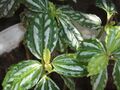 Pilea cadierei
 -
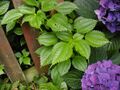 Pilea pumila
 -
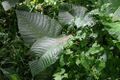 Dendrocnide sp.
 -
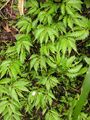 Elatostema umbellatum
 -
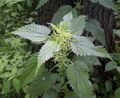 Urtica dioica
 -
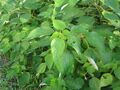 Boehmeria nivea
 -
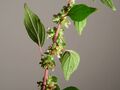 Parietaria judaica flowers
 -
 Urtica dioica stinging hairs
 -
 Leaves of Dendrocnide meyeniana
 -
 The dotted bumps on the leaves of Urtica thunbergiana


_Urtica_thunbergiana_20220406201651.jpg)
References
- ↑ Christenhusz, M. J. M., and Byng, J. W. (2016). "The number of known plants species in the world and its annual increase". Phytotaxa 261 (3): 201–217. doi:10.11646/phytotaxa.261.3.1. Bibcode: 2016Phytx.261..201C. http://biotaxa.org/Phytotaxa/article/download/phytotaxa.261.3.1/20598.
- ↑ Chomicki G, Renner SS. (2015). "Phylogenetics and molecular clocks reveal the repeated evolution of ant-plants after the late Miocene in Africa and the early Miocene in Australasia and the Neotropics". New Phytologist 207 (2): 411–424. doi:10.1111/nph.13271. PMID 25616013. Bibcode: 2015NewPh.207..411C.
- ↑ Fu, Xiao-Gang; Liu, Jie; Milne, Richard I.; Monro, Alex K.; Liu, Shui-Yin; Tian, Qin; Stull, Gregory W.; Kipkoech, Amos et al. (2025-12-17). "A robust phylogenomic framework supports a revised intrafamilial classification of Urticaceae". Plant Diversity. doi:10.1016/j.pld.2025.12.003. ISSN 2468-2659. https://www.sciencedirect.com/science/article/pii/S2468265925002185.
- ↑ 4.0 4.1 4.2 Pedersoli, Giseli D; Staedler, Yannick M; Schönenberger, Jürg; Teixeira, Simone P (2022-11-11). "A comparative approach reveals diversity of floral developmental processes in Urticaceae" (in en). Botanical Journal of the Linnean Society 200 (4): 465–490. doi:10.1093/botlinnean/boac028. ISSN 0024-4074. https://academic.oup.com/botlinnean/article/200/4/465/6605086.
- ↑ 5.0 5.1 Tuberville, Tracey D.; Dudley, Peter G.; Pollard, A. Joseph (February 1996). "Responses of Invertebrate Herbivores to Stinging Trichomes of Urtica dioica and Laportea canadensis". Oikos (Wiley) 75 (1): 83–88. doi:10.2307/3546324. ISSN 0030-1299. Bibcode: 1996Oikos..75...83T. https://doi.org/10.2307/3546324.
- ↑ Pedersoli, Giseli D.; Leme, Flávia M.; Leite, Viviane G.; Teixeira, Simone P. (2019-03-15). "Anatomy solves the puzzle of explosive pollen release in wind-pollinated urticalean rosids" (in en). American Journal of Botany 106 (3): 489–506. doi:10.1002/ajb2.1254. ISSN 0002-9122. PMID 30875436. https://bsapubs.onlinelibrary.wiley.com/doi/10.1002/ajb2.1254.
- ↑ 7.0 7.1 7.2 7.3 Corrado, Amanda Roberta; Gagliatti, André Luiz; Romaniuc Neto, Sergio; Ming, Lin Chau (2015-06-11). "Reports of the use of Urticaceae collected in Brazil and deposited in the herbaria of Kew (K), New York (NY) and Paris (P)". Ethnobiology and Conservation 4. doi:10.15451/ec2015-5-4.5-1-12. ISSN 2238-4782. https://doi.org/10.15451/ec2015-5-4.5-1-12.
- ↑ Hurley, Marina (October–December 2000). "Selective Stingers". CSIRO. http://www.ecosmagazine.com/?act=view_file&file_id=EC105p18.pdf.
- ↑ MacFarlane, W.V. (1963). "The Stinging Properties of Laportea". Economic Botany 17 (4): 303–311. doi:10.1007/BF02860137. Bibcode: 1963EcBot..17..303M.
- ↑ Poisonous native plants , The Encyclopedia of New Zealand
- ↑ Maroyi, A (2023-12-06). "Biological and medicinal properties of Pouzolzia mixta solms (Urticaceae): a narrative review". African Journal of Food, Agriculture, Nutrition and Development 23 (10): 24825–24843. doi:10.18697/ajfand.125.23570. ISSN 1684-5374. https://doi.org/10.18697/ajfand.125.23570.
- ↑ Liu, Mu; Lu, Jinsen; Li, Baoyong; Zhang, Lvshui (2023-01-02). "The complete chloroplast genome of Urtica angustifolia Fisch. ex Hornem. (Urticaceae), an important kind of traditional Chinese medicine in China". Mitochondrial DNA Part B 8 (1): 116–118. doi:10.1080/23802359.2022.2057246. ISSN 2380-2359. https://doi.org/10.1080/23802359.2022.2057246.
- ↑ Đurović, Saša; Kojić, Ivan; Radić, Danka; Smyatskaya, Yulia A.; Bazarnova, Julia G.; Filip, Snežana; Tosti, Tomislav (2024-03-18). "Chemical Constituents of Stinging Nettle (Urtica dioica L.): A Comprehensive Review on Phenolic and Polyphenolic Compounds and Their Bioactivity". International Journal of Molecular Sciences 25 (6): 3430. doi:10.3390/ijms25063430. ISSN 1422-0067. PMID 38542403.
- ↑ 14.0 14.1 "Common Names of Plant Diseases: Diseases of Foliage Plants (House Plants): Urticaceae". The American Phytopathological Society. 26 March 1993. http://www.apsnet.org/publications/commonnames/Pages/FoliagePlants.aspx.
- ↑ Chase, A. R. (1983). "Influence of host plant and isolate source on Myrothecium leaf spot of foliage plants". Plant Disease 67 (6): 668–671. doi:10.1094/PD-67-668. Bibcode: 1983PlDis..67..668C. http://www.apsnet.org/publications/PlantDisease/BackIssues/Documents/1983Articles/PlantDisease67n06_668.PDF.
- ↑ Nguyen, Thu Ha, Mathur, S. B., & Neergaard, Paul (1973). "Seed-borne species of Myrothecium and their pathogenic potential". Transactions of the British Mycological Society 61 (2): 347–354, IN14–IN16. doi:10.1016/S0007-1536(73)80156-1.
- ↑ Else Marie Friis; Peter R. Crane; Kaj Raunsgaard Pedersen (18 Aug 2011). Early Flowers and Angiosperm Evolution. Cambridge University Press. ISBN 978-0-521-59283-3.
- ↑ Treiber, E. L.; Gaglioti, A. L.; Romaniuc-Neto, S.; Madriñán, S.; Weiblen, G. D. (2016). "Phylogeny of the Cecropieae (Urticaceae) and the evolution of an ant-plant mutualism". Systematic Botany 41 (1): 56–66. doi:10.1600/036364416X690633. Bibcode: 2016SysBo..41...56T.
- ↑ DeVore, M. L.; Nyandwi, A.; Eckardt, W.; Bizuru, E.; Mujawamariya, M.; Pigg, K. B. (2020). "Urticaceae leaves with stinging trichomes were already present in latest early Eocene Okanogan Highlands, British Columbia, Canada". American Journal of Botany 107 (10): 1449–1456. doi:10.1002/ajb2.1548. PMID 33091153.
- ↑ Kim, Changkyun; Deng, Tao; Chase, Mark; Zhang, Dai-Gui; Nie, Ze-Long; Sun, Hang (2015-02-09). "Generic phylogeny and character evolution in Urticeae (Urticaceae) inferred from nuclear and plastid DNA regions". Taxon 64 (1): 65–78. doi:10.12705/641.20. ISSN 0040-0262. Bibcode: 2015Taxon..64...65K. https://doi.org/10.12705/641.20.
- ↑ Wu Z-Y, Monro AK, Milne RI, Wang H, Liu J, Li D-Z. (2013). "Molecular phylogeny of the nettle family (Urticaceae) inferred from multiple loci of three genomes and extensive generic sampling". Molecular Phylogenetics and Evolution 69 (3): 814–827. doi:10.1016/j.ympev.2013.06.022. PMID 23850510. Bibcode: 2013MolPE..69..814W.
- ↑ Wu Z-Y, Milne RI, Chen C-J, Liu J, Wang H, Li D-Z. (2015). "Ancestral state reconstruction reveals rampant homoplasy of diagnostic morphological characters in Urticaceae, conflicting with current classification schemes". PLoS ONE 10 (11). doi:10.1371/journal.pone.0141821. PMID 26529598. Bibcode: 2015PLoSO..1041821W.
- ↑ Sytsma KJ, Morawetz J, Pires JC, Morden CW. (2000). "Phylogeny of the Urticales based on three molecular data sets, with emphasis on relationships within Urticaceae". American Journal of Botany 87 (6): 162. http://2000.botanyconference.org/section13/abstracts/232.shtml.
- ↑ Sytsma KJ, Morawetz J, Pires C, Nepokroeff M, Conti E, Zjhra M, Hall JC, Chase MW. (2002). "Urticalean rosids: Circumscription, rosid ancestry, and phylogenetics based on rbcL, trnL–F, and ndhF sequences". American Journal of Botany 89 (9): 1531–1546. doi:10.3732/ajb.89.9.1531. PMID 21665755. Bibcode: 2002AmJB...89.1531S. http://www.bricol.net/research/CICphylog/CICfinalSTUFF/Urtical-rosids.pdf.
- ↑ Hadiah JT, Quinn CJ, Conn BJ. (2003). "Phylogeny of Elatostema (Urticaceae) using chloroplast DNA data". Telopea 10 (1): 235–246. doi:10.7751/telopea20035618. Bibcode: 2003Telop..10..235H. https://www.researchgate.net/publication/277933656.
- ↑ Datwyler SL, Weiblen G. (2004). "On the origin of the fig: Phylogenetic relationships of Moraceae from ndhF sequences". American Journal of Botany 91 (5): 767–777. doi:10.3732/ajb.91.5.767. PMID 21653431. Bibcode: 2004AmJB...91..767D.
- ↑ Zerega NJC, Clement WL, Datwyler SL, Weiblen GD. (2005). "Biogeography and divergence times in the mulberry family (Moraceae)". Molecular Phylogenetics and Evolution 37 (2): 402–416. doi:10.1016/j.ympev.2005.07.004. PMID 16112884. Bibcode: 2005MolPE..37..402Z.
- ↑ Monro AK. (2006). "The revision of species-rich genera: A phylogenetic framework for the strategic revision of Pilea (Urticaceae) based on cpDNA, nrDNA, and morphology". American Journal of Botany 93 (3): 426–441. doi:10.3732/ajb.93.3.426. PMID 21646202. Bibcode: 2006AmJB...93..426M.
- ↑ Hadiah JT, Conn BJ, Quinn CJ (2008). "Infra-familial phylogeny of Urticaceae, using chloroplast sequence data". Australian Systematic Botany 21 (5): 375–385. doi:10.1071/SB08041. Bibcode: 2008AuSyB..21..375H.
- ↑ Conn BJ, Hadiah JT (2009). "Nomenclature of tribes within the Urticaceae". Kew Bulletin 64 (2): 349–352. doi:10.1007/s12225-009-9108-4. Bibcode: 2009KewBu..64..349C.
- ↑ Kim C, Deng T, Chase M, Zhang D-G, Nie Z-L, Sun H. (2015). "Generic phylogeny and character evolution in Urticeae (Urticaceae) inferred from nuclear and plastid DNA regions". Taxon 64 (1): 65–78. doi:10.12705/641.20. Bibcode: 2015Taxon..64...65K.
- ↑ Treiber EL, Gaglioti EL, Romaniuc-Neto S, Madriñán S, Weiblen GD. (2016). "Phylogeny of the Cecropieae (Urticaceae) and the evolution of an ant–plant mutualism". Systematic Botany 41 (1): 56–66. doi:10.1600/036364416X690633. Bibcode: 2016SysBo..41...56T.
- ↑ Deng Tao; Kim C; Zhang D-G; Zhang J-W; Li Z-M; Nie Z-L; Sun H. (2013). "Zhengyia shennongensis: A new bulbiliferous genus and species of the nettle family (Urticaceae) from central China exhibiting parallel evolution of the bulbil trait". Taxon 62 (1): 89–99. doi:10.1002/tax.621008. Bibcode: 2013Taxon..62...89D.
Further reading
- Pignatti, Sandro (1982) (in it). Flora d'Italia. Bologna: Edagricole. ISBN 978-88-506-2449-2.
- Friis, Ib (1989). Urticaceae. Flora of tropical East Africa. Rotterdam: A.A. Balkema and the Royal Botanic Gardens, Kew. ISBN 978-90-6191-352-8.
External links
- Stevens, P. F.. "Angiosperm Phylogeny Website, Version 13". Missouri Botanical Garden. http://www.mobot.org/MOBOT/research/APweb/. continuously updated.


Wikidata ☰ Q156332 entry
 |  |
 EncycloReader
is supported by the
EncycloReader
is supported by the  KSF
KSF