Table of Contents Categories
Cenomanian
Topic: Earth
 From HandWiki - Reading time: 6 min
The Cenomanian is, in the International Commission on Stratigraphy's (ICS) geological timescale, the oldest or earliest age of the Late Cretaceous Epoch or the lowest stage of the Upper Cretaceous Series.[1] An age is a unit of geochronology; it is a unit of time; the stage is a unit in the stratigraphic column deposited during the corresponding age. Both age and stage bear the same name.
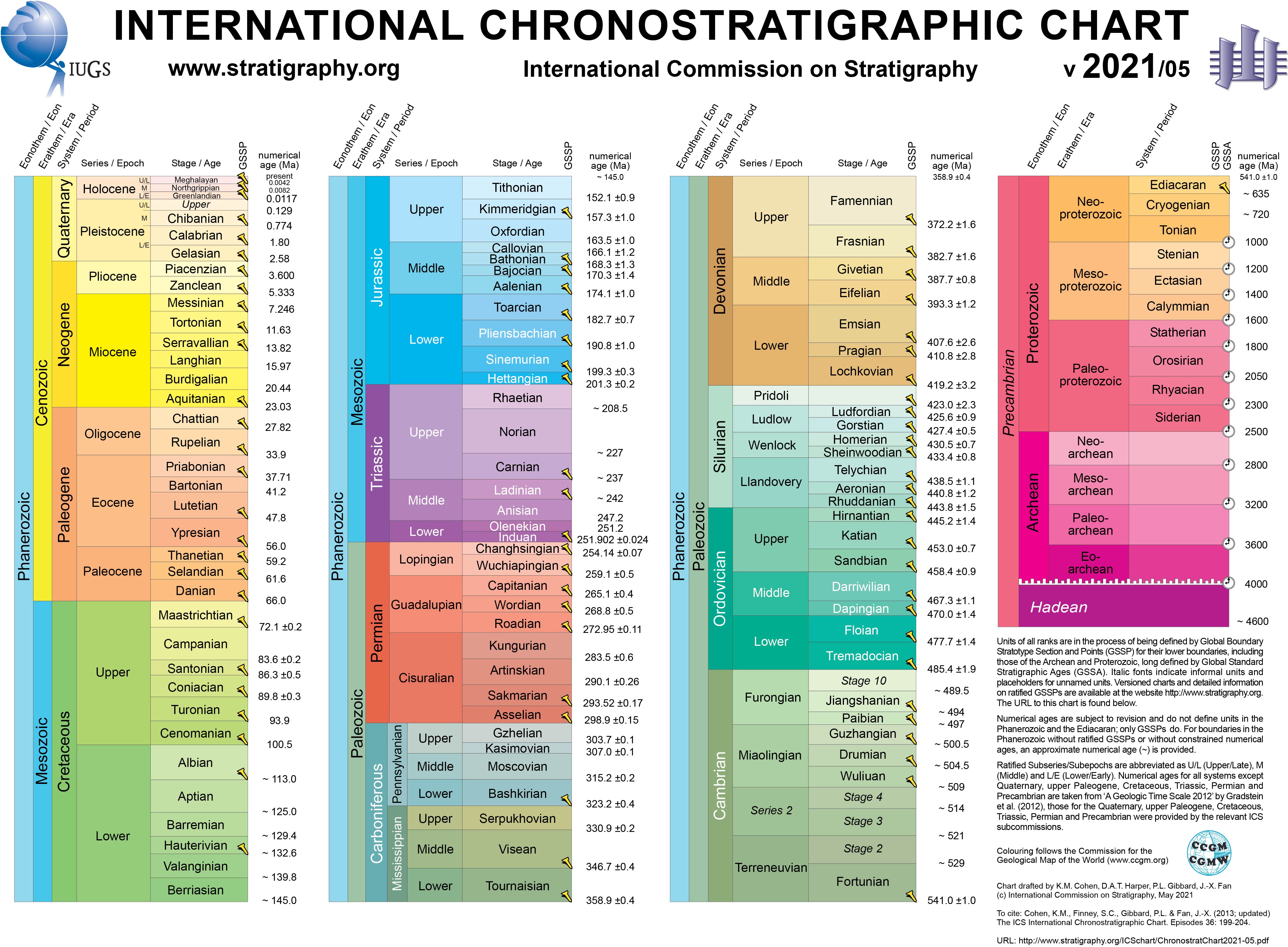
As a unit of geologic time measure, the Cenomanian Age spans the time between[2] 100.5 and 93.9 million years ago (Mya). In the geologic timescale, it is preceded by the Albian and is followed by the Turonian. The Upper Cenomanian starts around at 95 Mya. The Cenomanian is coeval with the Woodbinian of the regional timescale of the Gulf of Mexico and the early part of the Eaglefordian of the regional timescale of the East Coast of the United States.
At the end of the Cenomanian, an anoxic event took place, called the Cenomanian-Turonian boundary event or the "Bonarelli event", that is associated with a minor extinction event for marine species.
Cenomanithrips, an extinct thrip of the Stenurothripidae family, was named after the Cenomanian, the age of the Myanmar amber in which it was discovered.[3]
Stratigraphic definitions
The Cenomanian was introduced in scientific literature by French palaeontologist Alcide d'Orbigny in 1847. Its name comes from the Neo-Latin name of the French city of Le Mans (département Sarthe), Cenomanum. The base of the Cenomanian Stage (which is also the base of the Upper Cretaceous Series) is placed at the first appearance of foram species Rotalipora globotruncanoides in the stratigraphic record. An official reference profile for the base of the Cenomanian (a GSSP) is located in an outcrop at the western flank of Mont Risou, near the village of Rosans in the French Alps (département Hautes-Alpes, coordinates: 44°23'33"N, 5°30'43"E). The base is, in the reference profile, located 36 meters below the top of the Marnes Bleues Formation.[4]
The top of the Cenomanian (the base of the Turonian) is at the first appearance of ammonite species Watinoceras devonense.
Important index fossils for the Cenomanian are the ammonites Calycoceras naviculare, Acanthoceras rhotomagense, and Mantelliceras mantelli.
Sequence stratigraphy and palaeoclimatology
The Early Cenomanian was extremely hot, with mid-latitude sea surface temperatures (SSTs) estimated at >31°C and water temperatures in the upper bathyal depths estimated at >17 °C.[5] During the Cenomanian, Labrador's mean annual temperature (MAT) was around 15.1 ± 2.1°C, one of the coldest in North America at this time.[6] A pan-African rainforest existed.[7] Egypt was warm and humid, though occasionally saw intervals of relatively dry conditions.[8]
References
- ↑ See for a detailed geologic timescale Gradstein et al. (2004)
- ↑ "International Stratigraphic Chart v2021/05". https://stratigraphy.org/ICSchart/ChronostratChart2021-05.jpg.
- ↑ Tong T, Shih CK, Ren D (2019). "A new genus and species of Stenurothripidae (Insecta: Thysanoptera: Terebrantia) from mid-Cretaceous Myanmar amber". Cretaceous Research 100: 184–191. doi:10.1016/j.cretres.2019.03.005. Bibcode: 2019CrRes.100..184T.
- ↑ The GSSP for the Cenomanian was established by Kennedy et al. (2004)
- ↑ Ando, Atsushi; Huber, Brian T.; MacLeod, Kenneth G.; Watkins, David K. (4 November 2015). "Early Cenomanian "hot greenhouse" revealed by oxygen isotope record of exceptionally well-preserved foraminifera from Tanzania" (in en). Paleoceanography and Paleoclimatology 30 (11): 1556–1572. doi:10.1002/2015PA002854. ISSN 0883-8305. Bibcode: 2015PalOc..30.1556A. https://agupubs.onlinelibrary.wiley.com/doi/10.1002/2015PA002854. Retrieved 28 October 2024.
- ↑ Demers-Potvin, Alexandre V.; Larsson, Hans C. E. (2 August 2019). Lomax, Barry. ed. "Palaeoclimatic reconstruction for a Cenomanian-aged angiosperm flora near Schefferville, Labrador" (in en). Palaeontology 62 (6): 1027–1048. doi:10.1111/pala.12444. ISSN 0031-0239. Bibcode: 2019Palgy..62.1027D. https://onlinelibrary.wiley.com/doi/10.1111/pala.12444. Retrieved 20 October 2024.
- ↑ Acosta, R. Paul; Ladant, Jean‐Baptiste; Zhu, Jiang; Poulsen, Christopher J. (9 July 2022). "Evolution of the Atlantic Intertropical Convergence Zone, and the South American and African Monsoons Over the Past 95‐Myr and Their Impact on the Tropical Rainforests" (in en). Paleoceanography and Paleoclimatology 37 (7). doi:10.1029/2021PA004383. ISSN 2572-4517. https://agupubs.onlinelibrary.wiley.com/doi/full/10.1029/2021PA004383. Retrieved 9 March 2026.
- ↑ El Atfy, Haytham; Coiffard, Clément; El Beialy, Salah Y.; Uhl, Dieter (30 January 2023). Peppe, Daniel. ed. "Vegetation and climate change at the southern margin of the Neo-Tethys during the Cenomanian (Late Cretaceous): Evidence from Egypt" (in en). PLOS ONE 18 (1). doi:10.1371/journal.pone.0281008. ISSN 1932-6203. PMID 36716334. Bibcode: 2023PLoSO..1881008E.
Further reading
- Gradstein, F.M.; Ogg, J.G. & Smith, A.G.; 2004: A Geologic Time Scale 2004, Cambridge University Press.
- Kennedy, W.J.; Gale, A.S.; Lees, J.A. & Caron, M.; 2004: The Global Boundary Stratotype Section and Point (GSSP) for the base of the Cenomanian Stage, Mont Risou, Hautes-Alpes, France, Episodes 27, pp. 21–32.
External links
- GeoWhen Database - Cenomanian
- Late Cretaceous timescale, at the website of the subcommission for stratigraphic information of the ICS
- Stratigraphic chart of the Lower Cretaceous (including the Cenomanian), at the website of Norges Network of offshore records of geology and stratigraphy
- Cenomanian Microfossils: 20+ images of Foraminifera
[ ⚑ ] 44°23′33″N 5°30′43″E / 44.3925°N 5.51194°E
 |  |
 EncycloReader
is supported by the
EncycloReader
is supported by the  KSF
KSF