RRS Charles Darwin
Topic: Earth
 From HandWiki - Reading time: 3 min
 Charles Darwin in Avonmouth Docks, being readied for a research cruise.
| |
| History | |
|---|---|
 United Kingdom United Kingdom | |
| Name | RRS Charles Darwin |
| Namesake | Charles Darwin |
| Owner | Natural Environment Research Council |
| Operator | NERC - Research Vessel Services[1] |
| Builder | Appledore Shipbuilders, North Devon[2] |
| Yard number | 138[3] |
| Laid down | 1984 |
| Launched | 22 February 1984 by the Prince of Wales[4] |
| Out of service | June 2006 |
| Homeport | London |
 United Kingdom United Kingdom | |
| Name | RV Ocean Researcher |
| Owner | Gardline Shipping ltd.[5] |
| Operator | Gardline Shipping Limited. |
| Port of registry | Lowestoft[6] |
| Acquired | 2006 |
| Identification |
|
| Status | in service |
| General characteristics | |
| Class and type: | DTp VII, Lloyds 100A1[7] |
| Type: | Oceanography then Multi-Role Survey Vessel |
| Displacement: | 2,556 tonnes, fully loaded. |
| Length: | 69.4 m (228 ft) |
| Beam: | 14.4 m (47 ft) |
| Draught: | 4.85 m (16 ft) |
| Installed power: | 3 Mirrlees Blackstone MB275 diesels: 7,950 hp (5,928 kW) |
| Propulsion: |
|
| Speed: | 12.5 knots (23.2 km/h; 14.4 mph) |
| Range: | 9,240 nautical miles (17,110 km; 10,630 mi) |
| Endurance: | 35 days |
| Complement: | 39 (inc. scientific staff) |
| Sensors and processing systems: | Simrad EM 12S 120 and EA500 echo/sonar; multiple GPS systems; Bridgemaster ARPA C342/6 and C252/6 radar. |
The RRS Charles Darwin was a Royal Research Ship belonging to the United Kingdom Natural Environment Research Council. Since 2006, she has been the geophysical survey vessel, RV Ocean Researcher,
History
RRS Charles Darwin was built in 1985 by Appledore Shipbuilders in Devon. Named after the eminent English naturalist, she was used primarily for research in oceanography, geology, and geophysics. After 21 years of service, Charles Darwin was retired in June 2006, and replaced by the RRS James Cook.[8]
Purchased by Gardline Marine Sciences Limited of Great Yarmouth, she was renamed RV Ocean Researcher, and now conducts geophysical surveys.[9]

Science cruises
RRS Charles Darwin carried out 180 research cruises, worldwide, in her 21 years as a Natural Environment Research Council ship. The first cruise, in 1985, in the Northeast Atlantic, was led by Professor John Gould. Researchers from the National Oceanography Centre, Southampton, studying climate change, have used RRS Charles Darwin to investigate the slowing of the Gulf Stream. Her final cruise was a geophysical survey for the British Geological Survey.[8]
Gallery
-
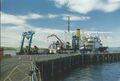 The Charles Darwin in Fairlie, Scotland, at the end of a research cruise in August 2005.
 -
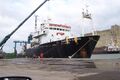 Loading for its last voyage as Charles Darwin, in March, 2006.


See also
- RV Neil Armstrong - United States equivalent
- RV Knorr - Predecessor to the Neil Armstrong
Footnotes
- ↑ "Charles Darwin". Research Ship Schedules & Information. http://www.researchvessels.org/country/UK/Darwin/darwin.html. Retrieved 28 February 2010.
- ↑ "Ocean Researcher". Sea Agent. http://seaagent.com/ships/oceanographic_research/ship_imo_8207941.html. Retrieved 28 February 2010.
- ↑ "Charles Darwin". Ship Photos. Archived from the original on 29 August 2009. https://web.archive.org/web/20090829090725/http://www.shipphotos.co.uk/pages/charlesdarwin.htm. Retrieved 1 March 2010.
- ↑ Freeman, R. B. (2007). "Charles Darwin: A companion". The Complete Work of Charles Darwin Online. http://darwin-online.org.uk/content/frameset?itemID=A27b&viewtype=text&pageseq=91. Retrieved 28 February 2010.
- ↑ "Ocean Researcher". Ships Old and New. http://www.shipsoldandnew.fotopic.net/p46799451.html. Retrieved 28 February 2010.[yes|permanent dead link|dead link}}]
- ↑ "Ocean Researcher". Ships Nostalgia. http://www.shipsnostalgia.com/gallery/showphoto.php?photo=125477. Retrieved 28 February 2010.
- ↑ "RRS Charles Darwin". The Inter-Agency Committee on Marine Science and Technology. Archived from the original on 9 October 2007. https://web.archive.org/web/20071009124006/http://www.marine.gov.uk/charles_darwin.htm. Retrieved 13 October 2007.
- ↑ 8.0 8.1 "Farewell to Royal Research Ship". NERC. 9 June 2006. http://www.nerc.ac.uk/press/releases/2006/charlesdarwin.asp. Retrieved 2007-11-24.
- ↑ "Ocean Researcher". Gardline Geosurvey. Archived from the original on 3 March 2012. https://web.archive.org/web/20120303235059/http://www.gardlinemarinesciences.co.uk/page/ocean-researcher/. Retrieved 2007-11-24.
 |  |
 EncycloReader
is supported by the
EncycloReader
is supported by the  KSF
KSF