Mystic Seaport
Topic: Engineering
 From HandWiki - Reading time: 18 min
 | |||||||||||||||||||||||||||||
 View from the Mystic River Estuary | |||||||||||||||||||||||||||||
| Established | 1929 | ||||||||||||||||||||||||||||
|---|---|---|---|---|---|---|---|---|---|---|---|---|---|---|---|---|---|---|---|---|---|---|---|---|---|---|---|---|---|
| Location | Mystic, Connecticut | ||||||||||||||||||||||||||||
| Coordinates | [ ⚑ ] : 41°21′41″N 71°57′52″W / 41.36139°N 71.96444°W | ||||||||||||||||||||||||||||
| Type | Maritime museum
! rowspan="3" colspan="2" width="14%" style="border-bottom:2px solid grey;" | Date/Time (UTC) ! Configuration ! Serial number ! Launch site ! Outcome |- |style="text-align:center;background-color:#e3e9e9;" | Payload |style="text-align:center;background-color:#e3e9e9;" | Separation orbit |style="text-align:center;background-color:#e3e9e9;" | Operator |style="text-align:center;background-color:#e3e9e9;" | Function |- | colspan="4" style="text-align:center;background-color:#e4dfdf;border-bottom:2px solid grey;" | Remarks |- Parameter 1=time required!
This is a navigational template created using {{navbox}}. It can be transcluded on pages by placing Initial visibilityThis template's initial visibility currently defaults to To change this template's initial visibility, the
Templates using the classes TemplateDataA navigational box that can be placed at the bottom of articles.
Template transclusions
 Not doneLatin pronunciation: [{{{1}}}] Not doneLatin pronunciation: [{{{1}}}]
| rowspan="1" colspan="2" style="border-top:2px solid #aabbcc;" | | style="border-top:2px solid #aabbcc;" | | style="border-top:2px solid #aabbcc;" | | style="border-top:2px solid #aabbcc;" | | style="border-top:2px solid #aabbcc;" | |- |- Vietnamese pronunciation: [{{{1}}}]-4500 — – -4000 — – -3500 — – -3000 — – -2500 — – -2000 — – -1500 — – -1000 — – -500 — – 0 —  Done Done To doRussian pronunciation: [{{{1}}}]Greek pronunciation: [{{{1}}}] To doRussian pronunciation: [{{{1}}}]Greek pronunciation: [{{{1}}}] Danish pronunciation: [{{{1}}}]Northern Sami pronunciation: [{{{1}}}]Mandarin pronunciation: [{{{ipa}}}]Cantonese pronunciation: [{{{1}}}]Entry from Mystic Seaport from TCI Europe, retrieved on {{{Date}}} Danish pronunciation: [{{{1}}}]Northern Sami pronunciation: [{{{1}}}]Mandarin pronunciation: [{{{ipa}}}]Cantonese pronunciation: [{{{1}}}]Entry from Mystic Seaport from TCI Europe, retrieved on {{{Date}}}
This is a navigational template created using {{navbox}}. It can be transcluded on pages by placing Initial visibilityThis template's initial visibility currently defaults to To change this template's initial visibility, the
Templates using the classes TemplateDataA navigational box that can be placed at the bottom of articles.
 In progressPalomares, M. L. D. and Pauly, D., eds. (2011). "{{{1}}} {{{2}}}" in SeaLifeBase. April 2011 version.Turkish pronunciation: [{{{1}}}]Finnish pronunciation: [{{{1}}}]Froese, Rainer and Pauly, Daniel, eds. (2006). "{{{1}}} {{{2}}}" in FishBase. April 2006 version. In progressPalomares, M. L. D. and Pauly, D., eds. (2011). "{{{1}}} {{{2}}}" in SeaLifeBase. April 2011 version.Turkish pronunciation: [{{{1}}}]Finnish pronunciation: [{{{1}}}]Froese, Rainer and Pauly, Daniel, eds. (2006). "{{{1}}} {{{2}}}" in FishBase. April 2006 version.
|- | ... | — | — | — | — | — | — |-Old Norse pronunciation: [{{{1}}}]Salish pronunciation: [{{{1}}}]Basque pronunciation: [{{{1}}}]{{{1}}}data-sort-value="" style="background: #ececec; color: #2C2C2C; vertical-align: middle; font-size: smaller; text-align: center; " class="table-na" | UnreleasedNorwegian pronunciation: [{{{1}}}] (aged {{{4}}})Hungarian pronunciation: [{{{1}}}]Quechua pronunciation: [{{{1}}}]Arabic pronunciation: [{{{1}}}]Punjabi pronunciation: [{{{1}}}]Afrikaans pronunciation: [{{{1}}}]Romanian pronunciation: [{{{1}}}]Hebrew pronunciation: [{{{1}}}][INVALID OR MISSING PARAMETER IN TEMPLATE Mystic Seaport]Uto-Aztecan pronunciation: [{{{1}}}]Tamil pronunciation: [{{{1}}}]Hindustani pronunciation: [{{{1}}}]Swedish pronunciation: [{{{1}}}]Kazakh pronunciation: [{{{1}}}]Lao pronunciation: [{{{1}}}]Tibetan pronunciation: [{{{1}}}]Khmer pronunciation: [{{{1}}}]data-sort-value="" style="vertical-align:middle; text-align:center" class="table-na" | —{{{1}}}Welsh pronunciation: [{{{1}}}] Partially doneAthabaskan pronunciation: [{{{1}}}]Māori pronunciation: [{{{1}}}]IPA: [{{{1}}}]Bulgarian pronunciation: [{{{1}}}]Korean pronunciation: [{{{1}}}]Icelandic pronunciation: [{{{1}}}]Sanskrit pronunciation: [{{{1}}}]Bengali pronunciation: [{{{1}}}]Indonesian pronunciation: [{{{1}}}]Serbo-Croatian pronunciation: [{{{1}}}]CROSBI {{{1}}} history museum Partially doneAthabaskan pronunciation: [{{{1}}}]Māori pronunciation: [{{{1}}}]IPA: [{{{1}}}]Bulgarian pronunciation: [{{{1}}}]Korean pronunciation: [{{{1}}}]Icelandic pronunciation: [{{{1}}}]Sanskrit pronunciation: [{{{1}}}]Bengali pronunciation: [{{{1}}}]Indonesian pronunciation: [{{{1}}}]Serbo-Croatian pronunciation: [{{{1}}}]CROSBI {{{1}}} history museum | ||||||||||||||||||||||||||||
| Visitors | 250,000 (2023) | ||||||||||||||||||||||||||||
| Public transit access | Template:Bus icon SEAT: 10 | ||||||||||||||||||||||||||||
| Website | www | ||||||||||||||||||||||||||||


Mystic Seaport Museum (founded as Marine Historical Association) is a maritime museum in Mystic, Connecticut, and the largest in the United States.[1] Its 19-acre (7.7 ha) site holds a collection of ships and boats and a re-creation of a 19th-century seaport village consisting of more than 60 historic buildings, including many rare commercial structures that were moved to the site and meticulously restored.[2] As of 2016, the museum received about 250,000 visitors each year.[2]
History
The museum was established in 1929 as the Marine Historical Association. One founder was philanthropist Mary Stillman Harkness, daughter of the only surviving child of Mystic shipbuilder Thomas Stillman Greenman. Harkness initially donated land that had belonged to her grandfather; in 1945, she would donate his house to the museum as well.[3][4]
The museum was one of the first living history museums in the United States, with a collection of buildings and craftsmen to show how people lived.[2] It gained fame with its 1941 acquisition of the Charles W. Morgan, the only surviving wooden whaling ship.
In 1955, maritime history professor Robert G. Albion of Harvard University established the Frank C. Munson Institute of American Maritime Studies, a summer graduate-level academic program.[5]
Citing mass layoffs and museum management's dishonesty about the museum's financial reality, Mystic Seaport Museum employees filed to organize a union with AFSCME Council 4, on February 20th, 2026. Ed Hawthorne, the president of the Connecticut AFL-CIO released a statement in solidarity with the workers at the Mystic Seaport Museum, saying in part, "As they head toward a union election, they should know they are not alone." Hawthorne continued, "The Connecticut AFL-CIO stands ready to support them every step of the way as they work to build a stronger future for themselves and their coworkers."[6]
Grounds and programs

The Henry B. du Pont Preservation Shipyard is an important part of the museum, where traditional tools and techniques are used to preserve the museum's collection of historic vessels,[7] including the Charles W. Morgan. A replica of the slave ship La Amistad was constructed in the shipyard and launched in 2000.[8] Amistad departed New Haven on June 21, 2007, on a 14,000-mile transatlantic voyage to Great Britain, Lisbon, West Africa, and the Caribbean, marking the Atlantic trade and slave route to commemorate the 200th anniversary of the end of the slave trade in Great Britain.[9]
The 19th-century seafaring village contains nearly all the types of general and specialized trades associated with building and operating a sailing fleet.[10] They include a chandlery, sail loft, ropewalk, cooperage, shipping agent's office, printing office, bank, and others. Also included is The Spouter Tavern, which is open seasonally and serving "travelers' fare". Each building is used to show the original activity and also to display examples of what was sold or constructed; the nautical instrument shop, for example, displays sextants, nautical timepieces, and so forth, while demonstrations at the cooperage show how casks were assembled.
-
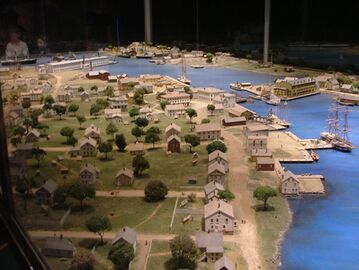 Scale model of Mystic, Connecticut as it was around 1870
 -
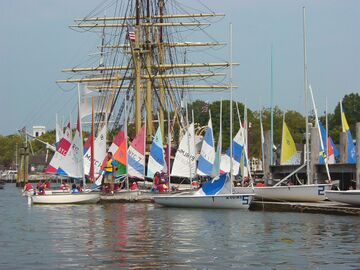 Children learning to sail in JY15s and Dyer Dhows


Additional buildings house more exhibits. A 40-foot, 1⁄128 scale model of the Mystic River area as it appeared around 1870, complete down to the outhouses that stood behind every residence.[11] Another contains a collection of carved ship figureheads.[12] Also among the museum's buildings is the Treworgy Planetarium which demonstrates how seamen used stars for navigation.[13]
Sailing instruction[14] is also offered, as well as tourist rides in various historical small craft that allow views of historic ships at their moorings. Mystic Seaport's music program features sea shanties in their original contexts as work songs.
The Seaport supports research via an extensive library.[15]
With Williams College, the museum hosts Williams–Mystic, an undergraduate program in maritime studies.[16]
Outreach includes sailing and history classes for area children.[17][18]
National Historic Landmarks
Four vessels at Mystic Seaport are recognized by the United States government as National Historic Landmarks:
| Vessel | Image | Type | Overall length | Built | Description |
|---|---|---|---|---|---|
| Emma C. Berry | 140px | well smack | 39 ft | 1866 | Emma C. Berry is the last surviving American well smack (also called Noank smacks). Well smacks originated in England about 1775 and were designed to keep the catch alive in an internal water-filled compartment known as a wet well. Seawater circulated through large holes in the bottom planking.[19] She was donated to Mystic Seaport in 1969 and was declared a National Historic Landmark in 1994.[20][21] |
| L. A. Dunton | 140px | fishing schooner | 123 ft | 1921 | L. A. Dunton was built in Massachusetts and is among the last of the larger fishing vessels that were powered solely by sail. She was named after Louis A. Dunton, a sailmaker who was a member of the syndicate that commissioned her construction.[22] She was worked in the New England fisheries until 1934 and then in the Newfoundland cod fishery of the Grand Banks into the 1950s. In 1955, she was converted for use as a coastal cargo boat. She was acquired by Mystic Seaport in 1963 and restored to her original condition.[22] Dunton was declared a National Historic Landmark and listed on the National Register of Historic Places in 1993.[23][22][24] |
| Charles W. Morgan | 140px | whaler | 113 ft | 1841 | Charles W. Morgan is a whaling ship which was active for 80 years. She is the only surviving wooden whaler from 2,700 ships that operated in the United States whaling fleet. On her deck are huge try pots used to render blubber into whale oil. She came to Mystic Seaport in 1941 and was designated a National Historic Landmark in 1966.[25] |
| Sabino | 140px | island steamer | 57 ft | 1908 | Sabino is a small wooden, coal-fired steamboat and is one of only two surviving members of the United States mosquito fleet. She was declared a National Historic Landmark in 1992.[23][26] Mystic Seaport acquired her after she became obsolete in 1974. The seaport has operated her as a working exhibit ever since, making her America's oldest regularly operating coal-powered steamboat.[27][28][29] |
Other vessels
| Vessel | Image | Type | Overall length | Built | Description |
|---|---|---|---|---|---|
| Annie | 140px | sandbagger sloop | 28 ft | 1880 | Annie was used for competitive racing. She was donated to Mystic Seaport in 1931 and became the first vessel in the collection. She was extensively restored in 2004.[30] |
| Breck Marshall | 140px | cat boat | 20 ft | c. 1900 | The Breck Marshall is a replica constructed in 1987 of Cape Cod catboats used for pleasure and fishing around 1900.[31] The working catboat is used the warmer months to carry sight-seeing passengers on the historic Mystic River, sailing either from Middle Wharf or from the Boathouse.[32] |
| Brilliant | 140px | auxiliary schooner | 61 ft | 1932 | Brilliant was built to a high standard as an ocean racing yacht. She crossed the Atlantic Ocean in just over 15 days on her maiden voyage, a record for a sailing yacht of her size. Subsequently, she did a run in England from the Lightship Nantucket to Bishop Rock Light. During World War II, she was acquired by the U.S. Coast Guard, equipped with machine guns, and used to patrol the New England coast for enemy submarines. She was donated to Mystic Seaport in 1957, where she is used as an offshore classroom.[33] |
| Estella A. | Friendship Sloop | 34 ft | 1904 | Estella A. is a classic friendship sloop built in Maine. She was acquired by Mystic Seaport in 1957 and restored in 1970–72.[34] | |
| Florence | 140px | dragger | 40 ft | 1926 | Florence is a western rig dragger built in 1926 along the Mystic River. She was used to trawl for fish at the bottom of Long Island Sound, dragging a conical net. In 1982, she was acquired by Mystic Seaport and restored to her original configuration. Florence is the only working dragger located in a museum collection. She is now used to carry students to collect marine biology specimens from Fishers Island Sound.[35] |
| Gerda III | 140px | lighthouse tender | 40 ft | 1926 | Gerda III was built in 1928 in Denmark as a lighthouse tender, though she appears to have been used as a common work boat. In 1943, she was used to smuggle Jews from Nazi-occupied Denmark to Sweden. Approximately 300 Jews were rescued by Greda III, and the Danish Parliament donated her to the Museum of Jewish Heritage. Mystic Seaport helps care for the boat and features her as part of their collection.[36] |
| Joseph Conrad | 140px | training ship | 111 ft | 1882 | Joseph Conrad is named after author Joseph Conrad. She is an iron-hulled and fully rigged sailing ship which was used to train sailors in Denmark. She sailed around the world as a private yacht in 1934, then served as a training ship in the United States. She was acquired by Mystic Seaport in 1947, and although she no longer goes to sea, she still fulfill's her original purpose as a training ship for the Mystic Mariner Program and the museum's educational programs.[37][38] |
| Kingston II | 140px | harbor tugboat | 44 ft | 1937 | Kingston II served U.S. Navy submarine-manufacturer Electric Boat in Groton, Connecticut for 42 years, until deemed surplus after EB turned to nuclear submarines, too large for this small tugboat. The tugboat is one of the earliest all-welded vessels, having been constructed from scrap steel by apprentice welders training to work on submarines. Came to Mystic Seaport in 1980.[39][40] |
| Nellie | 140px | oyster or shoal-draft sloop | 36 ft | 1891 | Nellie was built in New York[41] and was used for oyster dredging in Long Island Sound. Mystic Seaport acquired her in 1964.[42] |
| Regina M. | 140px | carry-away sloop | 45 ft | c. 1900 | Regina M. was built in 1900 in Passamaquoddy Bay and was used to collect herring from fish weirs and transport them to canneries on shore. Mystic Seaport acquired the vessel in 1940, and she was restored in 1992 to the way that she looked in 1909.[43] |
| Roann | 140px | dragger | 60 ft | 1947 | Roann is an eastern rig dragger built in Maine in 1947 and used to fish for flounder, cod, and haddock. Mystic Seaport acquired the vessel after she became obsolete in the 1970s. In 2009, Roann underwent complete restoration.[44] |
| Star | Fishing vessel | 34 ft | 1950 | Star was built in Connecticut for swordfishing and tuna fishing off Long Island. She was acquired by Mystic Seaport in 1976 and has undergone major restoration.[45] |
Gallery
-
 Mystic Seaport Light
 -
 Collection of historic buildings
 -
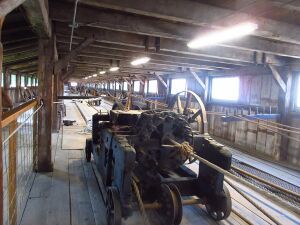 1824 ropewalk
 -
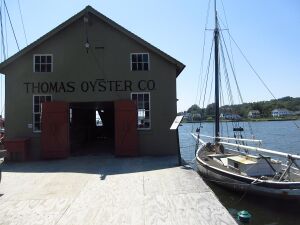 1874 oyster house
 -
 Carved vessel figureheads

.jpg)


See also
- List of maritime museums in the United States
- List of museum ships
- Captain Joseph Warren Holmes
- Whaleboat
- John Faunce Leavitt, former curator of Mystic Seaport.
References
Citations
- ↑ Young, Don (2005-06-13) (in en). Commemorating Mystic Seaport (Report). Government Printing Office. https://books.google.com/books?id=szWo_k9WPB4C&dq=%2522Mystic+Seaport%2522+largest&pg=RA2-PA66. Retrieved 2025-04-12. "Whereas Mystic Seaport has grown into the largest, most diverse maritime museum, and the fourth largest history museum, in the Nation;"
- ↑ 2.0 2.1 2.2 "About Mystic Seaport". Mystic Seaport: The Museum of America and the Sea. http://www.mysticseaport.org/about/.
- ↑ "Thomas Greenman House". Mystic Seaport Museum. https://mysticseaport.org/explore/village-old/thomas-greenman-house/.
- ↑ Nagy, Barbara (Spring 2005). "Who was Mary Harkness?". Connecticut College Magazine: 24–27. https://digitalcommons.conncoll.edu/cgi/viewcontent.cgi?article=1329&context=alumnews.
- ↑ "NEH Summer Institute for College and University Professors". November 7, 2013. http://www.mysticseaport.org/munson-neh/.
- ↑ "Mystic Seaport Museum Workers File for Union, Seek a Voice in the Museum’s Future | We Make Connecticut Happen" (in en). 2026-03-20. https://council4.org/news/mystic-seaport-museum-workers-file-union-seek-voice-museums-future.
- ↑ "Henry B. duPont Preservation Shipyard". http://www.mysticseaport.org/locations/shipyard/.
- ↑ "The New Topsail Schooner Amistad". http://www.tricoastal.com/amistad.html.
- ↑ "Minister Presents Wilberforce Slave Trade Act To Amistad Schooner". http://www.culture24.org.uk/history-and-heritage/art48297.
- ↑ Keenan, Annabel (2025-04-22). "The Mystic Seaport Museum Grapples With Threats from Rising Seas" (in en-US). The New York Times. ISSN 0362-4331. https://www.nytimes.com/2025/04/22/arts/design/mystic-seaport-museum-sea-level-rise.html.
- ↑ Bass, Elissa (2014-09-10). "Mystic Seaport: Mystic River Scale Model Exhibit" (in en-US). http://stories.mysticseaport.org/mystic-river-scale-model-exhibit/.
- ↑ "New Exhibit at Mystic Seaport Museum! Figureheads: Carvings of the Sea" (in en-US). https://mysticseaport.org/explore/exhibits-3/figureheads-shipcarving/.
- ↑ "Treworgy Planetarium - Mystic Seaport Museum - Planetarium Show in CT" (in en-US). http://mysticseaport.org/explore/planetarium/.
- ↑ "Sailing Programs and Classes in Mystic, CT" (in en-US). https://www.mysticseaport.org/learn/sailing/.
- ↑ "Library Fellows". http://www.mysticseaport.org/join/communities/library-fellows/.
- ↑ "College and Graduate Programs". http://www.mysticseaport.org/learn/college-graduate/.
- ↑ "Community Sailing". http://www.mysticseaport.org/learn/sailing/community-sailing/.
- ↑ "Planetarium Courses". http://www.mysticseaport.org/visit/explore/planetarium/courses/.
- ↑ March, E J (1970). Sailing trawlers – The story of deep-sea fishing with long line and trawl. David & Charles. p. [page needed]. ISBN 978-0-87742-004-0. OCLC 106703.
- ↑ d'Estang, Nancy (1994-02-09), "Emma C. Berry", National Historic Landmark Nomination (National Park Service), https://npgallery.nps.gov/pdfhost/docs/NHLS/Text/94001649.pdf
- ↑ "Emma C. Berry: Noank Smack" (in en-US). https://mysticseaport.org/explore/vessels/emma-c-berry-noank-smack/.
- ↑ 22.0 22.1 22.2 D'Estang, Nancy; German, Andrew (25 January 1993). "National Historic Landmark Nomination / L. A. Dunton" (pdf). National Park Service. https://npgallery.nps.gov/NRHP/GetAsset/NHLS/93001612_text. and
"Accompanying Photos" (pdf). https://npgallery.nps.gov/NRHP/GetAsset/NHLS/93001612_photos. - ↑ 23.0 23.1 "L. A. Dunton (Schooner)". National Park Service. http://tps.cr.nps.gov/nhl/detail.cfm?ResourceId=2169&ResourceType=Structure.
- ↑ L. A. Dunton: Fishing schooner Mystic Seaport. Date accessed 6 July 2016
- ↑ Charles W Morgan Mystic Seaport. Retrieved 29 June 2016.
- ↑ Dean, Nicolas (September 1991). "Marine Heritage of the United States NHL Theme Study—Large Vessels: Sabino / Excursion Steamer Sabino" (pdf). National Park Service. https://npgallery.nps.gov/NRHP/GetAsset/NHLS/92001887_text. and
"Accompanying 5 photos, from c.1910 to 1990". National Park Service. https://npgallery.nps.gov/NRHP/GetAsset/NHLS/92001887_photos. - ↑ "Historic Steamboat Sabino Returns to Service August 2, 2017". 2 August 2017. https://councilofamericanmaritimemuseums.org/2017/08/02/historic-steamboat-sabino-returns-to-service-august-2-2017/.
- ↑ Panko, Ben. "America's Oldest Coal-Powered Steamboat Chugs Along". https://www.smithsonianmag.com/smart-news/americas-oldest-coal-powered-steamboat-chugs-along-180964356/.
- ↑ "Sabino: Steamboat Cruises". 20 April 2018. https://thisismystic.com/to-do/mystic-tours/sabino-steamboat-cruises/.
- ↑ Annie: Sandbagger Mystic Seaport. Date accessed 29 June 2016
- ↑ Breck Marshall: Working catboat Mystic Seaport. Retrieved 29 June 2016.
- ↑ "BRECK MARSHALL: WORKING CATBOAT" (in en-US). https://www.mysticseaport.org/explore/vessels/breck-marshall-working-catboat/.
- ↑ Brilliant: Auxiliary schooner Mystic Seaport. Retrieved 29 June 2016.
- ↑ Estella A., Mystic Seaport. Date accessed 6 July 2016
- ↑ Florence: Dragger Mystic Seaport. Retrieved 29 June 2016.
- ↑ Gerda III: Danish lighthouse tender, Mystic Seaport. Retrieved 29 June 2016.
- ↑ Joseph Conrad: Fully rigged ship, Mystic Seaport. Retrieved 2 July 2016.
- ↑ "Joseph Conrad - Full Rigged Ship - Historic Vessel in Mystic, CT" (in en-US). https://www.mysticseaport.org/explore/vessels/joseph-conrad-full-rigged-ship/.
- ↑ "Kingston II: Harbor Tugboat". Mystic Seaport. https://www.mysticseaport.org/explore/vessels/kingston-ii-harbor-tugboat/.
- ↑ "Harbor Tugboat Kingston II". The Historical Marker Database. https://www.hmdb.org/m.asp?m=68304.
- ↑ "Sports & Recreation". The Woodenboat (169): 92. 2002.
- ↑ Nellie: Oyster Sloop Mystic Seaport. Date accessed 6 July 2016
- ↑ Regina M.: Carry away boat Mystic Seaport. Date accessed 6 July 2016
- ↑ Roann: Eastern rig dragger Mystic Seaport. Date accessed 6 July 2016
- ↑ "Lobster and Fishing Boat in Mystic, CT - Star" (in en-US). https://mysticseaport.org/explore/vessels/star-noank-fish-and-lobster-boat/.
General and cited references
- Bray, Maynard; Fuller, Benjamin; and Vermilya, Peter (2002) Mystic Seaport Watercraft. ISBN 0-913372-94-3
External links
- Mystic Seaport homepage
- Mystic Seaport Podcast(registration required)
- 360-Degree Panoramic Photographs of Mystic Seaport
 |  |
 EncycloReader
is supported by the
EncycloReader
is supported by the  KSF
KSF