Table of Contents Categories
Shooting-brake
Topic: Engineering
 From HandWiki - Reading time: 12 min
.jpg)
.jpg)
Shooting-brake is a car body style which originated in the 1890s as a horse-drawn wagon used to transport shooting parties with their equipment and game.[1]
The first automotive shooting brakes were manufactured in the early 1900s in the United Kingdom. The vehicle style became popular in England during the 1920s and 1930s, and was produced by vehicle manufacturers or as conversions by coachbuilders. The term was used in Britain interchangeably with estate car from the 1930s but has not been in general use for many years and has been more or less superseded by the latter term.[2][3][4][5][6]
Since the 1960s, the term has evolved, describing cars combining elements of both station wagon and coupé body styles, with or without reference to the historical usage for shooting parties.[7] During the 1960s and early 1970s, several high-end European manufacturers produced two-door shooting brake versions of their sports cars. Following a hiatus from the mid 1970s until the early 2010s, the shooting-brake body style entered a resurgence.
Horse-drawn wagons

Like many early automotive body styles, the shooting brake was originally a type of horse-drawn vehicle. A brake was originally a heavy drag chassis with slowing capability hooked to spirited horses;[4] however the etymology is likely related to any rear-facing vehicle such as a railway brake van (UK) or caboose (US).[8] It is also possible that the word 'brake' has its origins in the Dutch word 'brik' which means 'cart' or 'carriage'.[citation needed] The term brake later became broader in definition, being used for wagons in general.[4][9]
The shooting brake, which began in England in the 1890s, was a wagon (more specifically a type of wagonette) designed to transport hunting spoils, gun racks and ammunition on shooting trips.[10] In the US, a station wagon refers to luggage transport to railway depots ("stations").
Automobiles
1900s to 1950s

In the early 1900s, the Scottish Albion Motors began producing shooting brake models, described in the weekly magazine The Commercial Motor as having "seats for eight persons as well as the driver, whilst four guns and a large supply of cartridges, provisions baskets and a good 'bag' can be carried."[11]
The 1912 Hudson Model 33 was described in England as a shooting brake, on the basis that "...it was also used to carry the beaters to and from the location of the shoot, and for bringing back the game shot".[12]
Early[when?] motorized safari vehicles were described as shooting brakes with no windows or doors. "Instead roll-down canvas curtains were buttoned to the roof in the case of bad weather. These cars were heavy and comfortable in good weather and allowed quick and silent exit as no shooting was permitted from the vehicles."[13]
During the 1920s and 1930s, shooting brake vehicles were popular in England, and were produced as shooting brakes from the factory or converted by coachbuilders. The term "estate car" began to be used instead of shooting brake, as the use of the vehicle expanded from just shooting parties to other domestic uses including ferrying guests and their luggage to and from railway stations.[6]
The 1955 to 1957 Chevrolet Nomad is an early modern day Shooting-brake. SEE Chevrolet Nomad
1960s to 1990s
During the 1960s and early 1970s, several high end European manufacturers produced two-door shooting brake versions of their sports cars, including the 1960 Sunbeam Alpine Shooting Brake and 1965 Aston Martin DB5 Shooting Brake.[7][9][14] The 1966 Sunbeam Alpine was a limited-production three-door variant of its two-door open sports car with leather interior and walnut trim, selling at a price double its open counterpart and marketed as a shooting brake.[15][16][17] The Aston Martin DB5, DB6 and DBS shooting brakes were custom manufactured by coachbuilder Harold Radford from 1965 to 1967.[18]
In 1992, Aston Martin manufactured in-house a limited production shooting brake variant of its Virage/Vantage.[19]
Other cars combining elements of a wagon and coupé have been described but were never formally marketed as shooting brakes, including the Reliant Scimitar GTE (1968–1975)[20][21][22] and the Volvo P1800 ES (1972–1973).[23][24][25]
-
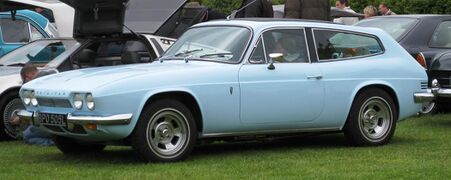 Reliant Scimitar GTE (1968–1975)
 -
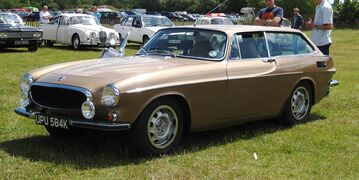 Volvo 1800ES (1972–1973)
 -
 Aston Martin DB5 Shooting Brake (1965-1971)


2000s to present

_(cropped).jpg)
.jpg)
Mostly dormant since the mid 1970s, the shooting brake term appeared in 2004 with the Chevrolet Nomad concept car.[7] The following year, the Audi Shooting Brake concept car was revealed at the Tokyo Motor Show.
The first production model shooting brake of the 21st century was the 2012 Mercedes Benz CLS-Class Shooting Brake (X218),[26][27] which was previewed as the Shooting Brake concept car at Auto China.[28][29] This model has four (passenger) doors, which is at odds with some definitions of a shooting brake as being a two-door car. In 2015, Mercedes-Benz added the smaller CLA-Class four-door shooting brake to the model range.[30][31][32][33]
The 2018 Porsche Panamera Sport Turismo is described by Porsche as a shooting brake.[34]
Several other cars have been described by journalists as shooting brakes, including the 1998 BMW Z3 Coupé (and associated M Coupé model),[35][36][37] 2005 Dodge Magnum Station Wagon,[38][39][40] 2006 Renault Altica concept car,[41] 2008 Mini Clubman,[42] 2011 Fisker Surf concept car[43] and 2011 Ferrari FF.[44][45]
Present-day definition
There is no universally agreed definition of a shooting-brake, however the common themes are the coupé and station wagon body styles, and the historical usage of the vehicle for hunting trips.[46][47][48] Descriptions of the body style and usage of the term include:
- "A sleek wagon with two doors and sports-car panache, its image entangled with European aristocracy, fox hunts and baying hounds".[7]
- "A cross between an estate and a coupé".[49]
- "Essentially a two-door station wagon".[50]
- An interchangeable term for estate car (station wagon).[4][3][5][51][2] In France, a station wagon is marketed as a break, once having been called a break de chasse, which translates as "hunting break".[52]
- A body style with "a very interesting profile. It makes use of the road space it covers a little better than a normal coupé, and also helps the rear person with headroom... The occasional use of the rear seat means you can do one of these cars, even if such a wagon lacks the everyday practicality of four doors."[7]
- A vehicle conceived "to take gentlemen on the hunt with their firearms and dogs... and "although [its] glory days came before World War II, and it has faded from the scene in recent decades, the body style is showing signs of a renaissance" (as of 2006).[7] "The most famous shooting brakes had custom two-door bodies fitted to the chassis of pedigreed cars".[7]
See also
References
- ↑ Tames, Richard (4 March 2008). "The Victorian and Edwardian Sportsman". Bloomsbury USA. https://books.google.com/books?id=lytfuLKy6zMC&pg=PA17&dq=%22to%20the%20shoot%20in%20a%20brake%22%20The%20Victorian%20and%20Edwardian%20Sportsman%20By%20Richard%20Tames&hl=en&ei=9vR3TrXnFIP2mAXH_vXDDQ&sa=X&oi=book_result&ct=result&resnum=1&ved=0CCwQ6AEwAA#v=onepage&q&f=false.
- ↑ 2.0 2.1 Automobile quarterly, 22, Princeton Institute for Historic Research, 1984, p. 1931, https://archive.org/details/automobilequarte22octprin, "If milord had it in mind to do a bit of hunting, he and his guns would then be transported to the shooting site in a "brake" (the English term originally applied to horse-drawn wagons). Being somewhat logical, the British determined that if a brake was used for shooting purposes it might well be named "shooting brake." However, the term fell into common parlance and eventually became a generic label..."
- ↑ 3.0 3.1 "Woody Gallery – British Woodies". http://www.oldwoodies.com/gallery-shootingbrakes.htm.
- ↑ 4.0 4.1 4.2 4.3 Hartford, Bill (February 1969). "Sizing up the 1969 Station Wagons". Popular Mechanics: 104. https://books.google.com/books?id=I9gDAAAAMBAJ&pg=PA104&dq=shooting-brake&hl=en&ei=9BV1Tr-lLfKmsAKvt6SMBQ&sa=X&oi=book_result&ct=result&resnum=1&ved=0CCwQ6AEwADgy#v=onepage&q=shooting-brake&f=false.
- ↑ 5.0 5.1 Chambers 21st Century Dictionary. Allied Chambers (India). 1996. p. 1295. https://archive.org/details/chambers21stcent00mair. "shooting-brake."
- ↑ 6.0 6.1 Peck, Colin (May 2008). British Woodies: From the 1920s to the 1950s. Veloce Publishing Limited. p. 5. https://books.google.com/books?id=edOlJadQjUgC&pg=PA5&dq=shooting-brake&hl=en&ei=6xR1TqTHEK6FsgL3uLWLBQ&sa=X&oi=book_result&ct=result&resnum=6&ved=0CEYQ6AEwBQ#v=onepage&q=shooting-brake&f=false.
- ↑ 7.0 7.1 7.2 7.3 7.4 7.5 7.6 Diem, William (26 November 2006). "The Shooting Brake Makes a Comeback". The New York Times. https://www.nytimes.com/2006/11/26/automobiles/26BRAKE.html.
- ↑ 1. A large carriage-frame (having two or four wheels) with no body, used for breaking in young horses. 1831 J. C. Loudon Encycl. Agric. (ed. 2) 1002 The training of coach-horses commences with‥driving in a brake or four-wheeled frame. 1865 Derby Mercury 1 Mar., A horse-breaker's drag, or brake, with two horses harnessed to it. Etymology uncertain. Oxford English Dictionary Online, Oxford University Press 2011.
- ↑ 9.0 9.1 "What a Shooting Brake Is and Why Automotive Journalists Love Them". https://www.complex.com/sports/2014/03/what-a-shooting-brake-is. Retrieved 28 October 2018.
- ↑ Terry, Christopher William (1914). Motor Body-building in all its Branches. London: E. & F.N. Spon Limited. p. 6. https://archive.org/details/motorbodybuildin00terrrich. "shooting-brake."
- ↑ The Edinburgh Show. The Commercial Motor. 30 January 1908. p. 475. https://books.google.com/books?id=9X_nAAAAMAAJ&pg=PA475&dq=shooting-brake+albion+The+Edinburgh+Show&hl=en&ei=g051TsrrCMSssQLWlsyLBQ&sa=X&oi=book_result&ct=result&resnum=2&ved=0CDcQ6AEwAQ#v=onepage&q=shooting-brake%20albion%20The%20Edinburgh%20Show&f=false.
- ↑ American Cars in Prewar England: A Pictorial Survey. McFarland & Company. 2004. https://books.google.com/books?id=5JI2rEeNlQsC&pg=PA89&dq=shooting-brake&hl=en&ei=F0F1TpLZE-WEsAKr5cGLBQ&sa=X&oi=book_result&ct=result&resnum=7&ved=0CEoQ6AEwBjhu#v=onepage&q=shooting-brake&f=false.
- ↑ Herne, Brian (1999). White Hunters: The Golden Age of African Safaris. Henry Holt and Company. p. 174. https://books.google.com/books?id=lm3OGE6UG1MC&pg=PA174&dq=shooting-brake&hl=en&ei=pRV1Tq-nCIjpsQK7l5iMBQ&sa=X&oi=book_result&ct=result&resnum=10&ved=0CFIQ6AEwCTgU#v=onepage&q=shooting-brake&f=false.
- ↑ "A Short History of the Shooting Brake". https://www.acontinuouslean.com/2015/08/04/acl-autos-short-history-shooting-brake/. Retrieved 28 October 2018.
- ↑ Spencer, Ian. "The 1960 Sunbeam Alpine Shooting Brake Estate Wagon". SunbeamAlpine.org. http://www.sunbeamalpine.org/index.php?categoryid=82&p2_articleid=16.
- ↑ "The Essential Buying Guide – Sunbeam Alpine The Essential Buying Guide – Sunbeam Alpine". https://silodrome.com/sunbeam-alpine-buying-guide/. Retrieved 4 November 2018.
- ↑ "Lost & Found- In search of the shooting brake estate wagon". https://www.hemmings.com/magazine/hsx/2008/04/Lost--amp--Found/1610366.html. Retrieved 4 November 2018.
- ↑ Cottingham, Tim (9 July 2008). "Aston Martin DB5 Shooting Brake by Harold Radford (1965–1967)". Aston Martins.com. http://www.astonmartins.com/db4_5_6_s/db5_radford_shooting_brake.htm.
- ↑ "Aston Martin DB5 Radford Shooting Brake Estate August 1972". https://www.flickr.com/photos/22405356@N05/3862968908/.
- ↑ Lieberman, Johny (25 July 2007). "Reliant Scimitar and Friends". Jalopnik. http://jalopnik.com/271804/reliant-scimitar-and-friends.
- ↑ "Scimitar GTE – a Trailblazing Shooting Brake". https://dyler.com/posts/155/scimitar-gte-a-trailblazing-shooting-brake. Retrieved 4 November 2018.
- ↑ "The Reliant Scimitar GTE – A Sports Shooting-Brake". https://www.motorsportmagazine.com/archive/article/june-1970/60/reliant-scimitar-gte. Retrieved 4 November 2018.
- ↑ Viehmann, Sebastian (2 April 2011). "Volvo P1800: A Swedish fairy-tale". Motormedia.de. MV Media. http://www.motorvision.de/artikel/a-swedish-fairy-tale,8264.html.[yes|permanent dead link|dead link}}]
- ↑ Joslin, Tom (9 January 2011). "Found Off the Street: 1973 Volvo P1800ES". Jalopnik. Gawker.com. http://jalopnik.com/5728157/1973-volvo-p1800es.
- ↑ Fowle, Stuart (29 October 2009). "Hindsight: Looking Back on Volvo's Quirky 1800ES". Kilometer Magazine. Vortex Media Group. Archived from the original on 29 September 2014. https://web.archive.org/web/20140929180143/http://www.kilometermagazine.com/artman2/publish/hindsight/retro_drive_Volvo_1800ES.html.
- ↑ Kew, Ollie (29 June 2012). "Mercedes CLS Shooting Brake (2012) first pictures". Car Magazine. http://www.carmagazine.co.uk/News/Search-Results/First-Official-Pictures/Mercedes-CLS-Shooting-Brake-2012-first-official-pictures/. Retrieved 6 July 2012.
- ↑ "2013 Mercedes CLS 63 AMG Shooting Brake Review @ Top Speed" (in en-US). Top Speed. https://www.topspeed.com/cars/mercedes/2013-mercedes-cls-63-amg-shooting-brake-ar118307.html.
- ↑ "2013 Mercedes-Benz CLS-class Shooting Brake". June 2012. http://www.caranddriver.com/news/2013-mercedes-benz-cls-shooting-brake-photos-and-info-news. Retrieved 21 August 2014.
- ↑ "China auto show: Mercedes-Benz Shooting Break concept previews new CLS". Autoweek. http://autoweek.com/article/china-auto-show/china-auto-show-mercedes-benz-shooting-break-concept-previews-new-cls-0.
- ↑ "Mercedes CLA Shooting Brake arrives in Geneva". https://www.autoexpress.co.uk/mercedes/cla/89563/mercedes-cla-shooting-brake-arrives-in-geneva. Retrieved 6 November 2018.
- ↑ "Mercedes-Benz CLA Shooting Brake: Vehicle concept". https://www.mercedes-benz.co.uk/passengercars/mercedes-benz-cars/models/cla/cla-shooting-brake/explore/concept-intro.module.html. Retrieved 21 December 2018.
- ↑ "Mercedes CLA Shooting Brake review". Telegraph Cars. https://www.youtube.com/watch?v=46muyJM-ivk. Retrieved 21 December 2018.
- ↑ "2015 Mercedes-Benz CLA Shooting Brake". https://www.fanmercedesbenz.com/2015-mercedes-benz-cla-shooting-brake-2/. Retrieved 21 December 2018.
- ↑ "Porsche shooting brake: past and present". https://newsroom.porsche.com/en/history/porsche-museum-secret-storehouse-928-shooting-brake-panamera-sport-turismo-landenberger-13483.html. Retrieved 8 November 2018.
- ↑ "Classifieds' Car Of The Day: Brutal BMW M Coupe". http://www.carthrottle.com/post/classifieds-car-of-the-day-brutal-bmw-m-coupe/.
- ↑ Lieberman, Jonny. "The Jalopnik Fantasy Garage: First-Generation BMW M Coupe". http://jalopnik.com/258496/the-jalopnik-fantasy-garage-first-generation-bmw-m-coupe.
- ↑ "Capsule Review: 1999 BMW Z3 M Coupe". 7 September 2010. http://www.thetruthaboutcars.com/2010/09/capsule-review-1999-bmw-z3-m-coupe/.
- ↑ Ackerson, Robert (2005). Chrysler 300 Series: Pedigree, Power and Performance Since 1955. Veloce Publishing. p. 190. https://books.google.com/books?id=Ign8btHPbvMC&pg=PA190&dq=dodge+magnum+shooting+brake&hl=en&ei=WP91ToqWJKGJsgKB2sCMBQ&sa=X&oi=book_result&ct=result&resnum=1&ved=0CEAQ6AEwAA#v=onepage&q=dodge%20magnum%20shooting%20brake&f=false.
- ↑ "2006 Dodge Magnum". Worldcarfans.com. Archived from the original on 8 September 2012. https://web.archive.org/web/20120908054638/http://www.worldcarfans.com/10506178925/2006-dodge-magnum.
- ↑ "Unattractive and Overhyped: The new Chrysler 300". About.com. Archived from the original on 18 September 2005. https://web.archive.org/web/20050918120133/http://cars.about.com/od/designandstyle/a/hemi_critique.htm.
- ↑ "Renault Altica". https://www.autoexpress.co.uk/car-reviews/16453/renault-altica. Retrieved 6 November 2018.
- ↑ A New Kind of Club. Torque Magazine. October 2007. https://books.google.com/books?id=_PUDAAAAMBAJ&pg=PA65&dq=%22shooting-brake%22+mini+clubman&hl=en&ei=GfR1TvGnHeH9sQLJ8uiLBQ&sa=X&oi=book_result&ct=result&resnum=1&ved=0CEIQ6AEwAA#v=onepage&q=%22shooting-brake%22%20mini%20clubman&f=false.
- ↑ Nordlicht, Donny (13 September 2011). "AUTO SHOWS: First Look: Fisker Surf Concept". Automobile Magazine. http://www.automobilemag.com/auto_shows/frankfurt/2011/1109_fisker_surf_concept_first_look/index.html.
- ↑ Jonathon Shultz (21 January 2011), Ferrari FF, an All-Wheel-Drive Shooting Brake, http://wheels.blogs.nytimes.com/2011/01/21/ferrari-ff-an-all-wheel-drive-shooting-brake/
- ↑ "2004 Chevrolet Nomad Concept - Supercars.net". 30 March 2016. http://www.supercars.net/cars/2736.html.
- ↑ "World’s best ever shooting brakes". https://www.msn.com/en-au/motoring/news/world%e2%80%99s-best-ever-shooting-brakes/ss-BBLf5F5. Retrieved 8 November 2018.
- ↑ "Wicked Wagons: 15 Best Shooting Brakes Of All Time". https://hiconsumption.com/2018/09/best-shooting-brakes-of-all-time/. Retrieved 8 November 2018.
- ↑ "12 of Our Favorite Shooting Brakes Ever Produced". https://www.roadandtrack.com/car-culture/g6678/ten-of-our-favorite-shooting-brakes-ever-produced/. Retrieved 8 November 2018.
- ↑ "Four-wheel-drive Ferrari shooting brake revealed". http://www.topgear.com/uk/car-news/ferrari-four-shooting-brake-revealed-2011-01-21.
- ↑ "It’s an Audi Shooting Brake and a Plug-In". The New York Times, LAWRENCE ULRICH JAN. 13, 2014. https://www.nytimes.com/2014/01/14/automobiles/autoshow/its-an-audi-shooting-brake-and-a-plug-in.html?src=rechp&_r=0.
- ↑ The 2001 Jaguar S-Type Estate. August 1999. p. 50. https://books.google.com/books?id=SWYEAAAAMBAJ&pg=PA50&dq=shooting-brake&hl=en&ei=IBZ1TsKtG4WHsgKK-f2LBQ&sa=X&oi=book_result&ct=result&resnum=5&ved=0CD0Q6AEwBDhG#v=onepage&q=shooting-brake&f=false.
- ↑ "Woodie Gallery: French Woodies – 1940 to 1949". http://oldwoodies.com/gallery-french4.htm. Retrieved 8 November 2018.
External links
 |
 EncycloReader
is supported by the
EncycloReader
is supported by the  KSF
KSF