University of Portsmouth
Topic: Organization
 From HandWiki - Reading time: 17 min
 University of Portsmouth | |
Other name | UoP |
|---|---|
Former names | See History |
| Motto | Latin: Lucem Sequamur[1] |
Motto in English | Let us follow the Light |
| Type | Public |
| Established | c. 1870 (as Portsmouth and Gosport School of Science and Art) |
| Budget | £290.5 million (2021/22)[2] |
| Chancellor | Karen Blackett[3] |
| Vice-Chancellor | Graham Galbraith[4] |
| Students | 29,000 (2021/2022)[5] |
| Undergraduates | 22,170 (2020/21) |
| Postgraduates | 6,110 (2020/21) |
| Location | Portsmouth , Hampshire, England , United Kingdom [ ⚑ ] : 50°47′43″N 01°05′36″W / 50.79528°N 1.09333°W |
| Campus | College town with multiple sites including: University Quarter Northern Quarter Langstone Campus London Campus |
| Purple Black White|u}}rs | Purple Black White |
| Affiliations | University Alliance Doctoral Training Alliance The Channel Islands Universities Consortium Universities UK |
| Website | www |
  Location in Hampshire | |
The University of Portsmouth is a public university in Portsmouth, England.[7] Comprising five faculties, the university offers a wide range of academic disciplines.[8] With around 28,280 students enrolled in undergraduate and postgraduate programs, the university in 2022 was the 25th-largest higher education institution by student enrolments in the United Kingdom .[9] The university employed approximately 3,500 staff in 2020.[10]
Portsmouth was rated #651 in the world by QS World University Rankings in 2024, in the top 501–600 universities in the world by the Times Higher Education World University Rankings 2022, #901-1,000 in the world by Shanghai Ranking, and #908 in the world by CWUR rankings.In the 2023 edition of the Good University Guide – compiled by The Times and The Sunday Times – the university ranked 62nd out of the 132 universities in the United Kingdom.[11] It is one of five universities in the South East of England to have been awarded the highest rating of Gold in the 2023 Teaching Excellence Framework.[12] In the Times Higher Education REF ranking, the university was ranked third in research power for modern post-1992 universities.[13]
In the 2021 edition of the Research Excellence Framework, 77 per cent of research submitted by the university was ranked as world-leading or internationally excellent, with impacts across society, health, culture and the environment.[14][13]
History
19th century
The University of Portsmouth traces its roots back to 1 June 1870 (or 1869 according to some sources) when it was first established as the Portsmouth and Gosport School of Science and Art.[15][16][17] During the late 19th century, the school occupied several buildings in Old Portsmouth and Southsea.[18] The main premises, located at the Crown Sale Rooms in Pembroke [disambiguation needed], was attended by both male and female students.[18][16] Due to its coastal location, the school provided technical instruction to engineers and skilled workers, who often graduated to work at the city docks, including for the Royal Navy at the Portsmouth Royal Dockyard.[19] The curriculum comprised a range of skills including practical geometry, artistic anatomy, and architectural and mechanical drawing.[16] Additionally, the school provided evening classes for local artisans.[16]
Portsmouth Municipal Technical Institute and the College of Art
In 1894, following education reforms which vested local authorities with control over technical and manual education, the Borough of Portsmouth established the Portsmouth Municipal Technical Institute.[20][21] Having acquired the school's science and technology courses, the Portsmouth and Gosport School of Science and Art was restructured to become the College of Art.[18][22]
20th century
Portsmouth Municipal College and construction of the Park Building
In 1903, following the enactment of the Education Act 1902, construction began on a site behind the Portsmouth Guildhall.[23][24] Designed by local Architect G.E. Smith and completed in 1908, the building incorporates a combination of Flemish and Renaissance architectural styles.[24] In the same year, the Portsmouth Municipal Technical Institute was succeeded by the newly established Portsmouth Municipal College.[23][25] Providing a range of further and higher education courses in chemistry and engineering, the college occupied the building together with the College of Art, the Portsmouth Day Training College, and a public reference library.[16][20][26] Today, the grade II listed building remains in use by the University and has since become known as the Park Building, having been named after an adjacent urban park known as Victoria Park.[24]
In 1911, male and female Students' union were established.[16] In autumn of 1911, the first addition of student magazine The Galleon, reported the creation of a women's Basketball team and expressed discontent over the state of the common room.[16]
Following World War II, there was a decline in the need for engineering skills in United Kingdom .[why?] In response, the college diversified its curriculum to include the arts and humanities.[20]
Portsmouth College of Technology
In 1953, the Portsmouth Municipal College, having changed its name to the Portsmouth College of Technology, became the Regional College for Southern England.[16]
Polytechnic status
The college was renamed Portsmouth Polytechnic after it gained polytechnic status in 1969 and by the late 1980s was one of the largest polytechnics in the UK.
University status
On 7 July 1992 the inauguration of the University of Portsmouth was celebrated at a ceremony at Portsmouth Guildhall. As a new university, it could validate its own degrees, under the provision of the Further and Higher Education Act 1992.
21st century
On Friday 4 May 2018, the University of Portsmouth was revealed as the main shirt sponsor of Portsmouth F.C. for the 2018–19, 2019–20 and 2020–21 seasons.[27]
In December 2022, an employment tribunal ruled that when the university failed to reappoint Kajal Sharma to her job, it had racially discriminated against her.[28]
Campuses
The university is split between the University Quarter, which is centred around the Portsmouth Guildhall area, and the Langstone Campus.
Langstone campus
Langstone is the smaller of the two campuses, located in Milton on the eastern edge of Portsea Island. The campus overlooks Langstone Harbour and it is home to the university's sports grounds.
Langstone Campus used to be home of the university's School of Languages and Area Studies, which has since moved into Park Building in the University Quarter. It also used to be home to three halls of residence: Queen Elizabeth Queen Mother (QEQM), Trust Hall and Langstone Flats. These used to house 565 students, however these have now been closed, in favour of those closer to the majority of the university buildings. These have now been demolished.[29]
University Quarter
The University Quarter is a collection of university buildings located around the centre of the city. This area contains most of the university's teaching facilities and nearly all of the Student Halls of residence (except the Langstone student village and two halls (Rees Hall and Burrell House) located on Southsea Terrace).
The University Library (formerly the Frewen Library) was extended in 2006 at a cost of £11 million.[30] It was opened by the crime writer P. D. James. The university has also recently invested in the Faculty of Science, in particular by renovating the aluminium-clad main building, St Michael's.
A new faculty called "Creative and Cultural Industries" was opened in September 2006.
-
 Anglesea buildings
 -
 James Watson building
 -
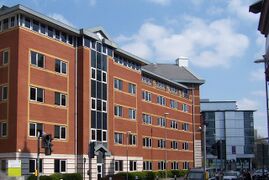
-
 Park building
 -
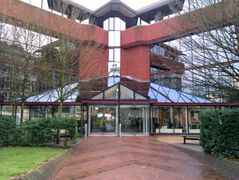 University House
 -
 Sports fields
 -
 St Michael's building
 -
 Dennis Sciama building
 -
 Library
 -
 Ravelin House


Military Technological College of Oman
On 7 June 2013, the University of Portsmouth announced its partnership with the Military Technological College of Oman. This involves the University of Portsmouth providing academic guidance and academic accreditation for the education of 4,200 students with technical roles in armed services and a few civilian employers in the Sultanate of Oman.[31] This has been criticised by the student Amnesty International Society and by Campaign Against the Arms Trade who consider Oman an authoritarian regime, likely to use military capabilities on their own citizens or in regional conflicts.[32]
Organisation and structure
Governance
The university is ceremonially headed by Karen Blackett, who was installed as Chancellor in 2017.[33] The University is however run day-to-day by the Vice-Chancellor, presently Graham Galbraith, along with a single integrated decision-making body known as the University Executive Board. This includes Pro Vice-Chancellors, the Director of Finance and the Executive Deans of Faculties, together with the Chief Operating Officer, the Director of Human Resources and the University Secretary and Clerk.[34]
The University's Board of Governors is the university’s governing body and is ultimately responsible for the University and all of its activities.
Faculties
The University of Portsmouth is composed of five faculties divided into a number of schools, institutes, academies and departments:[35]
|
Faculty of Business and Law
|
Faculty of Creative and Cultural Industries
|
Faculty of Humanities and Social Sciences
|
Faculty of Science and Health
|
Faculty of Technology
|
|
Finances
The University of Portsmouth is worth £1.1 billion to the British economy and brings £476 million to the city, an independent assessment in 2017 has shown.[36]
Academic profile
Portsmouth offers more than 200 undergraduate degrees and 150 postgraduate degrees, as well as 65 research degree programs.[37]
The university formerly validated BSc (Hons) degrees in Acupuncture and MSc courses in Traditional Chinese medicine that were carried out by the London College of Traditional Acupuncture and Oriental Medicine, a private education provider that collapsed in early 2011.[38]
Research
Over 60% of research submitted by the university to REF2014 was rated as world-leading and internationally excellent.[39] In two subject areas respectively – Allied Health Professions, Dentistry, Nursing and Pharmacy, and Physics – 90% and 89% of all research submitted was rated as world leading and internationally excellent.[39]
In 2017 Alessandro Melis[40] and Steffen Lehmann created the interdisciplinary project CRUNCH: Climate Resilient Urban Nexus Choices: Operationalising the Food-Water-Energy Nexus. This is a £1.6 million research project funded by Horizon 2020, Belmont Forum, ESRC and other funding bodies. University of Portsmouth is leading the project. The partners are five universities from Miami, Eindhoven, Gdansk, Uppsala and Taiwan. Crunch involves universities, local authorities and small business.[41][42]
Rankings
| National rankings | |
|---|---|
| Complete (2021)[43] | 47 |
| Guardian (2021)[44] | 33 |
| Times / Sunday Times (2021)[45] | 88 |
| Global rankings | |
| ARWU (2020)[46] | 901–1000 |
| QS (2021)[47] | 502= |
| THE (2021)[48] | 401–500 |
| British Government assessment | |
| Teaching Excellence Framework[49] | Gold |
Portsmouth was rated #651 in the world by QS World University Rankings in 2024. [50] It was rated in the top 501 – 600 universities in the world by the Times Higher Education World University Rankings 2022, #901-1,000 in the world by Shanghai Ranking, and #908 in the world by CWUR rankings.[51][52][53]
Internationally, the university was ranked 98th in Times Higher Education's '100 under 50' rankings of international modern universities 2017, but did not make the list in any subsequent year.[53]
In the 2022 edition of the Good University Guide – compiled by The Times and The Sunday Times – the university was ranked near the bottom at 88 out of 132.
The University of Portsmouth was one of four universities in 2017 in the south east to achieve the highest Gold rating in the Teaching Excellence Framework (TEF).[54][55]
Student life

The University of Portsmouth Students' Union (UPSU) is a registered charity that represents and supports all UoP students, who automatically become members upon registering for their course. The Students' Union offers members support services, development opportunities and represent them at different levels throughout the university, in the community and beyond.
The earliest record of the Union is in the September 1911 edition of The Galleon student magazine. From 1965, the Union was based in Union House – now St Paul's Gym – on St Pauls Road. In 1983, it moved to the ex-NAAFI building, Alexandra House, where it remained for 19 years. Since 2002, the union has been situated at the north end of Ravelin Park. The Union previously housed two nightclubs, Lux and Co2, but these were closed and redeveloped for other uses in 2009.[56]
The Union Advice Service offers confidential, impartial and non-judgemental support. The service delivers a range of academic & non-academic, information, advice, and guidance to the students of the University of Portsmouth and partner institutions. The service also undertakes other activities and events throughout the year to promote the health and wellbeing of students. The Advice Service is based in Gun House at The Union, next door to Cafe Coco. Portsmouth was named the UK's most affordable city for students in the Natwest Student Living Index 2016.[57]
Societies and sports clubs
The Union supports a range of over 150[58] student-led groups that provide extra-curricular opportunities to students, including sports clubs, societies, media groups and volunteering opportunities. Students can also create new societies with the support of the Union.
The Students' Union offers a range of sports clubs which are administered by the Athletic Union[59] The sports range from traditional team games like athletics, football, cricket, rugby union, netball, trampolining, and table tennis to octopush (a form of underwater hockey), lacrosse, polo and pole dancing. As of October 2020 there are 38 different sports clubs .[58]
The Students' Union runs a number of volunteering projects, such as HEFCE's Volunteering Team of the Year.[60] In 2010, the Union was awarded a £15,000 grant to work with elderly residents in the city.[61]
Student media
The university has two functioning student media outlets. Spyglass, the student magazine, and Pure FM, the student radio station, which works alongside local radio stations including Express FM. The university formerly had an active newspaper, The Galleon, as well as a video production society called Victory Studios.
Notable people
Faculty
- Deborah Sugg Ryan, Professor of Design History and Theory[62]
- Jen Gupta, Astrophysicist and science communicator[63]
- Nizar Ibrahim, professor of palaeontology
- Claudia Maraston, professor of astrophysics and winner of the 2018 Eddington Medal
- Alessandro Melis, professor of architecture innovation and curator of the Italian Pavilione at the XVII Venice Biennale
- June Purvis, professor of women's and gender history
- Neil Rackham, visiting professor at Portsmouth Business School and award-winning author
- David Wands, professor of cosmology at the Institute of Cosmology and Gravitation
Alumni
Notable students of the University of Portsmouth and its predecessor institutions include:
- Mohammed Abubakar Adamu, former head of the Police of Nigeria
- Karen Blackett, Chancellor of The University of Portsmouth and CEO of Group M.
- Paola Arlotta, chair of the Regenerative Biology Department at Harvard University
- Simon Armitage, poet, playwright and novelist who was appointed poet laureate in 2019[64]
- John Armitt, civil engineer and chairman of the Olympic Delivery Authority
- Ian Bishop, archdeacon of Macclesfield
- Jonathan Bullock, former member of the European Parliament for the East Midlands constituency
- Nira Chamberlain, principal consultant at SNC-Lavalin and president of the Institute of Mathematics and its Applications
- David Chidgey, Baron Chidgey, Liberal Democrat politician and former member of Parliament for Eastleigh[65]
- Ron Davies, former secretary of state for Wales and member of Parliament for Caerphilly[66]
- Chuck Easttom, computer scientist, author, and inventor
- John Flint, British banker and former chief executive officer of HSBC
- James Farrar, actor
- Ben Fogle, broadcaster, writer and adventurer[67]
- Christine Foyer, professor of plant science at Birmingham University
- Tim Godwin, former police officer who served as deputy commissioner of Deputy Commissioner of Police of the Metropolis
- Casyo 'Krept' Johnson, London-based musician and half of Krept and Konan
- Craig Jones, Royal Navy officer and campaigner[68]
- Nick Kennedy, retired rugby union player and former director of rugby at London Irish[69]
- Rachel Lowe, businesswoman and developer of the Destination board games[70]
- Diana Maddock, Baroness Maddock, former president of the Liberal Democrats and member of Parliament for Christchurch
- Ehsan Masood, science writer, journalist, broadcaster, and lecturer at Imperial College London
- Andrew Miller, former member of Parliament for Ellesmere Port and Neston
- Gerard Collier, 5th Baron Monkswell, politician and hereditary peer
- Darren Naish, vertebrate palaeontologist, author, science communicator, and scientific advisor to Netflix[71]
- Tim Peake, Army Air Corps officer, European Space Agency astronaut, and former International Space Station crew member[72]
- Grayson Perry, contemporary artist, writer, broadcaster, and recipient of the Turner Prize[73]
- John Rees, national officer of the Stop the War Coalition and Visiting Research Fellow at Goldsmiths, University of London
- Vernon Ross, Archdeacon of Westmorland and Furness
- Carol Smart, feminist sociologist and academic at Manchester University
- Lauren Steadman, Paralympic athlete who competed in three summer Paralympics in both swimming and the paratriathlon
- Anthony Tucker-Jones, former defence intelligence officer and a widely published military expert
- Martin Whitmarsh, businessman and chief executive of McLaren Racing[74]
See also
- Armorial of UK universities
- Drug Safety Research Unit
- International College Portsmouth
- Isle of Wight College
- List of universities in the UK
- Post-1992 universities
References
- ↑ "University of Portsmouth crest | Desray Preston" (in en-US). https://desraypreston.com/project/univeristy-of-portsmouth-crest.
- ↑ "University of Portsmouth – How We Spend Our Money". https://www.port.ac.uk/about-us/structure-and-governance/corporate-governance/how-we-spend-our-money.
- ↑ "Our Chancellor" (in en). https://www.port.ac.uk/about-us/structure-and-governance/our-people/our-chancellor.
- ↑ "University Executive Board" (in en). https://www.port.ac.uk/about-us/structure-and-governance/our-people/university-executive-board.
- ↑ "Our People" (in en). https://www.port.ac.uk/about-us/structure-and-governance/our-people.
- ↑ "University of Portsmouth – Our People". https://www.port.ac.uk/about-us/structure-and-governance/our-people.
- ↑ "University of Portsmouth – GOV.UK" (in en). https://get-information-schools.service.gov.uk/Establishments/Establishment/Details/133867.
- ↑ "Academic Structure" (in en). https://www.port.ac.uk/about-us/structure-and-governance/organisational-structure/our-academic-structure.
- ↑ "Where do HE students study? | HESA". https://www.hesa.ac.uk/data-and-analysis/students/where-study.
- ↑ "University of Portsmouth – Our People". https://www.port.ac.uk/about-us/structure-and-governance/our-people.
- ↑ Times, The Sunday. "Good University Guide" (in en). The Times. ISSN 0140-0460. https://www.thetimes.co.uk/article/good-university-guide-in-full-tp6dzs7wn.
- ↑ "TEF 2023 outcomes". https://tef2023.officeforstudents.org.uk/.
- ↑ 13.0 13.1 "National recognition for world-leading quality of University of Portsmouth research" (in en). 31 August 2022. https://www.port.ac.uk/news-events-and-blogs/news/national-recognition-for-world-leading-quality-of-university-of-portsmouth-research.
- ↑ "University of Portsmouth : Results and submissions : REF 2021". https://results2021.ref.ac.uk/profiles/institutions/10007155.
- ↑ "Portsmouth and Gosport School of Science and Art (1869 – 1894)". Mar 2012. https://library.port.ac.uk/w246.html.
- ↑ 16.0 16.1 16.2 16.3 16.4 16.5 16.6 16.7 Delaney, Anna (3 July 2017). "University of Portsmouth Archive". https://blog.archiveshub.jisc.ac.uk/2017/07/.
- ↑ "At a glance facts and figures" (in en). https://www.port.ac.uk/about-us/our-story/at-a-glance-facts-and-figures.
- ↑ 18.0 18.1 18.2 "Portsmouth and Gosport School of Science and Art – Archives Hub". https://archiveshub.jisc.ac.uk/data/gb1750-pgssa.
- ↑ "University Positions - University of Portsmouth". https://universitypositions.eu/companies/university-of-portsmouth.
- ↑ 20.0 20.1 20.2 "Portsmouth School of Art | Artist Biographies". https://www.artbiogs.co.uk/2/schools/portsmouth-school-art.
- ↑ Thomas, James (1998). 'To Meet All Competition: Park Building and the Provision of Education in Portsmouth 1908 – 1997 – Studies in the History of the University of Portsmouth No.1. University of Portsmouth.
- ↑ "College of Art – Archives Hub". https://archiveshub.jisc.ac.uk/data/gb1750-art.
- ↑ 23.0 23.1 Thomas, James (1998). 'To Meet All Competition: Park Building and the Provision of Education in Portsmouth 1908 – 1997 – Studies in the History of the University of Portsmouth No.1. University of Portsmouth.
- ↑ 24.0 24.1 24.2 "UNIVERSITY OF PORTSMOUTH, PARK BUILDING AND ATTACHED RAILINGS AND BALUSTRADE, Non Civil Parish – 1271860 | Historic England" (in en). https://historicengland.org.uk/listing/the-list/list-entry/1271860.
- ↑ "Portsmouth Municipal College - Archives Hub". https://archiveshub.jisc.ac.uk/data/gb1750-pmc.
- ↑ Stuart (2011-07-02), Portsmouth Day Training College - student's badge (c.1910), https://www.flickr.com/photos/23885771@N03/5900355083/, retrieved 2023-05-24
- ↑ "University of Portsmouth named as new Pompey shirt sponsor". 4 May 2018. https://www.portsmouth.co.uk/our-region/portsmouth/university-of-portsmouth-named-as-new-pompey-shirt-sponsor-1-8487074.
- ↑ Weale, Sally (12 December 2022). "Portsmouth University loses discrimination case against Indian lecturer". https://www.theguardian.com/education/2022/dec/12/portsmouth-university-loses-discrimination-case-against-indian-lecturer-kajal-sharma.
- ↑ "Demolition of Langstone Student Village, Portsmouth – H&S". https://www.hughesandsalvidge.co.uk/project/demolition-of-former-langstone-student-village-portsmouth/.
- ↑ "Library". University of Portsmouth. http://www.port.ac.uk/features/facilities/library/index.html.
- ↑ "University wins prestigious Oman contract". University of Portsmouth. 9 May 2013. http://www.port.ac.uk/uopnews/2013/05/09/university-wins-prestigious-oman-contract/.
- ↑ "University criticised for new contract with Oman military college". the Galleon. 17 May 2013. http://www.galleonnews.com/2013/05/university-criticised-for-new-contract-with-oman-military-college/.
- ↑ "Karen Blackett OBE announced as new University Chancellor". University of Portsmouth. http://uopnews.port.ac.uk/2017/01/26/karen-blackett-obe-announced-as-new-university-chancellor/.
- ↑ "Vice-Chancellor's Executive". University of Portsmouth. http://www.port.ac.uk/departments/services/universitysecretary/managementorganisationandcommitteestructures/directorate/filetodownload,87010,en.pdf.
- ↑ "Our academic structure" (in en). https://www.port.ac.uk/about-us/structure-and-governance/organisational-structure/our-academic-structure.
- ↑ Cleary, Simon (12 June 2017). "Portsmouth University generates £1.1bn for UK – BiGGAR Economics". https://biggareconomics.co.uk/recent-publications/portsmouth-university-generates-1-1bn-for-uk/.
- ↑ "Facts & Figures". University of Portsmouth. http://www.port.ac.uk/media/why-portsmouth/institution/facts-and-figures-2012-2013.pdf.
- ↑ Simon Baker (27 January 2011). "No relief for acupuncture students as private college collapses in debt". Times Higher Education. http://www.timeshighereducation.co.uk/story.asp?sectioncode=26&storycode=414980&c=1.
- ↑ 39.0 39.1 "Results & submissions: REF 2014: View results and submissions by institution". https://results.ref.ac.uk/(S(vqlanl55to3eb00vtpx4uesk))/Results/ByHei/73.
- ↑ "Dr Alessandro Melis". https://www.port.ac.uk/about-us/structure-and-governance/our-people/our-staff/alessandro-melis.
- ↑ "The CRUNCH Project: Sustaining Food, Water and Energy in an Age of Climate Change". 17 December 2018. https://www.urbantransformations.ox.ac.uk/blog/2018/introducing-the-crunch-project/.
- ↑ "CRUNCH: Climate Resilient Urban Nexus Choices: Operationalising the Food-Water-Energy Nexus". https://www.urbantransformations.ox.ac.uk/project/crunch-climate-resilient-urban-nexus-choices-operationalising-the-food-water-energy-nexus/.
- ↑ "University League Table 2021". The Complete University Guide. 1 June 2020. http://www.thecompleteuniversityguide.co.uk/league-tables/rankings.
- ↑ "University league tables 2021". The Guardian. 5 September 2020. https://www.theguardian.com/education/ng-interactive/2020/sep/05/the-best-uk-universities-2021-league-table.
- ↑ "The Times and Sunday Times University Good University Guide 2021". Times Newspapers. http://nuk-tnl-editorial-prod-staticassets.s3.amazonaws.com/2016/bespoke/university-guide/index.html.
- ↑ "Academic Ranking of World Universities 2020". Shanghai Ranking Consultancy. http://www.shanghairanking.com/ARWU2020.html.
- ↑ "QS World University Rankings 2021". Quacquarelli Symonds Ltd.. https://www.topuniversities.com/university-rankings/world-university-rankings/2021.
- ↑ "World University Rankings 2021". Times Higher Education. https://www.timeshighereducation.com/world-university-rankings/2021/world-ranking#!/page/0/length/-1/sort_by/rank/sort_order/asc/cols/stats.
- ↑ "Teaching Excellence Framework outcomes". Higher Education Funding Council for England. https://www.officeforstudents.org.uk/advice-and-guidance/teaching/tef-outcomes/.
- ↑ [1]
- ↑ [2]
- ↑ [3]
- ↑ 53.0 53.1 "University of Portsmouth". 15 March 2018. https://www.timeshighereducation.com/world-university-rankings/university-portsmouth.
- ↑ Archives, The National. "The National Archives – UK Government Web Archive". http://www.nationalarchives.gov.uk/sample-page/.
- ↑ "Gold rating for teaching excellence at the University of Portsmouth – UoP News". https://uopnews.port.ac.uk/2017/06/22/gold-rating-for-teaching-excellence-at-the-university-of-portsmouth/.
- ↑ "Students' anger over axed clubs". BBC News. 10 June 2009. http://news.bbc.co.uk/1/hi/england/hampshire/8093124.stm.
- ↑ "Student Living Index 2018 – Life Moments – NatWest". https://personal.natwest.com/personal/life-moments/students-and-graduates/student-living-index.html.
- ↑ 58.0 58.1 "Group Lists". https://membership.upsu.net/.
- ↑ "Activities". Upsu.net. http://www.upsu.net/activities/.
- ↑ "Credits for your career : Volunteering Advice". National Union of Students (United Kingdom). http://www.nus.org.uk/cy/advice/volunteering/volunteering-listing/credits-for-your-career-/.
- ↑ "Old folk and students to learn from each other". The News. 29 March 2010. http://www.portsmouth.co.uk/newshome/Old-folk-and-students-to.6190258.jp.
- ↑ "Deborah Sugg Ryan". https://www.port.ac.uk/about-us/structure-and-governance/our-people/our-staff/deborah-sugg-ryan.
- ↑ "Jen Gupta". https://www.port.ac.uk/about-us/structure-and-governance/our-people/our-staff/jen-gupta.
- ↑ "Poets: Simon Armitage". BBC. http://www.bbc.co.uk/poetryseason/poets/simon_armitage.shtml.
- ↑ "Lord Chidgey – Co-Chair of the Liberal Democrat Parliamentary Party Committee on International Affairs (DfID)". Liberal Democrats. http://www.libdems.org.uk/peers_detail.aspx?name=Lord_Chidgey&pPK=3b626cfc-061f-4a38-a507-af871dbdab67.
- ↑ "The man who would have been leader". BBC News. 27 October 1998. http://news.bbc.co.uk/1/hi/uk_politics/202477.stm.
- ↑ Vallely, Paul (14 January 2006). "Ben Fogle: Action man". The Independent (London). https://www.independent.co.uk/news/people/profiles/ben-fogle-action-man-522942.html.
- ↑ Jones, Craig (2019-11-20) (in en). Fighting with Pride. Pen & Sword Books Limited. ISBN 978-1-5267-6525-3. https://www.pen-and-sword.co.uk/Fighting-with-Pride-Hardback/p/16874.
- ↑ "Nick Kennedy". Rugby Football Union. http://www.rfu.com/squadsandplayers/englandsaxons/nickkennedy.
- ↑ Tabbitt, Sue (29 October 2012). "Bouncing back from bankruptcy". The Guardian. https://www.theguardian.com/small-business-network/2012/oct/29/bouncing-back-from-bankruptcy.
- ↑ "Staff – University of Portsmouth". http://www.port.ac.uk/school-of-earth-and-environmental-sciences/staff/darren-naish.html.
- ↑ "Timothy Peake". http://www.esa.int/Our_Activities/Human_Spaceflight/Astronauts/Timothy_Peake.
- ↑ "The 100 most powerful people in British culture". The Daily Telegraph (London). 11 November 2016. https://www.telegraph.co.uk/culture/3672609/The-100-most-powerful-people-in-British-culture-21-40.html.
- ↑ Henry, Alan (3 March 2008). "Whitmarsh was groomed to be safest bet in the one-horse race to succeed Dennis". The Guardian. https://www.theguardian.com/sport/2008/mar/03/motorsports.formulaone.
External links


 |
 EncycloReader
is supported by the
EncycloReader
is supported by the  KSF
KSF