Table of Contents Categories
Calculating Space
Topic: Physics
 From HandWiki - Reading time: 2 min
Short description: Book by Konrad Zuse
| Author | Konrad Zuse |
|---|---|
| Original title | Rechnender Raum |
| Country | Germany |
| Language | German |
| Subject | Automata theory |
| Genre | Non-fiction |
Publication date | 1969 |

Calculating Space (German: Rechnender Raum) is Konrad Zuse's 1969 book on automata theory. He proposed that all processes in the universe are computational.[2] This view is known today as the simulation hypothesis, digital philosophy, digital physics or pancomputationalism.[3] Zuse proposed that the universe is being computed by some sort of cellular automaton or other discrete computing machinery,[2] challenging the long-held view that some physical laws are continuous by nature. He focused on cellular automata as a possible substrate of the computation and pointed out that the classical notions of entropy and its growth do not make sense in deterministically computed universes.
See also
References
- ↑ "Rechnender Raum" (in de). Elektronische Datenverarbeitung (Bad Hersfeld, Germany) 8: 336–344. 1967. ftp://ftp.idsia.ch/pub/juergen/zuse67scan.pdf. Retrieved 2022-08-02. (9 pages)
- ↑ 2.0 2.1 The Universe as Automaton: From Simplicity and Symmetry to Complexity. Springer-Verlag. September 2011. p. 6.
- ↑ "Pancomputationalism: Theory or Metaphor?". Philosophy, Computing and Information Science. Pickering & Chattoo. January 2014. pp. 213–221. https://www.researchgate.net/publication/242700683. Retrieved 2022-08-02.
Further reading
- (in de) Rechnender Raum. Schriften zur Datenverarbeitung. 1. Braunschweig, Germany: Friedrich Vieweg & Sohn. 1969. ISBN 3-528-09609-8. (70+4 pages)
- "Calculating Space - Translation of: Rechnender Raum". Cambridge, Massachusetts, USA: Massachusetts Institute of Technology. February 1970. ftp://ftp.idsia.ch/pub/juergen/zuserechnenderraum.pdf. (98 pages); "Konrad Zuse's Rechnender Raum (Calculating Space)" (in en). A Computable Universe: Understanding & Exploring Nature as Computation (re-edition in LaTeX with permission of MIT and Zuse's family ed.). World Scientific. 2012. https://static1.squarespace.com/static/642c4773648f260aef50bc21/t/68c6f74cb4f00f70e4959223/1757869900113/ZuseCalculatingSpace-GermanZenil.pdf. Retrieved 2025-09-13. (69 pages)
- "Rechnender Raum". Zur Entstehung des Computers - Von Alfred Tarski zu Konrad Zuse [...] - Tertium non datur. Düsseldorf, Germany: VDI-Verlag. 2007. pp. 251–279. ISBN 978-3-18-150051-4.
External links
- Jürgen Schmidhuber's site Zuse's book and 1967 paper.
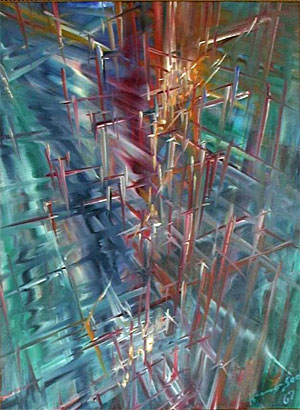
- Calculating Space - a painting by Zuse - Konrad Zuse's visualization of the idea
- Web article and simulation of such a calculating space in C and LIBPNG
- SecondSpace Simulation of waves within a 2D space (time and space are discrete), similar to FDTD. An OpenCL graphic card is needed.
 |  |
Licensed under CC BY-SA 3.0 | Source: https://handwiki.org/wiki/Physics:Calculating_Space22 views | Status: cached on July 28 2026 12:46:00↧ Download this article as ZWI file
 EncycloReader
is supported by the
EncycloReader
is supported by the  KSF
KSF