Table of Contents Categories
Microlensing Observations in Astrophysics
Topic: Physics
 From HandWiki - Reading time: 6 min

Microlensing Observations in Astrophysics (MOA) is a collaborative project between researchers in New Zealand[1] and Japan ,[2] led by Professor Yasushi Muraki of Nagoya University.[3] They use microlensing to observe dark matter, extra-solar planets, and stellar atmospheres from the Southern Hemisphere. The group concentrates especially on the detection and observation of gravitational microlensing events of high magnification, of order 100 or more, as these provide the greatest sensitivity to extrasolar planets. They work with other groups in Australia , the United States and elsewhere. Observations are conducted at New Zealand's Mt. John University Observatory using a 1.8 m (70.9 in) reflector telescope built for the project.[4]
In September 2020, astronomers using microlensing techniques reported the detection, for the first time, of an earth-mass rogue planet unbounded by any star, and free floating in the Milky Way galaxy.[5][6] In January 2022 in collaboration with Optical Gravitational Lensing Experiment (OGLE) they reported in a preprint the first rogue BH[7][8][9][10] while there have been others candidates[11] this is the most solid detection so far as their technique allowed to measure not only the amplification of light but also its deflection by the BH from the microlensing data.
MOA telescope mirror images
-
 Underside of main mirror
 -
 Camera assembly
 -
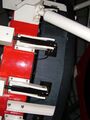 Main mirror, side view


Planets discovered
The following planets have been announced by this survey, some in conjunction with other surveys.
| Planet | Date announced |
|---|---|
| MOA-2020-BLG-208Lb | October 2022 |
| MOA-2020-BLG-135Lb | April 2022 |
| MOA-2014-BLG-472Lb | June 2021 |
| MOA-2007-BLG-197Lb | May 2015 |
| MOA-2008-BLG-379Lb | November 2013 |
| MOA-2011-BLG-322Lb | September 2013 |
| MOA-bin-1b | May 2012 |
| MOA-2009-BLG-387Lb | February 2011 |
| MOA-2007-BLG-400Lb | September 18, 2008 |
| MOA-2007-BLG-192Lb | May 30, 2008 |
| OGLE-2003-BLG-235/MOA-2003-BLG-53b | April 15, 2004 |
See also
- Optical Gravitational Lensing Experiment or OGLE, a similar microlensing survey
- List of extrasolar planets
References
- ↑ Staff (1995). "MOA (Microlensing observtion in Astrophysics)". Caltech. https://sites.astro.caltech.edu/~srk/Workshops/TDAMMS/Files4Facilities/MOA.pdf.
- ↑ Yock, Philip (2012). "Review article - A quarter century of astrophysics with Japan". New Zealand Science Review 69 (3).
- ↑ Latham, David W.; Gaudi, B. Scott (2014). "Microlensing Observations in Astrophysics". Encyclopedia of Astrobiology. p. 1. doi:10.1007/978-3-642-27833-4_1850-2. ISBN 978-3-642-27833-4. https://link.springer.com/content/pdf/10.1007%2F978-3-642-27833-4_1850-2.pdf. Retrieved 3 October 2020.
- ↑ Sumi, T. (1 July 2003). "Microlensing Optical Depth toward the Galactic Bulge from Microlensing Observations in Astrophysics Group Observations during 2000 with Difference Image Analysis". The Astrophysical Journal 591 (1): 204–227. doi:10.1086/375212. Bibcode: 2003ApJ...591..204S. https://iopscience.iop.org/article/10.1086/375212/fulltext/. Retrieved 3 October 2020.
- ↑ Gough, Evan (1 October 2020). "A Rogue Earth-Mass Planet Has Been Discovered Freely Floating in the Milky Way Without a Star". Universe Today. https://www.universetoday.com/148097/a-rogue-earth-mass-planet-has-been-discovered-freely-floating-in-the-milky-way-without-a-star/.
- ↑ Mroz, Przemek (29 September 2020). "A terrestrial-mass rogue planet candidate detected in the shortest-timescale microlensing event". The Astrophysical Journal 903 (1): L11. doi:10.3847/2041-8213/abbfad. Bibcode: 2020ApJ...903L..11M.
- ↑ Sahu, Kailash C.; Anderson, Jay; Casertano, Stefano; Bond, Howard E.; Udalski, Andrzej; Dominik, Martin; Calamida, Annalisa; Bellini, Andrea et al. (2022-05-25). "An Isolated Stellar-mass Black Hole Detected through Astrometric Microlensing". The Astrophysical Journal 933: 83. doi:10.3847/1538-4357/ac739e. Bibcode: 2022ApJ...933...83S.
- ↑ Lam, Casey Y.; Lu, Jessica R.; Udalski, Andrzej; Bond, Ian; Bennett, David P.; Skowron, Jan; Mroz, Przemek; Poleski, Radek et al. (2022-05-31). "An Isolated Mass-gap Black Hole or Neutron Star Detected with Astrometric Microlensing". The Astrophysical Journal Letters 933 (1): L23. doi:10.3847/2041-8213/ac7442. Bibcode: 2022ApJ...933L..23L.
- ↑ Gianopoulos, Andrea (2022-06-07). "Hubble Determines Mass of Isolated Black Hole Roaming Milky Way". http://www.nasa.gov/feature/goddard/2022/hubble-determines-mass-of-isolated-black-hole-roaming-our-milky-way-galaxy.
- ↑ O'Callaghan, Jonathan. "Astronomers Find First Ever Rogue Black Hole Adrift in the Milky Way" (in en). https://www.scientificamerican.com/article/astronomers-find-first-ever-rogue-black-hole-adrift-in-the-milky-way/.
- ↑ Bennett, D. P.; Becker, A. C.; Quinn, J. L.; Tomaney, A. B.; Alcock, C.; Allsman, R. A.; Alves, D. R.; Axelrod, T. S. et al. (2002-11-10). "Gravitational Microlensing Events Due to Stellar‐Mass Black Holes" (in en). The Astrophysical Journal 579 (2): 639–659. doi:10.1086/342225. ISSN 0004-637X. Bibcode: 2002ApJ...579..639B. https://iopscience.iop.org/article/10.1086/342225.
External links
| Forms of dark matter |  | ||||||
|---|---|---|---|---|---|---|---|
| Hypothetical particles | |||||||
| Theories and objects | |||||||
| Search experiments |
| ||||||
| Potential dark galaxies | |||||||
| Related | |||||||
| Ground-based |
|    | |||||||||
|---|---|---|---|---|---|---|---|---|---|---|---|
| Space missions |
| ||||||||||
 |  |
 EncycloReader
is supported by the
EncycloReader
is supported by the  KSF
KSF