Nordic Cross flag
Topic: Religion
 From HandWiki - Reading time: 8 min


Top row: Iceland, Faroe Islands, Orkney, Shetland, Norway , Sweden, Åland, Finland ;
Bottom row: Yorkshire West Riding, UK, Denmark , Scania. (outdated map)
The Nordic Cross flag is any of certain flags bearing the design of the Nordic or Scandinavian cross, a cross symbol in a rectangular field, with the center of the cross shifted towards the hoist.
All of the Nordic countries except Greenland have adopted such flags in the modern period, and while the Scandinavian cross is named for its use in the national flags of the Scandinavian nations, the term is used universally by vexillologists, in reference not only to the flags of the Nordic countries.[1]
The cross design represents Christianity,[2][3][4] and the characteristic shift of the center to the hoist side is early modern, first described the Danish civil ensign (Koffardiflaget) for merchant ships in a regulation of 11 June 1748, which specified the shift of the cross center towards the hoist as "the two first fields must be square in form and the two outer fields must be 6⁄4 lengths of those". The Danish design was adopted for the flags of Norway (civil ensign 1821) and Sweden (1906), both derived from a common ensign used during the Union between Sweden and Norway 1818–1844, as well as Iceland (1915) and Finland (1917); some of the subdivisions of these countries used this as inspiration for their own flags. The Norwegian flag was the first Nordic cross flag with three colours. All Nordic flags may be flown as gonfalons as well.[citation needed]
Flags of the Nordic countries
Note that some of these flags are historical. Also, note that flag proportions may vary between the different flags and sometimes even between different versions of the same flag.
The Flag of Greenland is the only national flag of a Nordic country or territory without a Nordic Cross. When Greenland was granted home rule, the present flag - with a graphic design unique to Greenland - was adopted on June 1985, supported by fourteen votes against eleven who supported a proposed green-and-white Nordic cross.[5]
Denmark
-
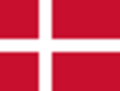 Flag of Denmark (1748)
 -
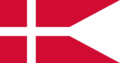 State flag of Denmark (17th century)
 -
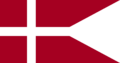 Naval ensign of Denmark (17th century). Note the darker kraprød colour (1939).
 -
 Flag of the Faroe Islands (1919)

.svg)


Finland
-
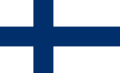 Flag of Finland (1918)
 -
 State flag of Finland (1978)
 -
 War flag and naval ensign of Finland (1918)
 -
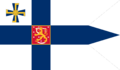 Flag of the President of Finland, with the Cross of Liberty in the canton (1978)
 -
 Finnish yacht club ensign. Ratified club emblem in the canton (1919)
 -
 Flag of the Åland Islands (1954)

.svg)


Iceland
-
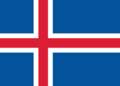 Flag of Iceland
 -
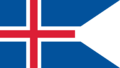 State flag of Iceland
 -
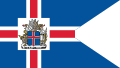 Flag of the President of Iceland
 -
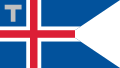 Flag of the Icelandic Customs Service

.svg)


Norway
-
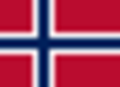 Flag of Norway 1821–1844 and 1899–present
 -
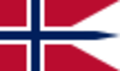 Naval ensign of Norway since 1905, civilian state flag since 1899.
 -
 Former flag of Norway (1814–1821).
 -
 The common naval ensign and war flag of Sweden and Norway from 1815 to 1844.
 -
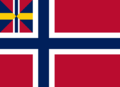 Merchant flag of Norway 1844–1898 with the union badge representing the union with Sweden.
 -
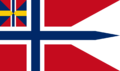 Naval ensign and state flag of Norway 1844–1905.


.svg)
.svg)

.svg)
Sweden
-
 Flag of Sweden
 -
 Naval ensign of Sweden
 -
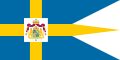 Royal standard of Sweden with the Greater coat of arms, used by the King of Sweden
 -
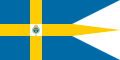 Royal standard of Sweden with the lesser coat of arms (the royal house using the greater coat of arms)
 -
 Flag of Sweden 1844–1905 representing the union with Norway
 -
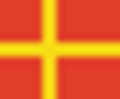 Flag of the Swedish province of Scania and Skåneland


.svg)

Kalmar Union
Historical Flag of the Kalmar Union, which united Denmark, Sweden and Norway 1397 to 1523. No pictorial evidence survives of the Kalmar Union's Flag. The flag appearing here is a reconstruction based on references in 1430 letters by King Eric of Pomerania.

Unofficial Nordic flags
These flags either do not have official status or represent various private entities. They have not been officially adopted and their use remains limited.
-
 Unofficial flag of Bornholm (1970s)
 -
![Proposal for flag of Jutland, designed by artist Per Kramer (1975)[6] (actual use is not recorded)](https://handwiki.org/wiki/images/thumb/0/08/Flag_of_Jutland.svg/120px-Flag_of_Jutland.svg.png) Proposal for flag of Jutland, designed by artist Per Kramer (1975)[6] (actual use is not recorded)
Proposal for flag of Jutland, designed by artist Per Kramer (1975)[6] (actual use is not recorded) -
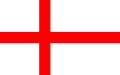 Another proposal for flag of Jutland, dating from 1972 (not in use)
 -
 Proposal for a flag of Greenland, designed in 1984 by Sven Tito Achen. Rejected in favour of the non-Nordic-Cross flag.
 -
 Unofficial flag representing the Swedish-speaking minority in Finland. To be flown along with the Finnish National Flag (1902)
 -
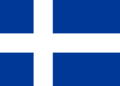 Template:FIAVFormer unofficial flag of Iceland (ca. 1900)
 -
 Proposal for flag of Iceland, designed in 1914 by Magnús Þórðarson
 -
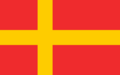 Flag of Norwegian fascist party Nasjonal Samling 1933–1945.
 -
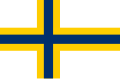 Unofficial flag of the Finnish speaking minority in Sweden
 -
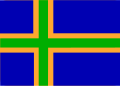 Flag of Vendsyssel, Denmark
 -
 Unofficial flag of Norrland, the northernmost land of Sweden

![Proposal for flag of Jutland, designed by artist Per Kramer (1975)[6] (actual use is not recorded)](https://handwiki.org/wiki/File:Flag_of_Jutland.svg)


Nordic cross flags outside of the Nordic region
Armenia
-
 Flag of Ejmiatsin.

Baltic
-
![Flag of the short-lived United Baltic Duchy (1918)[7]](https://handwiki.org/wiki/images/thumb/2/27/United_Baltic_Duchy_flag.svg/120px-United_Baltic_Duchy_flag.svg.png) Flag of the short-lived United Baltic Duchy (1918)[7]
Flag of the short-lived United Baltic Duchy (1918)[7]
![Flag of the short-lived United Baltic Duchy (1918)[7]](https://handwiki.org/wiki/File:United_Baltic_Duchy_flag.svg)
Estonia
-
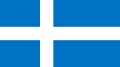 Flag of Pärnu, Estonia
 -
 Flag of Koigi Parish
 -
 Flag of Türi Parish
 -
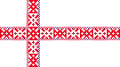 Flag of Setomaa
 -
 A proposed flag for Estonia.
 -
 A proposed flag for Estonia.
 -
 A proposed flag for Estonia.
 -
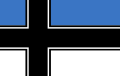 A proposed flag for Estonia (1919).


Latvia
-
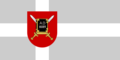 Flag of Alūksne, Latvia
 -
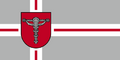 Flag of Grobiņa Municipality, Latvia
 -
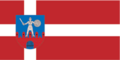 Flag of Cēsis, Latvia
 -
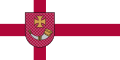 Flag of Ventspils, Latvia
 -
 Flag of Ventspils Municipality, Latvia


Lithuania
-
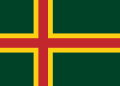 Nordic cross proposal for Lithuanian flag

Germany
Nordic flag designs very similar to Denmark 's, Sweden's, and Norway 's national flags were proposed as Germany's national flags in both 1919 and 1948, after World War I and World War II, respectively. Today, the Nordic cross is a feature in some city and district flags or coats of arms.
-
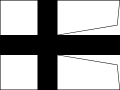 Teutonic Knights and their State
 -
Template:FIAVFlag of the Danish monarch, flown in his capacity as Duke of Holstein, Schleswig and Lauenburg. The three duchies were ceded to Austria and Prussia in 1864 as a result of the Second Schleswig War.[8]
-
![Civil flag of Oldenburg[9]](https://handwiki.org/wiki/images/thumb/4/40/Flagge_Herzogtum_Oldenburg.svg/120px-Flagge_Herzogtum_Oldenburg.svg.png) Civil flag of Oldenburg[9]
Civil flag of Oldenburg[9] -
 Former North German Federal Navy Ensign (1867–71), Reichskriegsflagge
 -
 Former War Ensign of Nazi Germany (1938–1945), now illegal in Germany
 -
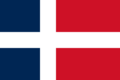 Flag of the former Saar Protectorate, Germany
 -
 Proposed National flag of Germany , circa 1919.
 -
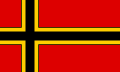 Flag proposed by the conspirators of the July 20 plot against Hitler
 -
 A proposed flag for West Germany (1948)

![Civil flag of Oldenburg[9]](https://handwiki.org/wiki/File:Flagge_Herzogtum_Oldenburg.svg)
.svg)
.svg)
.svg)


Netherlands
-
Flag of Aldtsjerk
-
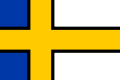 Flag of Bedum
 -
 Flag of Gemert-Bakel
 -
 Flag of Gulpen-Wittem
 -
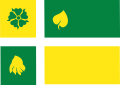 Flag of Hof van Twente
 -
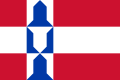 Flag of Houten
 -
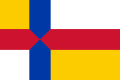 Flag of Kapelle
 -
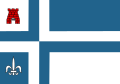 Flag of the Noordoostpolder
 -
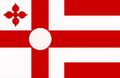 Flag of Rosmalen
 -
 Flag of Skarsterlân
 -
 Flag of Tilburg
 -
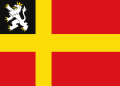 Flag of Utrechtse Heuvelrug
 -
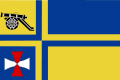 Flag of Vlagtwedde
 -
 Flag of Werkendam
 -
 Flag of Weststellingwerf
 -
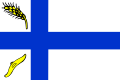 Flag of Wierden


United Kingdom
A number of flags for localities in the United Kingdom (primarily Scotland) are based on Nordic cross designs, intended to reflect the Scandinavian heritage introduced to the British Isles during the Viking Age and through the High Middle Ages.
-
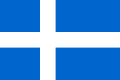 Flag of Shetland (2005)
 -
 Flag of Orkney (2007)
 -
 Flag of Caithness (2016)
 -
 Flag of Yorkshire West Riding (2013)
 -
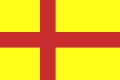 Cross of St Magnus, former unofficial Flag of Orkney (1990s)
 -
![Flag of the island of South Uist (recognised 2017)[10]](https://handwiki.org/wiki/images/thumb/8/89/Flag_of_South_Uist.svg/120px-Flag_of_South_Uist.svg.png) Flag of the island of South Uist (recognised 2017)[10]
Flag of the island of South Uist (recognised 2017)[10] -
![Isle of Barra (recognised 2017)[11]](https://handwiki.org/wiki/images/thumb/c/cf/Isle_of_Barra_flag.svg/120px-Isle_of_Barra_flag.svg.png) Isle of Barra (recognised 2017)[11]
Isle of Barra (recognised 2017)[11]


![Flag of the island of South Uist (recognised 2017)[10]](https://handwiki.org/wiki/File:Flag_of_South_Uist.svg)
![Isle of Barra (recognised 2017)[11]](https://handwiki.org/wiki/File:Isle_of_Barra_flag.svg)
Brazil
-
 Flag of the City of São Paulo
 -
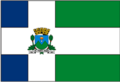 Flag of Areias, São Paulo State
 -
 Flag of Borborema, São Paulo State
 -
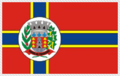 Flag of Carmo do Paranaíba, Minas Gerais
 -
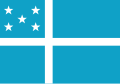 Flag of Chapadinha, Maranhão
 -
 Flag of Colorado, Rio Grande do Sul
 -
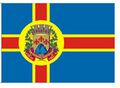 Flag of Domingos Martins, Espírito Santo
 -
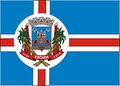 Flag of Escada, Pernambuco
 -
 Flag of Frei Martinho, Paraíba
 -
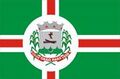 Flag of Grão Pará, Santa Catarina
 -
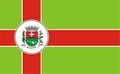 Flag of Guaíra, São Paulo State
 -
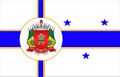 Flag of Itu, São Paulo State
 -
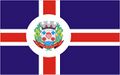 Flag of Lagoa Formosa, Minas Gerais
 -
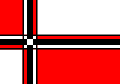 Flag of Nova Era, Minas Gerais
 -
 Flag of Nova Prata, Rio Grande do Sul
 -
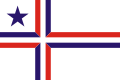 Flag of Palotina, Pará
 -
 Flag of Peritiba, Santa Catarina
 -
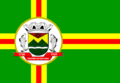 Flag of Pirapora do Bom Jesus, São Paulo State
 -
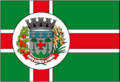 Flag of Santo Antônio do Pinhal, São Paulo State
 -
 Flag of Santo Cristo, Rio Grande do Sul
 -
 Flag of Vinhedo, São Paulo State


.svg)


United States (including Puerto Rico)
-
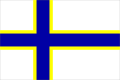 Flag of Bayamón, Puerto Rico
 -
Flag of Little Rock, Arkansas
-
 Campaign Flag of Puerto Rican Independence Party
 -
 Flag of Wilmington, Delaware
 -
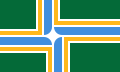 Flag of Portland, Oregon


Ukraine
-
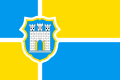 Flag of Zhytomyr.

Other
-
Flag of Andalucía, Colombia
-
 Flag of Bleimor, a former Breton Scouting organization in France
 -
 Proposed Flag of Belarus (1992)
 -
 Flag of Pula, Croatia
 -
 Flag of Calais, France
 -
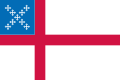 Flag of Episcopal Church
 -
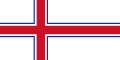 Flag of the Georgian Orthodox Church
 -
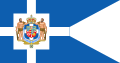 Royal Standard of Greece (1863). Note: George I was also a prince of Denmark.
 -
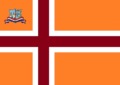 Flag of Hernandarias, Paraguay
 -
 Flag of Ladonia, (micronation)
 -
Unofficial flag of Saint Barthelemy
-
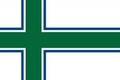 Proposed flag of South Island, New Zealand
 -
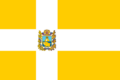 Flag of Stavropol Krai, Russia
 -
 Naval ensign of South Africa (1952–1981)
 -
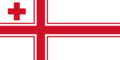 Naval ensign of Tonga
 -
 Alternative flag of Tudela, Navarre, Spain
 -

-
 Flag of Vikesland, (micronation)
 -
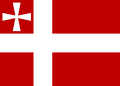 Flag of Volyn Oblast, Ukraine
 -
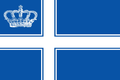 Flag of Westarctica, (micronation)
.svg)

.svg)


.svg)


Ethnic flags
-
![Unofficial flag of Ingrian people, designed in 1919[12][13]](https://handwiki.org/wiki/images/thumb/6/6b/Flag_of_Ingrian_people.svg/120px-Flag_of_Ingrian_people.svg.png%3Futm_source%3Dcommons.wikimedia.org%26utm_campaign%3Dimageinfo%26utm_content%3Dthumbnail)
-
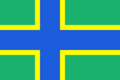 Flag of the Veps since 1992, designed by Vitaly Dobrynin. In 2000-2005 span used as the official flag of Vepsian autonomous region in Russian Karelia
 -
 Former official flag of East Karelia, designed by Akseli Gallen-Kallela.
 -
-
![Proposed flag of Frisia (2006)[16]](https://handwiki.org/wiki/images/thumb/6/6e/Flag_of_Frisia.svg/120px-Flag_of_Frisia.svg.png)
-
 Flag of the Mi'kmaq people, Canada (horizontal version)
 -
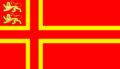 Falaise Cross flag (Croix de Falaise) – Falaise in Normandy was the birthplace of William the Conqueror
 -
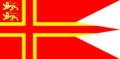 Flag used by the sailors of Normandy
 -
Flag of Setos
-
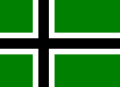 The "Vinnland flag", used by American band Type O Negative
![Unofficial flag of Ingrian people, designed in 1919[12][13]](https://handwiki.org/wiki/File:Flag_of_Ingrian_people.svg)


![Proposed flag of Frisia (2006)[16]](https://handwiki.org/wiki/File:Flag_of_Frisia.svg)


Sport societies
-
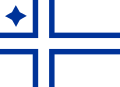 Flag of Idrottsföreningen Kamraterna


See also
- Flags of Central America
- Flag of Greenland
- Flag of Sámi
- Flag of Gran Colombia
- Pan-African colours
- Pan-Arab colours
- Pan-Slavic colours
- Southern Cross Flag
- Union Flag
- Tricolour
References
- ↑ EnchantedLearning.com; Historical flags of the world: The Scandinavian cross; Eric Inglefield: "Fahnen und Flaggen" (translated to German by Dagmar Hahn), Delphin Verlag, Munich 1986, p.16
- ↑ Jeroen Temperman. State Religion Relationships and Human Rights Law: Towards a Right to Religiously Neutral Governance. Martinus Nijhoff Publishers. p. 88. https://books.google.com/books?id=Khag6tbsIn4C&pg=PA88. Retrieved 2007-12-31. "Many predominantly Christian states show a cross, symbolising Christianity, on their national flag. The so-called Scandinavian crosses or Nordic crosses on the flags of the Nordic countries–Denmark, Finland, Iceland, Norway and Sweden–also represent Christianity."
- ↑ Carol A. Foley. The Australian Flag: Colonial Relic or Contemporary Icon. William Gaunt & Sons. https://books.google.com/books?id=WV7ag4EpHF8C&pg=PA10. Retrieved 2007-12-31. "The Christian cross, for instance, is one of the oldest and most widely used symbols in the world, and many European countries, such as the United Kingdom, Norway, Sweden, Finland, Denmark, Iceland, Greece and Switzerland, adopted and currently retain the Christian cross on their national flags."
- ↑ Andrew Evans. Iceland. Bradt. https://books.google.com/books?id=9_GfdBAASUQC&pg=PA27. Retrieved 2007-12-31. "Legend states that a red cloth with the white cross simply fell from the sky in the middle of the 13th-century Battle of Valdemar, after which the Danes were victorious. As a badge of divine right, Denmark flew its cross in the other Scandinavian countries it ruled and as each nation gained independence, they incorporated the Christian symbol."
- ↑ "Nu vajer det grønlandske flag over Danmark". http://www.dr.dk/nyheder/indland/nu-vajer-det-groenlandske-flag-over-danmark.
- ↑ "Kunstavisen på internettet – Artikler". Archived from the original on 2 October 2008. https://web.archive.org/web/20081002112217/http://www.netgallery.dk/kunstavisen/artikler/artikel_2001_09_1.asp.
- ↑ "Baltic Duchy (1918)". http://www.crwflags.com/fotw/flags/bal_duke.html. Retrieved 28 December 2017.
- ↑ In 1844, pro-German nationalists in the two duchies of Holstein and Schleswig created a blue-white-red tricolour as a symbol for independence which began to see widespread use. In 1845, Denmark responded by outlawing all other flags than the Danish one shown here. This ban was enforced as long as Denmark controlled the three duchies (Holstein and Lauenburg: effectively until 1863, Schleswig effectively until 1864.) Use of the Danish flag was in turn outlawed by the secessionist government that claimed the three duchies between 1848–1851.
- ↑ "Grand Duchy of Oldenburg 1815-1918 (Lower Saxony, Germany)". http://flagspot.net/flags/de-ol815.html. Retrieved 28 December 2017.
- ↑ "South Uist flag". http://www.hebrides-news.com/south-uist-flag-28617.html. Retrieved 28 December 2017.
- ↑ "Isle of Barra's flag officially recognised". BBC News. https://www.bbc.co.uk/news/uk-scotland-highlands-islands-42094599. Retrieved 26 May 2018.
- ↑ Пюккенен, А. Ю.; Сыров, А. А. (2002) (in ru). Что такое Ингерманландия? Краткое введение в историю ингерманландских финнов. Saint Petersburg.
- ↑ Пюккенен, А. Ю. (2011-05-30). "Геральдика Невского края" (in ru). Санкт-Петербургские ведомости (Saint Petersburg: АО Издательский дом «С.-Петербургские ведомости»).
- ↑ "Hur ser Svenskfinland ut om 100 år?" (in Swedish) (PDF). Medborgarbladet (Helsinki: Svenska folkpartiet RP) 61 (4): 20. December 2006. Archived from the original on 2011-07-21. https://web.archive.org/web/20110721123258/http://www.sfp.fi/files/Medborgarblad/MED%204_06.pdf. Retrieved 2008-06-06.
- ↑ Engene, Jan Oskar (10 March 1996). "Swedish speaking population in Finland". Flags of the World. http://www.fotw.net/flags/xn_fi-se.html. Retrieved 6 June 2008.
- ↑ "Interfrisian flag". Groep fan Auwerk. http://www.groepfanauwerk.com/homeIflagge.html. Retrieved 1 December 2015.
Bibliography
- Znamierowski, Alfred (2002). The world encyclopedia of flags : The definitive guide to international flags, banners, standards and ensigns. London: Hermes House. pp. 103 and 134. ISBN 1-84309-042-2.
External links
 |
Wikimedia Commons has media related to Nordic Cross flags. |
 |
 EncycloReader
is supported by the
EncycloReader
is supported by the  KSF
KSF