Nomad
Topic: Social
 From HandWiki - Reading time: 17 min
Nomads are communities without fixed habitation who regularly move to and from areas. Such groups include hunter-gatherers, pastoral nomads (owning livestock), tinkers and trader nomads.[1][2] In the twentieth century, the population of nomadic pastoral tribes slowly decreased, reaching an estimated 30–40 million nomads in the world as of 1995[update].[3]
Nomadic hunting and gathering—following seasonally available wild plants and game—is by far the oldest human subsistence method known.[4] Pastoralists raise herds of domesticated livestock, driving or accompanying them in patterns that normally avoid depleting pastures beyond their ability to recover.[5] Nomadism is also a lifestyle adapted to infertile regions such as steppe, tundra, or ice and sand, where mobility is the most efficient strategy for exploiting scarce resources. For example, many groups living in the tundra are reindeer herders and are semi-nomadic, following forage for their animals.
Sometimes also described as "nomadic" are various itinerant populations who move among densely populated areas to offer specialized services (crafts or trades) to their residents—external consultants, for example. These groups are known as "peripatetic nomads".[6][7]
Etymology
The English word nomad comes from the Middle French nomade, from Latin nomas ("wandering shepherd"), from Ancient Greek νομᾰ́ς (nomás, "roaming, wandering, esp. to find pasture"), which is derived from the Ancient Greek νομός (nomós, "pasture").[8]
Common characteristics


Many nomadic and pastorally nomadic peoples are associated with semi-arid and desert climates; examples include the Mongolic and Turkic peoples of Central Asia, the Plains Indians of the Great Plains, and the Amazigh and other peoples of the Sahara Desert. Pastoral nomads who are residents of arid climates include the Fulani of the Sahel, the Khoikhoi of South Africa and Namibia, groups of Northeast Africa such as Somalis and Oromo, and the Bedouin of the Middle East.
In the case of Mongolian nomads, a family moves twice a year. These two movements generally occur during the summer and winter. The winter destination is usually located near the mountains in a valley and most families already have fixed winter locations. Their winter locations have shelter for animals and are not used by other families while they are out. In the summer they move to a more open area in which the animals can graze. Most nomads usually move within the same region and do not travel very far. Since they usually circle around a large area, communities form and families generally know where the other ones are. Often, families do not have the resources to move from one province to another unless they are moving out of the area permanently. A family can move on its own or with others; if it moves alone, they are usually no more than a couple of kilometres from each other. The geographical closeness of families is usually for mutual support. Pastoral nomad societies usually do not have large populations.
One nomadic society, the Mongols, gave rise to the largest land empire in history. The Mongols originally consisted of loosely organized nomadic tribes in Mongolia, Manchuria, and Siberia. In the late 12th century, Genghis Khan united them and other nomadic tribes to found the Mongol Empire, which eventually stretched the length of Asia.[9]
The nomadic way of life has become increasingly rare. Many countries have converted pastures into cropland and forced nomadic peoples into permanent settlements.[10]
Modern forms of nomadic peoples are variously referred to as "shiftless", "gypsies", "rootless cosmopolitans", hunter-gatherers, refugees and urban homeless or street-people, depending on their individual circumstances. These terms may be used in a derogatory sense.
According to Gérard Chaliand, terrorism originated in nomad-warrior cultures. He points to Machiavelli's classification of war into two types, which Chaliand interprets as describing a difference between warfare in sedentary and nomadic societies:[11]
There are two different kinds of war. The one springs from the ambition of princes or republics that seek to extend their empire; such were the wars of Alexander the Great, and those of the Romans, and those which two hostile powers carry on against each other. These wars are dangerous but never go so far as to drive all its inhabitants out of a province, because the conqueror is satisfied with the submission of the people... The other kind of war is when an entire people, constrained by famine or war, leave their country with their families for the purpose of seeking a new home in a new country, not for the purpose of subjecting it to their dominion as in the first case, but with the intention of taking absolute possession of it themselves and driving out or killing its original inhabitants.
Primary historical sources for nomadic steppe-style warfare are found in many languages: Chinese, Persian, Polish, Russian, Classical Greek, Armenian, Latin and Arabic. These sources concern both the true steppe nomads (Mongols, Huns, Magyars and Scythians) and also the semi-settled people like Turks, Crimean Tatars and Russians, who retained or, in some cases, adopted the nomadic form of warfare.[12]
Hunter-gatherers

Hunter-gatherers (also known as foragers) move from campsite to campsite, following game and wild fruits and vegetables. Hunting and gathering describes early peoples' subsistence living style. Following the development of agriculture, most hunter-gatherers were eventually either displaced or converted to farming or pastoralist groups. Only a few contemporary societies, such as the Pygmies, the Hadza people, and some uncontacted tribes in the Amazon rainforest, are classified as hunter-gatherers; some of these societies supplement, sometimes extensively, their foraging activity with farming or animal husbandry.
Pastoralism


Pastoral nomads are nomads moving from pastures to pastures. Nomadic pastoralism is thought to have developed in three stages that accompanied population growth and an increase in the complexity of social organization. Karim Sadr has proposed the following stages:[14]
- Pastoralism: This is a mixed economy with a symbiosis within the family.
- Agropastoralism: This is when symbiosis is between segments or clans within an ethnic group.
- True Nomadism: This is when symbiosis is at the regional level, generally between specialised nomadic and agricultural populations.
The pastoralists are sedentary to a certain area, as they move between the permanent spring, summer, autumn and winter (or dry and wet season) pastures for their livestock. The nomads moved depending on the availability of resources.[15]
History
Origins
The first nomadic pastoral society developed in the period from 8,500 to 6,500 BCE in the area of the southern Levant.[16] There, during a period of increasing aridity, Pre-Pottery Neolithic B (PPNB) cultures in the Sinai were replaced by a nomadic, pastoral pottery-using culture, which seems to have been a cultural fusion between them and a newly-arrived Mesolithic people from Egypt (the Harifian culture), adopting their nomadic hunting lifestyle to the raising of stock.[17]
This lifestyle quickly developed into what Jaris Yurins has called the circum-Arabian nomadic pastoral techno-complex and is possibly associated with the appearance of Semitic languages in the region of the Ancient Near East. The rapid spread of such nomadic pastoralism was typical of such later developments as of the Yamnaya culture of the horse and cattle nomads of the Eurasian steppe (c. 3300–2600 BCE), and of the Mongol spread in the later Middle Ages.[17]
Yamnaya steppe pastoralists from the Pontic–Caspian steppe, who were among the first to master horseback riding, played a key role in Indo-European migrations and in the spread of Indo-European languages across Eurasia.[18][19]
Trekboers in southern Africa adopted nomadism from the 17th century.[20] Some elements of gaucho culture in colonial South America also re-invented nomadic lifestyles.[21]
Increase in post-Soviet Central Asia
One of the results of the break-up of the Soviet Union and the subsequent political independence and economic collapse of its Central Asian republics has been the resurgence of pastoral nomadism.[22] Taking the Kyrgyz people as a representative example, nomadism was the centre of their economy before Russian colonization at the turn of the 20th century[23], when they were settled into agricultural villages. The population became increasingly urbanized after World War II, but some people still take their herds of horses and cows to high pastures (jailoo) every summer, continuing a pattern of transhumance. Since the 1990s, as the cash economy shrank, unemployed relatives were reabsorbed into family farms, and the importance of this form of nomadism has increased. The symbols of nomadism, specifically the crown of the grey felt tent known as the yurt, appears on the national flag, emphasizing the central importance of nomadism in the genesis of the modern nation of Kyrgyzstan.[24]
Sedentarization
From 1920 to 2008, the population of nomadic pastoral tribes slowly decreased from over a quarter of Iran's population.[25] Tribal pastures were nationalized during the 1960s. The National Commission of UNESCO registered the population of Iran at 21 million in 1963, of whom two million (9.5%) were nomads.[26] Although the nomadic population of Iran has dramatically decreased in the 20th century, Iran still has one of the largest nomadic populations in the world, an estimated 1.5 million in a country of about 70 million.[27]
In Kazakhstan where the major agricultural activity was nomadic herding,[28] forced collectivization under Joseph Stalin's rule met with massive resistance and major losses and confiscation of livestock.[29] Livestock in Kazakhstan fell from 7 million cattle to 1.6 million and from 22 million sheep to 1.7 million. The resulting famine of 1931–1934 caused some 1.5 million deaths: this represents more than 40% of the total Kazakh population at that time.[30]

In the 1950s as well as the 1960s, large numbers of Bedouin throughout the Middle East started to leave the traditional, nomadic life to settle in the cities of the Middle East, especially as home ranges have shrunk and population levels have grown. Government policies in Egypt and Israel, oil production in Libya and the Persian Gulf, as well as a desire for improved standards of living, effectively led most Bedouin to become settled citizens of various nations, rather than stateless nomadic herders. A century ago, nomadic Bedouin still made up some 10% of the total Arab population. Today, they account for some 1% of the total.[31]
At independence in 1960, Mauritania was essentially a nomadic society. The great Sahel droughts of the early 1970s caused massive problems in a country where 85% of its inhabitants were nomadic herders. Today only 15% remain nomads.[32]
In Ireland, historically Irish Travellers families practiced seasonal nomadism, with 92% residing in tents or horse-drawn wagons as recent as 1960, often traveling in dispersed, small groups between March and November. Rapid modernization and laws targeting the "itinerant problem" saw this lifestyle decline to 27% by 1971 and 4% by 1981, with most families transitioning to urban, sedentary housing. Current housing, as of today includes roadside/vacant lots (40%), public housing (36%), and government-provided sites (25%).[33]
As many as 2 million nomadic Kuchis wandered over Afghanistan in the years before the Soviet invasion, and most experts agreed that by 2000 the number had fallen dramatically, perhaps by half. A severe drought had destroyed 80% of the livestock in some areas.[34]
Niger experienced a serious food crisis in 2005 following erratic rainfall and desert locust invasions. Nomads such as the Tuareg and Fulani, who make up about 20% of Niger's 12.9 million population, had been so badly hit by the Niger food crisis that their already fragile way of life is at risk.[35] Nomads in Mali were also affected.[36] The Fulani of West Africa are the world's largest nomadic group.[37]
Lifestyle

Pala nomads living in Western Tibet have a diet that is unusual in that they consume very few vegetables and no fruit. The main staple of their diet is tsampa and they drink Tibetan style butter tea. Pala will eat heartier foods in the winter months to help keep warm. Some of the customary restrictions they explain as cultural saying only that drokha do not eat certain foods, even some that may be naturally abundant. Though they live near sources of fish and fowl these do not play a significant role in their diet, and they do not eat carnivorous animals, rabbits or the wild asses that are abundant in the environs, classifying the latter as horse due to their cloven hooves. Some families do not eat until after the morning milking, while others may have a light meal with butter tea and tsampa. In the afternoon, after the morning milking, the families gather and share a communal meal of tea, tsampa and sometimes yogurt. During winter months the meal is more substantial and includes meat. Herders will eat before leaving the camp and most do not eat again until they return to camp for the evening meal. The typical evening meal may include thin stew with tsampa, animal fat and dried radish. Winter stew would include a lot of meat with either tsampa or boiled flour dumplings.[38]
Nomadic diets in Kazakhstan have not changed much over centuries. The Kazakh nomad cuisine is simple and includes meat, salads, marinated vegetables and fried and baked breads. Tea is served in bowls, possibly with sugar or milk. Milk and other dairy products, like cheese and yogurt, are especially important. Kumys is a drink of fermented milk. Wrestling is a popular sport, but the nomadic people do not have much time for leisure. Horse riding is a valued skill in their culture.[39]
.jpg)
Perception
Ann Marie Kroll Lerner states that the pastoral nomads were viewed as "invading, destructive, and altogether antithetical to civilizing, sedentary societies" during the late-19th and early-20th centuries. According to Lerner, they are rarely accredited as "a civilizing force".[40]
Allan Hill and Sara Randall observe that western authors have looked for "romance and mystery, as well as the repository of laudable characteristics believed lost in the West, such as independence, stoicism in the face of physical adversity, and a strong sense of loyalty to family and to tribe" in nomadic pastoralist societies. Hill and Randall observe that nomadic pastoralists are stereotypically seen by the settled populace in Africa and Middle East as "aimless wanderers, immoral, promiscuous and disease-ridden" peoples. According to Hill and Randall, both of these perceptions "misrepresent the reality".[41]
The development of "nomadology" by Deleuze and Guattari emphasises a positive view of features of nomadism.[42]
Contemporary peripatetic minorities in Eurasia
 | This section may stray from the topic of the article. (July 2013) |

Peripatetic minorities are mobile populations moving among settled populations offering a craft or trade.[43]
Each existing community is primarily endogamous, and subsists traditionally on a variety of commercial or service activities. Formerly, all or a majority of their members were itinerant, and this largely holds true today. Migration generally takes place within the political boundaries of a single state these days.
Each of the peripatetic communities is multilingual, it speaks one or more of the languages spoken by the local sedentary populations, and, additionally, within each group, a separate dialect or language is spoken. They are speaking languages of Indic origin and many are structured somewhat like an argot or secret language, with vocabularies drawn from various languages. There are indications that in northern Iran at least one community speaks Romani language, and some groups in Turkey also speak Romani.
Asia
Afghanistan
India

Dom people
In Iran, the Asheq of Azerbaijan, the Challi of Baluchistan, the Luti of Kurdistan, Kermānshāh, Īlām, and Lorestān, the Mehtar in the Mamasani district, the Sazandeh of Band-i Amir and Marv-dasht, and the Toshmal among the Bakhtyari pastoral groups worked as professional musicians. The men among the Kowli worked as tinkers, smiths, musicians, and monkey and bear handlers; they also made baskets, sieves, and brooms and dealt in donkeys. Their women made a living from peddling, begging, and fortune-telling.
Little is known for certain about the past of these communities; the history of each is almost entirely contained in their oral traditions. Although some groups—such as the Vangawala—are of Indian origin, some—like the Noristani—are most probably of local origin; still others probably migrated from adjoining areas. The Ghorbat and the Shadibaz claim to have originally come from Iran and Multan, respectively, and Tahtacı traditional accounts mention either Baghdad or Khorāsān as their original home. The Baluch say they[clarification needed] were attached as a service community to the Jamshedi, after they fled Baluchistan because of feuds.[44][45]
Kochi people
Yörüks
Still some groups such as Sarıkeçililer continues nomadic lifestyle between coastal towns Mediterranean and Taurus Mountains even though most of them were settled by both late Ottoman and Turkish republic.
Bukat people
The Bukat people of Borneo in Malaysia live within the region of the river Mendalam, which the natives call Buköt. Bukat is an ethnonym that encapsulates all the tribes in the region. These natives are historically self-sufficient but were also known to trade various goods. This is especially true for the clans who lived on the periphery of the territory. The products of their trade were varied and fascinating, including: "...resins (damar, Agathis dammara; jelutong bukit, Dyera costulata, gutta-percha, Palaquium spp.); wild honey and beeswax (important in trade but often unreported); aromatic resin from insence wood (gaharu, Aquilaria microcarpa); camphor (found in the fissures of Dryobalanops aromaticus); several types of rotan of cane (Calamus rotan and other species); poison for blowpipe darts (one source is ipoh or ipu: see Nieuwenhuis 1900a:137); the antlers of deer (the sambar, Cervus unicolor); rhinoceros horn (see Tillema 1939:142); pharmacologically valuable bezoar stones (concretions formed in the intestines and gallbladder of the gibbon, Seminopithecus, and in the wounds of porcupines, Hestrix crassispinus); birds' nests, the edible nests of swifts (Collocalia spp.); the heads and feathers of two species of hornbills (Buceros rhinoceros, Rhinoplax vigil); and various hides (clouded leopards, bears, and other animals)."[46] These nomadic tribes also commonly hunted boar with poison blow darts for their own needs.
Europe
Roma
Image gallery
-
 Nomad camp near Tingri, Tibet. 1993
 -
 Snake charmer from Telugu community of Sri Lanka.
 -
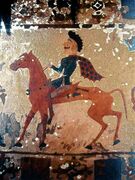 A Scythian horseman from the general area of the Ili river, Pazyryk, c. 300 BCE.
 -
 Yeniche people, 15th century
 -
 A young Bedouin lighting a camp fire in Wadi Rum, Jordan.
 -
 Kazakhs in Xinjiang, China, 1987
 -
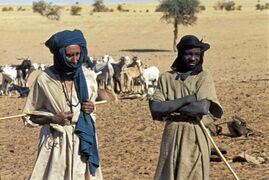 Tuareg in Mali, 1974.
 -
 Kyrgyz nomads, 1869–1870.
 -
 Nomads in the Desert (Giulio Rosati).
 -
 Kazakhs, c. 1910
 -
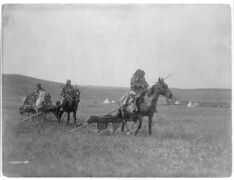 Gros Ventre (Atsina) American Indians moving camps with travois for transporting skin lodges and belongings.
 -
 House barge of the Sama-Bajau peoples, Indonesia. 1914–1921
 -
 Photograph of Bedouins of Tunisia, 1899
 -
 Indian nomads (1893), by Raja Ravi Varma
 -
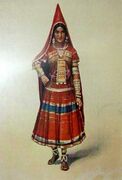 Indian nomad Banjara

.jpg)


.jpg)

See also
- Nomadic peoples of Europe
- Shahsevan
- Seasonal human migration
- Nomadic conflict
- Nomadology
- Sea Gypsies
- Pastoral society
- Pastoralism
- Transhumance
Figurative use of the term:
- Global nomad
- Digital nomad
- Snowbird (people)
- Military brat
- The Nomadic Project
- Perpetual traveler
- RV lifestyle
- Third culture kid
- Overlanding
References
- ↑ "NOMAD". https://encyclopedia2.thefreedictionary.com/NOMAD.
- ↑ "nomadism | society | Britannica". https://www.britannica.com/topic/nomadism.
- ↑ "Nomads: At the Crossroads – The Facts". New Internationalist (266). April 5, 1995. http://www.newint.org/features/1995/04/05/facts/. Retrieved January 10, 2013.
- ↑ "Subsistence". https://explorable.com/subsistence.
- ↑ Homewood, Katherine; Rodgers, W.A. (1988), "Pastoralism, conservation and the overgrazing controversy", Conservation in Africa (Cambridge University Press): pp. 111–128, doi:10.1017/cbo9780511565335.009, ISBN 978-0521341998
- ↑ Teichmann, Michael. "ROMBASE: Didactically edited information on Roma". http://romani.uni-graz.ac.at/rombase/cd/data/ethn/topics/data/nomadic.en.pdf.
- ↑ Rao, Aparna (1987). The concept of peripatetics: An introduction. Cologne: Bohlau Verlag. pp. 1–32. https://www.scribd.com/doc/209394957/Rao-1987-the-Concept-of-Peripatetics-an-Introduction. Retrieved 2017-09-10. "[...] peripatetics, [...] endogamous nomads who are largely non-primary producers or extractors, and whose principal resources are constituted by other human populations [...]."
- ↑ English dictionaries agree that the word came from French in the 16th century but incorrectly claim that the French word referred to pasturing. (See the American Heritage Dictionary and the Digitized Treasury of the French Language (in French). The meanings of the Latin and Greek predecessors are irrelevant and in fact misleading for the meaning of the English word.)
- ↑ Weatherford, Jack (2005-03-22) (in en). Genghis Khan and the Making of the Modern World. Crown. ISBN 978-0-307-23781-1. https://books.google.com/books?id=A8Y9B5uHQcAC.
- ↑ Johnson, Douglas L. (1993). "Nomadism and Desertification in Africa and the Middle East". GeoJournal 31 (1): 51–66. doi:10.1007/BF00815903. Bibcode: 1993GeoJo..31...51J. https://www.jstor.org/stable/41145912. Retrieved 2021-02-17.
- ↑ Chaliand, Gerard (2007). The History of Terrorism: From Antiquity to Al Qaeda. University of California Press. pp. 85–86.
- ↑ "Steppe Nomadic Warfare". https://www.oxfordbibliographies.com/view/document/obo-9780199791279/obo-9780199791279-0119.xml.
- ↑ "Your pictures: Ed Vallance". BBC News – In Pictures. 2008-09-23. http://news.bbc.co.uk/2/hi/in_pictures/7631678.stm.
- ↑ Yee, Danny (1991). "The Development of Nomadism in Ancient Northeast Africa Karim Sadr [Book Review"]. http://dannyreviews.com/h/Nomadism.html.
- ↑ Nomads of the Middle East , David Zeidan, OM-IRC, 1995
- ↑ Ning, Shi; Dupont, Lydie M. (June 1997). "Vegetation and climatic history of southwest Africa: A marine palynological record of the last 300,000 years". Vegetation History and Archaeobotany 6 (2): 117–131. doi:10.1007/bf01261959. ISSN 0939-6314. Bibcode: 1997VegHA...6..117N.
- ↑ 17.0 17.1 "Patterns of Subsistence: Pastoralism". http://anthro.palomar.edu/subsistence/sub_3.htm.
- ↑ Gibbons, Ann (21 February 2017). "Thousands of horsemen may have swept into Bronze Age Europe, transforming the local population". Science. https://www.science.org/content/article/thousands-horsemen-may-have-swept-bronze-age-europe-transforming-local-population. Retrieved 29 October 2022.
- ↑ Curry, Andrew (August 2019). "The first Europeans weren't who you might think". National Geographic. https://www.nationalgeographic.com/culture/article/first-europeans-immigrants-genetic-testing-feature.
- ↑ Fouché, Leo (1936). "V: Foundation of the Cape Colony, 1652–1708". in Walker, Eric Anderson. The Cambridge History of the British Empire. VIII: South Africa, Rhodesia and the Protectorates. Cambridge: CUP Archive. 1963. p. 136. https://books.google.com/books?id=ISg9AAAAIAAJ. Retrieved 2016-11-16. "[...] van der Stel recognised the roving tendency among the colonists and tried to arrest it. A proclamation of 1692 illustrated his fears: it stated that colonists were making a living by grazing cattle and bartering in the interior [...]. This seems clear proof that the trekboer, as a distinct type, was coming into existence during the time of van der Stel. [...] Generation after generation of these hardy and self-reliant nomads pushed the frontiers of civilisation further into the wilderness."
- ↑ Slatta, Richard W. (1 January 1992). Gauchos and the Vanishing Frontier (reprint ed.). Lincoln: University of Nebraska Press. p. 189. ISBN 9780803292154. https://books.google.com/books?id=tWN1W5DHIvcC. Retrieved 23 April 2023. "[...] the early nineteenth century witnessed 'the nomad gaucho of the colonial period converted into the loyal gaucho of the estancia.'"
- ↑ Pastoral Livestock Development in Central Asia , FAO Rural Development Division
- ↑ Alimakyn, Duisenali (2026-02-24). "An Early European View of Nomadic Central Asia - The Times Of Central Asia" (in en-US). https://timesca.com/an-early-european-view-of-nomadic-central-asia/.
- ↑ "CONCLUSION", Speaking Soviet with an Accent (University of Pittsburgh Press): pp. 140–146, 2012, doi:10.2307/j.ctt5vkh78.13, ISBN 978-0822978091
- ↑ "Persian & Iranian Nomads at Best Iran Travel.com". http://www.bestirantravel.com/culture/history/nomads.html.
- ↑ Moussavi-Nejad, Ebrahim (December 2003). "Censuses of Pastoral Nomads and Some General Remarks about the Census of Nomadic Tribes of Iran in 1998". Nomadic Peoples 7 (2): 24–35. doi:10.3167/082279403781826328.
- ↑ Iran's nomads going extinct, Los Angeles Times, February 18, 2008
- ↑ "National Geographic: Images of Animals, Nature, and Cultures". http://worldmusic.nationalgeographic.com/worldmusic/view/page.basic/country/content.country/kazakhstan_672.
- ↑ "Kazahstan Student Society in the United Kingdom". http://www.kazsociety.org.uk/events/2006/06/51.htm.
- ↑ "General information". http://www.unesco.kz/heritagenet/kz/hn-english/history_en.htm.
- ↑ The Middle East People Groups and Their Distribution , Zeidan, David, OM-IRC, 1995
- ↑ Mauritania – Political Power in the Mid-1980s , U.S. Library of Congress Country Studies
- ↑ "Irish Travellers | Encyclopedia.com". https://www.encyclopedia.com/humanities/encyclopedias-almanacs-transcripts-and-maps/irish-travellers.
- ↑ "Severe Drought Driving Nomads From Desert", Los Angeles Times, June 30, 2000
- ↑ Niger way of life 'under threat' , BBC News, August 16, 2005
- ↑ Mali's nomads face famine BBC News, August 9, 2005
- ↑ "West Africa's Fulani nomads fight climate change to survive". France 24. 5 December 2019. https://www.france24.com/en/20191205-west-africa-s-fulani-nomads-fight-climate-change-to-survive.
- ↑ Goldstein, Mervyll (1990). Nomads of Western Tibet: The Survival of a Way of Life. University of California Press. p. 114. ISBN 978-0520072107. https://books.google.com/books?id=igQiDpD66pwC&pg=PA114.
- ↑ Pavlovic, Zoran (2003). Kazakhstan. Infobase Publishing. p. 57. ISBN 978-1438105192. https://books.google.com/books?id=uR_x9HdQra0C&pg=PA57.
- ↑ Lerner, Ann Marie Kroll (2006). "History of Nomad Studies in Anthropology: Nineteenth and Twentieth Centuries". Iron Age Nomads of the Urals: Interpreting Sauro–Sarmatian and Sargat Identities (Ph.D.). Department of Anthropology, Michigan State University. p. 34. OCLC 1084037447.
- ↑ Hill, Allan G.; Randall, Sara (2012). "Issues in the Study of the Demography of Sahelian Pastoralists and Agro–Pastoralists". in Hill, Allan G.. Population, Health and Nutrition in the Sahel: Issues in the Welfare of Selected West African Communities. Routledge. pp. 21–40. ISBN 978-1136882845. https://books.google.com/books?id=N_T_O_8XmdQC&pg=PA21.
- ↑ Bogue, Ronald (13 May 2016). "Nomadism, Globalism and Cultural Studies". Deleuze's Way: Essays in Transverse Ethics and Aesthetics. Abingdon: Routledge. p. 124. ISBN 9781317153405. https://books.google.com/books?id=nAUpDAAAQBAJ. Retrieved 18 June 2025. "Deleuze and Guattari apply the concept of 'nomadism' to a wide range of topics, including mathematics, physics, games, cloth manufacture, metallurgy, music and art [...] citing as instances of nomadism traditional hunter-gatherer tribes of Africa and South America, various pastoral nomads, such as the Mongols and the Bedouins, the sea nomads of Patagonia, as well as peripatetics of diverse sorts — itinerant craftsmen, gypsies, street gangs, and so on. [...] Their object is to identify two broad tendencies — the nomadic and the sedentary [...]."
- ↑ Gmelch, S B (October 1986). "Groups That Don't Want In: Gypsies and Other Artisan, Trader, and Entertainer Minorities". Annual Review of Anthropology 15 (1): 307–330. doi:10.1146/annurev.an.15.100186.001515. ISSN 0084-6570.
- ↑ "Peripatetics of Afghanistan, Iran, and Turkey | Encyclopedia.com". https://www.encyclopedia.com/humanities/encyclopedias-almanacs-transcripts-and-maps/peripatetics-afghanistan-iran-and-turkey.
- ↑ Berland, Joseph C.; Rao, Aparna (2004). Customary Strangers. Greenwood Publishing. ISBN 978-0897897716. https://books.google.com/books?id=8CAv53wlHfoC&q=nomads+customary+%22peripatetic+minorities%22&pg=PA28. Retrieved 29 April 2015.
- ↑ Sellato, Barnard (1995). Nomads of the Borneo Rainforest: The Economics, Politics, and Ideology of Settling Down.. University of Hawaii Press. pp. 56.
Further reading
 |
Wikisource has the text of the 1905 New International Encyclopedia article Nomad. |
- Jen Grimble (10 Jul 2021). "A different way of living: the last surviving nomads". https://www.msn.com/en-us/travel/tripideas/a-different-way-of-living-the-last-surviving-nomads/ss-BB1fyKnQ?li=BBnb7Kz#image=1.
- Oberfalzerova, Alena (2006): Metaphors and Nomads, Triton, Prague. ISBN 8072548492
- Sadr, Karim (1991). The Development of Nomadism in Ancient Northeast Africa, University of Pennsylvania Press. ISBN 0812230663
- Cowan, Gregory (2002). "Nomadology in Architecture: Ephemerality, Movement and Collaboration" University of Adelaide (available: Nomadology in architecture: ephemerality, movement and collaboration. Adelaide University Public View)
- Chatty, Dawn (1983–2009). Articles on Nomadic life
- Chatwin, Bruce (1987). The Songlines
- Deleuze and Guattari (1980). A Thousand Plateaus
- Melvyn Goldstein: The Impact of China's Reform Policy on the Nomads of Western Tibet
- The Remote World of Tibet's Nomads
- Grousset, René (1939). L'Empire des Steppes (in French)
- Michael Haerdter. Remarks on modernity, mobility, nomadism and the arts
- Kradin, Nikolay (2004). "Nomadic Empires in Evolutionary Perspective". In Alternatives of Social Evolution. Ed. by N.N. Kradin, A.V. Korotayev, Dmitri Bondarenko, V. de Munck, and P.K. Wason (pp. 274–288). Vladivostok: Far Eastern Branch of the Russian Academy of Sciences; reprinted in: The Early State, its Alternatives and Analogues. Ed. by Leonid Grinin et al. (pр. 501–524). Volgograd: Uchitel'.
- Kradin, Nikolay N. (2002). "Nomadism, Evolution, and World-Systems: Pastoral Societies in Theories of Historical Development+. Journal of World-System Research 8: 368–388.
- Kradin, Nikolay N. (2003). "Nomadic Empires: Origins, Rise, Declin"e. In Nomadic Pathways in Social Evolution. Ed. by N.N. Kradin, Dmitri Bondarenko, and T. Barfield (pp. 73–87). Moscow: Center for Civilizational Studies, Russian Academy of Sciences.
- Kradin, Nikolay N. (2006). "Cultural Complexity of Pastoral Nomads". World Cultures 15: 171–189.
- Beall, Cynthia and Goldstein, Melvyn (May 1993). "Past becoming future for Mongolian nomads" National Geographic Magazine
- Vigo, Julian (2005). "Nomadic Sexualities and Nationalities: Postcolonial Performative Words and Visual Texts". Inscriptions in the Sand Famagusta: Eastern Mediterranean University Press.
 |  |
 EncycloReader
is supported by the
EncycloReader
is supported by the  KSF
KSF