Table of Contents Categories
Formula One 2003 (video game)
Topic: Software
 From HandWiki - Reading time: 10 min
| Formula One 2003 | |
|---|---|
 | |
| Developer(s) | Studio Liverpool |
| Publisher(s) | Sony Computer Entertainment |
| Series | Formula One |
| Platform(s) | PlayStation 2 |
| Release |
|
| Genre(s) | Racing |
| Mode(s) | Single-player, multiplayer |
Formula One 2003 is a racing video game developed by Studio Liverpool and published by Sony Computer Entertainment exclusively for PlayStation 2. It is a sequel to the 2002 video game Formula One 2002 and was based on the 2003 Formula One World Championship.[1]
Gameplay
The game features all ten teams and twenty drivers competing in the 2003 Formula One World Championship (except for mid-season changes), as well as the sixteen circuits and Grands Prix that formed the championship calendar. The game also includes the new one-shot qualifying rules and points system introduced for the 2003 Formula One World Championship, as well as the alterations to the Hungaroring and Suzuka circuits.[1]
There are eleven game modes available for single and multiplayer, including single-player arcade and simulation single race, time trial and championship modes, multiplayer for up to 4 players and a non-interactive spectator option.[1] Online connectivity is not supported.[2]
The game features all the drivers and tracks from the 2003 Formula One World Championship, but does not represent the replacement drivers that featured in the real 2003 Formula One World Championship, therefore Nicolas Kiesa, Zsolt Baumgartner, Marc Gené and Takuma Sato are not featured.
Development
Formula One 2003 was announced in a press release from Sony Computer Entertainment on in June 2003 with a July release date.[3][4] The game was the first Formula One series to have an exclusive license from the Formula One Administration (FOA), which is responsible for the commercial rights and promotion of the Formula One world championship.[3] The exclusive license granted Sony Computer Entertainment the sole rights to the Formula One series for four years.[3]
Circuits
The game features 16 official Formula One circuits based on the 2003 Formula One World Championship:
- Albert Park Circuit; Australian Grand Prix
- Sepang International Circuit; Malaysian Grand Prix
- Interlagos; Grande Prêmio do Brasil
- Autodromo Enzo e Dino Ferrari; Gran Premio di San Marino
- Circuit de Barcelona-Catalunya; Gran Premio de España
- A1-Ring; Grosser Preis von Osterreich
- Circuit de Monaco; Grand Prix de Monaco
- Circuit Gilles Villeneuve; Grand Prix du Canada
- Nürburgring Großer Pries-Strecke; Grand Prix of Europe
- Circuit de Nevers Magny-Cours; Grand Prix de France
- Silverstone Circuit; British Grand Prix
- Hockenheimring; Großer Preis von Deutschland
- Hungaroring; Magyar Nagydíj
- Autodromo Nazionale di Monza; Gran Premio d'Italia
- Indianapolis Motor Speedway Grand Prix Layout; United States Grand Prix
- Suzuka International Racing Course; Japanese Grand Prix
Covers
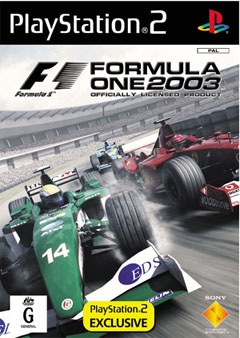
Similar to the FIFA series, Formula One 2003 has different cover art depending on the region. David Coulthard's McLaren MP4-17D is used on the European/Global release.[5] Fernando Alonso's Renault R23B was used on the Spanish release.[6] Michael Schumacher's Ferrari F2003-GA is moved from the second car to the leading car for the Italian release.[7] Heinz-Harald Frentzen's Sauber C22 is featured on the Swiss and Dutch releases.[8] Mark Webber's Jaguar R4 is used on the Australian edition.[9]
Reception
Formula One 2003 gained mixed to positive reviews upon release, holding an aggregate score of 67.20% on GameRankings.[10]
Kristan Reed of Eurogamer praised the controls and the graphics, stating that "every track is packed with detail, down to the individual trackside adverts, yet there is never any hint of pop up or the kind of draw distance issues that have blighted just about every F1 game ever made".[11] He did however have reservations about the game's car damage and crash physics. He gave the game 8 out of 10.[11] Brodie Gibbons of Futuregamez also praised the graphics but criticised the sound and replay value, scoring the game 77%.[12] Writing in The Guardian , Jack Schofield noted that the game did not offer a large improvement over its predecessor outside the rule changes, but concluded that it "offers more than enough to keep casual gamers happy".[2]
References
- ↑ 1.0 1.1 1.2 "Formula One 2003". Official Playstation website. https://uk.playstation.com/ps2/games/detail/item35042/Formula-One-2003/.
- ↑ 2.0 2.1 Schofield, Jack (12 August 2003). "Formula One 2003". The Guardian. https://www.theguardian.com/sport/2003/aug/12/thegear.formulaone2003.
- ↑ 3.0 3.1 3.2 Calvert, Justin (16 June 2003). "Sony announces Formula One 2003". Gamespot. http://uk.gamespot.com/news/sony-announces-formula-one-2003-6030084.
- ↑ Bramwell, Tom (17 June 2003). "Formula One 2003 due out in July". http://www.eurogamer.net/articles/news170603f12003.
- ↑ "Formula one 2003 Box Shot for Playstation 2". Gamefaqs. 11 July 2003. http://www.gamefaqs.com/ps2/915239-formula-one-2003/images/box-25704.
- ↑ "Formula One 2003 Front Cover". neoseeker. 11 July 2003. http://img.neoseeker.com/boxview.php?iid=11578&eid=30959&type=front.
- ↑ "Formula One 2003 (2003) Playstation 2 Box Cover Art". Moby Games. 11 July 2003. http://www.mobygames.com/game/ps2/formula-one-2003/cover-art/gameCoverId,30505/.
- ↑ "Formula One 2003 (2003) Playstation 2 Box Cover Art". Moby Games. 11 July 2003. http://www.mobygames.com/game/ps2/formula-one-2003/cover-art/gameCoverId,201899/.
- ↑ "F1 2003 PS2 review". Impulse gamer. 11 July 2003. http://www.impulsegamer.com/igversion01/ps2/formulaone2003cover.jpg.
- ↑ "Formula One 2003". GameRankings. CBS Interactive. http://www.gamerankings.com/ps2/915239-formula-one-2003/index.html.
- ↑ 11.0 11.1 Reed, Kristan (9 July 2003). "Formula One 2003 Review". Eurogamer. http://www.eurogamer.net/articles/r_formulaone2003_ps2.
- ↑ Gibbons, Brodie (30 September 2004). "Formula One 2003 - Review". Futuregamez. http://www.futuregamez.net/ps2games/f12003/review.html.
External links
- MobyGames is a commercial database website that catalogs information on video games and the people and companies behind them via crowdsourcing. This includes over 300,000 games for hundreds of platforms.[1] Founded in 1999, ownership of the site has changed hands several times. It has been owned by Atari SA since 2022.
Features
Edits and submissions to the site (including screenshots, box art, developer information, game summaries, and more) go through a verification process of fact-checking by volunteer "approvers".[2] This approval process after submission can range from minutes to days or months.[3] The most commonly used sources are the video game's website, packaging, and credit screens. There is a published standard for game information and copy-editing.[4] A ranking system allows users to earn points for contributing accurate information.[5]
Registered users can rate and review games. Users can create private or public "have" and "want" lists, which can generate a list of games available for trade with other registered users. The site contains an integrated forum. Each listed game can have its own sub-forum.
History

MobyGames was founded on March 1, 1999, by Jim Leonard and Brian Hirt, and joined by David Berk 18 months later, the three of which had been friends since high school.[6][7] Leonard had the idea of sharing information about computer games with a larger audience. The database began with information about games for IBM PC compatibles, relying on the founders' personal collections. Eventually, the site was opened up to allow general users to contribute information.[5] In a 2003 interview, Berk emphasized MobyGames' dedication to taking video games more seriously than broader society and to preserving games for their important cultural influence.[5]
In mid-2010, MobyGames was purchased by GameFly for an undisclosed amount.[8] This was announced to the community post factum , and the site's interface was given an unpopular redesign.[7] A few major contributors left, refusing to do volunteer work for a commercial website.{{Citation needed|date=June 2025} On December 18, 2013, MobyGames was acquired by Jeremiah Freyholtz, owner of Blue Flame Labs (a San Francisco-based game and web development company) and VGBoxArt (a site for fan-made video game box art).[9] Blue Flame Labs reverted MobyGames' interface to its pre-overhaul look and feel,[10] and for the next eight years, the site was run by Freyholtz and Independent Games Festival organizer Simon Carless.[7]
On November 24, 2021, Atari SA announced a potential deal with Blue Flame Labs to purchase MobyGames for $1.5 million.[11] The purchase was completed on 8 March 2022, with Freyholtz remaining as general manager.[12][13][14] Over the next year, the financial boost given by Atari led to a rework of the site being built from scratch with a new backend codebase, as well as updates improving the mobile and desktop user interface.[1] This was accomplished by investing in full-time development of the site instead of its previously part-time development.[15]
In 2024, MobyGames began offering a paid "Pro" membership option for the site to generate additional revenue.[16] Previously, the site had generated income exclusively through banner ads and (from March 2014 onward) a small number of patrons via the Patreon website.[17]
On February 13, 2025, Freyholtz stepped down as the site lead to move onto new projects, leaving operations to Tracy Poff, a veteran coder on the site, and Atari staff.[18]
See also
- IGDB – game database used by Twitch for its search and discovery functions
References
- ↑ 1.0 1.1 Sheehan, Gavin (2023-02-22). "Atari Relaunches The Fully Rebuilt & Optimized MobyGames Website". https://bleedingcool.com/games/atari-relaunches-the-fully-rebuilt-optimized-mobygames-website/.
- ↑ Litchfield, Ted (2021-11-26). "Zombie company Atari to devour MobyGames". https://www.pcgamer.com/zombie-company-atari-to-devour-mobygames/.
- ↑ "MobyGames FAQ: Emails Answered § When will my submission be approved?". Blue Flame Labs. 30 March 2014. http://www.mobygames.com/info/faq7#g1.
- ↑ "The MobyGames Standards and Practices". Blue Flame Labs. 6 January 2016. http://www.mobygames.com/info/standards.
- ↑ 5.0 5.1 5.2 Miller, Stanley A. (2003-04-22). "People's choice awards honor favorite Web sites". Milwaukee Journal Sentinel.
- ↑ "20 Years of MobyGames" (in en). 2019-02-28. https://trixter.oldskool.org/2019/02/28/20-years-of-mobygames/.
- ↑ 7.0 7.1 7.2 Plunkett, Luke (2022-03-10). "Atari Buys MobyGames For $1.5 Million". https://kotaku.com/mobygames-retro-credits-database-imdb-atari-freyholtz-b-1848638521.
- ↑ "Report: MobyGames Acquired By GameFly Media". Gamasutra. 2011-02-07. https://www.gamedeveloper.com/game-platforms/report-mobygames-acquired-by-gamefly-media.
- ↑ Corriea, Alexa Ray (December 31, 2013). "MobyGames purchased from GameFly, improvements planned". http://www.polygon.com/2013/12/31/5261414/mobygames-purchased-from-gamefly-improvements-planned.
- ↑ Wawro, Alex (31 December 2013). "Game dev database MobyGames getting some TLC under new owner". Gamasutra. https://www.gamedeveloper.com/business/game-dev-database-mobygames-getting-some-tlc-under-new-owner.
- ↑ "Atari invests in Anstream, may buy MobyGames". November 24, 2021. https://www.gamesindustry.biz/articles/2021-11-24-atari-invests-in-anstream-may-buy-mobygames.
- ↑ Rousseau, Jeffrey (2022-03-09). "Atari purchases Moby Games". https://www.gamesindustry.biz/atari-purchases-moby-games.
- ↑ "Atari Completes MobyGames Acquisition, Details Plans for the Site's Continued Support". March 8, 2022. https://www.atari.com/atari-completes-mobygames-acquisition-details-plans-for-the-sites-continued-support/.
- ↑ "Atari has acquired game database MobyGames for $1.5 million" (in en-GB). 2022-03-09. https://www.videogameschronicle.com/news/atari-has-acquired-game-database-mobygames-for-1-5-million/.
- ↑ Stanton, Rich (2022-03-10). "Atari buys videogame database MobyGames for $1.5 million". https://www.pcgamer.com/atari-buys-videogame-database-mobygames-for-dollar15-million/.
- ↑ Harris, John (2024-03-09). "MobyGames Offering “Pro” Membership". https://setsideb.com/mobygames-offering-pro-membership/.
- ↑ "MobyGames on Patreon". http://www.patreon.com/mobygames.
- ↑ "An update on MobyGames leadership". 2025-02-13. https://www.mobygames.com/forum/3/thread/269628/an-update-on-mobygames-leadership/#post-269628.
 |
Wikidata has the property:
|

External links
- No URL found. Please specify a URL here or add one to Wikidata.

 |  |
| |
 EncycloReader
is supported by the
EncycloReader
is supported by the  KSF
KSF