Table of Contents Categories
Grand Slam (video game)
Topic: Software
 From HandWiki - Reading time: 8 min
| Grand Slam | |
|---|---|
 Cover art featuring Jeff Bagwell and Scott Servais | |
| Developer(s) | Burst Studios |
| Publisher(s) | Virgin Interactive Entertainment |
| Platform(s) | PlayStation, Sega Saturn, Microsoft Windows |
| Release | Saturn
|
| Genre(s) | Sports video game |
| Mode(s) | Single-player video game, multiplayer video game |
Grand Slam is a baseball video game developed by Burst Studios and published by Virgin Interactive Entertainment for the Sony PlayStation, Sega Saturn, and Microsoft Windows in 1997.
Grand Slam was met with mixed reviews, and any possibility of a sequel was eliminated when Virgin reconfigured to publish only PC games early in 1998.[1]
Gameplay
Grand Slam is a baseball video game that includes both a pitching meter and a power meter.[2]
Reception
| Reception | |||||||||||||||||||||||||||||||||||||||||||||||||||
|---|---|---|---|---|---|---|---|---|---|---|---|---|---|---|---|---|---|---|---|---|---|---|---|---|---|---|---|---|---|---|---|---|---|---|---|---|---|---|---|---|---|---|---|---|---|---|---|---|---|---|---|
| |||||||||||||||||||||||||||||||||||||||||||||||||||


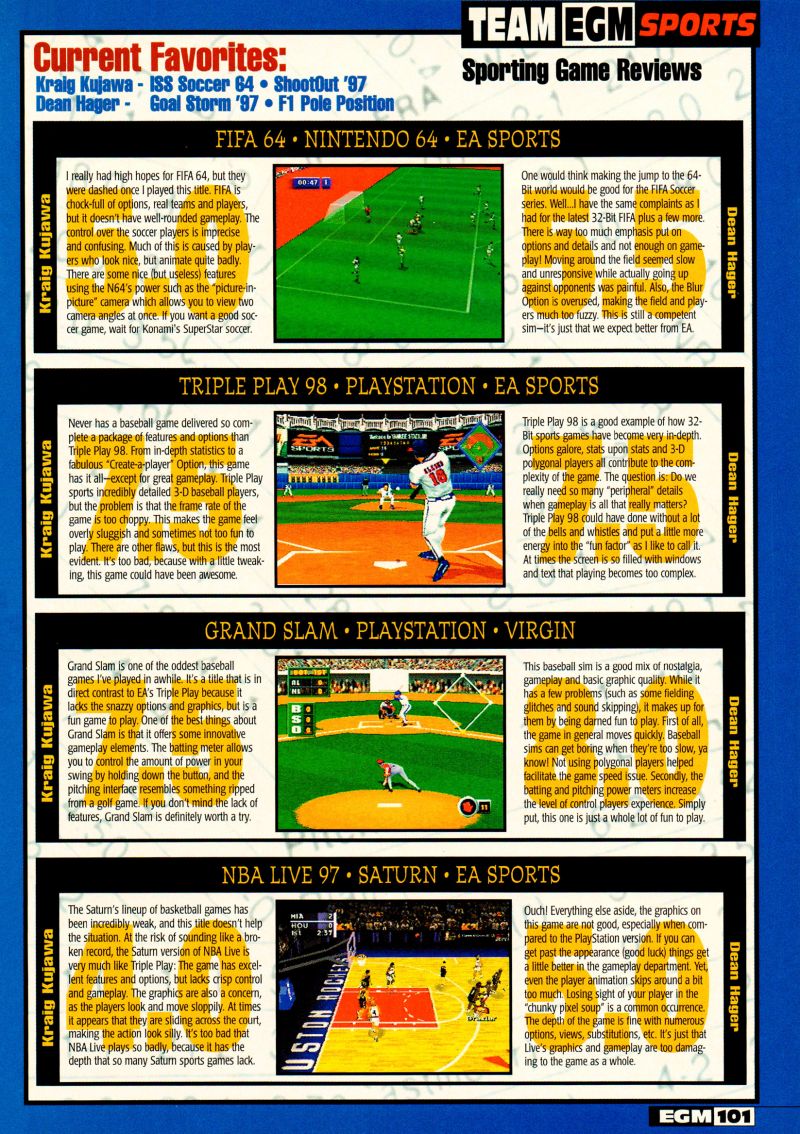
Grand Slam received mostly mixed reviews. Critics agreed that the pitching and batting controls, while obviously derived from golf video games, are innovative and add a new depth of control to the baseball genre.[11][2][14] However, they lambasted the graphics and animation, often describing them as reminiscent of the 16-bit era.[11][2][14] Next Generation concluded that "Grand Slam has all the features and options in place, but ultimately can't make up for substandard graphics and slow pace."[2] Other reactions to the selection of features and options were mixed; Darren Lerhman of GameSpot and GamePro both found that though they were generally ample, the absence of create-a-player and team licenses stood out, since most of the game's competitors included these features.[11][14] Lerhman nonetheless judged that "It may not have the team licenses, fifty years worth of statistics, or incredible graphics, but it is indeed fun (and it does have real MLB players). Suffice to say baseball fanatics will be disappointed by this title, but casual sports fans looking for an enjoyable baseball sim may find themselves willing to overlook these shortcomings."[11] GamePro's assessment was similar but more dismal: "... if you can overlook the game's faults, you'll have a pretty good time playing. But with an extraordinary game like Triple Play 98 on the market, why settle for anything less?"[14][lower-alpha 2]
Notes
References
- ↑ Air Hendrix (April 1998). "Scouting Report". GamePro (IDG) (115): 86. "Finally, Virgin's decided to publish only PC games, so Grand Slam 2 isn't even a possibility.".
- ↑ 2.0 2.1 2.2 2.3 2.4 "Grand Slam (PS)". Next Generation (Imagine Media) (31): 157–58. July 1997. https://archive.org/details/NEXT_Generation_31/page/n161/mode/2up. Retrieved July 24, 2021.
- ↑ Marriott, Scott Alan. "Grand Slam (PS) - Review". All Media Network. http://www.allgame.com/game.php?id=7861&tab=review.
- ↑ Brumley, Doug (June 12, 1997). "Grand Slam (PC)". CNET. http://www.gamecenter.com/Reviews/Item/0,6,0-918,00.html.
- ↑ Bauman, Steve (1997). "Grand Slam". Strategy Plus, Inc.. http://www.cdmag.com/articles/002/154/grand_slam_review.html.
- ↑ McCauley, Dennis (October 1997). "A Real Slam (Grand Slam Review)". Computer Gaming World (Ziff Davis) (159): 228. http://www.cgwmuseum.org/galleries/issues/cgw_159.pdf. Retrieved July 24, 2021.
- ↑ Kujawa, Kraig; Hager, Dean (June 1997). "Grand Slam". Electronic Gaming Monthly (Ziff Davis) (95): 101. https://www.nintendo64ever.com/scans/mags/Scan-Magazine-1955-101.jpg. Retrieved July 24, 2021.
- ↑ 8.0 8.1 "Grand Slam Baseball [sic (PS, Saturn)"]. Game Informer (FuncoLand) (50). June 1997. http://www.gameinformer.com/june97/slam.html. Retrieved July 24, 2021.
- ↑ Joe Kidd (June 1997). "GrandSlam Baseball [sic (PS)"]. GameFan (Metropolis Media) 5 (6): 80. https://archive.org/details/Gamefan_Vol_5_Issue_06/page/n81/mode/2up. Retrieved July 24, 2021.
- ↑ Kaiafas, Tasos (September 27, 1997). "Grand Slam Review (PC) [date mislabeled as "May 1, 2000""]. CBS Interactive. https://www.gamespot.com/reviews/grand-slam-review/1900-2536277/.
- ↑ 11.0 11.1 11.2 11.3 11.4 Lerhman, Darren (May 8, 1997). "Grand Slam 97 [sic Review (PS) [date mislabeled as "April 28, 2000"]"]. CBS Interactive. https://www.gamespot.com/reviews/grand-slam-97-review/1900-2547797/.
- ↑ PSX staff (May 13, 1997). "Grand Slam (PS)". Ziff Davis. https://www.ign.com/articles/1997/05/14/grand-slam.
- ↑ Novicki, Joe (September 1997). "Grand Slam". PC Gamer (Imagine Media) 4 (9). http://www.pcgamer.com/reviews/497.html. Retrieved July 24, 2021.
- ↑ 14.0 14.1 14.2 14.3 Johnny Ballgame (June 1997). "A Long Out Is Still Just an Out". GamePro (IDG) (105): 85. https://archive.org/details/GamePro_Issue_105_Volume_09_Number_06_1997-06_IDG_Publishing_US/page/n85/mode/2up. Retrieved July 24, 2021.
External links
- Official website
- MobyGames is a commercial database website that catalogs information on video games and the people and companies behind them via crowdsourcing. This includes over 300,000 games for hundreds of platforms.[1] Founded in 1999, ownership of the site has changed hands several times. It has been owned by Atari SA since 2022.
Features
Edits and submissions to the site (including screenshots, box art, developer information, game summaries, and more) go through a verification process of fact-checking by volunteer "approvers".[2] This approval process after submission can range from minutes to days or months.[3] The most commonly used sources are the video game's website, packaging, and credit screens. There is a published standard for game information and copy-editing.[4] A ranking system allows users to earn points for contributing accurate information.[5]
Registered users can rate and review games. Users can create private or public "have" and "want" lists, which can generate a list of games available for trade with other registered users. The site contains an integrated forum. Each listed game can have its own sub-forum.
History

MobyGames was founded on March 1, 1999, by Jim Leonard and Brian Hirt, and joined by David Berk 18 months later, the three of which had been friends since high school.[6][7] Leonard had the idea of sharing information about computer games with a larger audience. The database began with information about games for IBM PC compatibles, relying on the founders' personal collections. Eventually, the site was opened up to allow general users to contribute information.[5] In a 2003 interview, Berk emphasized MobyGames' dedication to taking video games more seriously than broader society and to preserving games for their important cultural influence.[5]
In mid-2010, MobyGames was purchased by GameFly for an undisclosed amount.[8] This was announced to the community post factum , and the site's interface was given an unpopular redesign.[7] A few major contributors left, refusing to do volunteer work for a commercial website.{{Citation needed|date=June 2025} On December 18, 2013, MobyGames was acquired by Jeremiah Freyholtz, owner of Blue Flame Labs (a San Francisco-based game and web development company) and VGBoxArt (a site for fan-made video game box art).[9] Blue Flame Labs reverted MobyGames' interface to its pre-overhaul look and feel,[10] and for the next eight years, the site was run by Freyholtz and Independent Games Festival organizer Simon Carless.[7]
On November 24, 2021, Atari SA announced a potential deal with Blue Flame Labs to purchase MobyGames for $1.5 million.[11] The purchase was completed on 8 March 2022, with Freyholtz remaining as general manager.[12][13][14] Over the next year, the financial boost given by Atari led to a rework of the site being built from scratch with a new backend codebase, as well as updates improving the mobile and desktop user interface.[1] This was accomplished by investing in full-time development of the site instead of its previously part-time development.[15]
In 2024, MobyGames began offering a paid "Pro" membership option for the site to generate additional revenue.[16] Previously, the site had generated income exclusively through banner ads and (from March 2014 onward) a small number of patrons via the Patreon website.[17]
On February 13, 2025, Freyholtz stepped down as the site lead to move onto new projects, leaving operations to Tracy Poff, a veteran coder on the site, and Atari staff.[18]
See also
- IGDB – game database used by Twitch for its search and discovery functions
References
- ↑ 1.0 1.1 Sheehan, Gavin (2023-02-22). "Atari Relaunches The Fully Rebuilt & Optimized MobyGames Website". https://bleedingcool.com/games/atari-relaunches-the-fully-rebuilt-optimized-mobygames-website/.
- ↑ Litchfield, Ted (2021-11-26). "Zombie company Atari to devour MobyGames". https://www.pcgamer.com/zombie-company-atari-to-devour-mobygames/.
- ↑ "MobyGames FAQ: Emails Answered § When will my submission be approved?". Blue Flame Labs. 30 March 2014. http://www.mobygames.com/info/faq7#g1.
- ↑ "The MobyGames Standards and Practices". Blue Flame Labs. 6 January 2016. http://www.mobygames.com/info/standards.
- ↑ 5.0 5.1 5.2 Miller, Stanley A. (2003-04-22). "People's choice awards honor favorite Web sites". Milwaukee Journal Sentinel.
- ↑ "20 Years of MobyGames" (in en). 2019-02-28. https://trixter.oldskool.org/2019/02/28/20-years-of-mobygames/.
- ↑ 7.0 7.1 7.2 Plunkett, Luke (2022-03-10). "Atari Buys MobyGames For $1.5 Million". https://kotaku.com/mobygames-retro-credits-database-imdb-atari-freyholtz-b-1848638521.
- ↑ "Report: MobyGames Acquired By GameFly Media". Gamasutra. 2011-02-07. https://www.gamedeveloper.com/game-platforms/report-mobygames-acquired-by-gamefly-media.
- ↑ Corriea, Alexa Ray (December 31, 2013). "MobyGames purchased from GameFly, improvements planned". http://www.polygon.com/2013/12/31/5261414/mobygames-purchased-from-gamefly-improvements-planned.
- ↑ Wawro, Alex (31 December 2013). "Game dev database MobyGames getting some TLC under new owner". Gamasutra. https://www.gamedeveloper.com/business/game-dev-database-mobygames-getting-some-tlc-under-new-owner.
- ↑ "Atari invests in Anstream, may buy MobyGames". November 24, 2021. https://www.gamesindustry.biz/articles/2021-11-24-atari-invests-in-anstream-may-buy-mobygames.
- ↑ Rousseau, Jeffrey (2022-03-09). "Atari purchases Moby Games". https://www.gamesindustry.biz/atari-purchases-moby-games.
- ↑ "Atari Completes MobyGames Acquisition, Details Plans for the Site's Continued Support". March 8, 2022. https://www.atari.com/atari-completes-mobygames-acquisition-details-plans-for-the-sites-continued-support/.
- ↑ "Atari has acquired game database MobyGames for $1.5 million" (in en-GB). 2022-03-09. https://www.videogameschronicle.com/news/atari-has-acquired-game-database-mobygames-for-1-5-million/.
- ↑ Stanton, Rich (2022-03-10). "Atari buys videogame database MobyGames for $1.5 million". https://www.pcgamer.com/atari-buys-videogame-database-mobygames-for-dollar15-million/.
- ↑ Harris, John (2024-03-09). "MobyGames Offering “Pro” Membership". https://setsideb.com/mobygames-offering-pro-membership/.
- ↑ "MobyGames on Patreon". http://www.patreon.com/mobygames.
- ↑ "An update on MobyGames leadership". 2025-02-13. https://www.mobygames.com/forum/3/thread/269628/an-update-on-mobygames-leadership/#post-269628.
 |
Wikidata has the property:
|

External links
- No URL found. Please specify a URL here or add one to Wikidata.

 |  |
| |
 EncycloReader
is supported by the
EncycloReader
is supported by the  KSF
KSF