Table of Contents Categories
Guardian War
Topic: Software
 From HandWiki - Reading time: 10 min
| Guardian War | |
|---|---|
 | |
| Developer(s) | Microcabin |
| Publisher(s) | Matsushita Electric Corporation of America |
| Designer(s) | Masashi Kato Kenzo Furuya Shinji Ishikawa |
| Composer(s) | Yasufumi Fukuda Yukiharu Urita |
| Platform(s) | 3DO |
| Release | |
| Genre(s) | Tactical role-playing game |
| Mode(s) | Single player |
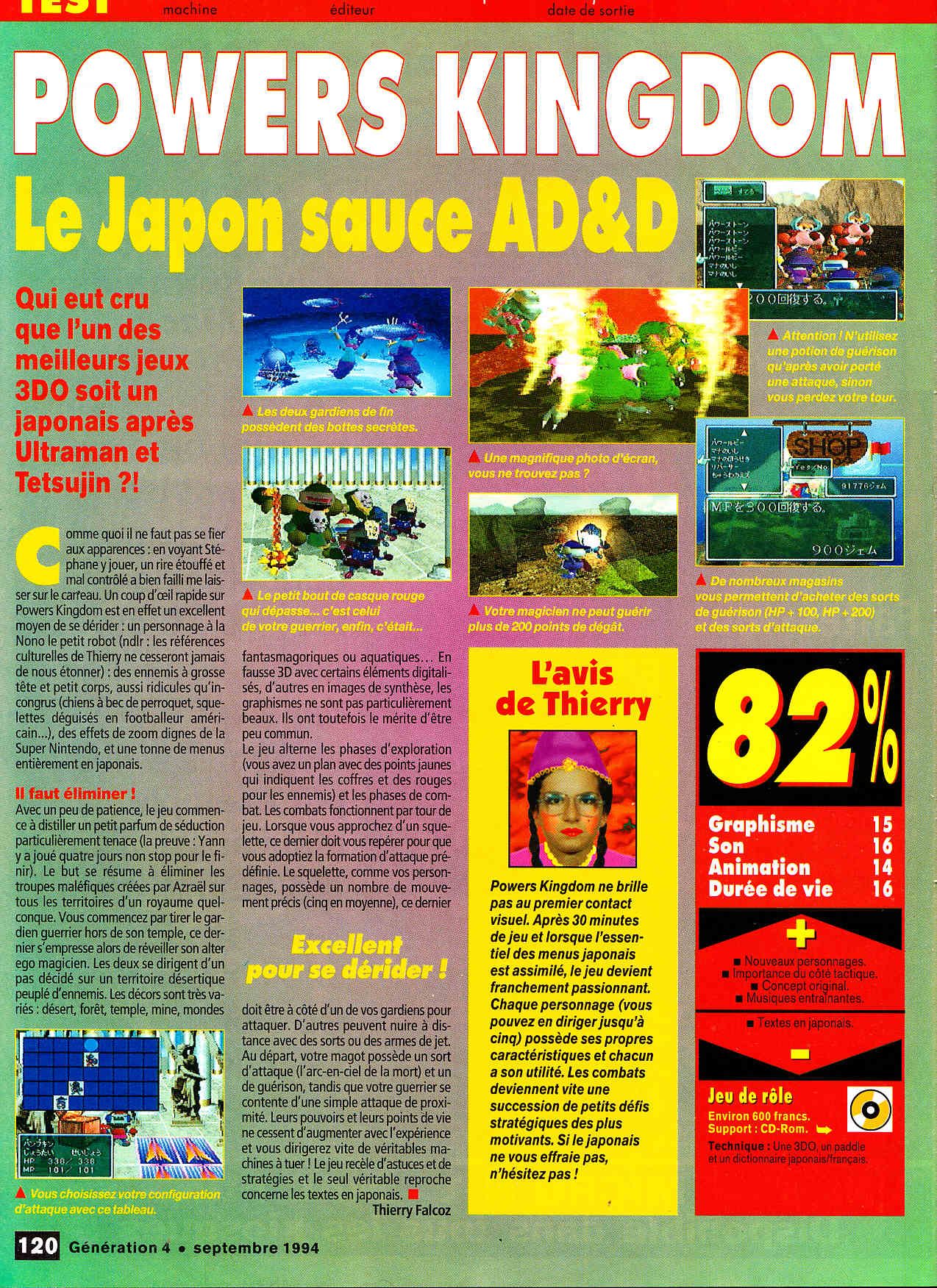
Guardian War is a console RPG or tactical role-playing game released for the 3DO console. It is notable for its use of 3-D animation which was uncommon for console RPGs at the time. It is also known as Powers Kingdom (パワーズキングダム, Pawazu Kingudamu)[3] in Japan and Europe, and is one of the few 3DO games which is region-protected.[4] This only applies to the PAL game and console. Both NTSC versions can play on both US and JP consoles.
Gameplay
_-_World_Map.png)
_-_Battle.png)
Bottom: A battle taking place.
The player moves a party around a world map consisting of distinct nodes. Most nodes are hostile territory (called fields in the game), very much like in Final Fantasy Tactics. When the party enters hostile territory, the party moves around as a single character in an over-the-shoulder perspective until they come in range of an enemy. The party then moves into a battle formation that the player designs beforehand. Unlike most console RPGs, the game does not cut to a separate screen or location for battles. Attacks have various ranges and area of effects. Turns are defined on a unit-by-unit basis, similarly to Shining Force: The Legacy of Great Intention. To advance past a hostile territory, the player must defeat all the enemies in that territory. Some side territories (called fields in the game) cannot be cleared and can be used to continue leveling characters. The player may also leave a territory any time that the party is not engaging an enemy, in which case all enemies will have respawned when the party returns to that territory.
Each shrine node houses an additional golem, which will immediately awaken and join the party if they enter the shrine. There are also shop nodes where the player can sell and buy items and equipment.
Additional golem bodies (character classes) can be applied to each character. Each character can carry up to three bodies. The primary slot determines the character's appearance, stats, equipable items, and ability to navigate specific terrains, and class experience gained from killing monsters is applied only to the body in that character's primary slot. However, the character may use the skills of secondary and tertiary bodies as long as that character has sufficient magic points. Accumulated class experience allows the character to eventually promote that body to a more powerful class. Certain skills can only be used when two characters with compatible skills combine them.
Some items allow the party to try to persuade an enemy to join the party. If they are successful, the enemy joins the party and will gain experience points when killing monsters, but remains under AI control. The game finishes when all members of the active party have been killed, or when the player has conquered all hostile territories.
Synopsis
The player controls a golem who was awakened by the Goddess Erald which is fighting against Azrael, the Evil Lord.
Reception
| Reception | ||||||||||||||||||||||
|---|---|---|---|---|---|---|---|---|---|---|---|---|---|---|---|---|---|---|---|---|---|---|
| ||||||||||||||||||||||
| ||||||||||||||||||||||


Guardian War received two awards in GameFan's 1994 "Megawards", including Best Strategy Game and Best Special Effects on the 3DO.[14]
GamePro's Leonardo da Video declared Guardian War "one of the most original, enjoyable, and addictive RPG/strategy games to come along in a while". He remarked that the system of party members changing bodies and carrying along sub-bodies is highly unique yet easy to adjust to due to the "simple and virtually self-explanatory" interface, and highly praised the graphics, especially the spell casting effects.[7]
Electronic Gaming Monthly scored it 7.75 out of 10, and ranked it as one of their 50 highest-rated games of 1994.[6][15]
Game Bytes gave the game a positive review in 1994.[16]
Next Generation gave three stars out of five to the game.[8]
References
- ↑ "Fact File Guardian War". Electronic Gaming Monthly (Ziff Davis) (63): 212. October 1994.
- ↑ "Guardian War for 3DO – GameFAQs". http://www.gamefaqs.com/console/3do/data/584396.html.
- ↑ 3.0 3.1 "作品紹介|マイクロキャビン". http://www.microcabin.co.jp:80/sakuhin_intro/index3.html.
- ↑ Matthews, Will (December 2013). "Ahead of its Time: A 3DO Retrospective". Retro Gamer (Imagine Publishing) (122): 18–29.
- ↑ Sackenheim, Shawn (1998). "Guardian War – Review". AllGame. All Media Network. http://www.allgame.com/game.php?id=2387&tab=review.
- ↑ 6.0 6.1 Semrad, Ed; Carpenter, Danyon; Manuel, Al; Williams, Ken; Weigand, Mike (November 1994). "Review Crew: Major Mike's Game Roundup – Guardian War". Electronic Gaming Monthly (Sendai Publishing) (64): 44. https://archive.org/stream/Electronic_Gaming_Monthly_64#page/n43/mode/1up.
- ↑ 7.0 7.1 da Video, Leonardo (January 1995). "Role-Player's Realm: Guardian War". GamePro (IDG) (76): 126–127. https://retrocdn.net/index.php?title=File:GamePro_US_066.pdf&page=144.
- ↑ 8.0 8.1 "Finals – Hollow – Guardian War". Next Generation (Imagine Media) (2): 91. February 1995. https://archive.org/stream/NEXT_Generation_02#page/n92/mode/1up.
- ↑ Wynne, Stuart (1995–1996). "Review: Powers Kingdom – Bizarre, spectacular and very different, this combative role-playing game provides a unique insight into Japanese gaming". 3DO Magazine (Paragon Publishing) (1): 77. https://archive.org/stream/3-do-gold-01#page/77/mode/1up.
- ↑ Falcoz, Thierry (September 1994). "Test: Powers Kingdom – Le Japon sauce AD&D". Génération 4 (Computec Media France) (69): 120. http://download.abandonware.org/magazines/Generation%204/generation4_numero069/G%C3%A9n%C3%A9ration4%20069%20-%20Page%20120%20%281994-09%29.jpg.
- ↑ Pinky (November 1994). "Vidéotests: Powers Kingdom – Un soft atypique". Joystick (54): 75. http://download.abandonware.org/magazines/Joystick/joystick_numero054/Joystick%20054%20-%20Page%20075%20%28novembre%201994%29.jpg.
- ↑ Hara, Tetsuhiko (April 1995). "Real 3DO – Reviews: Powers Kingdom". Video Games (Future-Verlag) (41): 77. https://retrocdn.net/index.php?title=File%3AVideoGames_DE_1995-04.pdf&page=75.
- ↑ "Capsule Reviews: Guardian War". VideoGames - The Ultimate Gaming Magazine (Larry Flynt Publications) (72): 83. January 1995. https://archive.org/stream/Video_Games_The_Ultimate_Gaming_Magazine_Issue_72_January_1995#page/n82/mode/1up.
- ↑ 14.0 14.1 "GameFan's Third Annual Megawards". GameFan (DieHard Gamers Club) 3 (1): 68–75. January 1995. https://archive.org/stream/Gamefan_Vol_3_Issue_01#page/n73/mode/1up. Retrieved 2018-04-12.
- ↑ 15.0 15.1 "The EGM Hot 50 – Guardian War". Electronic Gaming Monthly (Sendai Publishing) (69): 44–48. April 1995. http://www.megalextoria.com/magazines/index.php?twg_album=Video_Game_Magazines%2FElectronic_Gaming_Monthly%2Fegm_1995-04&twg_show=electronic_gaming_monthly_069_-_1995_apr_048.jpg.
- ↑ Garrett, Bill (11 November 1994). "Cartridge Game Reviews – Guardian War". Game Bytes (Ross Erickson) 1 (21). http://www.ibiblio.org/GameBytes/issue21/creviews/guardian.html. Retrieved 2020-05-24.
External links
- MobyGames is a commercial database website that catalogs information on video games and the people and companies behind them via crowdsourcing. This includes over 300,000 games for hundreds of platforms.[1] Founded in 1999, ownership of the site has changed hands several times. It has been owned by Atari SA since 2022.
Features
Edits and submissions to the site (including screenshots, box art, developer information, game summaries, and more) go through a verification process of fact-checking by volunteer "approvers".[2] This approval process after submission can range from minutes to days or months.[3] The most commonly used sources are the video game's website, packaging, and credit screens. There is a published standard for game information and copy-editing.[4] A ranking system allows users to earn points for contributing accurate information.[5]
Registered users can rate and review games. Users can create private or public "have" and "want" lists, which can generate a list of games available for trade with other registered users. The site contains an integrated forum. Each listed game can have its own sub-forum.
History

MobyGames was founded on March 1, 1999, by Jim Leonard and Brian Hirt, and joined by David Berk 18 months later, the three of which had been friends since high school.[6][7] Leonard had the idea of sharing information about computer games with a larger audience. The database began with information about games for IBM PC compatibles, relying on the founders' personal collections. Eventually, the site was opened up to allow general users to contribute information.[5] In a 2003 interview, Berk emphasized MobyGames' dedication to taking video games more seriously than broader society and to preserving games for their important cultural influence.[5]
In mid-2010, MobyGames was purchased by GameFly for an undisclosed amount.[8] This was announced to the community post factum , and the site's interface was given an unpopular redesign.[7] A few major contributors left, refusing to do volunteer work for a commercial website.{{Citation needed|date=June 2025} On December 18, 2013, MobyGames was acquired by Jeremiah Freyholtz, owner of Blue Flame Labs (a San Francisco-based game and web development company) and VGBoxArt (a site for fan-made video game box art).[9] Blue Flame Labs reverted MobyGames' interface to its pre-overhaul look and feel,[10] and for the next eight years, the site was run by Freyholtz and Independent Games Festival organizer Simon Carless.[7]
On November 24, 2021, Atari SA announced a potential deal with Blue Flame Labs to purchase MobyGames for $1.5 million.[11] The purchase was completed on 8 March 2022, with Freyholtz remaining as general manager.[12][13][14] Over the next year, the financial boost given by Atari led to a rework of the site being built from scratch with a new backend codebase, as well as updates improving the mobile and desktop user interface.[1] This was accomplished by investing in full-time development of the site instead of its previously part-time development.[15]
In 2024, MobyGames began offering a paid "Pro" membership option for the site to generate additional revenue.[16] Previously, the site had generated income exclusively through banner ads and (from March 2014 onward) a small number of patrons via the Patreon website.[17]
On February 13, 2025, Freyholtz stepped down as the site lead to move onto new projects, leaving operations to Tracy Poff, a veteran coder on the site, and Atari staff.[18]
See also
- IGDB – game database used by Twitch for its search and discovery functions
References
- ↑ 1.0 1.1 Sheehan, Gavin (2023-02-22). "Atari Relaunches The Fully Rebuilt & Optimized MobyGames Website". https://bleedingcool.com/games/atari-relaunches-the-fully-rebuilt-optimized-mobygames-website/.
- ↑ Litchfield, Ted (2021-11-26). "Zombie company Atari to devour MobyGames". https://www.pcgamer.com/zombie-company-atari-to-devour-mobygames/.
- ↑ "MobyGames FAQ: Emails Answered § When will my submission be approved?". Blue Flame Labs. 30 March 2014. http://www.mobygames.com/info/faq7#g1.
- ↑ "The MobyGames Standards and Practices". Blue Flame Labs. 6 January 2016. http://www.mobygames.com/info/standards.
- ↑ 5.0 5.1 5.2 Miller, Stanley A. (2003-04-22). "People's choice awards honor favorite Web sites". Milwaukee Journal Sentinel.
- ↑ "20 Years of MobyGames" (in en). 2019-02-28. https://trixter.oldskool.org/2019/02/28/20-years-of-mobygames/.
- ↑ 7.0 7.1 7.2 Plunkett, Luke (2022-03-10). "Atari Buys MobyGames For $1.5 Million". https://kotaku.com/mobygames-retro-credits-database-imdb-atari-freyholtz-b-1848638521.
- ↑ "Report: MobyGames Acquired By GameFly Media". Gamasutra. 2011-02-07. https://www.gamedeveloper.com/game-platforms/report-mobygames-acquired-by-gamefly-media.
- ↑ Corriea, Alexa Ray (December 31, 2013). "MobyGames purchased from GameFly, improvements planned". http://www.polygon.com/2013/12/31/5261414/mobygames-purchased-from-gamefly-improvements-planned.
- ↑ Wawro, Alex (31 December 2013). "Game dev database MobyGames getting some TLC under new owner". Gamasutra. https://www.gamedeveloper.com/business/game-dev-database-mobygames-getting-some-tlc-under-new-owner.
- ↑ "Atari invests in Anstream, may buy MobyGames". November 24, 2021. https://www.gamesindustry.biz/articles/2021-11-24-atari-invests-in-anstream-may-buy-mobygames.
- ↑ Rousseau, Jeffrey (2022-03-09). "Atari purchases Moby Games". https://www.gamesindustry.biz/atari-purchases-moby-games.
- ↑ "Atari Completes MobyGames Acquisition, Details Plans for the Site's Continued Support". March 8, 2022. https://www.atari.com/atari-completes-mobygames-acquisition-details-plans-for-the-sites-continued-support/.
- ↑ "Atari has acquired game database MobyGames for $1.5 million" (in en-GB). 2022-03-09. https://www.videogameschronicle.com/news/atari-has-acquired-game-database-mobygames-for-1-5-million/.
- ↑ Stanton, Rich (2022-03-10). "Atari buys videogame database MobyGames for $1.5 million". https://www.pcgamer.com/atari-buys-videogame-database-mobygames-for-dollar15-million/.
- ↑ Harris, John (2024-03-09). "MobyGames Offering “Pro” Membership". https://setsideb.com/mobygames-offering-pro-membership/.
- ↑ "MobyGames on Patreon". http://www.patreon.com/mobygames.
- ↑ "An update on MobyGames leadership". 2025-02-13. https://www.mobygames.com/forum/3/thread/269628/an-update-on-mobygames-leadership/#post-269628.
 |
Wikidata has the property:
|

External links
- No URL found. Please specify a URL here or add one to Wikidata.



 |  |
| |
 EncycloReader
is supported by the
EncycloReader
is supported by the  KSF
KSF