Table of Contents Categories
Knife Edge
Topic: Software
 From HandWiki - Reading time: 10 min
| Knife Edge: Nose Gunner | |
|---|---|
 North American Nintendo 64 cover art | |
| Developer(s) | Kemco |
| Publisher(s) | Kemco |
| Platform(s) | Nintendo 64 |
| Release | |
| Genre(s) | 3D rail shooter |
| Mode(s) | Single-player, multiplayer |
Knife Edge: Nose Gunner[lower-alpha 1], known in Europe as Knife Edge, is a 1998 3D rail shooter game developed and published by Kemco for Nintendo 64.
Plot
The game describes a "New Frontier Plan" announced by the United States at the end of the 20th century: an ambitious program to enable humans to migrate to Mars. The United States Congress approved an enormous budget for the National Aeronautics and Space Agency to initiate development of this program. Other technologically advanced countries also participated in the plan. Through an unprecedented cooperative effort, the New Frontier Plan members had built an orbiting space station; life on Mars would soon be a reality.
This plan for developing Mars was officially named the "Mars Frontier Project" (MFP). At the end of the 21st century, a domed structure called the "Plant" was built on Martian soil, and colonization finally began. The first wave of colonists applied themselves to terraforming the planet for human survival, adjusting the atmosphere and securing water resources.
Half a century passed. On Mars, the air was breathable, and oceans formed as the southern ice caps continued to melt. Trees and shrubs gradually flourished; Mars was evolving from a planet of red dust into a lush, green environment. At the beginning of the fifth emigration wave, MFP officials received an alarming report from the Martian colonists, saying that unknown lifeforms were coming to one of the colonies.
Upon receiving the reports, key government officials on Earth were alarmed. To protect the colonists, the United Nations established a military relay station on the Martian moon Phobos and built a military post on Mars itself. This was the opportunity that restless armed forces worldwide had been awaiting. One day troops patrolling an undeveloped part of Mars discovered ancient ruins with what appeared to be signs of alien life. A reconnaissance unit was immediately dispatched; they reported that the ruins were of a civilization destroyed around the 11th century, Earth time. One theory was that the restored atmosphere had awakened the previously dormant Martian creatures, who had been sighted in the area in the past.
Soon after this the trouble began. First, communications from one of the other colonies was suddenly cut off. Then, one after another, each of the other colonies as well as the military post lost all communication channels. An investigative party could leave immediately from Earth but would require several days to reach Mars. The United Nations therefore ordered a test squadron for a new type of experimental assault aircraft, stationed on Phobos, to investigate and eliminate the disturbances on Mars.
Soon after the squadron was airborne, transfer station monitors received the final communication from the military post on Mars: "Mayday! Mayday! What is that?! It's crawling on the surface… It's attacking!! Mayday, mayday!"
Characters
Michael Samson
(Second Lieutenant, American)
A young gunner sent to investigate the trouble on Mars. As the gunner, he rides in the automatically piloted experimental aircraft and blasts the enemy. Although he has an impulsive side, he burns with a sense of duty and will bravely stand up against the attacking enemy.
Gregory MacKenzie
(Wing Commander, British)
Samson's commanding officer who gives the player instructions and information from the relay station on the Martian moon, Phobos. A classic career British military member, he is calm and composed, and his subordinates unquestionably trust his judgement. While in active service, MacKenzie won fame for his bravery as the top pilot in the Royal Space Force.
Dr. Linx
(Exo-archeobiologist)
A noted scientist specializing in ancient alien theoretical biology. Linx was sent to the military post on Mars as an archeological researcher. She survived the enemy attack that destroyed her research colony. Because of this experience, Linx has valuable information about the enemy invader.
Gameplay
Knife Edge is for one to four players. The player, while moving between the locations of the game in the Knife Edge ship, controls a cursor that fires vulcan cannon bullets. When more than one player is playing each cursor is color-coded to distinguish them. As well as the regular gun, there is the option for a secondary weapon. Hints are provided by a commanding officer over the communication system.
Movement of the vehicle is clearly predetermined, but the player is given some ability to move in the form of the four C-buttons on the Nintendo 64 controller. When a button is depressed the ship will move slightly in the corresponding direction. This is used primarily to avoid obstacles and attacks.
Reception
| Reception | ||||||||||||||||||||||||||||||||
|---|---|---|---|---|---|---|---|---|---|---|---|---|---|---|---|---|---|---|---|---|---|---|---|---|---|---|---|---|---|---|---|---|
| ||||||||||||||||||||||||||||||||
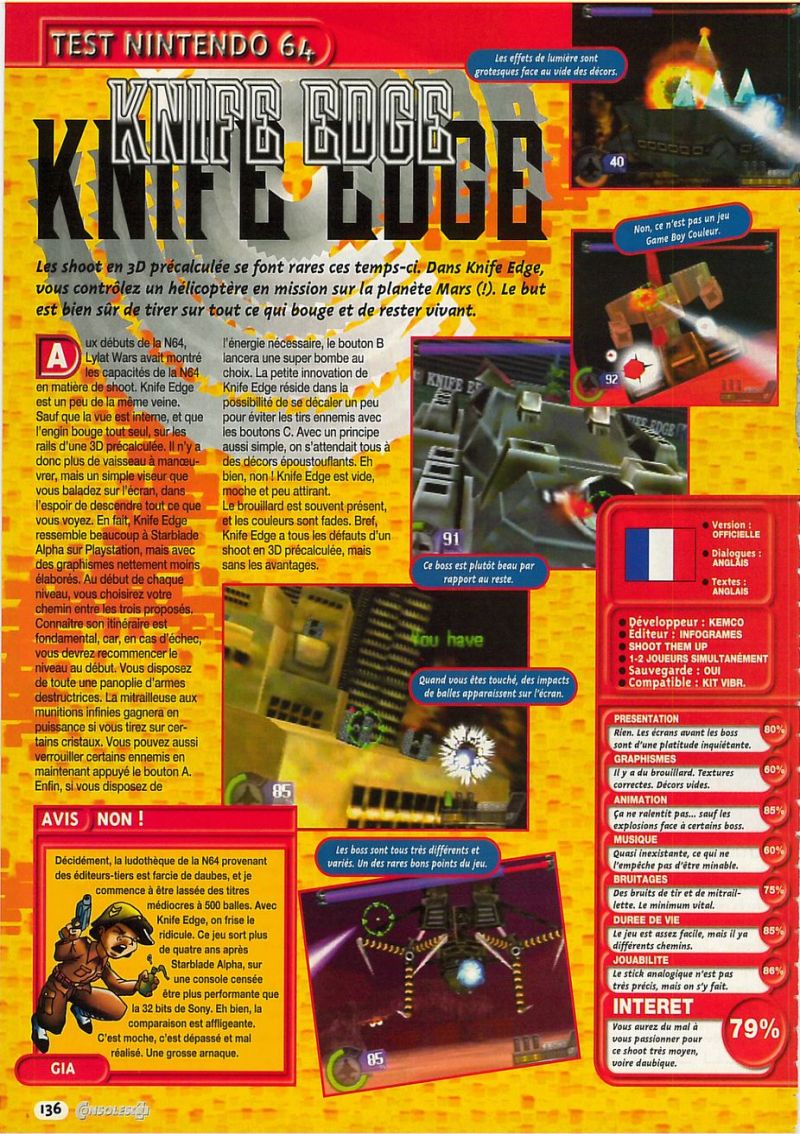
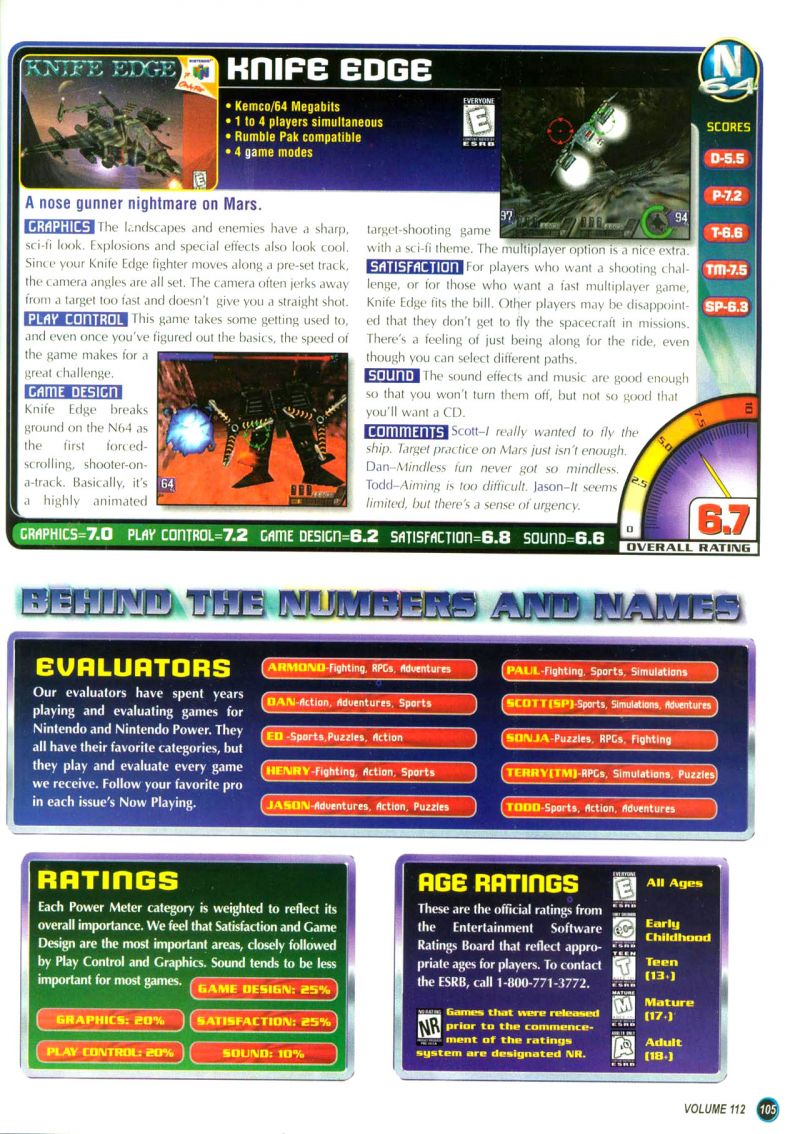
The game received mixed reviews according to the review aggregation website GameRankings.[1] Nintendo Power gave it a mixed review, months before it was released Stateside.[11] IGN criticized the presentation and the graphics of the game, stating that it was blurry, bland, boring and slow.[8] N64 Magazine dismissed it as "a light gun game without a light gun".[10] In Japan, Famitsu gave it a score of 22 out of 40.[4]
Notes
References
- ↑ 1.0 1.1 "Knife Edge: Nose Gunner for Nintendo 64". CBS Interactive. Archived from the original on May 12, 2019. https://web.archive.org/web/20190512180216/https://www.gamerankings.com/n64/197742-knife-edge-nose-gunner/index.html. Retrieved October 5, 2020.
- ↑ Gia (December 1998). "Knife Edge" (in French). Consoles + (83): 136. http://www.nintendo64ever.com/scans/mags/Scan-Magazine-232-136.jpg. Retrieved October 5, 2020.
- ↑ EGM staff (December 1998). "Knife Edge: Nose Gunner". Electronic Gaming Monthly (Ziff Davis) (113).
- ↑ 4.0 4.1 "ナイフエッジ 〜ノーズカンナー〜 [NINTENDO64"] (in Japanese). Famitsu (Enterbrain). https://www.famitsu.com/cominy/?m=pc&a=page_h_title&title_id=14544&redirect=no. Retrieved October 5, 2020.
- ↑ "Knife Edge [Nose Gunner]". Game Informer (FuncoLand) (67): 82. November 1998.
- ↑ Dr. Zombie (December 1998). "Knife Edge: Nose Gunner". GamePro (IDG Entertainment) (123): 154. https://archive.org/details/GamePro_Issue_113_December_1998/page/n157/mode/2up. Retrieved October 5, 2020.
- ↑ MacDonald, Ryan (December 29, 1998). "Knife Edge [Nose Gunner Review [date mislabeled as "April 28, 2000"]"]. CBS Interactive. Archived from the original on January 22, 2005. https://web.archive.org/web/20050122212909/http://www.gamespot.com/n64/action/knifeedge/review.html. Retrieved October 5, 2020.
- ↑ 8.0 8.1 Schneider, Peer (November 11, 1998). "Knife Edge: Nose Gunner Review". Ziff Davis. https://www.ign.com/articles/1998/11/12/knife-edge-nose-gunner. Retrieved October 5, 2020.
- ↑ lightman (February 6, 1999). "Test: Knife Edge" (in French). Webedia. https://www.jeuxvideo.com/articles/0000/00000212_test.htm. Retrieved October 5, 2020.
- ↑ 10.0 10.1 Ashton, James (January 1999). "Knife Edge". N64 Magazine (Future Publishing) (24): 71.
- ↑ 11.0 11.1 "Knife Edge [Nose Gunner"]. Nintendo Power (Nintendo of America) 112: 105. September 1998. http://www.nintendo64ever.com/scans/mags/Scan-Magazine-354-105.jpg. Retrieved October 5, 2020.
- ↑ "Knife Edge" (in de). Video Games. January 1999. https://archive.org/details/video-games-de-1999-01/page/84/mode/2up. Retrieved September 1, 2025.
External links
- MobyGames is a commercial database website that catalogs information on video games and the people and companies behind them via crowdsourcing. This includes over 300,000 games for hundreds of platforms.[1] Founded in 1999, ownership of the site has changed hands several times. It has been owned by Atari SA since 2022.
Features
Edits and submissions to the site (including screenshots, box art, developer information, game summaries, and more) go through a verification process of fact-checking by volunteer "approvers".[2] This approval process after submission can range from minutes to days or months.[3] The most commonly used sources are the video game's website, packaging, and credit screens. There is a published standard for game information and copy-editing.[4] A ranking system allows users to earn points for contributing accurate information.[5]
Registered users can rate and review games. Users can create private or public "have" and "want" lists, which can generate a list of games available for trade with other registered users. The site contains an integrated forum. Each listed game can have its own sub-forum.
History

MobyGames was founded on March 1, 1999, by Jim Leonard and Brian Hirt, and joined by David Berk 18 months later, the three of which had been friends since high school.[6][7] Leonard had the idea of sharing information about computer games with a larger audience. The database began with information about games for IBM PC compatibles, relying on the founders' personal collections. Eventually, the site was opened up to allow general users to contribute information.[5] In a 2003 interview, Berk emphasized MobyGames' dedication to taking video games more seriously than broader society and to preserving games for their important cultural influence.[5]
In mid-2010, MobyGames was purchased by GameFly for an undisclosed amount.[8] This was announced to the community post factum , and the site's interface was given an unpopular redesign.[7] A few major contributors left, refusing to do volunteer work for a commercial website.{{Citation needed|date=June 2025} On December 18, 2013, MobyGames was acquired by Jeremiah Freyholtz, owner of Blue Flame Labs (a San Francisco-based game and web development company) and VGBoxArt (a site for fan-made video game box art).[9] Blue Flame Labs reverted MobyGames' interface to its pre-overhaul look and feel,[10] and for the next eight years, the site was run by Freyholtz and Independent Games Festival organizer Simon Carless.[7]
On November 24, 2021, Atari SA announced a potential deal with Blue Flame Labs to purchase MobyGames for $1.5 million.[11] The purchase was completed on 8 March 2022, with Freyholtz remaining as general manager.[12][13][14] Over the next year, the financial boost given by Atari led to a rework of the site being built from scratch with a new backend codebase, as well as updates improving the mobile and desktop user interface.[1] This was accomplished by investing in full-time development of the site instead of its previously part-time development.[15]
In 2024, MobyGames began offering a paid "Pro" membership option for the site to generate additional revenue.[16] Previously, the site had generated income exclusively through banner ads and (from March 2014 onward) a small number of patrons via the Patreon website.[17]
On February 13, 2025, Freyholtz stepped down as the site lead to move onto new projects, leaving operations to Tracy Poff, a veteran coder on the site, and Atari staff.[18]
See also
- IGDB – game database used by Twitch for its search and discovery functions
References
- ↑ 1.0 1.1 Sheehan, Gavin (2023-02-22). "Atari Relaunches The Fully Rebuilt & Optimized MobyGames Website". https://bleedingcool.com/games/atari-relaunches-the-fully-rebuilt-optimized-mobygames-website/.
- ↑ Litchfield, Ted (2021-11-26). "Zombie company Atari to devour MobyGames". https://www.pcgamer.com/zombie-company-atari-to-devour-mobygames/.
- ↑ "MobyGames FAQ: Emails Answered § When will my submission be approved?". Blue Flame Labs. 30 March 2014. http://www.mobygames.com/info/faq7#g1.
- ↑ "The MobyGames Standards and Practices". Blue Flame Labs. 6 January 2016. http://www.mobygames.com/info/standards.
- ↑ 5.0 5.1 5.2 Miller, Stanley A. (2003-04-22). "People's choice awards honor favorite Web sites". Milwaukee Journal Sentinel.
- ↑ "20 Years of MobyGames" (in en). 2019-02-28. https://trixter.oldskool.org/2019/02/28/20-years-of-mobygames/.
- ↑ 7.0 7.1 7.2 Plunkett, Luke (2022-03-10). "Atari Buys MobyGames For $1.5 Million". https://kotaku.com/mobygames-retro-credits-database-imdb-atari-freyholtz-b-1848638521.
- ↑ "Report: MobyGames Acquired By GameFly Media". Gamasutra. 2011-02-07. https://www.gamedeveloper.com/game-platforms/report-mobygames-acquired-by-gamefly-media.
- ↑ Corriea, Alexa Ray (December 31, 2013). "MobyGames purchased from GameFly, improvements planned". http://www.polygon.com/2013/12/31/5261414/mobygames-purchased-from-gamefly-improvements-planned.
- ↑ Wawro, Alex (31 December 2013). "Game dev database MobyGames getting some TLC under new owner". Gamasutra. https://www.gamedeveloper.com/business/game-dev-database-mobygames-getting-some-tlc-under-new-owner.
- ↑ "Atari invests in Anstream, may buy MobyGames". November 24, 2021. https://www.gamesindustry.biz/articles/2021-11-24-atari-invests-in-anstream-may-buy-mobygames.
- ↑ Rousseau, Jeffrey (2022-03-09). "Atari purchases Moby Games". https://www.gamesindustry.biz/atari-purchases-moby-games.
- ↑ "Atari Completes MobyGames Acquisition, Details Plans for the Site's Continued Support". March 8, 2022. https://www.atari.com/atari-completes-mobygames-acquisition-details-plans-for-the-sites-continued-support/.
- ↑ "Atari has acquired game database MobyGames for $1.5 million" (in en-GB). 2022-03-09. https://www.videogameschronicle.com/news/atari-has-acquired-game-database-mobygames-for-1-5-million/.
- ↑ Stanton, Rich (2022-03-10). "Atari buys videogame database MobyGames for $1.5 million". https://www.pcgamer.com/atari-buys-videogame-database-mobygames-for-dollar15-million/.
- ↑ Harris, John (2024-03-09). "MobyGames Offering “Pro” Membership". https://setsideb.com/mobygames-offering-pro-membership/.
- ↑ "MobyGames on Patreon". http://www.patreon.com/mobygames.
- ↑ "An update on MobyGames leadership". 2025-02-13. https://www.mobygames.com/forum/3/thread/269628/an-update-on-mobygames-leadership/#post-269628.
 |
Wikidata has the property:
|

External links
- No URL found. Please specify a URL here or add one to Wikidata.

 |  |
| |
 EncycloReader
is supported by the
EncycloReader
is supported by the  KSF
KSF