Table of Contents Categories
NBA Showtime
Topic: Software
 From HandWiki - Reading time: 12 min
| NBA Showtime: NBA on NBC | |
|---|---|
 Arcade flyer | |
| Developer(s) | Midway Games[lower-alpha 1] Torus Games (GBC) |
| Publisher(s) | Midway Games |
| Programmer(s) | Mark Turmell |
| Artist(s) | Sal Divita |
| Composer(s) | John Hey |
| Platform(s) | Arcade, PlayStation, Dreamcast, Nintendo 64, Game Boy Color |
| Release | Arcade Dreamcast, Nintendo 64, PlayStation Game Boy Color |
| Genre(s) | Sports (basketball) |
| Mode(s) | Single-player, multiplayer |
NBA Showtime is a basketball arcade game released by Midway in 1999, featuring teams and players from the National Basketball Association (NBA). The game is modeled after the NBA presentations on NBC and takes its name from NBC's NBA pregame show. It is the successor to Midway's previous basketball titles NBA Hangtime and NBA Jam and is the first in the series to have fully 3-D polygonal graphics, featuring real uniforms for all teams. Showtime was also featured in a dual game cabinet along with NFL Blitz 2000 that Midway dubbed the "SportStation." Midway followed up the game with the console exclusive NBA Hoopz.
Gameplay
The game features gameplay similar to its predecessors NBA Jam and NBA Hangtime. Rather than typical 5 on 5 action, this game features 2-on-2 play with the ability to pick two players from any NBA team's starting line-up for the first half and can choose again for the second. The game introduces personal fouls for each shove on another player; after a certain number of fouls the opposing team gets a free throw. The game retains the series standard "on fire" feature. After a player makes three consecutive shots he becomes "on fire", which allows him to easily make shots from almost anywhere, as well as goaltend without penalty and push opponents without being charged a foul. Play otherwise is similar to NBA rules. The arcade version accommodates up to four players, as do the home versions produced for the Nintendo 64 and Dreamcast.
Development
Midway first hinted at the development of Showtime in the end credits to its previous basketball title, Maximum Hangtime, promising the next entry in the series would have a new "third dimension."
Early previews and screenshots of the game in publications such as GamePro and Tips & Tricks indicate that Midway originally intended for Showtime to be the first in the series to feature 3-on-3 gameplay.[5][6] In a 2002 interview conducted by Game Informer with Mark Turmell, Showtime's lead programmer, he noted that issues with slowdown and having the game run at 60 frames per second led to a decision to revert to a 2-on-2 structure for gameplay, prior to showing up in arcades.[7] Showtime's sequel, NBA Hoopz, would later become the first game in the series to implement 3-on-3 action.
Showtime utilized Midway's Vegas arcade hardware system, allowing the game to render 1,000,000 polygons per second at 60 frames per second of animation, roughly twice the graphical performance of the arcade version of Midway's NFL Blitz.[5] The game's player models and face textures were crafted in part using footage exclusively shot for the game by NBC in the lead up to its television coverage of the 1998–99 NBA season.[8] Lead artist Sal Divita's work on the game was achieved using 3D rendering software such as LightWave 3D, Wavefront and Film Box.[8]
The announcer from NBA Jam, Tim Kitzrow, returned, after Midway used the Bulls radio announcer Neil Funk in NBA Hangtime. Jon Hey produced all the sound, music and script save for the NBC basketball theme "Roundball Rock" by John Tesh. At the time, the music was influenced by 2Pac and Dr. Dre's "California Love" and Master P's "Make 'Em Say Uhh!" and previous NBA Themes written by Jon Hey for NBA Jam and NBA Hangtime.
As with the previous NBA Jam and NBA Hangtime games, the game contains many secret characters, including members of the Midway staff and 12 NBA mascots. The arcade version features the Universal Monsters Frankenstein's monster, Bride of Frankenstein, The Mummy, The Wolf Man and Creature from the Black Lagoon.[9] The Universal Monsters characters remained exclusive to the arcade version and were not available in any of the game's various home versions. Detroit Pistons legend Isiah Thomas is the only former NBA player included as a secret character in the game, across all versions. Dennis Rodman, a member of the Los Angeles Lakers' roster when the game initially shipped, was in later revisions alternately classified as a secret character, and as selectable from the roster of the Dallas Mavericks starting with version 3.0.[10]
The original arcade version shipped with team rosters from the beginning of the 1998–99 NBA season. After the release of the console versions, the game featured team rosters from prior to the 1999–2000 NBA season, then Midway released a "Gold" update for arcades with rosters from midway through the 1999-2000 NBA season, shortly before the midseason trading deadline.
Charles Barkley and Shaquille O'Neal, both previously absent in all versions of NBA Jam Tournament Edition and NBA Hangtime, and home console ports of NBA Jam due to licensing issues, are selectable players in Showtime.[11]
Reception
| Reception | |||||||||||||||||||||||||||||||||||||||||||||||||||||||||||||||||||||||||||||||||||||||||||||||||||||
|---|---|---|---|---|---|---|---|---|---|---|---|---|---|---|---|---|---|---|---|---|---|---|---|---|---|---|---|---|---|---|---|---|---|---|---|---|---|---|---|---|---|---|---|---|---|---|---|---|---|---|---|---|---|---|---|---|---|---|---|---|---|---|---|---|---|---|---|---|---|---|---|---|---|---|---|---|---|---|---|---|---|---|---|---|---|---|---|---|---|---|---|---|---|---|---|---|---|---|---|---|---|
| |||||||||||||||||||||||||||||||||||||||||||||||||||||||||||||||||||||||||||||||||||||||||||||||||||||
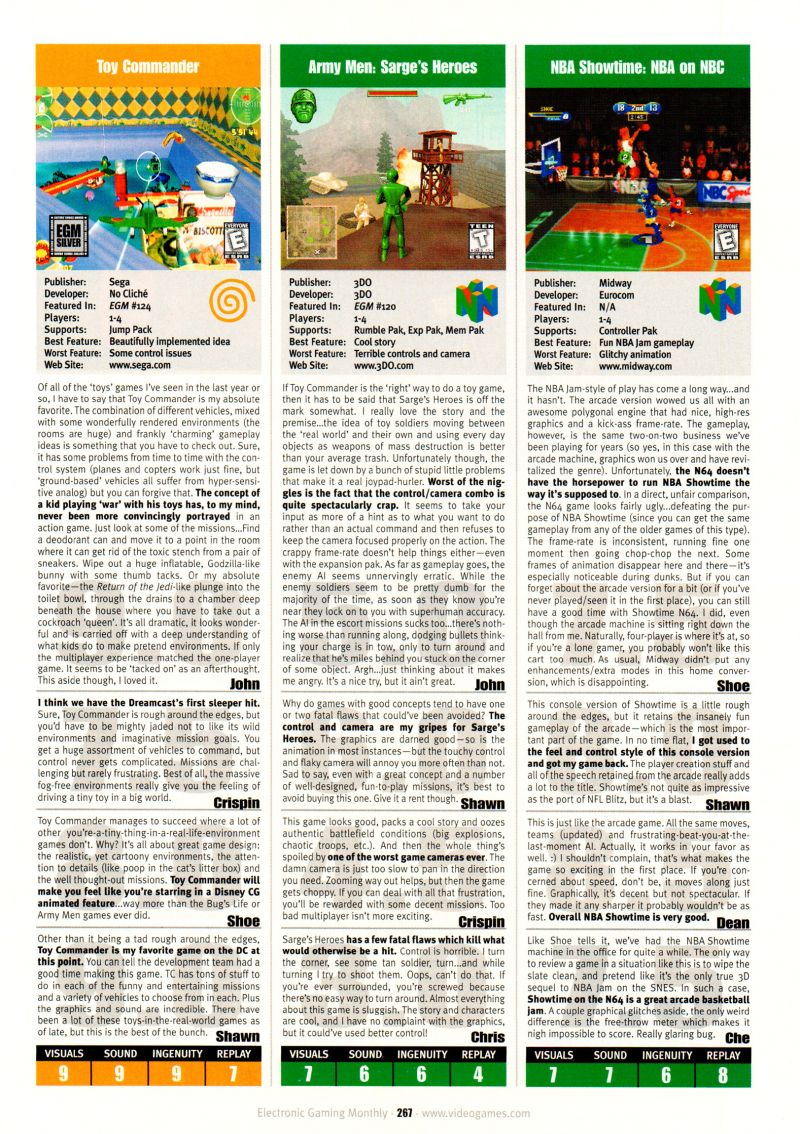
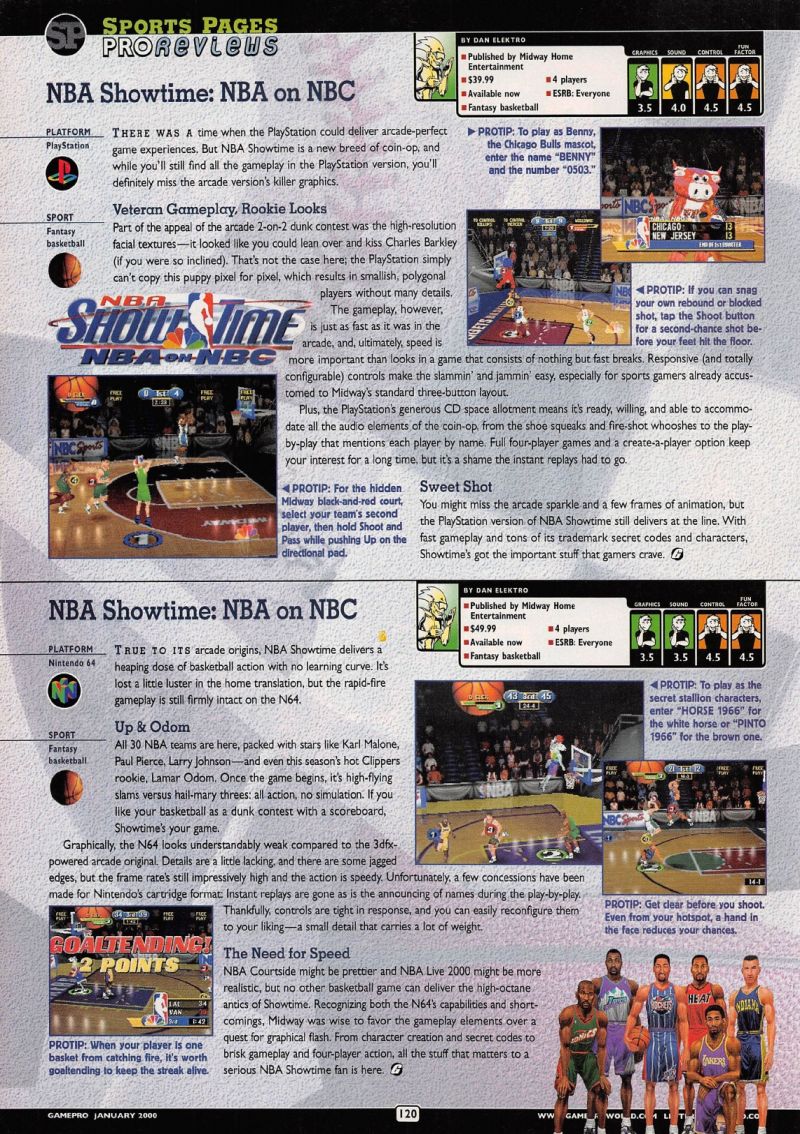
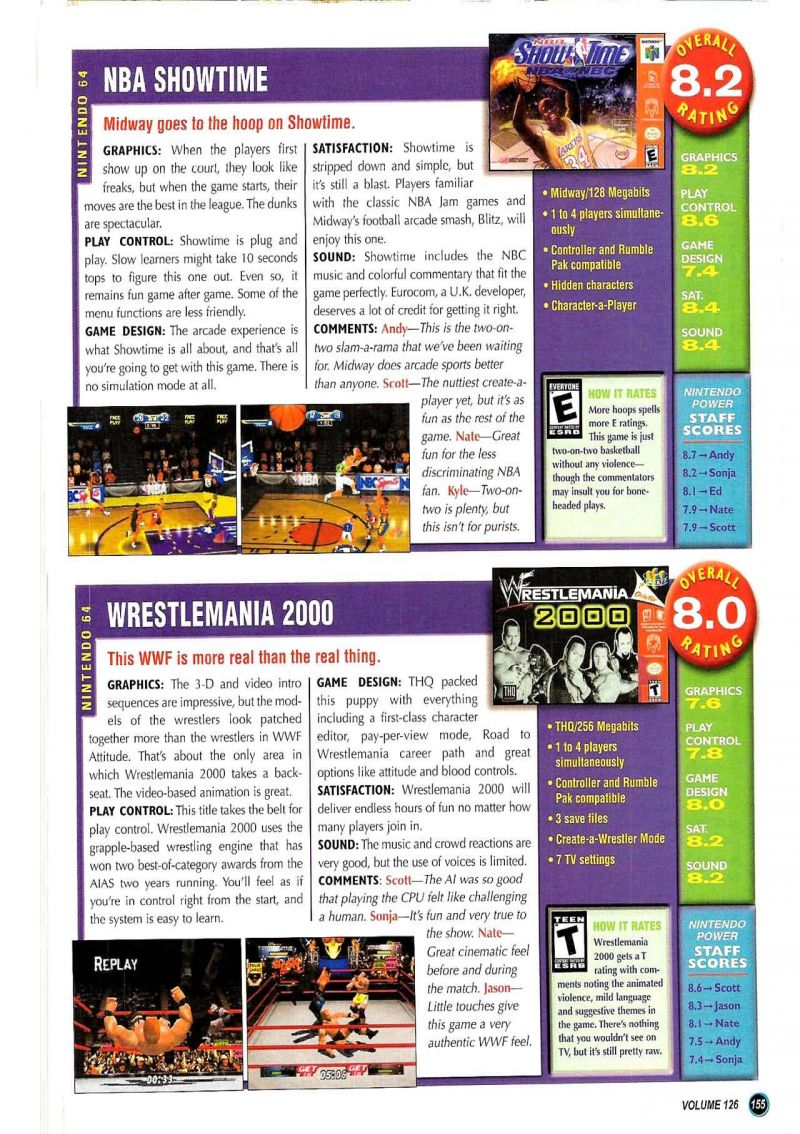
The Dreamcast version received "favorable" reviews, and the Nintendo 64 and PlayStation versions received mixed or average reviews, while the Game Boy Color version received "unfavorable" reviews according to video game review aggregator platform GameRankings.[12][13][14][15] Doug Trueman of NextGen said that the N64 version "would probably best be called NBA Jam 64", calling it "Arcade-style basketball action captured remarkably well on Nintendo 64."[45]
Notes
- ↑ Ported to Nintendo 64 and PlayStation by Eurocom, and to Dreamcast by Avalanche Software.
References
- ↑ "Game Informer News". Game Informer. 1999-05-08. http://www.gameinformer.com/news/apr99/040599a.html. Retrieved 2023-04-06.
- ↑ Kennedy, Sam (November 16, 1999). "Midway Ships NBA Showtime [date mislabeled as "April 27, 2000""]. CBS Interactive. https://www.gamespot.com/articles/midway-ships-nba-showtime/1100-2446907/.
- ↑ "NBA Showtime: NBA on NBC". http://www.chipsworld.co.uk/detProd.asp?ProductCode=2805.
- ↑ "NBA Showtime". http://www.ebworld.com/ebx/categories/products/product.asp?pf_id=165978.
- ↑ 5.0 5.1 GamePro, Issue 126, March 1999, MAG-GAMEPRO.126, Location: GamePro. GamePro, MAG-GAMEPRO. Video Game History Foundation Library. https://library.gamehistory.org/repositories/2/archival_objects/988 Accessed June 27, 2026.
- ↑ Tips & Tricks, Number 49, March 1999, MAG-TIPSTRICKS.049, Location: Tips & Tricks. Tips & Tricks, MAG-TIPSTRICKS. Video Game History Foundation Library. https://library.gamehistory.org/repositories/2/archival_objects/7414 Accessed June 27, 2026.
- ↑ Game Informer, Issue 113, September 2002, MAG-GAMEINFORMER.113, Location: Game Informer. Game Informer, MAG-GAMEINFORMER. Video Game History Foundation Library. https://library.gamehistory.org/repositories/2/archival_objects/6428 Accessed June 28, 2026.
- ↑ 8.0 8.1 GamePro, Issue 126, March 1999, MAG-GAMEPRO.126, Location: GamePro. GamePro, MAG-GAMEPRO. Video Game History Foundation Library. https://library.gamehistory.org/repositories/2/archival_objects/988 Accessed June 28, 2026.
- ↑ "GameWinners.com -- 1995 - 2017". http://www.gamewinners.com/arcade/NBAShowtimeNBAOnNBC.htm.
- ↑ https://segaretro.org/NBA_Showtime:_NBA_on_NBC/Hidden_content#Others retrieved June 28th, 2026
- ↑ https://www.bunnyears.net/hangtime/hangtimefaq.html retrieved June 28th, 2026
- ↑ 12.0 12.1 "NBA Showtime: NBA on NBC for Dreamcast". CBS Interactive. https://www.gamerankings.com/dreamcast/198091-nba-showtime-nba-on-nbc/index.html.
- ↑ 13.0 13.1 "NBA Showtime: NBA on NBC for Game Boy Color". CBS Interactive. https://www.gamerankings.com/gbc/576140-nba-showtime-nba-on-nbc/index.html.
- ↑ 14.0 14.1 "NBA Showtime: NBA on NBC for Nintendo 64". CBS Interactive. https://www.gamerankings.com/n64/198092-nba-showtime-nba-on-nbc/index.html.
- ↑ 15.0 15.1 "NBA Showtime: NBA on NBC for PlayStation". CBS Interactive. https://www.gamerankings.com/ps/198093-nba-showtime-nba-on-nbc/index.html.
- ↑ Nguyen, Cal. "NBA Showtime: NBA on NBC (DC) - Review". All Media Network. http://www.allgame.com/game.php?id=18940&tab=review.
- ↑ McCall, Scott. "NBA Showtime: NBA on NBC (N64) - Review". All Media Network. http://www.allgame.com/game.php?id=20231&tab=review.
- ↑ Kanarick, Mark. "NBA Showtime: NBA on NBC (PS) - Review". All Media Network. http://www.allgame.com/game.php?id=20398&tab=review.
- ↑ Young, Jeffrey Adam (March 17, 2000). "NBA Showtime: NBA on NBC (DC)". CNET. http://gamecenter.com/Consoles/Dreamcast/Nbashow/.
- ↑ Ham, Tom (January 5, 2000). "NBA Showtime: NBA on NBC (N64)". CNET. http://gamecenter.com/Consoles/Nintendo/Nbashowtime/.
- ↑ EGM staff (December 1999). "NBA Showtime: NBA on NBC (DC)". Electronic Gaming Monthly (Ziff Davis) (125).
- ↑ Hsu, Dan "Shoe"; Smith, Shawn; Hager, Dean; Chou, Che (December 1999). "NBA Showtime: NBA on NBC (N64)". Electronic Gaming Monthly (Ziff Davis) (125): 267. https://www.nintendo64ever.com/scans/mags/Scan-Magazine-1734-267.jpg. Retrieved March 1, 2021.
- ↑ Hawkins, Beaux (July 1999). "NBA Showtime [NBA on NBC] (Arcade)". Game Informer (FuncoLand) (75): 73.
- ↑ "NBA Showtime: NBA on NBC (DC)". Game Informer (FuncoLand) (80). December 1999.
- ↑ "NBA Showtime: NBA on NBC (N64)". Game Informer (FuncoLand) (80). December 1999.
- ↑ Reiner, Andrew (January 2000). "NBA Showtime [NBA on NBC (PS)"]. Game Informer (FuncoLand) (81). https://www.gameinformer.com/reviews/review_detail.cfm?ITEM_ID=4754. Retrieved May 7, 2015.
- ↑ Higgins, Geoff "El Nino"; Chau, Anthony "Dangohead" (January 2000). "NBA Showtime [NBA on NBC (DC)"]. GameFan (Shinno Media) 8 (1): 88. https://archive.org/details/Gamefan_Vol_8_Issue_01/page/n89/mode/2up. Retrieved March 1, 2021.
- ↑ Mosquera, Fernando "Lagi" (November 10, 1999). "REVIEW for NBA Showtime [NBA on NBC (DC)"]. GameFan (Shinno Media). http://www.gamefan.com/repre.asp?g=1292&t=r. Retrieved May 8, 2015.
- ↑ "REVIEW for NBA Showtime [NBA on NBC] (N64)". GameFan. December 1, 1999.
- ↑ Scary Larry (1999). "NBA Showtime Review for Dreamcast on GamePro.com". GamePro (IDG Entertainment). http://gamepro.com/sega/dreamcast/games/reviews/3345.shtml. Retrieved May 8, 2015.
- ↑ 31.0 31.1 Dan Elektro (January 2000). "NBA Showtime: NBA on NBC (N64, PS)". GamePro (IDG Entertainment) (136): 120. https://www.nintendo64ever.com/scans/mags/Scan-Magazine-1669-122.jpg. Retrieved March 1, 2021.
- ↑ iBot (November 20, 1999). "NBA Showtime Review for N64 on GamePro.com". GamePro. http://gamepro.com/nintendo/n64/games/reviews/3211.shtml. Retrieved May 8, 2015.
- ↑ Air Hendrix (1999). "NBA Showtime Review for PlayStation on GamePro.com". GamePro. http://gamepro.com/sony/psx/games/reviews/3289.shtml. Retrieved May 8, 2015.
- ↑ Liu, Johnny (January 2000). "NBA Showtime: NBA on NBC Review (DC)". CraveOnline. https://www.gamerevolution.com/review/32314-nba-showtime-nba-on-nbc-review.
- ↑ Liu, Johnny (January 2000). "NBA Showtime: NBA on NBC - N64 Review". CraveOnline. http://www.game-revolution.com/games/n64/sports/nba_showtime_64.htm.
- ↑ Liu, Johnny (January 2000). "NBA Showtime: NBA on NBC - PS". CraveOnline. http://www.game-revolution.com/games/sony/sports/nba_showtime_psx.htm.
- ↑ Gerstmann, Jeff (November 19, 1999). "NBA Showtime: NBA on NBC Review (DC)". CBS Interactive. https://www.gamespot.com/reviews/nba-showtime-nba-on-nbc-review/1900-2540442/.
- ↑ Gerstmann, Jeff (November 19, 1999). "NBA Showtime: NBA on NBC Review (N64)". CBS Interactive. https://www.gamespot.com/reviews/nba-showtime-nba-on-nbc-review/1900-2544897/.
- ↑ Gerstmann, Jeff (November 19, 1999). "NBA Showtime: NBA on NBC Review (PS)". CBS Interactive. https://www.gamespot.com/reviews/nba-showtime-nba-on-nbc-review/1900-2549267/.
- ↑ Fragmaster (November 22, 1999). "NBA Showtime [NBA on NBC"]. IGN Entertainment. http://www.planetdreamcast.com/games/reviews/nbashowtime/.
- ↑ Justice, Brandon (November 16, 1999). "NBA Showtime: NBA on NBC (DC)". Ziff Davis. https://www.ign.com/articles/1999/11/17/nba-showtime-nba-on-nbc-3.
- ↑ Harris, Craig (March 2, 2000). "NBA Showtime [NBA on NBC (GBC)"]. Ziff Davis. https://www.ign.com/articles/2000/03/03/nba-showtime.
- ↑ Boulding, Aaron (November 17, 1999). "NBA Showtime: NBA on NBC (N64)". Ziff Davis. https://www.ign.com/articles/1999/11/18/nba-showtime-nba-on-nbc-2.
- ↑ Perry, Douglass C. (December 16, 1999). "NBA Showtime: NBA on NBC (PS)". Ziff Davis. https://www.ign.com/articles/1999/12/17/nba-showtime-nba-on-nbc.
- ↑ 45.0 45.1 Trueman, Doug (January 1999). "NBA Showtime: NBA on NBC (N64)". NextGen (Imagine Media) (61): 95. https://archive.org/details/NextGen61Jan2000/page/n95/mode/2up. Retrieved March 1, 2021.
- ↑ "NBA Showtime [NBA on NBC (GBC)"]. Nintendo Power (Nintendo of America) 130: 126. March 2000. https://archive.org/details/nintendo-power-issue-130-march-2000/page/n135/mode/2up. Retrieved November 25, 2021.
- ↑ "NBA Showtime [NBA on NBC (N64)"]. Nintendo Power (Nintendo of America) 127: 155. December 1999. https://www.nintendo64ever.com/scans/mags/Scan-Magazine-369-155.jpg. Retrieved March 1, 2021.
- ↑ "NBA Showtime: NBA on NBC". Official U.S. PlayStation Magazine (Ziff Davis) 3 (4). January 2000.
External links
- NBA Showtime[Usurped!] at Eurocom
- NBA Showtime: NBA on NBC at the Killer List of Videogames
- MobyGames is a commercial database website that catalogs information on video games and the people and companies behind them via crowdsourcing. This includes over 300,000 games for hundreds of platforms.[1] Founded in 1999, ownership of the site has changed hands several times. It has been owned by Atari SA since 2022.
Features
Edits and submissions to the site (including screenshots, box art, developer information, game summaries, and more) go through a verification process of fact-checking by volunteer "approvers".[2] This approval process after submission can range from minutes to days or months.[3] The most commonly used sources are the video game's website, packaging, and credit screens. There is a published standard for game information and copy-editing.[4] A ranking system allows users to earn points for contributing accurate information.[5]
Registered users can rate and review games. Users can create private or public "have" and "want" lists, which can generate a list of games available for trade with other registered users. The site contains an integrated forum. Each listed game can have its own sub-forum.
History

MobyGames was founded on March 1, 1999, by Jim Leonard and Brian Hirt, and joined by David Berk 18 months later, the three of which had been friends since high school.[6][7] Leonard had the idea of sharing information about computer games with a larger audience. The database began with information about games for IBM PC compatibles, relying on the founders' personal collections. Eventually, the site was opened up to allow general users to contribute information.[5] In a 2003 interview, Berk emphasized MobyGames' dedication to taking video games more seriously than broader society and to preserving games for their important cultural influence.[5]
In mid-2010, MobyGames was purchased by GameFly for an undisclosed amount.[8] This was announced to the community post factum , and the site's interface was given an unpopular redesign.[7] A few major contributors left, refusing to do volunteer work for a commercial website.{{Citation needed|date=June 2025} On December 18, 2013, MobyGames was acquired by Jeremiah Freyholtz, owner of Blue Flame Labs (a San Francisco-based game and web development company) and VGBoxArt (a site for fan-made video game box art).[9] Blue Flame Labs reverted MobyGames' interface to its pre-overhaul look and feel,[10] and for the next eight years, the site was run by Freyholtz and Independent Games Festival organizer Simon Carless.[7]
On November 24, 2021, Atari SA announced a potential deal with Blue Flame Labs to purchase MobyGames for $1.5 million.[11] The purchase was completed on 8 March 2022, with Freyholtz remaining as general manager.[12][13][14] Over the next year, the financial boost given by Atari led to a rework of the site being built from scratch with a new backend codebase, as well as updates improving the mobile and desktop user interface.[1] This was accomplished by investing in full-time development of the site instead of its previously part-time development.[15]
In 2024, MobyGames began offering a paid "Pro" membership option for the site to generate additional revenue.[16] Previously, the site had generated income exclusively through banner ads and (from March 2014 onward) a small number of patrons via the Patreon website.[17]
On February 13, 2025, Freyholtz stepped down as the site lead to move onto new projects, leaving operations to Tracy Poff, a veteran coder on the site, and Atari staff.[18]
See also
- IGDB – game database used by Twitch for its search and discovery functions
References
- ↑ 1.0 1.1 Sheehan, Gavin (2023-02-22). "Atari Relaunches The Fully Rebuilt & Optimized MobyGames Website". https://bleedingcool.com/games/atari-relaunches-the-fully-rebuilt-optimized-mobygames-website/.
- ↑ Litchfield, Ted (2021-11-26). "Zombie company Atari to devour MobyGames". https://www.pcgamer.com/zombie-company-atari-to-devour-mobygames/.
- ↑ "MobyGames FAQ: Emails Answered § When will my submission be approved?". Blue Flame Labs. 30 March 2014. http://www.mobygames.com/info/faq7#g1.
- ↑ "The MobyGames Standards and Practices". Blue Flame Labs. 6 January 2016. http://www.mobygames.com/info/standards.
- ↑ 5.0 5.1 5.2 Miller, Stanley A. (2003-04-22). "People's choice awards honor favorite Web sites". Milwaukee Journal Sentinel.
- ↑ "20 Years of MobyGames" (in en). 2019-02-28. https://trixter.oldskool.org/2019/02/28/20-years-of-mobygames/.
- ↑ 7.0 7.1 7.2 Plunkett, Luke (2022-03-10). "Atari Buys MobyGames For $1.5 Million". https://kotaku.com/mobygames-retro-credits-database-imdb-atari-freyholtz-b-1848638521.
- ↑ "Report: MobyGames Acquired By GameFly Media". Gamasutra. 2011-02-07. https://www.gamedeveloper.com/game-platforms/report-mobygames-acquired-by-gamefly-media.
- ↑ Corriea, Alexa Ray (December 31, 2013). "MobyGames purchased from GameFly, improvements planned". http://www.polygon.com/2013/12/31/5261414/mobygames-purchased-from-gamefly-improvements-planned.
- ↑ Wawro, Alex (31 December 2013). "Game dev database MobyGames getting some TLC under new owner". Gamasutra. https://www.gamedeveloper.com/business/game-dev-database-mobygames-getting-some-tlc-under-new-owner.
- ↑ "Atari invests in Anstream, may buy MobyGames". November 24, 2021. https://www.gamesindustry.biz/articles/2021-11-24-atari-invests-in-anstream-may-buy-mobygames.
- ↑ Rousseau, Jeffrey (2022-03-09). "Atari purchases Moby Games". https://www.gamesindustry.biz/atari-purchases-moby-games.
- ↑ "Atari Completes MobyGames Acquisition, Details Plans for the Site's Continued Support". March 8, 2022. https://www.atari.com/atari-completes-mobygames-acquisition-details-plans-for-the-sites-continued-support/.
- ↑ "Atari has acquired game database MobyGames for $1.5 million" (in en-GB). 2022-03-09. https://www.videogameschronicle.com/news/atari-has-acquired-game-database-mobygames-for-1-5-million/.
- ↑ Stanton, Rich (2022-03-10). "Atari buys videogame database MobyGames for $1.5 million". https://www.pcgamer.com/atari-buys-videogame-database-mobygames-for-dollar15-million/.
- ↑ Harris, John (2024-03-09). "MobyGames Offering “Pro” Membership". https://setsideb.com/mobygames-offering-pro-membership/.
- ↑ "MobyGames on Patreon". http://www.patreon.com/mobygames.
- ↑ "An update on MobyGames leadership". 2025-02-13. https://www.mobygames.com/forum/3/thread/269628/an-update-on-mobygames-leadership/#post-269628.
 |
Wikidata has the property:
|

External links
- No URL found. Please specify a URL here or add one to Wikidata.

 |  |
- [1] NBA Showtime at The Arcade Flyer Archive
Template:Midway sports games Template:NBA on NBC Template:Eurocom
Warning: Default sort key "Nba Showtime: Nba On Nbc" overrides earlier default sort key "Mobygames".
| |
 EncycloReader
is supported by the
EncycloReader
is supported by the  KSF
KSF