Table of Contents Categories
Pacific Islands (video game)
Topic: Software
 From HandWiki - Reading time: 7 min
| Pacific Islands | |
|---|---|
 Cover art | |
| Developer(s) | Oxford Digital Enterprises The Mystery Machine |
| Publisher(s) | Empire Interactive |
| Platform(s) | MS-DOS, Amiga, Atari ST |
| Release | 1992 |
| Genre(s) | Strategy |
| Mode(s) | Single-player |
Pacific Islands is a computer game published by Empire Interactive in 1992 for the MS-DOS, Amiga and Atari ST. It is the sequel to the 1987 video game, Team Yankee.
Plot
Pacific Islands is a tank simulation game involving platoon-style combat.[1] A member of the Soviet Communist Party has seized control of the fictitious Yama Yama Isles in the South Pacific that are an important outpost for the Western nations. The player will have to regain control of the islands in five missions.
Reception
Computer Gaming World criticized Pacific Islands's lack of infantry (making the machines guns useless) or air power (despite the aircraft on the box art), both faults that existed with Team Yankee. The magazine concluded that it "comes closer to a Nintendo game than a wargame".[2] The game was reviewed in 1993 in Dragon #189 by Hartley, Patricia, and Kirk Lesser in "The Role of Computers" column. The reviewers gave the game 4 out of 5 stars.[1]
Reviews
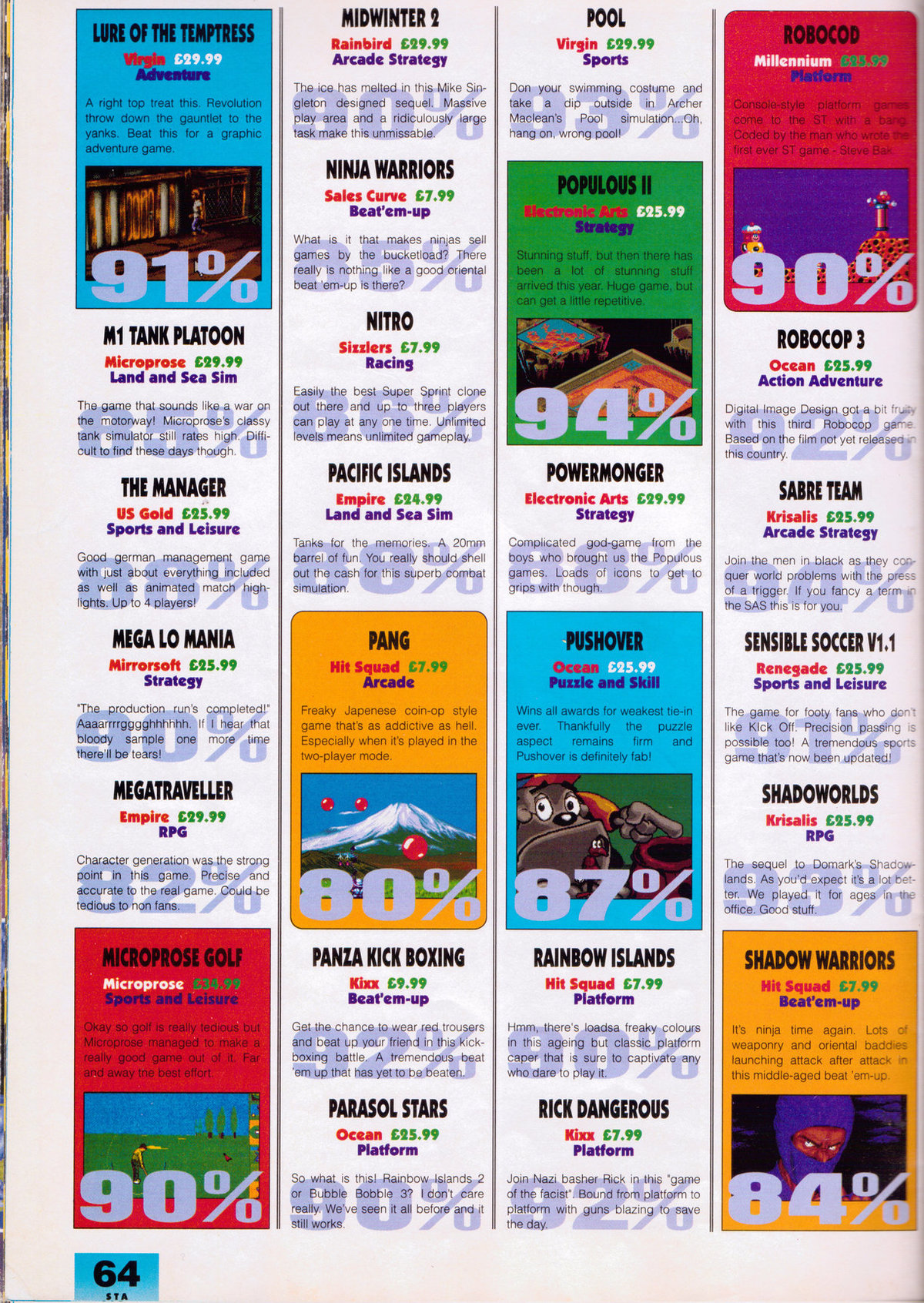
- ST Format - Jun, 1992[3]
- Amiga Computing - Jun, 1992[4]
- CU Amiga - May, 1992[5]
- ASM (Aktueller Software Markt) - Jul, 1992
- ASM (Aktueller Software Markt) - Aug, 1992[6]
- Amiga Format (Jun, 1992)[7]
- Amiga Action (May, 1992)[8]
- ST Action (Mar, 1993)[9]
- Amiga Power (May, 1992)[10]
- Zero (Jun, 1992)[11]
- Amiga Joker (May, 1992)[12]
- The One for Amiga Games (May, 1992)[13]
- Play Time (Oct, 1992)[14]
References
- ↑ 1.0 1.1 Lesser, Hartley; Lesser, Patricia; Lesser, Kirk (January 1993). "The Role of Computers". Dragon (189): 57–62.
- ↑ Savage, Richard (December 1992). "Empire's Team Yankee & Pacific Islands". Computer Gaming World: pp. 172. http://www.cgwmuseum.org/galleries/index.php?year=1992&pub=2&id=101. Retrieved 5 July 2014.
- ↑ "ST Format (Issue 35) - June - 1992: Atari magazine scans, PDF". http://www.atarimania.com/atari-magazine-issue-st-format-issue-35_1197.html.
- ↑ "Amiga Computing Magazine Issue 049". June 1992. https://archive.org/details/amiga-computing-magazine-049/page/n71/mode/2up.
- ↑ "CU Amiga Magazine Issue 027". May 1992. https://archive.org/details/cuamiga-magazine-027/page/n62/mode/2up.
- ↑ https://www.kultboy.com/index.php?site=t&id=4540 [bare URL]
- ↑ https://archive.org/stream/Amiga_Format_Issue_035_1992-06_Future_Publishing_GB#page/n49/mode/2up
- ↑ "Pacific Islands: Team Yankee 2 review from Amiga Action 32 (May 1992) - Amiga Magazine Rack". http://amr.abime.net/review_49427.
- ↑ http://www.atarimania.com/mags/hi_res/atari_st_action_59_64.jpg
- ↑ https://archive.org/stream/Amiga_Power_Issue_13_1992-05_Future_Publishing_GB#page/n94/mode/2up
- ↑ "Zero Magazine Issue 32". June 1992. https://archive.org/details/zero-magazine-32/page/n41/mode/2up.
- ↑ http://amigareviews.classicgaming.gamespy.com/pacifici.htm#pacificislandsaj
- ↑ "TheOne Magazine Issue 44". May 1992. https://archive.org/details/theone-magazine-44/page/n83/mode/2up.
- ↑ http://www.kultboy.com/index.php?site=t&id=4326
External links
- MobyGames is a commercial database website that catalogs information on video games and the people and companies behind them via crowdsourcing. This includes over 300,000 games for hundreds of platforms.[1] Founded in 1999, ownership of the site has changed hands several times. It has been owned by Atari SA since 2022.
Features
Edits and submissions to the site (including screenshots, box art, developer information, game summaries, and more) go through a verification process of fact-checking by volunteer "approvers".[2] This approval process after submission can range from minutes to days or months.[3] The most commonly used sources are the video game's website, packaging, and credit screens. There is a published standard for game information and copy-editing.[4] A ranking system allows users to earn points for contributing accurate information.[5]
Registered users can rate and review games. Users can create private or public "have" and "want" lists, which can generate a list of games available for trade with other registered users. The site contains an integrated forum. Each listed game can have its own sub-forum.
History

MobyGames was founded on March 1, 1999, by Jim Leonard and Brian Hirt, and joined by David Berk 18 months later, the three of which had been friends since high school.[6][7] Leonard had the idea of sharing information about computer games with a larger audience. The database began with information about games for IBM PC compatibles, relying on the founders' personal collections. Eventually, the site was opened up to allow general users to contribute information.[5] In a 2003 interview, Berk emphasized MobyGames' dedication to taking video games more seriously than broader society and to preserving games for their important cultural influence.[5]
In mid-2010, MobyGames was purchased by GameFly for an undisclosed amount.[8] This was announced to the community post factum , and the site's interface was given an unpopular redesign.[7] A few major contributors left, refusing to do volunteer work for a commercial website.{{Citation needed|date=June 2025} On December 18, 2013, MobyGames was acquired by Jeremiah Freyholtz, owner of Blue Flame Labs (a San Francisco-based game and web development company) and VGBoxArt (a site for fan-made video game box art).[9] Blue Flame Labs reverted MobyGames' interface to its pre-overhaul look and feel,[10] and for the next eight years, the site was run by Freyholtz and Independent Games Festival organizer Simon Carless.[7]
On November 24, 2021, Atari SA announced a potential deal with Blue Flame Labs to purchase MobyGames for $1.5 million.[11] The purchase was completed on 8 March 2022, with Freyholtz remaining as general manager.[12][13][14] Over the next year, the financial boost given by Atari led to a rework of the site being built from scratch with a new backend codebase, as well as updates improving the mobile and desktop user interface.[1] This was accomplished by investing in full-time development of the site instead of its previously part-time development.[15]
In 2024, MobyGames began offering a paid "Pro" membership option for the site to generate additional revenue.[16] Previously, the site had generated income exclusively through banner ads and (from March 2014 onward) a small number of patrons via the Patreon website.[17]
On February 13, 2025, Freyholtz stepped down as the site lead to move onto new projects, leaving operations to Tracy Poff, a veteran coder on the site, and Atari staff.[18]
See also
- IGDB – game database used by Twitch for its search and discovery functions
References
- ↑ 1.0 1.1 Sheehan, Gavin (2023-02-22). "Atari Relaunches The Fully Rebuilt & Optimized MobyGames Website". https://bleedingcool.com/games/atari-relaunches-the-fully-rebuilt-optimized-mobygames-website/.
- ↑ Litchfield, Ted (2021-11-26). "Zombie company Atari to devour MobyGames". https://www.pcgamer.com/zombie-company-atari-to-devour-mobygames/.
- ↑ "MobyGames FAQ: Emails Answered § When will my submission be approved?". Blue Flame Labs. 30 March 2014. http://www.mobygames.com/info/faq7#g1.
- ↑ "The MobyGames Standards and Practices". Blue Flame Labs. 6 January 2016. http://www.mobygames.com/info/standards.
- ↑ 5.0 5.1 5.2 Miller, Stanley A. (2003-04-22). "People's choice awards honor favorite Web sites". Milwaukee Journal Sentinel.
- ↑ "20 Years of MobyGames" (in en). 2019-02-28. https://trixter.oldskool.org/2019/02/28/20-years-of-mobygames/.
- ↑ 7.0 7.1 7.2 Plunkett, Luke (2022-03-10). "Atari Buys MobyGames For $1.5 Million". https://kotaku.com/mobygames-retro-credits-database-imdb-atari-freyholtz-b-1848638521.
- ↑ "Report: MobyGames Acquired By GameFly Media". Gamasutra. 2011-02-07. https://www.gamedeveloper.com/game-platforms/report-mobygames-acquired-by-gamefly-media.
- ↑ Corriea, Alexa Ray (December 31, 2013). "MobyGames purchased from GameFly, improvements planned". http://www.polygon.com/2013/12/31/5261414/mobygames-purchased-from-gamefly-improvements-planned.
- ↑ Wawro, Alex (31 December 2013). "Game dev database MobyGames getting some TLC under new owner". Gamasutra. https://www.gamedeveloper.com/business/game-dev-database-mobygames-getting-some-tlc-under-new-owner.
- ↑ "Atari invests in Anstream, may buy MobyGames". November 24, 2021. https://www.gamesindustry.biz/articles/2021-11-24-atari-invests-in-anstream-may-buy-mobygames.
- ↑ Rousseau, Jeffrey (2022-03-09). "Atari purchases Moby Games". https://www.gamesindustry.biz/atari-purchases-moby-games.
- ↑ "Atari Completes MobyGames Acquisition, Details Plans for the Site's Continued Support". March 8, 2022. https://www.atari.com/atari-completes-mobygames-acquisition-details-plans-for-the-sites-continued-support/.
- ↑ "Atari has acquired game database MobyGames for $1.5 million" (in en-GB). 2022-03-09. https://www.videogameschronicle.com/news/atari-has-acquired-game-database-mobygames-for-1-5-million/.
- ↑ Stanton, Rich (2022-03-10). "Atari buys videogame database MobyGames for $1.5 million". https://www.pcgamer.com/atari-buys-videogame-database-mobygames-for-dollar15-million/.
- ↑ Harris, John (2024-03-09). "MobyGames Offering “Pro” Membership". https://setsideb.com/mobygames-offering-pro-membership/.
- ↑ "MobyGames on Patreon". http://www.patreon.com/mobygames.
- ↑ "An update on MobyGames leadership". 2025-02-13. https://www.mobygames.com/forum/3/thread/269628/an-update-on-mobygames-leadership/#post-269628.
 |
Wikidata has the property:
|

External links
- No URL found. Please specify a URL here or add one to Wikidata.

 |  |
- Review in Compute!
| |
 EncycloReader
is supported by the
EncycloReader
is supported by the  KSF
KSF